Pharmacology for Professional Nursing (NUR2474) - Test #1 - Review
(NUR2474 Section CPPC2A0Z Pharmacology for Professional Nursing (11 Weeks) - Residential
and Online - 2021 Spring Quarter)
1. Lithium levels, use, sid
...
Pharmacology for Professional Nursing (NUR2474) - Test #1 - Review
(NUR2474 Section CPPC2A0Z Pharmacology for Professional Nursing (11 Weeks) - Residential
and Online - 2021 Spring Quarter)
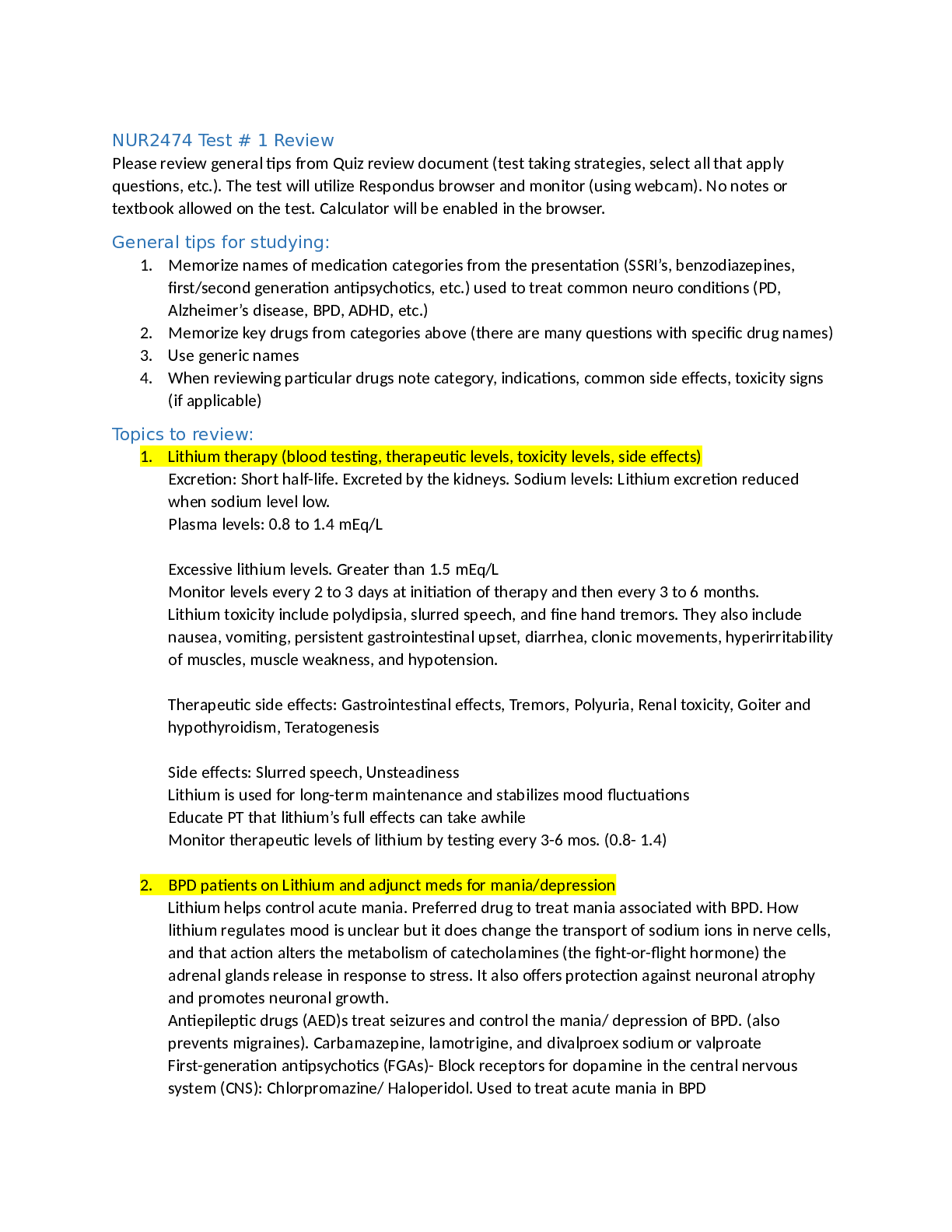
1. Lithium levels, use, side effects
o Lithium is a MOOD STABILIZER
o Levels:
0.4 to 1 mEq/L.
o Action:
Prevents/decreases incidence of acute manic episodes
- May inhibit MOA = Increase activity of brain
o Use:
Treat Bipolar Disorder
o Side Effects:
Nausea, , Abdominal bloating, Anorexia, Fatigue, and Memory impairment,
Polyuria (frequently urinating), Tremor, Hypothyroidism
o Teratogenic
Def: Can disturb the development of the embryo/fetus and produce malformation
o 1-3 weeks for full effect
2. Benzodiazepines uses, actions, antidote, side effects
o Suffix: -PAM, -LAM
o Fast Acting
o Short term use
o Can cause dependency
o Uses:
Anxiety, Insomnia, and Seizure disorders, Muscle spasms, and Withdrawal
from alcohol
o Actions:
Binds to GABA receptors to enhance the action of GABA
- GABA is a neurotransmitter that slows/calms the speed of brain
activity
o Antidote:
Flumazenil
- Administered IV
o Side Effects:
Sedation, Low respiration rate, Low blood pressure, Low heart rate, and
Amnesia
3. Medications for anxiety, sleep and concentration
o Anxiety:
Selective Serotonin Reuptake Inhibitor (SSRI’s)
- Suffix: -TINE, -LINE, -PRAM
- 4 weeks for full effect - Works slow
- Do not take with St. Johns Wort
- Action:
o Inhibits the reuptake of serotonin back into the neuron leading
to more serotonin floating around in the brain = Improve mood
- Use:
o Anxiety, Depression, PTSD, OCD
- Side Effects:
o Weight gain. Insomnia, and Sexual dysfunction
- Drug used: Paroxetine
o Dosage:
20 to 50 mg/day
- Drug used: Venlafaxine (SNRI)
o Dosage:
37.5 mg once a day
o Routes:
Standard tablets (generic only)
Nonbenzodiazepine-Nonbarbiturates
- Drug used: Buspirone (Atypical)
o 1-2 weeks for full effect – Works slow
o Short term use
o Does not cause sedation or dependency
o Take with food if GI upset
o Side Effects:
Dizziness, Nausea, Headache
o Use:
Anxiety, PTSD, OCD, and Panic
Benzodiazepines
- Suffix: -PAM, -LAM
- Works immediately
- Drug used: Diazepam
- Uses:
o Anxiety, Insomnia, and Seizure disorders, Muscle spasms, and
Withdrawal from alcohol
- Actions:
o Binds to GABA receptors to enhance the action of GABA
GABA is a neurotransmitter that slows/calms the speed
of brain activity
- Side Effects:
o Sedation, Low respiration rate, Low blood pressure, Low heart
rate, and Amnesia
o Sleep:
Benzodiazepines
- (See Anxiety)
Antidepressants
- Takes 2-4 weeks to take full effect
- Risk for suicide
- Medications:
o SSRI’s
Action: Improves mood
Risk: Serotonin Syndrome = Agitation, Hallucinations,
Fever, Tremors, and Sweating
Side Effects: Weight gain. Insomnia, and Sexual
dysfunction
Suffix: -TINE, -LINE, -PRAM
o SNRI’s
Action: Inhibits the reuptake of serotonin and
norepinephrine into the neuron.. leading to more
floating around the brain
Side Effects: Loss of appetite, Insomnia, and Sexual
dysfunction
o TCA’s
Action: Inhibits serotonin reuptake, norepinephrine, and
alpha receptors
Use: Depression, Anxiety, Insomnia, and Fibromyalgia
Side Effects: Orthostatic hypotension, Sedation,
anticholinergic, and Urinary retention
Suffix: -TRYPTLINE, -IPRAMINE
Be careful in the sun = Increase fiber and fluids
o MAOI’s
Action: Blocks the destruction of serotonin,
norepinephrine, dopamine, and tyramine.. leading to
increase of serotonin, norepinephrine, dopamine, and
tyramine
Use: Depression and Panic disorder
Side Effects: Agitation, Anxiety, Low blood pressure,
Hypertensive crisis,
Do not eat tyramine foods
o Atypicals
Buproprion (Wellbutrin)
For Depression and Smoking cessation
Trazadone
For Depression (high dose) and Insomnia
o Concentration:
Stimulants (see #4 for more info)
- Adderall (dextroamphetamine)
- Ritalin & Concerta (methylphenidate)
4. Stimulants, examples, education
* Stimulants Examples:
o Amphetamines: for attention deficit and hyperactive disorder
Adderall (dextroamphetamine)
Action:
CNS & respiratory stimulation
Increased motor activity
Mental alertness
Increased attention span in ADHD
Use:
ADHD
Ritalin & Concerta (methylphenidate)
Action:
Produce CNS and respiratory stimulation with weak
sympathomimetic activity
Use:
Increases attention span in ADHD
Increase motor activity, mental alertness, and diminished
fatigue in narcoleptic patients.
o Anorexiants: for obesity
Didrex (benzphetamine)
Phentride (phentermine)
o Analeptics: to prevent narcolepsy due to sleep apnea & hypoventilation
Caffiene
Dopram (doxapram)
Dexidrine
(dextroamphetamine)
CPAP machine
o Result of Stimulants
Trigger release of dopamine & norepinephrine
Increase level of alertness
Addictive rush
Euphoria
Alertness
Loss of appetite
Weight loss
Sleeplessness
Tremors
Restlessness
Irritability
Increased heart rate
Palpitations
Hypertension
o Stimulants (therapeutic class)
Timing: AM keeps you awake
HR goes up, avoid stress, caffeine, etc
Abuse is common
Most are controlled substances—need new Rx
o Education:
Warn patients against habitual caffeine use
Cardiovascular responses to caffeine (palpitations, rapid pulse, dizziness)
Overdose can cause convulsions
[Show More]