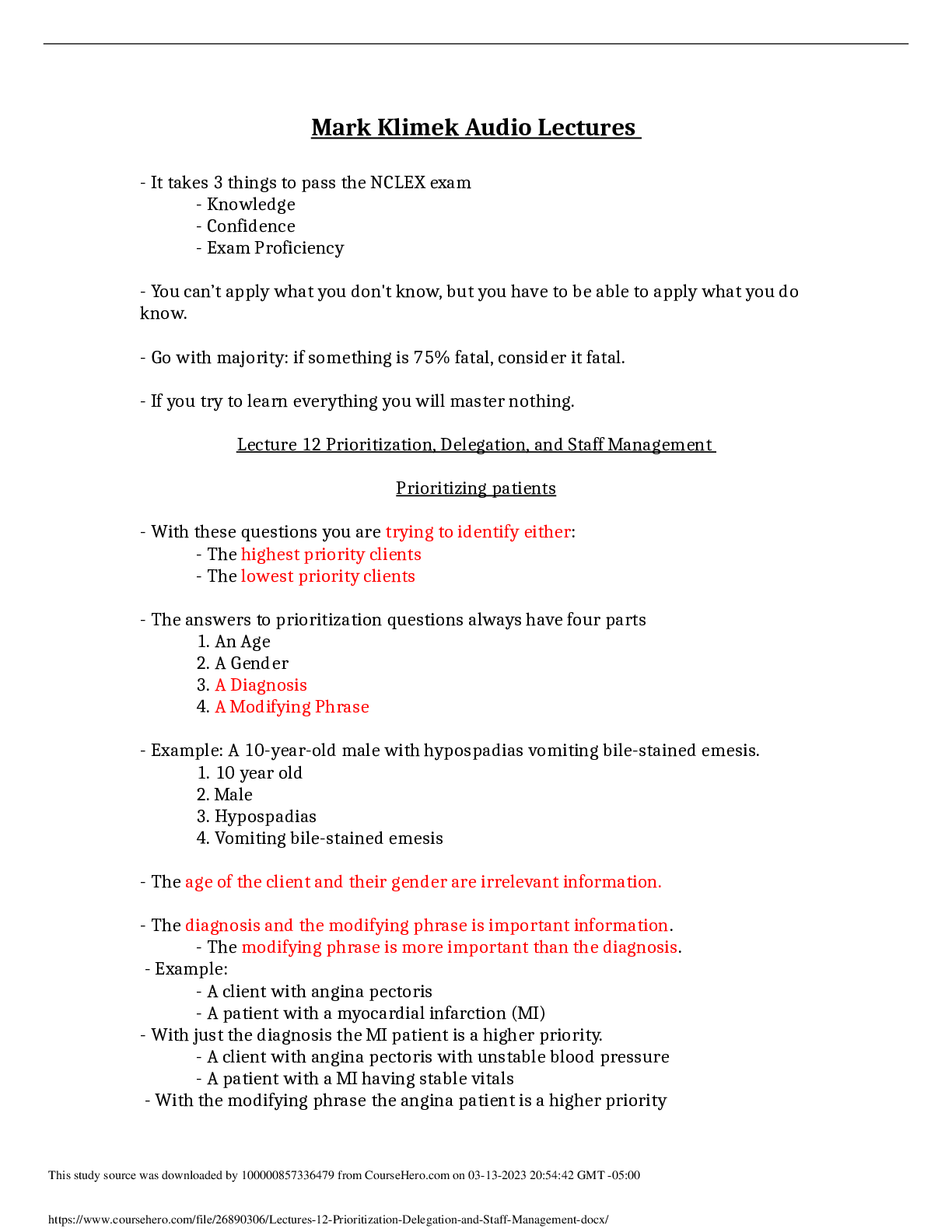
1. The components of a chromosome include one long DNA molecule and
a. phospholipids.
b. proteins.
c. carbohydrates.
d. steroids.
e. RNA.
2. The first level of compaction of DNA consists of
a. DNA winding around h
...
1. The components of a chromosome include one long DNA molecule and
a. phospholipids.
b. proteins.
c. carbohydrates.
d. steroids.
e. RNA.
2. The first level of compaction of DNA consists of
a. DNA winding around histones to form small nucleosomes.
b. tight coiling of DNA with nucleosomes into higher order structures.
c. high level compaction into metaphase-type chromosomes.
d. histone, DNA, and non-histone covalent bonding.
3. Which of the histone proteins is not a part of the core histone proteins?
a. Histone H1
b. Histone H2A
c. Histone H3
d. Histone H4
4. In DNA, the 300Å fiber is formed into structural loops. Responsibility for this function
appears to lie with
a. histone H4.
b. nucleosomase.
c. histone H1.
d. certain non-histone proteins.
5. Telomeres appear to function in at least two ways during the replication of chromosomes.
One way is to provide a primer for DNA polymerase. The second is to
a. allow the chromosome to shorten each generation to speed up replication.
b. bind to telomerase
c. permit the hairpin turn at the end to be cleaved.
d. carry genes needed for DNA replication
6. The two chromatids of each replicated chromosome must separate from one another and
segregate during
a. mitosis.
b. meiosis I.
c. meiosis II.
d. both mitosis and meiosis I.
e. both mitosis and meiosis II.
7. FISH analysis is useful for determining the
a. order of DNA fragments in a BAC.
b. pattern of expression of a cloned gene.
c. chromosomal location of a gene.
d. map order of two closely linked genes.
8. You are studying a histone complex that contains an unusually high level of modification
with methyl groups. What can you conclude about the DNA bound to this histone complex?
a. It contains actively transcribed genes.
b. It is most likely heterochromatin.
c. It is most likely telomeric.
d. Methyl groups can either cause or inhibit transcription, depending on where
they are located. A more in depth analysis would need to be performed.
9. You are studying a histone complex that contains an unusually high level of modification
with acetyl groups. What can you conclude about the DNA bound to this histone complex?
a. It contains actively transcribed genes
10. SNP is the acronym for: single nucleotide polymorphism
11. Which of the following polymorphism would you predict to most likely affect an individual's
phenotype?
a. An SNP in the start codon of a protein-coding gene
12. In Sanger sequencing, what causes DNA synthesis to terminate at a specific base?
a. nucleotide triphosphates that lack a hydroxyl at the 3' position
13. You treat a sample of DNA with DNase and run the digested fragments out on an
electrophoretic gel. You found mostly very long fragments. What can you conclude about
this sample of DNA?
a. The sample contains mostly heterochromatin
14. After digestion of DNA with a restriction endonuclease, which statement is true about the
resulting DNA fragments?
a. They will have either a single stranded overhang or blunt ends, depending on the
enzyme used
15. What information cannot be determined from the DNA sequence of a cDNA clone?
a. sequence of the promoter
16. If it is desired to clone the largest fragments possible from a genome, which vector would be
the most appropriate
a. YAC (Yeast artificial chromosomes)
17. What is the best definition for the FISH technique?
a. A method to fluorescently label different genes on metaphase chromosomes.
b. A method to fluorescently label different chromosomes during metaphase.
c. A method to fluorescently label heterochromatin.
d. A method to fluorescently label euchromatin.
18. The term for the type of mutation that results in a loss of material from the genome is
a. Inversion
b. Duplication
c. Deletion
d. Translocation
19. What types of mutations adds material to the genome?
a. Inversions
b. Duplications
c. Deletions
d. Translocations
20. The type of chromosomal rearrangement that reorganizes the DNA sequence within one
chromosome is known as a(n)
a. inversion.
b. duplication.
c. deletion.
d. translocation.
21. A piece of DNA that can use transposase to move from one place in the genome to another
is known as a(n)
a. regulatory region
b. duplication.
c. translocation.
d. transposable element.
22. Despite the large amount of chromosomal rearrangements in a species, karyotypes
generally remain relatively constant. What may be a likely explanation for this?
a. rearrangements occur frequently.
b. changes in chromosome number occur infrequently.
c. genetic instabilities produced by genomic changes usually are at a selective
disadvantage.
d. genetic imbalances are often at a selective advantage.
23. Inversions may be difficult to detect because they
a. never visibly change chromosome banding patterns.
b. increase recombination in heterozygotes.
c. do not usually cause an abnormal phenotype.
d. normally are removed immediately in natural populations.
24. Which of the following does not happen when an intragenic inversion occurs?
a. One part of the gene is relocated to a distant region of the chromosome.
b. One part of the gene stays at its original site.
c. Homozygotes for the inversion do not survive.
d. The gene's function is not disrupted.
25. When a crossover occurs within the inversion loop of a pericentric inversion each
recombinant chromatid will have
a. a dicentric bridge.
b. no duplications.
c. a deletion of some genes in the inverted region.
d. no mutations
26. Which is not a typical characteristic of transposable elements?
a. typically smaller than 50 bp
b. may be present in a genome from one to thousands of times
c. found only in a select group of organisms
d. need not be sequences that do something for the organism
27. What is a typical characteristic of bacterial chromosomes?
a. 5% of the sequences encodes proteins
b. It has telomeres
c. It is linear.
d. On average a gene occurs once in every 1000bp
28. The episome in an Hfr strain is inserted near the trp (tryptophan) locus. This Hfr strain is
incubated with an F trp strain. We isolate a trp+ strain that can readily donate the trp+
phenotype to other F- trp strains. No other traits are transferred. What has happened?
a. An F+ trp plasmid has been generated
b. Typical Hfr mating
c. Transduction occurs
d. Transformation occurs
29. Viruses are isolated from wild type E. coli cells that have been infected with wild type.
These viruses are used to infect a gal strain of E. coli. A few bacterial colonies that grow on
minimal galactose are obtained, while no bacteria are obtained in cells that are not
infected. What has happened?
a. A gal+ phage was generated
b. Reversion mutations have occurred.
c. The bacteria underwent conjugation with a gal+ strain
d. The bacteria underwent transformation with a wild type E. coli strain.
30. If an Hfr cell is used for mating what is the last gene that could possibly be transfered from
the host chromosome?
a. A gene that is at the site of integration and on the same side as where transfer
starts.
b. A gene that is at 45 minutes from the site of integration.
c. A gene that is at the site of integration of the episome but on the opposite side
from where transfer starts
d. A gene that is at 30 minutes from the site of integration
31. Which is not a defining feature differentiating bacterial cells are different from eukaryotic
counterparts?
a. Bacteria do not have a nucleus, and thus their chromosome(s) are typically
packaged in a nucleoid body
b. When considering the pangenome, bacteria have many more genes than a
eukaryote
c. All genes are packaged in a single chromosome, or in plasmid DNA
d. Bacterial cells are lined with a thick cell wall, whereas eukaryotic cells are not
32. During conjugation, an appendage structure connects two bacterial cells. The genes for this
appendage are located on a ________, and the genes are referred to as the _________
genes.
a. F´ plasmid, appendagase
b. F plasmid, pilin
c. F plasmid, pilus
d. F´ plasmid, pilin
33. How do negative regulators such as the lac repressor prevent RNA polymerase from
initiating transcription?
a. by altering the looping of the mRNA produced from the gene
b. by forming a loop in the operator that restricts the passage of the polymerase
c. by physically blocking the DNA binding site of RNA polymerase
d. by binding to the polymerase, thus preventing its binding
34. How do positive regulators stimulate initiation of transcription by RNA polymerase?
a. by allowing passage of the polymerase through the operator
b. by binding to the polymerase and increasing its ability to initiate transcription
c. by causing the helix to unwind in the operator allowing easier initiation
d. by making the transcription start site more exposed to the polymerase
35. How is glucose involved in the catabolite repression of the lactose operon?
a. It has nothing to do with regulation of the lactose operon.
b. It results in decreased cAMP levels, which in turn leads to decreased CRP
binding; thus the lac operon is repressed even if lactose is present along with the
glucose.
c. It is also a substrate for -galactosidase and thus competes with lactose for this
enzyme.
d. Its presence in the cell increases the amount of lac repressor in the cell.
36. A common amino acid motif found in many of the polypeptides that function as repressors
is
a. Leucine zipper motif
b. Zinc finger motif.
c. Helix-turn-helix motif.
d. Helix-loop-helix motif.
37. How does tryptophan, the end product of the trp operon, function in the regulation of the
operon?
a. It binds to the repressor preventing it from binding to DNA thus allowing
transcription of the operon.
b. It binds to the repressor and only then can the repressor bind to DNA allowing
transcription of the operon.
c. It binds directly to DNA and inhibits transcription of the operon.
d. It binds to the repressor and only then can this complex bind to DNA preventing
transcription of the operon.
38. The transition from transcriptional initiation to elongation involves
a. binding of sigma factor.
b. release of sigma factor.
c. release of RNA polymerase from DNA.
d. binding of RNA polymerase to DNA.
e. binding of rho factor.
39. A single DNA unit that enables the simultaneous regulation of more than one coding region
in response to environmental changes is called
a. promoter.
b. operator.
c. regulator.
d. inducer.
e. operon.
40. Transcription in prokaryotes and eukaryotes is similar in that
a. the mRNA produced can undergo alternative splicing.
b. both clustering genes involved in similar processes.
c. both are contained within the cell nucleus.
d. both are regulated by attachment of proteins to DNA adjacent to the gene being
transcribed.
41. In generating a reporter construct to study gene regulation, the reporter gene introduced
replaces
a. galactosidase.
b. a random region of DNA.
c. the cis-acting regulatory DNA sequence.
d. X-gal.
e. the coding region of the gene being studied.
42. Trans-acting proteins that influence transcription are commonly referred to as
a. DNA polymerases.
b. tumor suppressors.
c. transcription factors.
d. promoter elements.
43. A variation that does not involve a change in DNA sequence but can be passed from one
generation to another is a(n)
a. enhancer trap.
b. replication origin.
c. Mendelian enhancer.
d. mutant chromosome.
e. epigenetic phenomenon.
Topic to focus on for short answer and bonus:
• Understand the principles of DNA methylation
[Show More]


.png)
.png)