21 questions were answered correctly.
3 questions were answered incorrectly.
1
Consider the case of the Scottsboro Boys, who were arrested in 1931.
What does this incident suggest about the state of racial relations
...
21 questions were answered correctly.
3 questions were answered incorrectly.
1
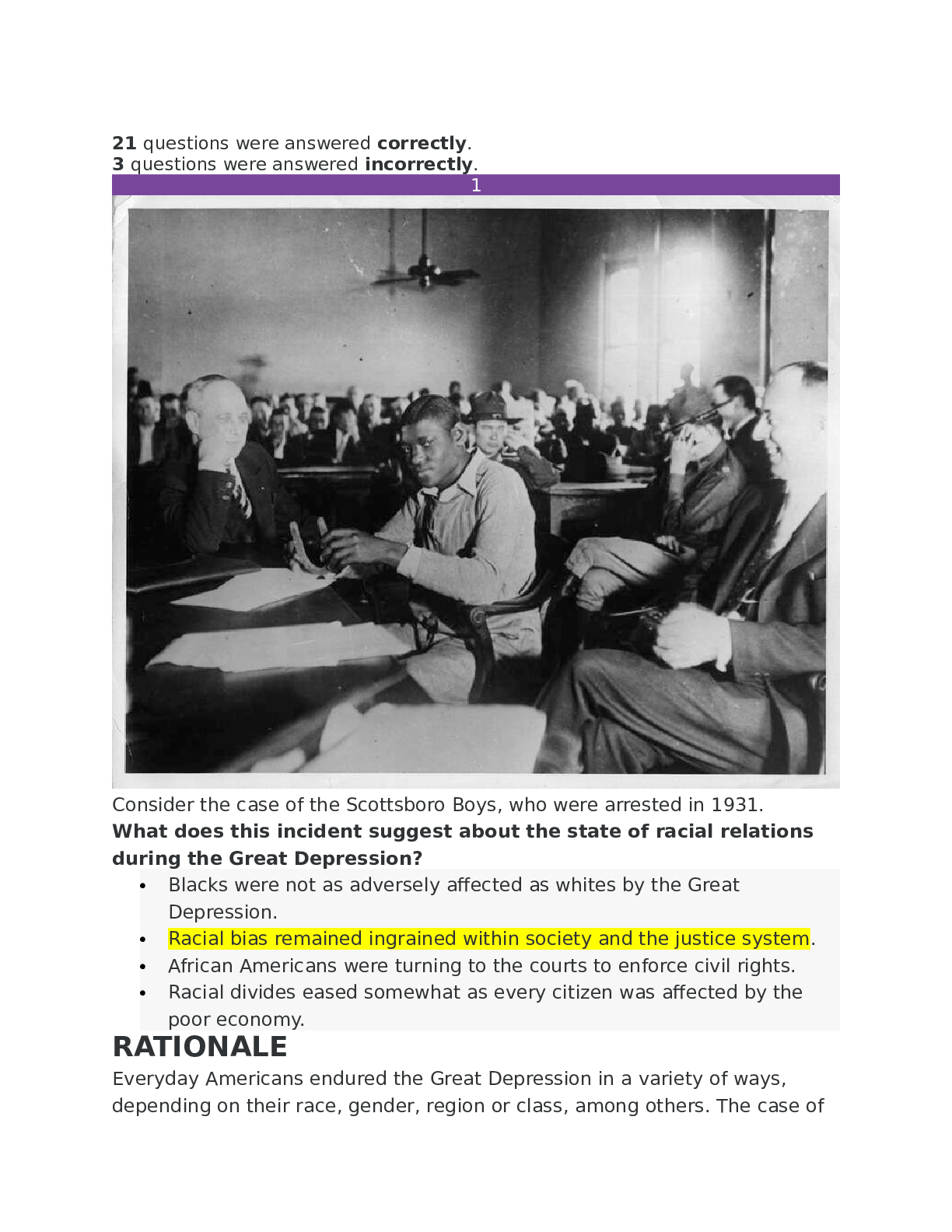
Consider the case of the Scottsboro Boys, who were arrested in 1931.
What does this incident suggest about the state of racial relations
during the Great Depression?
• Blacks were not as adversely affected as whites by the Great
Depression.
• Racial bias remained ingrained within society and the justice system.
• African Americans were turning to the courts to enforce civil rights.
• Racial divides eased somewhat as every citizen was affected by the
poor economy.
RATIONALE
Everyday Americans endured the Great Depression in a variety of ways,
depending on their race, gender, region or class, among others. The case of
the Scottsboro Boys, who were convicted and sentenced to death within two
weeks of being falsely accused of raping two white women on a train,
revealed the racial injustice still engrained within the southern court system.
Like whites, African Americans endured economic hardship during the Great
Depression, but they also continued to endure racism and inequality.
CONCEPT
Enduring the Great Depression
2
What was one purpose of the Civil Works Administration, which was
a part of Franklin Roosevelt’s First New Deal?
• To stabilize crop prices, the government paid farmers to maintain
production quotas.
• To provide jobs for the unemployed, workers were hired to construct
public projects.
• To provide a permanent solution to the exploitation of workers, this
required industries to adhere to a minimum wage.
• To expand the capacity of the Federal Reserve, this allowed the
reopening of banks under federal supervision.
RATIONALE
The Civil Works Administration was a public program that reduced
unemployment by hiring workers to repair bridges, build roads and airports
and complete other public works projects.
CONCEPT
Roosevelt's New Deal
3
Many historians have argued that the New Deal permanently changed the
U.S.
Which of the following is a long-term effect of the New Deal
identified by historians?
• Many more Americans were employed, but wages remained unfairly
low.
• The government assumed greater responsibility for the security of the
people.
• Elderly Americans lost faith in a government that did not consider their
needs.
• The lifting of burdensome regulations made it easier for businesses
and corporations to profit.
CONCEPT
Interpreting the New Deal as an Historian
4
Progressives pushed for democratic reforms in party politics, which included
allowing party members, rather than delegates, to nominate candidates for
office.
What is the term for this reform?
• The recall system
• The direct primary system
• The commission system
• The initiative system
CONCEPT
Grass Roots Progressivism
5
President Franklin Roosevelt oversaw both a First New Deal and a Second
New Deal to curb the Great Depression.
Choose the action that was part of his First New Deal.
• The Works Progress Administration provided jobs for more than eight
million unemployed workers over an eight-year span.
• The National Labor Relations Act reformed labor relations by protecting
American workers’ right to unionize and bargain collectively for wages
and benefits.
• To put Americans back to work quickly, the Public Works Administration
contracted with private companies to build highways, bridges and
military bases.
• The Social Security Act established a permanent safety net to help the
most vulnerable Americans, including the elderly, the disabled and
single parents.
CONCEPT
Roosevelt's New Deal
6
Which statement best represents Henry Cabot Lodge's position on
American involvement in the proposed League of Nations?
• "I am angry that my colleagues across the aisle aren't open to
negotiating."
• “I urge that sanctions against aggressor nations be included in the
League of Nations platform.”
• “I offer 14 reservations I have about the Treaty of Versailles and the
League of Nations.”
• “The U.S. must join the League of Nations, and I will appeal to the
American people for public support.”
CONCEPT
Woodrow Wilson's Vision: America and the League of Nations
7
During the 1920s, W. E. B. Du Bois and Marcus Garvey were early proponents
of an ideology known as Pan-Africanism.
What was a key way in which Garvey's beliefs differed from that of
Du Bois?
• Garvey celebrated African American culture and encouraged racial
pride.
• Garvey rejected the notion that African Americans had a distinct
racial identity.
• Garvey was frustrated over the racism he witnessed and
experienced in the United States.
• Garvey believed that black and white Americans were incapable of
working together to overcome racism.
RATIONALE
Garvey and Du Bois shared a number of beliefs associated with PanAfricanism. However, Garvey was less optimistic about the possibility that
African American communities could overcome racism and injustice in
America. He was skeptical of cooperation with white Americans and, as a
result, promoted a “Back to Africa” movement to return African Americans to
a presumably more welcoming home in Africa.
CONCEPT
The Harlem Renaissance
8
The cartoon above was printed in 1907 in the Washington Evening Star.
Uncle Sam offers a baseball bat called "National Big Stick" to a player in a
Nationals uniform, a reference to President Theodore Roosevelt's big stick
diplomacy. Roosevelt had recently offered the Roosevelt Corollary to the
Monroe Doctrine, an example of his big stick approach, in 1904. He was also
continuing work in the Panama Canal in 1906. Teddy bear, a reference to
Roosevelt, assures the player that "it's a victory getter, all right!"
How does this cartoon depict the state of American foreign policy in
the early 1900s?
• The American government was tiring of efforts to influence
international events and was looking to scale back its military, in a
sense retiring its "National Big Stick."
• The American government was taking an aggressive foreign policy
stance backed by military power, which is represented by the "National
Big Stick."
• The American people did not care for international affairs and wanted
to focus their attention on baseball, the favorite national sport.
• The American people were attempting to influence foreign policy
through diplomatic channels by promoting sports competitions
between nations, referred to as the "National Big Stick."
CONCEPT
The Origins of American Imperialism
9
Select a factor that shifted American foreign policy toward
imperialism in the 1890s.
• Navy officials supported the acquisition of Pacific islands to establish
bases and coaling stations.
• American businessmen reduced their investments in mining and
railroad ventures in Mexico.
• The U.S. government hoped to attract more immigrants to boost the
American population.
• Major European nations were beginning the process of decolonization.
CONCEPT
The Origins of American Imperialism
10
Choose the statement that describes a cause of the War of 1898.
• Spain positioned battleships between Cuba and the United States and
threatened war.
• Yellow journalism inflamed American nationalism with sensational
reporting on events in Cuba.
• Some Americans saw the Cuban conflict as a dangerous risk for the
weak U.S. military.
• Uprisings in Cuba over Spanish control were encouraged by
businessmen who had investments there.
CONCEPT
The Creation of an American Empire
11
Although many young Americans in urban areas were associated with the
"new generation" during the 1920s, the decade also witnessed the rise of the
Lost Generation.
Which of the following describes an aspect of the “Lost
Generation?”
• Many joined the Ku Klux Klan and other nativist groups to fight against
radical ideologies and immigrants.
• Authors created characters who had to display resilience amid constant
struggle and failure.
• They turned to religion to provide stability and order to an otherwise
turbulent decade.
• An economic downturn saddled them with burdensome debt that
prevented their full participation in the "American Dream."
CONCEPT
The Roaring 20's: A Nervous Generation
12
Choose the true statement about Progressives or the Progressive
Era.
• The Progressive Era represented the apex of racial equality in America.
• Progressives pushed for the nomination of candidates through a direct
vote by party members.
• The Progressive Era marked the emergence of modern conservatism in
the country.
• Progressives had lofty goals for political, social and economic reform,
but realized little actual policy change.
CONCEPT
Grass Roots Progressivism
13
Theodore Roosevelt’s “Square Deal” had three main components, one of
which was consumer protections.
What else was included in his plan?
• Regulation of corporations
• Federal food program
• Education reform
• Civil rights
CONCEPT
Theodore Roosevelt
14
President Wilson’s stance on American neutrality in World War I changed
between 1914 and 1917.
Which event occurred most proximate to Wilson's request to
Congress to declare war?
• Britain suffered massive causalities in the Battle of the Somme.
• Germany launched attacks on military and merchant ships around
Great Britain.
• Germany broke its promise to restrict its use of submarine warfare and
sank the Laconia.
• The value of American exports to the Allied powers reached $3 billion.
RATIONALE
In February 1917, two months before the U.S. entered the war, Germany
broke its promise to limit submarine warfare, sinking five American merchant
ships. This, along with the discover of the Zimmermann Telegram, prompted
Wilson to request a declaration of war from Congress.
CONCEPT
Woodrow Wilson's Dilemma: American Neutrality and the First World War
15
Which of the following contributed to the Democratic Party
becoming the party of the welfare state after the New Deal?
• The Democratic Party opposed the expansion of the federal
government during and after the New Deal.
• President Franklin Roosevelt proposed taxing the richest in order to
fund direct payments to the poor.
• Under Roosevelt's leadership, Congress established a federal health
insurance program for poor Americans.
• American workers’ rights to organize and bargain collectively were
protected by the government.
CONCEPT
Challenges to the New Deal
16
Read the sentence from a Chicago newspaper account of a race riot during
the Red Summer.
Some of the victims were chased, caught and dragged into alleys and lots,
where they were left for dead. In all parts of the city, white mobs dragged
from surface cars, black passengers wholly ignorant of any trouble, and set
upon them.
The writer of this account was most likely sympathetic to which
group?
• Chicago's white population
• Chicago's police
• Chicago's black population
• Chicago's working class
RATIONALE
This article describes a race riot that occurred in Chicago in the summer of
1919 when a white mob stoned a young black boy to death because he
swam too close to the “white beach” on Lake Michigan. The Chicago
Defender, from which this excerpt comes, was the city’s leading African
American newspaper. The language describing "white mobs" attacking "black
passengers wholly ignorant of any trouble," who were "chased, caught and
dragged into alleys and lots, where they were left for dead," suggests that
the author is sympathetic to Chicago's black population.
CONCEPT
The Significance of 1919
17
When the United States entered World War I, suffragists saw the opportunity
to enact a women's suffrage amendment.
What was one of their main reasons for optimism?
• Women took over a number of Congressional seats from their
husbands who went abroad to fight.
• Wilson's attention was focused on the war, so Congress was less
concerned about his opposition to suffrage.
• They found it hypocritical to fight a war to defend freedom and
democracy abroad and deny the vote to women at home.
• Women were required to register for potential military service under
the Selective Service Act.
CONCEPT
Progressivism and the First World War
18
Which of the statements reflects President Herbert Hoover’s
response to the Great Depression?
• "The American tradition of rugged individualism can't possibly see the
nation and its people through this challenging time."
• “Rather than being paralyzed by fear, we must act now to resolve the
banking crisis and other problems associated with the Great
Depression.”
• "The federal government must step in to provide direct assistance to
Americans until this crisis fades."
• “I oppose the Federal Emergency Relief Act because it interferes with
the balance of power between states and the federal government.”
CONCEPT
Federal Responses to the Great Depression
19
The Red Scare was a period following World War I in which Americans
suppressed radical dissent.
Which event is considered a cause of the Red Scare?
• A Republican President, Warren G. Harding, was elected in a landslide
victory.
• Race riots revealed that white Americans were willing to use violence
and intimidation to maintain positions of supremacy in northern cities.
• Laborers who had originally agreed not to strike in support of the war
effort participated in nearly 3,000 strikes in 1919.
• The "Palmer Raids" arrested hundreds without warrants and deported
Russians back to the Soviet Union.
CONCEPT
The Significance of 1919
20
Why did President Theodore Roosevelt use the power of his office to
advance Progressive reform?
• He believed the disabled and the poor had been neglected and needed
governmental welfare.
• He believed the country needed governmental solutions to the ills of
industrialization and corruption.
• He believed the moral and social climate in the United States had
deteriorated and required federal regulation.
• He believed that monopolies and other business combinations were
perfectly acceptable under capitalism.
CONCEPT
Theodore Roosevelt
21
Study the political cartoon published in Puck in 1899:
All of the following are aspects of U.S. foreign policy during the
Progressive Era represented in this political cartoon EXCEPT
__________.
• unilaterialism
• imperialism
• white superiority
• dollar diplomacy
CONCEPT
American Foreign Policy in the Progressive Era
22
Which of the following was a cause of the Great Depression?
• Consumerism outpaced supply and businesses had insufficient sources
for their raw materials, causing prices to skyrocket.
• Immigrants had arrived in large numbers during the previous decade
and taken many low-paying jobs, leaving many Americans
unemployed.
• Investors and the general public withdrew their money from banks. The
more they withdrew, the closer the banks came to collapse.
• A rapid rise in population due to a higher birthrate led to a demand for
jobs and housing that were just not available.
CONCEPT
The Beginnings of the Great Depression
23
Youth in urban areas during the Roaring ’20s adopted a new morality.
What was one of the features of this new morality?
• A concern for natural conservation
• A challenge to traditional gender roles
• A reinvigorated interest in hard work and responsibility
• A rejection of consumer culture
CONCEPT
The Roaring 20's: A New Generation
24
Which statement is most likely to have been spoken by W.E.B. Du
Bois, reflecting his approach to black equality in the Progressive
Era?
• "We must seek to build trust with our white neighbors in the South."
• “I call for immediate and uncompromising activism for African
American civil rights in order to achieve social progress.”
• "The best path forward is to provide for our economic welfare by
excelling in agriculture, domestic service and other trades."
• “The burden of change is upon us, the African American community;
we are responsible for our own success.”
RATIONALE
CONCEPT
What it Means to be a Progressive
[Show More]