27 questions were answered correctly.
4 questions were answered incorrectly.
1
President Franklin Roosevelt became convinced that the United
States should support the Allies in World War II for which of the
followin
...
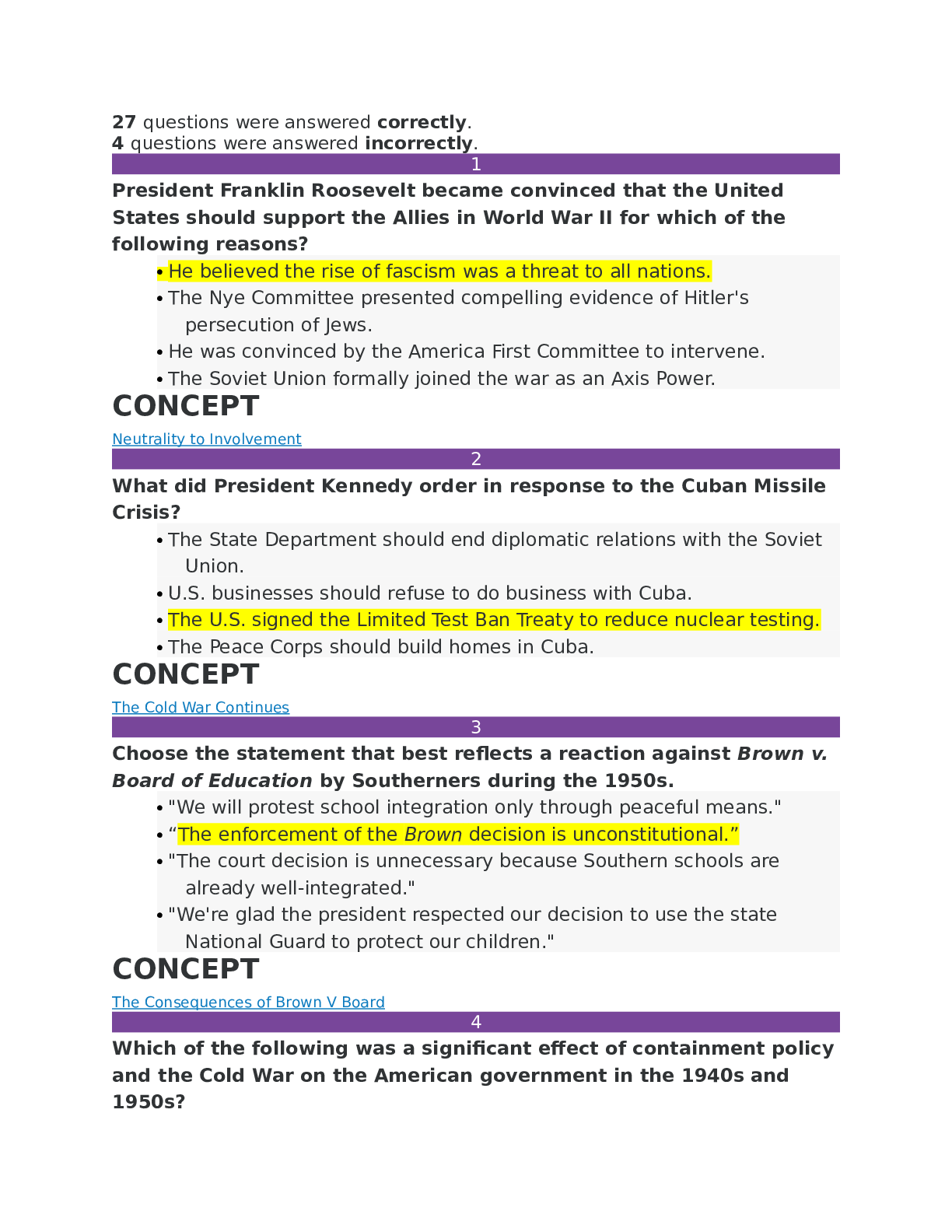
27 questions were answered correctly.
4 questions were answered incorrectly.
1
President Franklin Roosevelt became convinced that the United
States should support the Allies in World War II for which of the
following reasons?
He believed the rise of fascism was a threat to all nations.
The Nye Committee presented compelling evidence of Hitler's
persecution of Jews.
He was convinced by the America First Committee to intervene.
The Soviet Union formally joined the war as an Axis Power.
CONCEPT
Neutrality to Involvement
2
What did President Kennedy order in response to the Cuban Missile
Crisis?
The State Department should end diplomatic relations with the Soviet
Union.
U.S. businesses should refuse to do business with Cuba.
The U.S. signed the Limited Test Ban Treaty to reduce nuclear testing.
The Peace Corps should build homes in Cuba.
CONCEPT
The Cold War Continues
3
Choose the statement that best reflects a reaction against Brown v.
Board of Education by Southerners during the 1950s.
"We will protest school integration only through peaceful means."
“The enforcement of the Brown decision is unconstitutional.”
"The court decision is unnecessary because Southern schools are
already well-integrated."
"We're glad the president respected our decision to use the state
National Guard to protect our children."
CONCEPT
The Consequences of Brown V Board
4
Which of the following was a significant effect of containment policy
and the Cold War on the American government in the 1940s and
1950s? The temporary suspension of the First Amendment in an effort to
contain state secrets related to the atomic bomb
The expulsion of all persons of Russian descent from state and federal
employment
A gradual acceptance of diverse views and behaviors related to
sexuality and gender
The creation of new federal bodies, such as the National Security
Council and the Central Intelligence Agency, to curtail Communist
subversion at home and abroad
CONCEPT
The Cold War in America
5
Prior to Brown v. Board of Education, in 1946, President Harry Truman worked
on advancing civil rights.
What was a civil rights achievement undertaken by the Truman
administration?
Thurgood Marshall helped found the NAACP's Legal Defense and
Education Fund.
The armed forces were desegregated through an executive order.
The Supreme Court ruled in favor of Heman Sweatt, who had been
denied admission to a Texas law school.
The Double V Campaign successfully desegregated lunch counters in
Washington, D.C.
CONCEPT
The Origins of Brown V Board
6
Choose the statement that describes a way that conformity was
encouraged among Americans during the Second Red Scare.
"Our national health insurance program takes away our freedom of
choice."
"The state must protect all workers from exploitation by subjecting
industry to strict government regulation and supervision."
"Our neighbors seem to have an unusual family structure and
nontraditional gender roles, and we think they might be
Communists."
"The government required us to report to the police anyone whom we
felt might be a communist."CONCEPT
The Cold War in America
7
What was one reason president John Kennedy was slow to put forth
an aggressive civil rights agenda?
He believed strongly in the rights of the states to govern themselves.
He was waiting for committee reports investigating racism.
He didn’t have the support of Congress on the issue.
His administration prioritized engineering an exit from Vietnam.
CONCEPT
The Early 1960s
8
Which statement reflects an effect that World War II had on
American workers?
"As a black man, Roosevelt's Executive Order 8802 prohibits me from
taking advantage of opportunities in the defense industry."
"The war has made it harder for me to find a well paid job that allows
me to support my family."
"I'm grateful that the government is helping me to take care of my
children while I support the war effort."
"As a woman, I feel excluded from the economic benefits the war has
generated."
CONCEPT
The American Homefront
9
Federal housing policies prior to World War II and government
agencies, such as the Home Owners' Loan Corporation, helped
create ________.
de jure segregation
equal access to home ownership
residential segregation
low-income housing
CONCEPT
The Origins of Brown V Board
10
Choose the statement that best explains why Eugene McCarthy had
the support of many students during the 1968 presidential election. He had the support of most party leaders and was popular with blue
collar workers who were in unions.
Most of his support was coming from African Americans and other
minorities, as well as Catholics.
He represented Southern Democrats who were resistant to the party’s
support of the civil rights movement.
He decided to compete in the Democratic primary by running on an
antiwar campaign.
CONCEPT
The Significance of 1968
11
Which of the following World War II events happened first?
Japan and Germany signed a mutual defense treaty.
Congress passed the Lend-Lease Act to assist Great Britain.
Japan invaded China and captured the city of Nanjing.
Britain and France declared war on Germany.
CONCEPT
Neutrality to Involvement
12
Name the group that formed in 1960 to organize protests such as
sit-ins on behalf of the civil rights movement.
The National Association for the Advancement of Colored People
The Mississippi Freedom Democratic Party
The Student Nonviolent Coordinating Committee
The Citizens' Council
CONCEPT
The Early 1960s
13
Which of the following is true about the Yalta Conference?
It occurred after Germany's surrender but before Japan's.
The U.S. and the Soviet Union promised to fight Japan together.
The Allied powers agreed to put Nazi officials on trial at the end of the
war.
Germany was split into multiple zones of occupation.
CONCEPT
Origins of the Cold War
14Which of the following was associated with the counterculture
movement in the 1960s?
Protesting free speech policies at universities
Registering African American voters in the South
Organizing sit-ins at lunch counters
Experimenting with marijuana and psychedelic drugs
CONCEPT
The Liberal Coalition Unravels
15
Which of the following statements reflects a reason identity politics
grew in the United States in the 1960s?
"The Democratic and Republican Parties were growing further apart on
social policy."
“Because we were poor and working class, we were disproportionately
drafted and sent into combat in Vietnam.”
“Based on the idea that the United States is a melting pot, we support
policies that address the needs of all Americans.”
"My identity as a woman was less important than my identity as an
American."
CONCEPT
The Rise of Identity Politics in America
16
What was one assumption behind the United States's decision to
adopt a strategy of containment after World War II?
Communism was poised to expand into Asia and Europe.
Isolating Germany would protect the Soviet Union from further
invasions.
The United States would have to eventually confront the Soviet Union
with military force.
Through a gradual process, the United States would withdraw from the
world stage.
CONCEPT
Origins of the Cold War
17
"As part of the Lyndon Johnson administration's War on Poverty, my teenage
son participated in a program which provided training and work experience
so he could have the same advantages as others."What was the name of that program?
Job Corps
Community Action Program
Head Start
Teacher Corps
CONCEPT
Johnson's Vision: The Great Society
18
Economic expansion and suburbanization in the 1950s led to
cultural pressures to behave in certain ways according to your
__________.
gender
income
location
profession
CONCEPT
Family Life in the 1950s
19
The United Nations issued a Universal Declaration of Human Rights in 1948.
Which of the following statements reflects an idea contained in the
United Nations' Universal Declaration of Human Rights?
All nations are bound to defend this Declaration if another nation
violates it.
Human rights are impossible to define.
All war should be outlawed for the good of the world.
Slavery is wrong no matter where or why it occurs.
CONCEPT
Cold War and the Civil Rights Movement
20
Which of the following was a cause of the attack on Pearl Harbor?
American citizens were ordered to leave Japan and return to the U.S.
America was protecting its Pacific interests.
The U.S. had placed an embargo on Japan's ally, Italy.
The U.S. was providing supplies to Great Britain.
CONCEPT
The American Homefront
21Read the excerpt from a presidential committee report published in 1947:
"It is impossible to decide who suffers the greatest moral damage from our
civil rights transgressions, because all of us are hurt. That is certainly true of
those who are victimized. Their belief in the basic truth of the American
promise is undermined . . . The damage to those who are responsible for
these violations of our moral standards may well be greater . . . All of us
must endure the cynicism about democratic values which our failures
breed."
How does this excerpt demonstrate that the Cold War affected the
civil rights movement in the United States?
The committee is aware that the United States needs to take stronger
steps to address racial discrimination at home.
Communists are distorting America’s racial shortcomings to challenge
the growth of democracies.
In response to global criticism, the committee vows to investigate and
prosecute racism in the United States.
Those who oppose the United States are trying to create hostilities
toward it by members of other races.
CONCEPT
Cold War and the Civil Rights Movement
22
What was the purpose of the U.S. strategy of "island-hopping" in the
Pacific?
To keep Japanese soldiers at sea rather than entrenched in fortified
bunkers on land.
To protect the Philippines and other American holdings from being
invaded.
To seize outlying islands in order to get close enough to bomb the
Japanese mainland.
To weaken and divide Japanese troops by launching multiple attacks in
multiple locations.
CONCEPT
Fighting World War II
23
Which of the following was a factor in President Harry Truman's
decision to drop atomic bombs on Japan?
Germany’s conditional surrender A desire to test the bomb for the first time
Concern that the Soviet Union would do so first
Racism toward the Japanese
CONCEPT
Truman and the Atomic Bomb
24
Looking at the election of Richard Nixon to the presidency in 1968
through ONLY the lens of class leads to which of the following
conclusions?
Many voters were angry at the Kerner Commission's suggestion that
white Americans were responsible for the creation of the racial
ghetto.
The disarray of the Democratic Party in Chicago aided Nixon's election
by contributing to the sense that America was unraveling.
Republican voters accused the federal government of neglecting the
needs of white rural Americans.
The election of 1968 revealed a political realignment occurring in many
of the Southern states.
CONCEPT
The Significance of 1968
25
"In these days, it is doubtful that any child may reasonably be expected to
succeed in life if he is denied the opportunity of an education. Such an
opportunity, where the state has undertaken to provide it, is a right which
must be made available to all on equal terms."
According to this excerpt from the Supreme Court's decision
in Brown v. Board of Education, why was public school segregation
unconstitutional?
Public school segregation violates the Supreme Court decision handed
down in Plessy v. Ferguson in 1896.
The segregation of public schools is in violation of the "equal
protection" clause of the 14th Amendment.
The segregation of public schools has led to underfunded schools for
black children that lack the same amenities as white schools.
Segregation in schools creates feelings of inferiority among black
children, which has a lasting and negative effect on society.
CONCEPTThe Consequences of Brown V Board
26
Choose the action that reflects U.S. involvement in Vietnam during
the Dwight Eisenhower administration.
The United States supported a corrupt and oppressive leader with
money and military advisers.
American pilots exposed North Vietnamese and Viet Cong supply lines
by dropping "Agent Orange."
The United States escalated U.S. troop involvement until it reached
over 500,000.
The United States approved a military coup in South Vietnam as the
government continued to weaken despite continued American
support.
CONCEPT
The Early 1960s
27
Select the statement that best reflects Dwight Eisenhower's New
Look strategy during the Cold War.
It provided the U.S. with a range of nonmilitary options for dealing with
communist aggression.
It cut the size of the armed forces nearly in half while building up the
nuclear arsenal.
It encouraged the formation of the Green Berets, a special forces unit
trained in counterinsurgency.
It reduced the American nuclear arsenal to diminish the threat of
nuclear war.
CONCEPT
The Cold War Continues
28
One component of containment policy was the Marshall Plan.
Which of the following was one of the conditions of the Marshall
Plan?
“Countries that receive aid must agree to defend one another in the
event of Soviet aggression.”
“Any money received from the plan must be spent on American
goods.” "A percentage of any aid received must go to the production of food
and other supplies for West Berlin."
"Countries must formally pledge their support for capitalism and free
trade before receiving any aid."
CONCEPT
The Cold War in Europe: The Iron Curtain Descends
29
Choose the true statement about the relationship between private
business and the federal government during World War II.
"Prices for the consumer goods we produced spiked during the war in
the absence of government regulation."
"Wartime production was mostly done by government-owned factories
rather than private companies like mine."
"Corporations were allowed to ignore federal regulations to protect us
workers in the interest of wartime production."
"Wartime mobilization was so important that the government eased
antitrust regulations while we were in production."
CONCEPT
Arsenal of Democracy
30
Choose the statement that describes an economic consequence of
the United States as an "arsenal of democracy" during World War II.
"The U.S. manufacturing sector produced less than Germany did during
the war."
"U.S. soldiers gained the most from our participation in the war."
"Working on an assembly line really helped us build airplanes quickly."
"Because taxes on income were lowered for the middle class, the
wealthy, like my family, bore the brunt of funding the war effort."
CONCEPT
Arsenal of Democracy
31
Choose the true statement about the effects of economic expansion
in 1950s America.
"Like our peers, my husband and I married young and had more
children than our parents did."
“Unemployment rose when soldiers returned home from the war and
jobs were scarce.” "I was happy to leave the suburbs behind and move to the city."
"We sold our car because public transportation was so much more
convenient."
CONCEPT
Family Life in the 1950s
[Show More]