New Mexico Search and Rescue Field
Certification Study Guide Questions and
Answers
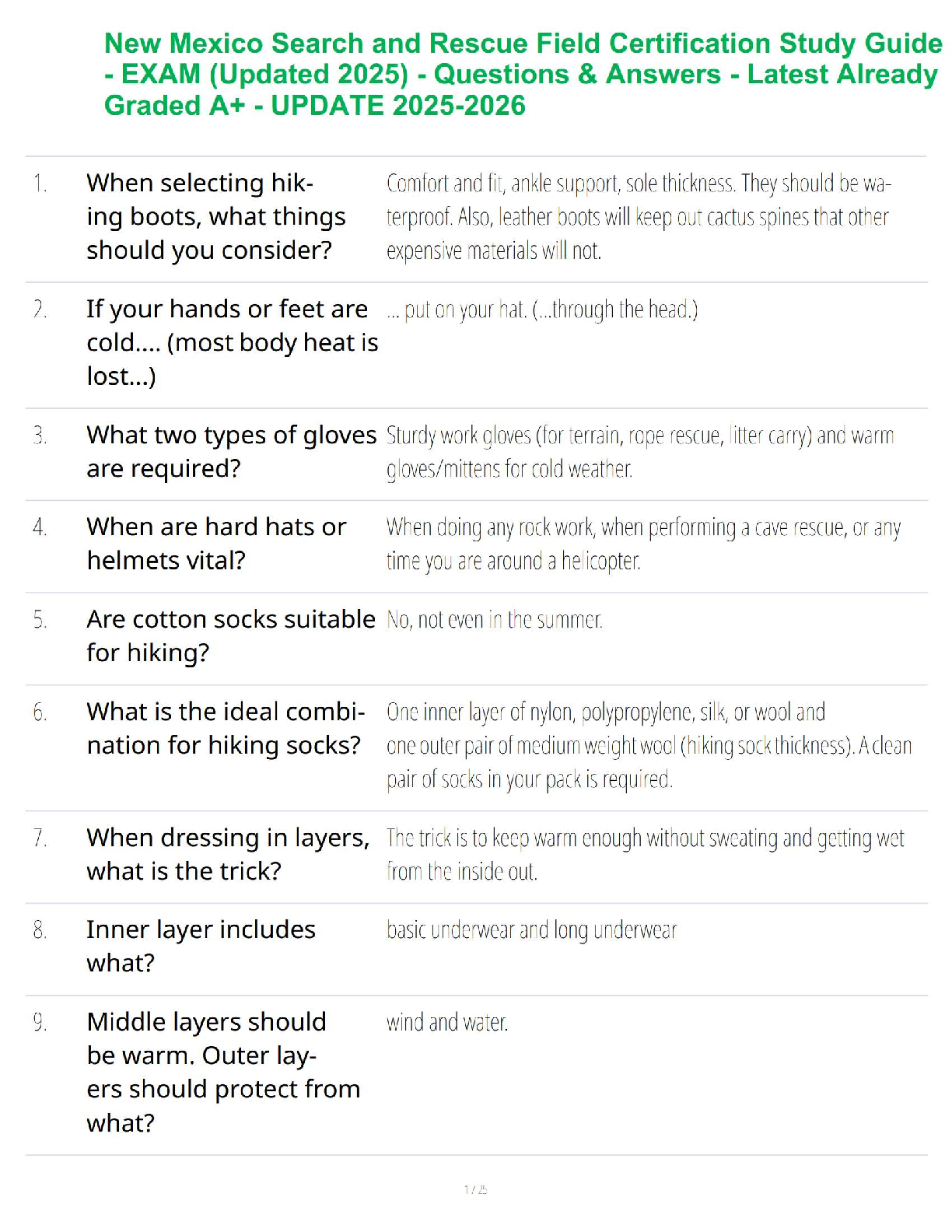
When selecting hiking boots, what things should you consider? >>>Comfort and fit,
ankle support, sole thickness. They should be water
...
New Mexico Search and Rescue Field
Certification Study Guide Questions and
Answers
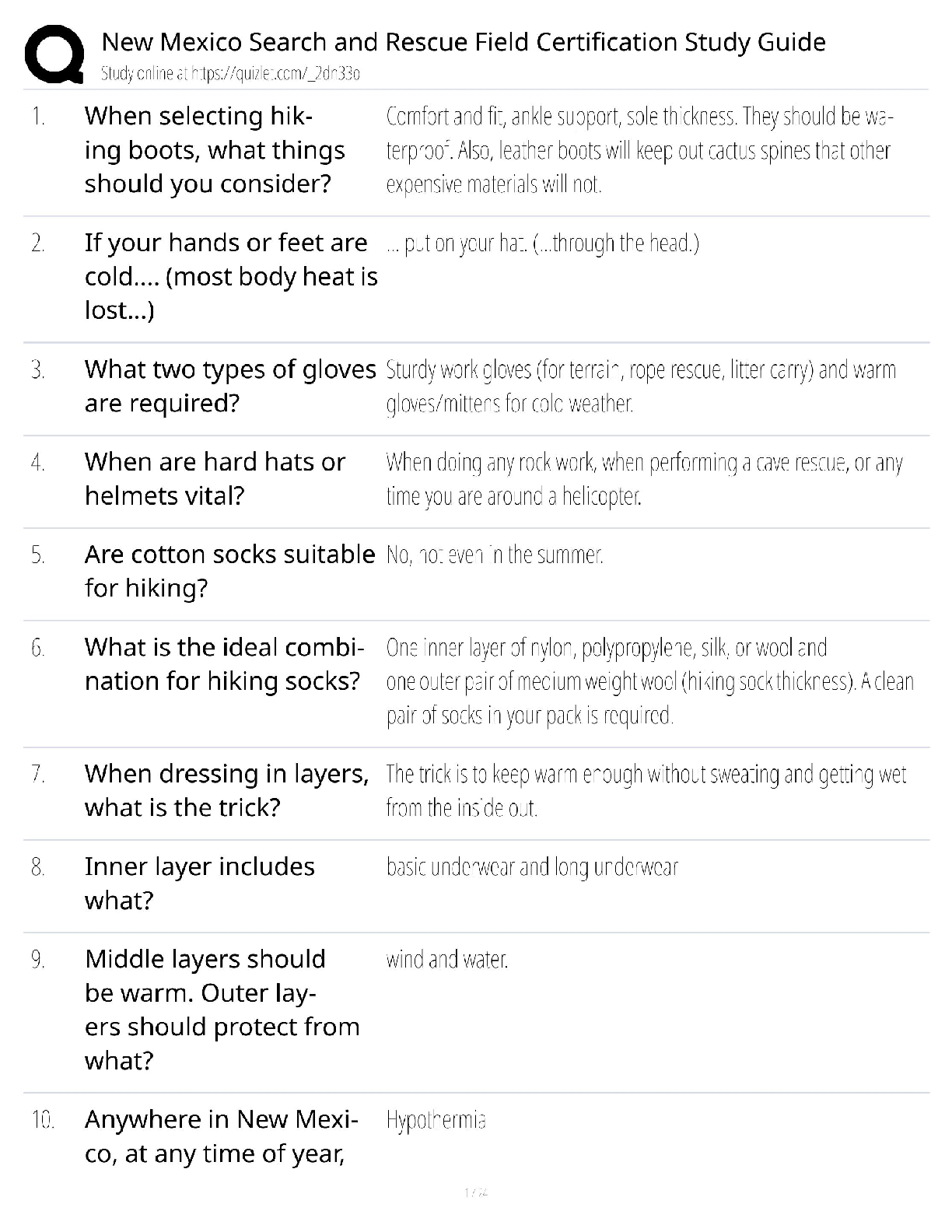
When selecting hiking boots, what things should you consider? >>>Comfort and fit,
ankle support, sole thickness. They should be waterproof. Also, leather boots will keep
out cactus spines that other expensive materials will not.
If your hands or feet are cold.... (most body heat is lost...) >>>... put on your hat.
(...through the head.)
What two types of gloves are required? >>>Sturdy work gloves (for terrain, rope rescue,
litter carry) and warm gloves/mittens for cold weather.
When are hard hats or helmets vital? >>>When doing any rock work, when performing a
cave rescue, or any time you are around a helicopter.
Are cotton socks suitable for hiking? >>>No, not even in the summer.
What is the ideal combination for hiking socks? >>>One inner layer of nylon,
polypropylene, silk, or wool and
one outer pair of medium weight wool (hiking sock thickness). A clean pair of socks in
your pack is required.
When dressing in layers, what is the trick? >>>The trick is to keep warm enough without
sweating and getting wet from the inside out.
Inner layer includes what? >>>basic underwear and long underwear
Middle layers should be warm. Outer layers should protect from what? >>>wind and
water.
Anywhere in New Mexico, at any time of year, you may need to protect yourself from
what? >>>Hypothermia
To pass the gear and clothing check section of this Certification, you must: >>>• Have
silk, synthetics, or wool for the inner layer (next to your skin),
• Wool or synthetics for the middle (warm) layer, and
• A breathable wind/water protective outer layer.
When packing food for yourself, for how long should you plan? >>>24 hoursHow much water is required for the certification for a 24 hour period? >>>2 quarts
(containers only are required for the certification, do not have to be filled with water)
How accurate must your compass be for this certification? >>>within 5 degrees
A vehicle driver or passenger should have a duffel bag or similar container which
could be _______ ________if a walkout were necessary. >>>easily carried
On average, doing day-to-day activities, you lose about _____ ounces of water through
urine
production and another ____ ounces through perspiration and respiration. >>>48, 24
We recommend you carry _____ or _____ GALLONS if you are searching for two to
four
hours in hot/dry weather. >>>1, 2
When working in a cave, how many sources of light may be required >>>three
By far the most efficient communication method is.... >>>... face to face
Before going into the field, you and your team should be briefed.... >>>... face to face
Cell phones are ___ _______ _______ in search and rescue. >>>of limited value
If cell phone communications are necessary, try _____ ______ so that you may be
within line-of-sight of a cell tower. >>>going uphill
Satellite phones must have what in order to operate? >>>A clear field of view to a
relatively large area of sky. They are not useful from the bottom of deep, narrow
canyons or in areas with dense tree canopy.
The vast majority of communications within an incident occur on what? >>>two-way
radios
Where can you find information about types of communication and associated radio
frequencies in use for an operation? >>>The mission's Communications Plan. DO NOT
go into the field without this information
VHF and UHF stand for what? >>>Very High Frequency and Ultra High Frequency
What are the VHF State SAR frequencies? >>>155.160 (commonly used both for call-in
for those responding and from search teams to incident base), 151.370, and 159.285
Megahertz
What are the UHF State SAR frequencies? >>>460.250 and 465.250
[Show More]