WGU C464 Assessment Questions and
Answers Latest Update Already Passed
Challenges of Communication ✔✔significant intellectual and psychological resources.
Not everyone we encounter will appreciate the value of communi
...
WGU C464 Assessment Questions and
Answers Latest Update Already Passed
Challenges of Communication ✔✔significant intellectual and psychological resources.
Not everyone we encounter will appreciate the value of communication.
*We may over-rely on digitally mediated communication.
*We live in a diverse world where intercultural understanding can be difficult.
Effective Communication Strategies ✔✔1) Determine how to deliver a message by developing the
ability to understand and predict the needs and potential responses of others.
2) During communication, be aware the feedback we receive from others to assess whether our
approach is creating the meanings we intend in the minds of other communicators.
3) After an interaction: pause, reflect, and evaluate both the process and outcome of
communication in order to determine the next steps.
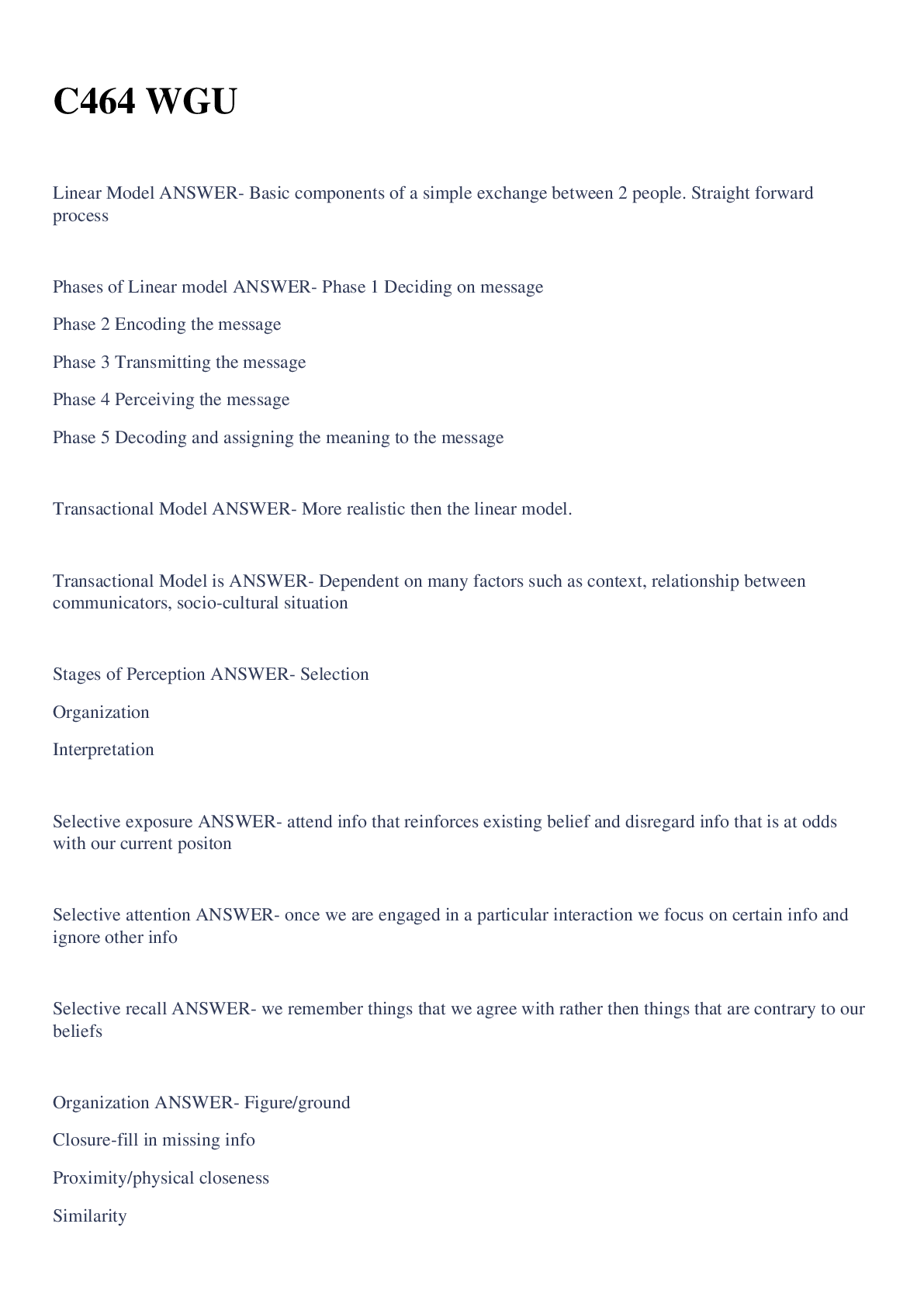
Linear Model of Communication ✔✔-Deciding on the message. A sender selects a message to
send to a receiver in order to achieve a desired outcome.
-Encoding the message. Encoding refers to a psychological process in which the sender of a
message assigns symbols, such as words, sounds, or gestures, to his or her thoughts and feelings.
-Transmitting the message. A message is "sent" from sender to receiver, using a particular channel
that is selected by the sender. The channel is the medium that carries the message, such as email,
telephone, face-to-face communication, or a written document.
-Perceiving the message. When a receiver detects that a message has been sent, he or she attends
to it and perceives it in some fashion.
-Decoding and assigning meaning to the message. When a receiver assigns meaning to the message
that has been communicated, he or she is engaging in a psychological process known as decoding.
The receiver translates the symbols (words, sounds, and gestures) perceived into thoughts and
feelings.
Noise ✔✔Any auditory, visual, or psychological distraction that interferes with the sending and
receiving of messages.
Transactional Model ✔✔The addition of feedback, along with consideration of the factors that
make accurate decoding of messages difficult. Communication is a simultaneous, interactive
process and during interactions, communicators mutually influence one another—making the
process a transaction in which all communicators are affected in some way.
Competent Communicator ✔✔Sense What Is Appropriate in a Given Situation. Build and Develop
Their Communication Skills. Look for ways to improve their skills by taking courses, reading
books, participating in training and development workshops, communicating with a wide range of
people and in many situations, and reflecting on the feedback they receive.
Motivation of Competent Communicator ✔✔Even the most astute, skilled communicator may at
times lack the drive to communicate and your drive may vary according to the situation and even
the hour of the day.
Stages of Perception ✔✔Selection, Organization, Interpretation
Selection Stage of Perception ✔✔1) SELECTIVE EXPOSURE states that we will attend to
information that reinforces existing beliefs and disregard information that is at odds with our
current position.
SELECTIVE ATTENTION illustrates how, once we are engaged in a particular interaction, we
focus on certain information and ignore other information.
SELECTIVE PERCEPTION - we begin to apply our own unique experiences to the message—
our inclination to see, hear, and believe what we want to see, hear, and believe.
SELECTIVE RECALL of information; that is, we remember things that we agree with rather than
things that are contrary to our beliefs
[Show More]