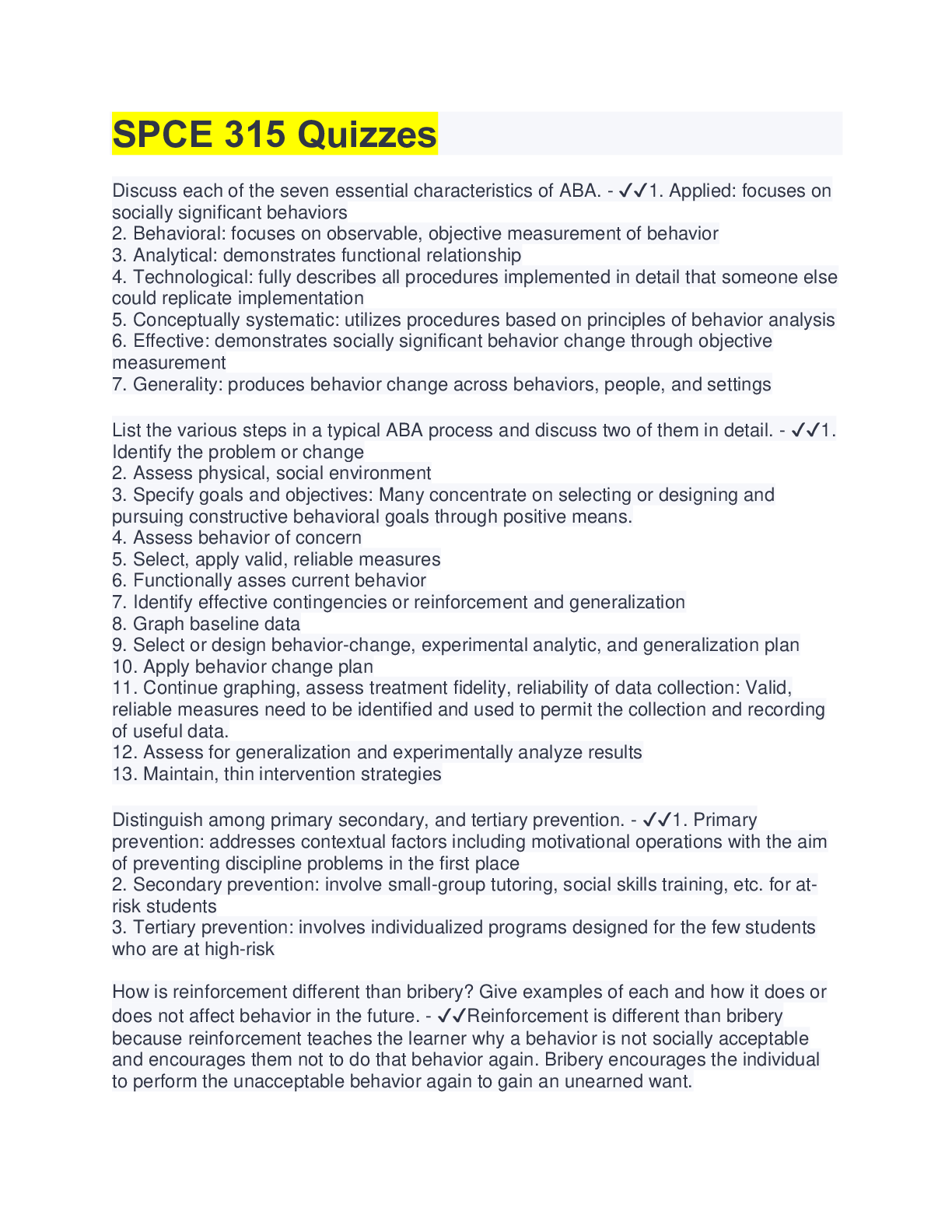
SPCE 315 Quizzes
Discuss each of the seven essential characteristics of ABA. - ✔✔1. Applied: focuses on
socially significant behaviors
2. Behavioral: focuses on observable, objective measurement of behavior
3. Analyt
...
SPCE 315 Quizzes
Discuss each of the seven essential characteristics of ABA. - ✔✔1. Applied: focuses on
socially significant behaviors
2. Behavioral: focuses on observable, objective measurement of behavior
3. Analytical: demonstrates functional relationship
4. Technological: fully describes all procedures implemented in detail that someone else
could replicate implementation
5. Conceptually systematic: utilizes procedures based on principles of behavior analysis
6. Effective: demonstrates socially significant behavior change through objective
measurement
7. Generality: produces behavior change across behaviors, people, and settings
List the various steps in a typical ABA process and discuss two of them in detail. - ✔✔1.
Identify the problem or change
2. Assess physical, social environment
3. Specify goals and objectives: Many concentrate on selecting or designing and
pursuing constructive behavioral goals through positive means.
4. Assess behavior of concern
5. Select, apply valid, reliable measures
6. Functionally asses current behavior
7. Identify effective contingencies or reinforcement and generalization
8. Graph baseline data
9. Select or design behavior-change, experimental analytic, and generalization plan
10. Apply behavior change plan
11. Continue graphing, assess treatment fidelity, reliability of data collection: Valid,
reliable measures need to be identified and used to permit the collection and recording
of useful data.
12. Assess for generalization and experimentally analyze results
13. Maintain, thin intervention strategies
Distinguish among primary secondary, and tertiary prevention. - ✔✔1. Primary
prevention: addresses contextual factors including motivational operations with the aim
of preventing discipline problems in the first place
2. Secondary prevention: involve small-group tutoring, social skills training, etc. for atrisk students
3. Tertiary prevention: involves individualized programs designed for the few students
who are at high-risk
How is reinforcement different than bribery? Give examples of each and how it does or
does not affect behavior in the future. - ✔✔Reinforcement is different than bribery
because reinforcement teaches the learner why a behavior is not socially acceptable
and encourages them not to do that behavior again. Bribery encourages the individual
to perform the unacceptable behavior again to gain an unearned want.
For example, a kid is crying in a toy store because she wants several toys after already
being told no. An example of reinforcement (negative) in this situation would be to
remove the child from the toy store without any toys. An example of bribery in this
situation would be to give the child the toys she wants to make her stop crying.
Reinforcement encourages the behavior to decrease in the future; bribery encourages
the behavior to increase in the future.
What is treatment integrity and why is it important when using behavioral treatments? -
✔✔Treatment integrity refers to ensuring that everyone involved carries out and
supports the intervention as planned. This is important when using behavioral
treatments because procedures that veer away from their intended path pose a risk of
failure.
When the focus is on form/appearance/shape of the behavior, we are referring to the
'topography' of the behavior. - ✔✔True
When the focus is on strength or force of the expression of behavior, we are referring to
duration of the behavior. - ✔✔False
Treatment integrity is the same thing as inter-observer reliability. - ✔✔False
Transitory behaviors are only noted when an individual is transitioning from high
preferred activity to a low preferred activity. - ✔✔False (pg. 116)
A behavioral objective includes: - ✔✔Clear information on environmental details in
which behavior is to occur
Level of proficiency of a behavior can be measured by: - ✔✔Rate
What is the best way to select potential reinforcers: - ✔✔Conduction preference
assessments
What is the proper way to refer to data when talking or writing about it: - ✔✔The data
are stable
Deprivation is defined as: - ✔✔Absence or reduction of a reinforcer's availability for a
period of time
Which one of the following is not a characteristics of a good measurement system: -
✔✔Fast
The following are examples of different classes of reinforcers: - ✔✔idk
List the steps to conducting a functional behavior assessment of a 7 yr-old engaging in
spitting behavior during recess. - ✔✔1. Identify the problem
2. Collect information to determine function
3. Form a hypothesis
4. Plan interventions
5. Evaluate the effectiveness of the plan
What is a reinforcement sch
[Show More]