ASHI CPR Exam Study Questions 2022
Sudden cardiac arrest in an adult is MOST LIKELY caused by - ✔✔Ventricular
fibrillation
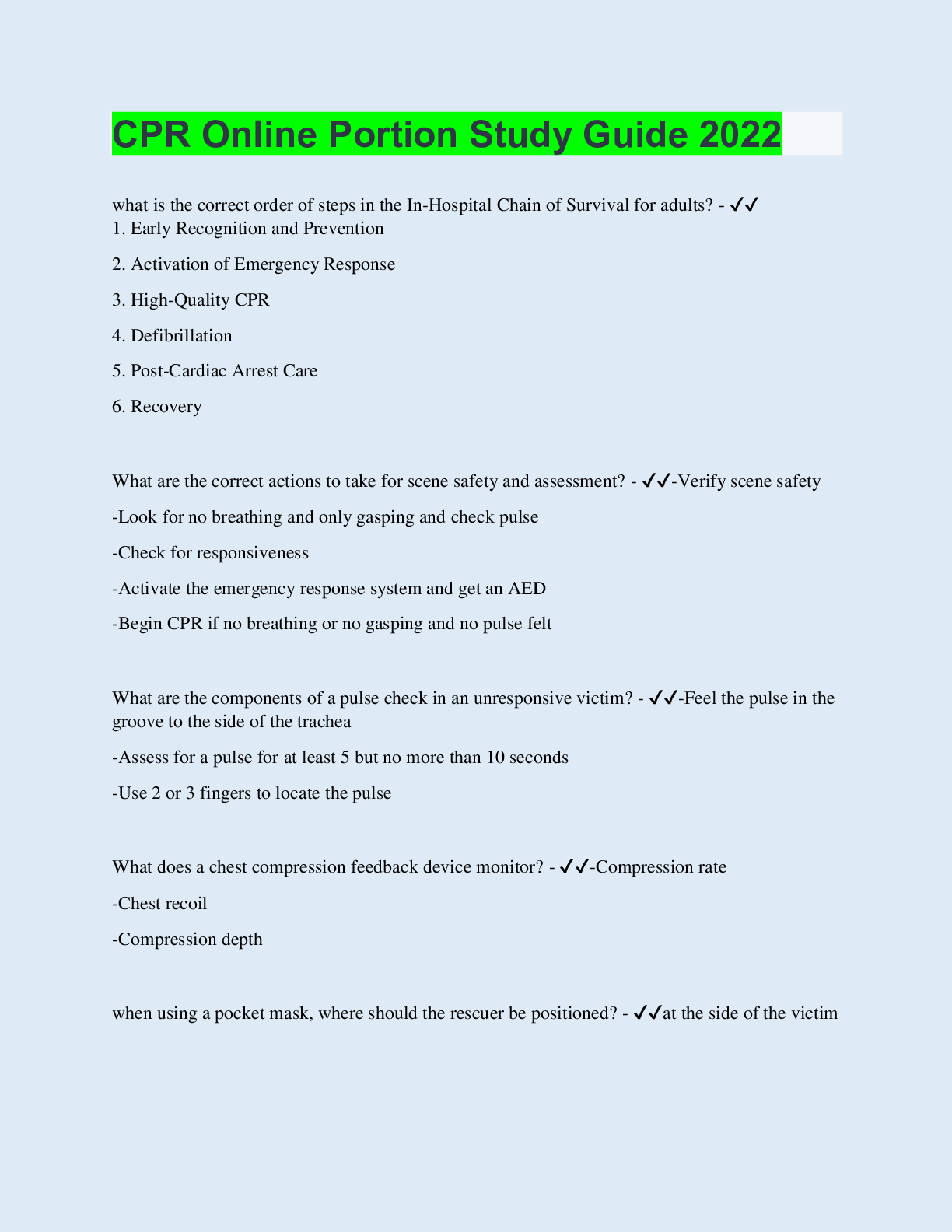
The "chain of survival" is used: - ✔✔To describe the most effective approach for treating
sud
...
ASHI CPR Exam Study Questions 2022
Sudden cardiac arrest in an adult is MOST LIKELY caused by - ✔✔Ventricular
fibrillation
The "chain of survival" is used: - ✔✔To describe the most effective approach for treating
sudden cardiac arrest
The links in the "chain of survival" in children is slightly different than for adults and
includes: - ✔✔Prevention, early CPR, early activation of EMS, early pediatric advanced
life support, and integrated post-cardiac arrest care.
A roofer was electrocuted when his aluminum ladder contacted an energized power
line. The scene has been made safe. An AED has been attached to the patient. The
AED has analyzed the heart and a shock is advised. You should: - ✔✔Clear the patient
and deliver the shock.
You are attending to an unresponsive 4-year-old child who is not breathing normally, but
definitely has a carotid pulse. Using a CPR mask or bag-mask device, you should: -
✔✔Give 12 to 20 rescue breaths per minute.
Standing in line at a local government facility, a middle-aged man suddenly collapses.
The man is unresponsive and he occasionally gasps for breath. He looks dead. This
condition is most likely caused by and treated with: - ✔✔Sudden cardiac arrest, CPR,
defibrillation.
You and another provider are attending to a 17-year-old found unresponsive with
occasional gasps. After checking for a pulse, you are not certain if a pulse is present or
not. You should: - ✔✔Start CPR; 30:2 compressions to ventilations.
When giving rescue breaths, make sure to: - ✔✔Avoid excessive volume.
You find an 11-year-old child who is unresponsive, blue, and is not breathing normally.
Her friend states that she collapsed and stopped moving after playing the "pass out"
choking game. You are the only trained provider. You need to: - ✔✔Perform 5 cycles of
CPR at 30:2 and send the friend to alert EMS. OR Send the friend to activate EMS and
get an AED, then check for a carotid pulse.
CPR is being performed on a child who was removed from a swimming pool. An AED
arrives and is positioned near the child's head. The next step is to: - ✔✔Wipe his chest
dry before attaching the pads.
You are performing CPR on your uncle who collapsed at a family gathering where you
are the only trained rescuer. What is the most appropriate approach to deliver rescue
breaths? - ✔✔Use a CPR mask with a one-way valve.
After delivering a shock with an AED, you should: - ✔✔Immediately resume CPR and
follow any instructions given by the AED.
You are attending a person who is unresponsive, not breathing, but you can clearly feel
a carotid pulse. What is the determined problem? - ✔✔Respiratory arrest.
You respond to a 51-year-old man found collapsed inside a closed garage. Bystanders
have dragged him outside onto the lawn. He is unresponsive and does not appear to be
breathing normally. You can clearly feel his carotid pulse. What is your next step? -
✔✔Give 10 to 12 rescue breaths per minute.
Adults need how many rescue breaths? - ✔✔10-12
Children/infants need how many rescue breaths? - ✔✔12-20
The proper depth of chest compression for an adult patient is: - ✔✔at least 2 inches.
You have determined a 47-year-old man is unresponsive. In order to assess for normal
breathing, you should: - ✔✔Quickly look at the face and chest.
You are at the park with your dog, walking near a group of teenagers who are
skateboarding along the park paths. Suddenly, they start shouting for help. One of the
teenagers is on the ground and not moving. You should: - ✔✔Pause for a brief moment
and look for obvious hazards.
You are part of a three person team performing CPR. One rescuer is giving chest
compressions. You are one of two people giving rescue breaths using a bag-mask
device. Your partner will hold and squeeze the bag. You should: - ✔✔Position the mask
on the person's face, with your palms and thumbs on both sides of the mask.
During CPR, you are opening the airway of a person who you suspect has had
significant trauma to the head, neck, and back. You should: - ✔✔Place your palms and
thumbs on both sides of a CPR ma
[Show More]



.png)
.png)
.png)
.png)