KPER 1200 TEST #1
What are the 4 reasons to study physical activity? - ✔✔1) because humans have
evolved to be physically active
2) because our environment no longer fulfills our needs for physical activity
3) because
...
KPER 1200 TEST #1
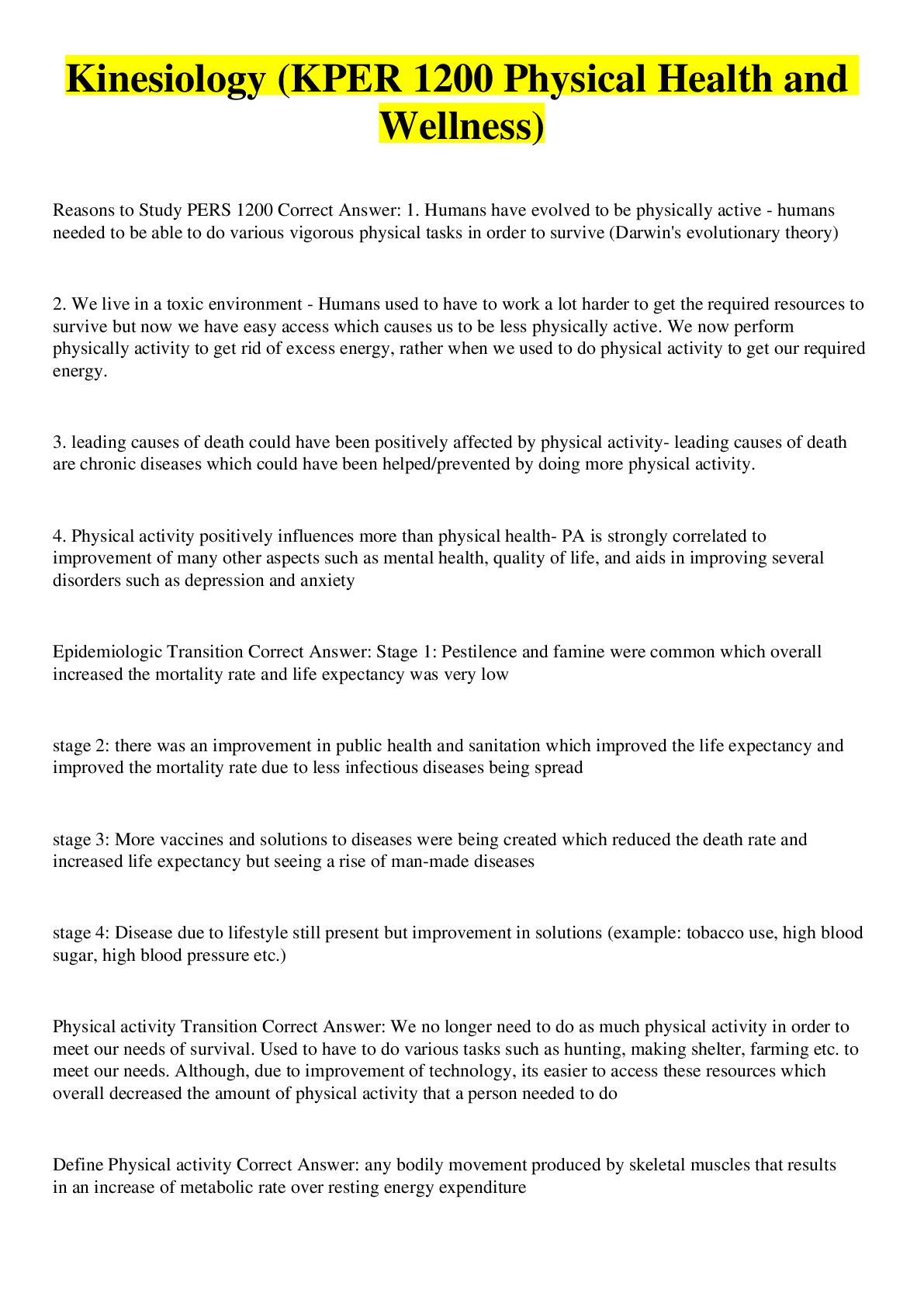
What are the 4 reasons to study physical activity? - ✔✔1) because humans have
evolved to be physically active
2) because our environment no longer fulfills our needs for physical activity
3) because the leading causes of death and disease is due to our Physical activity's
level
4) because more than just our health is impacted by physical activity
What is the epidemiological transition? - ✔✔documents what causes death in each
stage of the Demographic transition
4 stages of epidemiologic transition - ✔✔Stage 1: Pestilence and Famine
Stage 2: Receding Pandemics
Stage 3: Degenerative and man- made Diseases
Stage 4: Delayed Degenerative Diseases
STAGE 1: Pestilence and Famine - ✔✔- large mortality rate and low life expectancy
- infectious disease and famine
STAGE 2: Receding Pandemics - ✔✔- improvements in public health and sanitization
which led to a decrease in infectious disease
STAGE 3: Degenerative and Man-Made Diseases - ✔✔- life expectancy increased, but
diseases of lifestyle (cancer, cardiovascular disease) increased
STAGE 4: Degenerative Disease - ✔✔- diseases of lifestyle still prevalent but treatment
improves
Physical Activity (Definition) - ✔✔Any bodily movement produced by the contraction of
skeletal muscles that results in a increase in metabolic rate over resting energy
expenditure
Physical Fitness (Definition) - ✔✔An individual having necessary characteristics to
perform a given task
Two Types of Physical Fitness - ✔✔Performance related and Health related
Early Conceptualizations of Health - ✔✔idea of holistic health, homeostasis
Early Western Culture (Biomedical Model) - ✔✔focused on the ill and physical , rather
than increasing overall health
1900's inclusion of mental healthWorld Health Organization (WHO) - ✔✔a sate of complete, physical, mental, social well
being and not merely the absence of disease
1st holistic definition of health
Wellness (Definition) - ✔✔holistic concept of describing a state of positive health in the
individual comprising physical, social, and psychological well-being
Do you think there is a difference between heath and well-ness? - ✔✔
Pro's of Self Report Measures - ✔✔- provides lots of info
- cost effective
- easy to use
Con's of Self Report Measures - ✔✔- people over estimate
- memory recall related problems
Self Report Method #1: Psychophysical Rating Scales - ✔✔- measure the subjects
percieved "effort sense"
Self Report Method #2: Records/Logs - ✔✔participants record activities and time spent
dong them and each activity is assigned a value
Self Report Method #2: Records/Logs (PROS) - ✔✔good for providing a semi detailed
record of activities undertaking
Self Report Method #2: Records/Logs (CONS) - ✔✔- cumbersome
- prone to bias
- reactive (may exercise more because they are being tracked fro behavior)
Self Report Method #3: Questionnaires (PROS) - ✔✔- easy to distribute and administer
- allows researchers to collect data from large amount of participants
- method of choice for large studies
Self Report Method #3: Questionnaires (CONS) - ✔✔- requires participants to be
motivated and have time to complete
- prone to recall errors
How do you maximize recall? - ✔✔- provide examples of intensities
- normalize missed physical activity
- emphasize importance of accurate reporting
- electronic surveysWhat is an issue that comes with meausring Physical Activity? - ✔✔Measurement
Reactivity- people may increase their physical activity as they know they are being
watched
Objective measures of Physical Activity (PROS) - ✔✔- provide direct measures of
intensity and duration of physical activity
- provide indirect estimates of energy expenditure
- not subject to over - reporting and memory error
Objective measures of Physical Activity (CONS) - ✔✔- expensive
- can be complex for researcher
- can be cumbersome and annoying for participant
- do not provide info about all aspects of activity
Objective Method #1: Heart Rate Monitor - ✔✔- transmitter is strapped to the chest
- emits signal that displays on wristwatch
- provides info about heart rate
Objective Method #2: Pedometers - ✔✔- small device that connects to waist or shoe
- like a car odometer, it provides info on # steps a individual does
Objective Method #2: Pedometer (CON) - ✔✔- based on stride length so accuracy may
become poor for slower/faster than avg stride length
Objective Method #3: Accelerometer - ✔✔- detects acceleration of the limb
- provides data about amount of activity performed overtime
What are some cons of using an accelerometer? - ✔✔- can over or under estimate
energy expenditure
- can be cumbersome
Objective Method #4: Global Positioning Unit (GPS) - ✔✔- microwave signals from
satellites are picked up by a GPS receiver
- give info about speed, slope of terrain, location
- estimate energy expenditure
What goes into deciding what Physical Activity measurement is the best? - ✔✔-
practical considerations
- stage of research
What is the definition of Epidemiology - ✔✔the study of the distribution and
determinants of disease frequency in human populations
Father of modern epidemiology - ✔✔John SnowWhat is physical activity epidemiology? - ✔✔studies how participation in physical
activity relates to the probability of disease and injury
What are we after in epidemiological research? - ✔✔- degree of change in physical
activity or inactivity that causes some heath outcome
What are the 4 different research designs in epidemiology? - ✔✔1) cross sectional
surveys
2) case control studies
3) prospective cohort studies
4) Randomized clinical trial
What is a cross-sectional study? - ✔✔- m
[Show More]


.png)
.png)
.png)