Anatomy & Physiology Openstax Chapter 4 Review
Questions With Correct Answers 2022
Which of the following is not a type of tissue?
A. muscle
B. nervous
C. embryonic
D. epithelial - Answer- C. embryonic
The proces
...
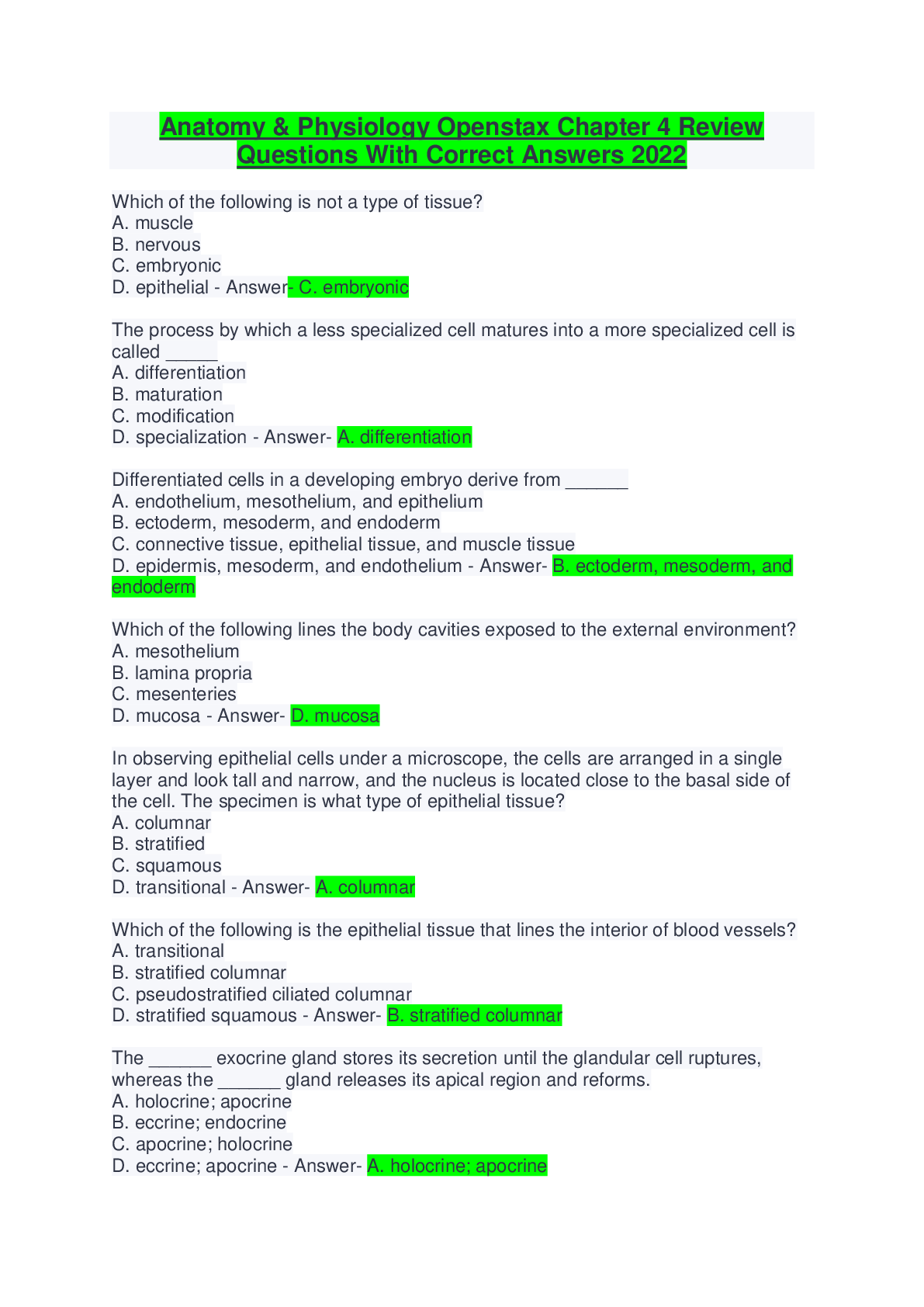
Anatomy & Physiology Openstax Chapter 4 Review
Questions With Correct Answers 2022
Which of the following is not a type of tissue?
A. muscle
B. nervous
C. embryonic
D. epithelial - Answer- C. embryonic
The process by which a less specialized cell matures into a more specialized cell is
called _____
A. differentiation
B. maturation
C. modification
D. specialization - Answer- A. differentiation
Differentiated cells in a developing embryo derive from ______
A. endothelium, mesothelium, and epithelium
B. ectoderm, mesoderm, and endoderm
C. connective tissue, epithelial tissue, and muscle tissue
D. epidermis, mesoderm, and endothelium - Answer- B. ectoderm, mesoderm, and
endoderm
Which of the following lines the body cavities exposed to the external environment?
A. mesothelium
B. lamina propria
C. mesenteries
D. mucosa - Answer- D. mucosa
In observing epithelial cells under a microscope, the cells are arranged in a single
layer and look tall and narrow, and the nucleus is located close to the basal side of
the cell. The specimen is what type of epithelial tissue?
A. columnar
B. stratified
C. squamous
D. transitional - Answer- A. columnar
Which of the following is the epithelial tissue that lines the interior of blood vessels?
A. transitional
B. stratified columnar
C. pseudostratified ciliated columnar
D. stratified squamous - Answer- B. stratified columnar
The ______ exocrine gland stores its secretion until the glandular cell ruptures,
whereas the ______ gland releases its apical region and reforms.
A. holocrine; apocrine
B. eccrine; endocrine
C. apocrine; holocrine
D. eccrine; apocrine - Answer- A. holocrine; apocrine
Connective tissue is made of which three essential components?
A. cells, ground substance, and carbohydrate fibers
B. cells, ground substance, and protein fibers
C. collagen, ground substance, and protein fibers
D. matrix, ground substance, and fluid - Answer- B. cells, ground substance, and
protein fibers
Under the microscope, a tissue specimen shows cells located in spaces scattered in
a transparent background. This is probably ______.
A. loose connective tissue
B. a tendon
C. bone
D. hyaline cartilage - Answer- D. hyaline cartilage
Which connective tissue specialized in storage of fat?
A. tendon
B. adipose tissue
C. reticular tissue
D. dense connective tissue - Answer- B. adipose tissue
Ligaments connect bones together and withstand a lot of stress. What type of
connective tissue should you expect ligaments to contain?
A. areolar tissue
B. adipose tissue
C. dense regular connective tissue
D. dense irregular connective tissue - Answer- D. dense regular connective tissue
In adults, new connective tissue cells originate from the _______
A. mesoderm
B. mesenchyme
C. ectoderm
D. endoderm - Answer- B. mesenchyme
In bone, the main cells are_______
a. fibroblasts
b. chondrocytes
c. lymphocytes
d. osteocytes - Answer- d. osteocytes
Striations, cylindrical cells, and multiple nuclei are observed in _______
a. skeletal muscle only
b. cardiac muscle only
c. smooth muscle only
d. skeletal and cardiac muscles - Answer- a. skeletal muscle only
The cells of muscles, myocytes, develop from ________.
a. myoblasts
b. endoderm
c. fibrocytes
d. chondrocytes - Answer- a. myoblasts
Skeletal muscle is composed of very hard working cells. Which organelles do you
expect to find in abundance in skeletal muscle cell?
a. nuclei
b. striations
c. golgi bodies
d. mitochondria - Answer- d. mitochondria
The cells responsible for the transmission of the nerve impulse are _________
a. neurons
b. oligodendrocytes
c. astrocytes
d. microglia - Answer- a. neurons
The nerve impulse travels done a(n) ________, away from the cell body
a. dendrite
b. axon
c. microglia
d. collagen fiber - Answer- b. axon
Which of the following central nervous system cells regulate ions, regulate the
uptake and/or breakdown of some neurotransmitters, and contribute to the formation
of the blood-brain barrier?
a. microglia
b. neuroglia
c. oligodendrocytes
d. astrocytes - Answer- d. astrocytes
Which of the following processes is not a cardinal sign of inflammation?
a. redness
b. heat
c. fever
d. swelling - Answer- c. fever
When a mast cell reacts to an irritation, which of the following chemicals does it
release?
a. collagen
b. histamine
c. hyalurnic acid
d. meylin - Answer- b. histamine
Atrophy refers to _______
a. loss of elasticity
b. loss of mass
c. loss of rigidity
d. loss of permeability - Answer- b. loss of mass
Individuals can slow the rate of aging by modifying all of these lifestyle aspects
except for _______
a. diet
b. exercise
c. genetic factors
d. stress - Answer- c. genetic factors
What are 5 ways to distinguish epithelial tissue? - Answer- 1. Have one free surface
(apical)
2. Bound by specialized junctions
3. Attached to basement membrane
4. Avascular
5. Can easily divide and regenerate
How do you name epithelial tissue? - Answer- By the number of layers and cell
shape
ex: simple or stratified
squamous, cuboidal, columnar
What are the the 8 types of epithelial tissue? - Answer- simple squamous
simple cuboidal
simple columnar
pseudostratified columnar
stratified squamous
stratified cuboidal
stratified columnar
transitional
What type of tissue forms connective tissue? - Answer- mesenchyme
What are the 11 different types of connective tissue? - Answer- proper: loose,
areolar
proper: loose, adipose
proper: loose, reticular
proper: dense regular
proper: dense, elastic
proper: dense, irregular
hyaline cartilage
elastic cartilage
fibrocartilage
bones
blood
Which types of connective tissue are poorly vascularized? - Answer- cartilage,
tendon, and ligaments
What are the three characteristics of connective tissue? - Answer- 1. vascularized
2. composed of many types of cells
3. matrix between cells
What are the two components of the matrix? - Answer- ground substance and fibers
What are the fibers in the matrix? - Answer- collagen, yellow elastic, reticular
Where do tissue cells in cartilage and bone reside? - Answer- lacunae
What are the most common cells in connective tissue? - Answer- fibroblasts
What are the two cell populations in nervous tissue? - Answer- neuroglia - protect,
support, insulate neurons
neurons - receive stimuli and generate electrical signals
cell body
dendrites
axon
What are the three types of muscle tissue? - Answer- skeletal, cardiac, and smooth
How do you describe skeletal muscle? - Answer- voluntary control, long, cylindrical,
nonbranching, and multinucleate, obvious striations
How do you describe cardiac muscle? - Answer- striations, branching uninucleate
cells that have junctions called intercalated discs, involuntary conrtol
How do you describe smooth muscle? - Answer- found in hollow organs, two layers,
contraction can constrict or dilate the lumen (cavity) and propel substances.
no striations, uninucleate, spindle shape, involuntary control
What are the 4 types of body membranes? - Answer- cutaneous, mucous, serous,
synovial
How do you define tissue? - Answer- Groups of cells that are similar in structure and
function
What are the three germ layers? - Answer- ectoderm, mesoderm, endoderm
Describe the endoderm tissue - Answer- lung cell, thyroid cell, pancreatic cell
Describe the mesoderm tissue - Answer- cardiac muscle, skeletal muscle, smooth
muscle, tubule cell of kidney, RBC
Describe the ectoderm tissue - Answer- skin cells, neurons, pigment cells
What are the two broad categories of tissue membranes? - Answer- connective
tissue
epithelial membranes
Name the epithelial membranes - Answer- cutaneous
mucous
serous
Name the connective tissue membranes - Answer- synovial
What are the locations of mucous membranes? - Answer- digestive, respiratory,
urinary, and reproductive tracts
What are the layers of mucous membranes? - Answer- surface epithelium, loose
connective tissue (lamina propria)
What are the layers of serous membranes? - Answer- mesothelium (simple
squamous), areolar connective tissue
What are the three serous membranes? - Answer- pleural (lungs)
peritoneum (abdomen)
pericardium (heart)
*double membrane*
What are the layers of cutaneous membrane? - Answer- keratinzed stratified
squamous epithelium, areolar and dense irregular connective
What are the layers of synovial membranes? - Answer- (no epithelium) areolar
connective tissue with collagen, proteoglycans, and glycoproteins in matrix
synovial fluid around joints reduces hyaline cartilage friction
What are the 5 types of cell junctions? - Answer- tight, adherens, desmosomes,
hemidesmosomes, and gap
What are the non-anchoring junctions? - Answer- tight (stomach, intestine, bladder)
gap
What are the anchoring junctions? - Answer- desmosomes (attaches to
cytoskeleton)
hemidesmosomes (don't link adjacent cells)
adherens junctions (actin filament)
What are the 4 functions of epithelial tissue?
[Show More]

.png)