2022 PMP Study Project Management Professional
Full Questions And Answers
What is Project Management? Correct Answers: The management of a temporary endeavor
undertaken to create a unique product or service.
Portfol
...
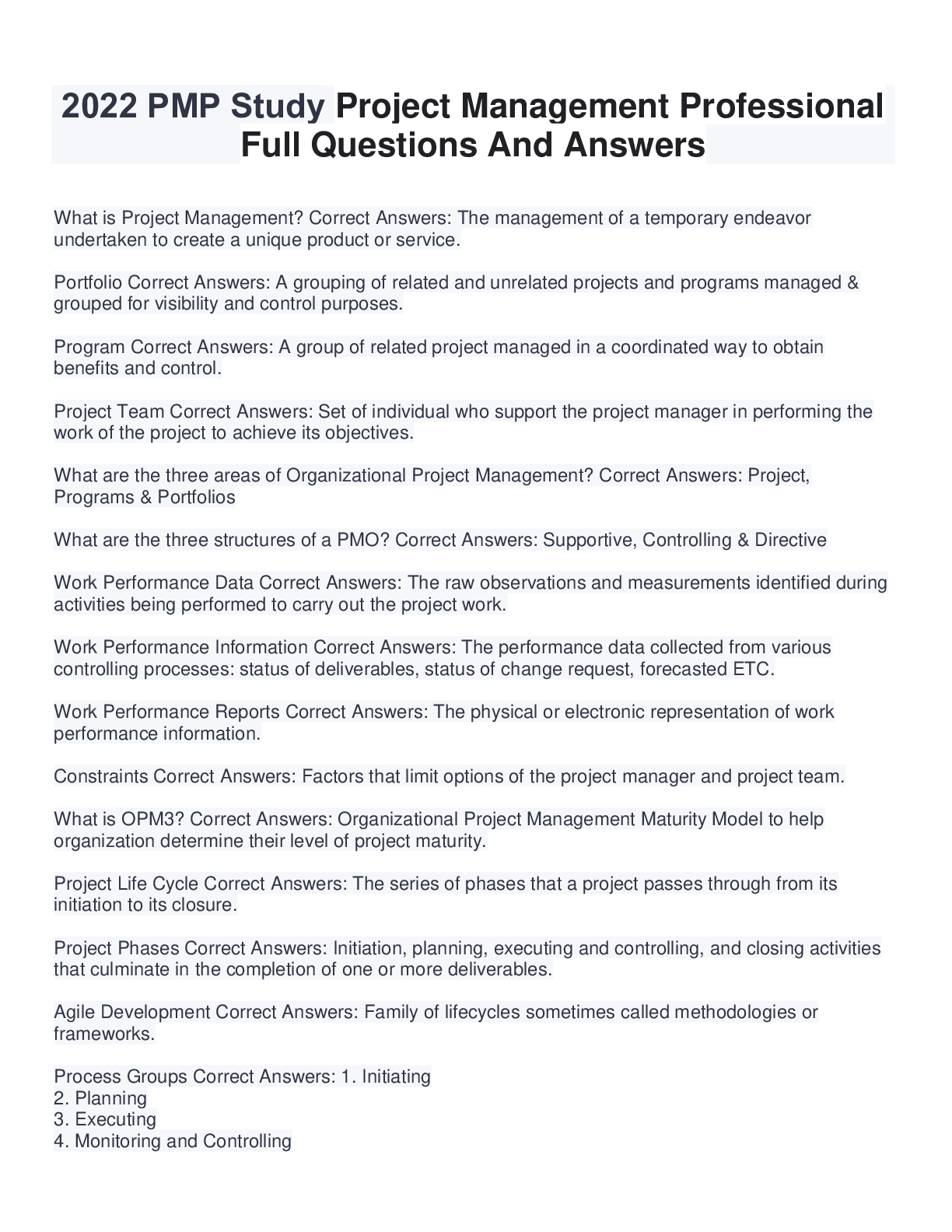
2022 PMP Study Project Management Professional
Full Questions And Answers
What is Project Management? Correct Answers: The management of a temporary endeavor
undertaken to create a unique product or service.
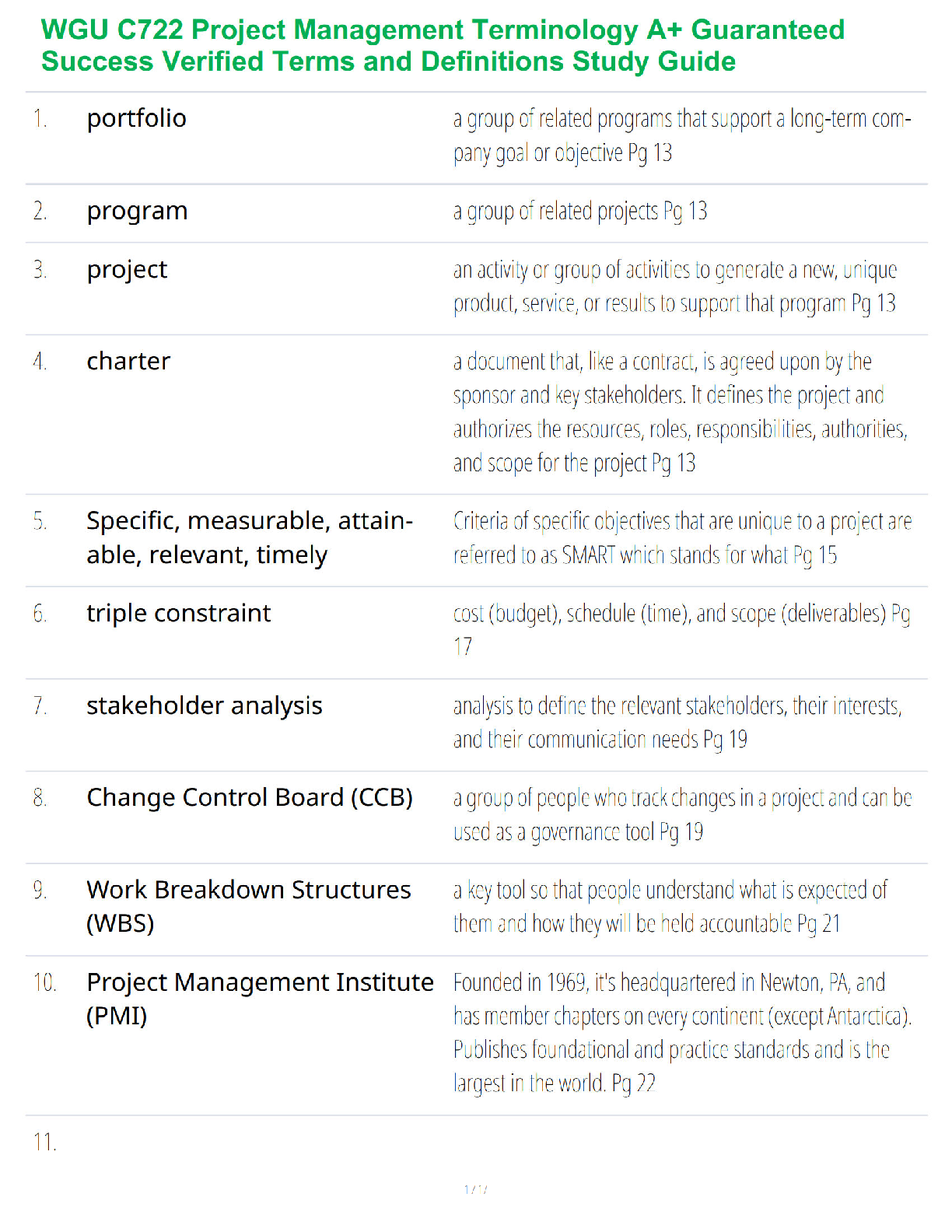
Portfolio Correct Answers: A grouping of related and unrelated projects and programs managed &
grouped for visibility and control purposes.
Program Correct Answers: A group of related project managed in a coordinated way to obtain
benefits and control.
Project Team Correct Answers: Set of individual who support the project manager in performing the
work of the project to achieve its objectives.
What are the three areas of Organizational Project Management? Correct Answers: Project,
Programs & Portfolios
What are the three structures of a PMO? Correct Answers: Supportive, Controlling & Directive
Work Performance Data Correct Answers: The raw observations and measurements identified during
activities being performed to carry out the project work.
Work Performance Information Correct Answers: The performance data collected from various
controlling processes: status of deliverables, status of change request, forecasted ETC.
Work Performance Reports Correct Answers: The physical or electronic representation of work
performance information.
Constraints Correct Answers: Factors that limit options of the project manager and project team.
What is OPM3? Correct Answers: Organizational Project Management Maturity Model to help
organization determine their level of project maturity.
Project Life Cycle Correct Answers: The series of phases that a project passes through from its
initiation to its closure.
Project Phases Correct Answers: Initiation, planning, executing and controlling, and closing activities
that culminate in the completion of one or more deliverables.
Agile Development Correct Answers: Family of lifecycles sometimes called methodologies or
frameworks.
Process Groups Correct Answers: 1. Initiating
2. Planning
3. Executing
4. Monitoring and Controlling
5. Closing
Project Artifacts Correct Answers: Documents, templates, agendas, diagrams, and other work
products used in managing the project.
Project Governance Correct Answers: The framework, functions, and processes that guide project
management activities in order to create a unique product, service, or result to meet organizational,
strategic, and operational goals.
Phase Gate Correct Answers: A review at the end of a phase in which a decision is made to continue
to the next phase, to continue with modification, or to end a project or program.
Sequential relationships Correct Answers: Contain consecutive phases that start only when the
previous phase is complete. This relationship reduces the level of uncertainty, which may eliminate
the option for shortening a project's schedule.
Overlapping Relationships Correct Answers: Contain phases that start prior to the previous phase
ending. This relationship increases the level of risk and may cause rework if something from the
previous phase directly affects the next phase.
Team Charter Correct Answers: A document that records the team values, agreements, and
operating guidelines, as well as establishing clear expectations regarding acceptable behavior by
project team members.
What 6 key item of a Team Charter? MDTTCC Correct Answers: Team values, Communication
guidelines, Decision making criteria and process, Conflict resolution process, Meeting guidelines and
team agreements.
SLA Correct Answers: Service level agreement. An agreement between a company and a vendor
that stipulates performance expectations, such as minimum uptime and maximum downtime levels.
Service Level Agreement Measures BSSTD Correct Answers: Business results, Service availability,
Security, Technical quality and Defect rates.
How are SLA's measured with Agile Projects? PCC Correct Answers: Product backlog progress,
completed/accepted stories and comparison of stories delivered.
Resource Calendar Correct Answers: A calendar that identifies the working days and shifts on which
each specific resource is available.
Lesson Learned Register Correct Answers: A project document used to record knowledge gained
during a project so that it can be used in the current project and entered into the lessons learned
repository.
Black Out Times Correct Answers: Occur when the deliverables are handed over for implementation.
They suspend any potential changes and reduce negative risk as the solution is released to the
customer.
Go-Live Correct Answers: the official time and date that the facility begins using the new system
How are teams built? PASSPAF Correct Answers: Pre-Assignment
Attitudinal Surveys
Structured Interviews
Specific Assessments
PMOs & Organizational Structures
Ability Tests
Focus Groups
Typical 3 PMO Structures DCS Correct Answers: Directive
Controlling
Supportive
What is an Agile PMO? Correct Answers: Centers of excellence
Key aspects of an Agile PMO? SMEDRT Correct Answers: Stakeholder management
Multi-project management
Executing specialized tasks for projects
Development and implementation of standards
Recruiting, selecting, and evaluating team leaders
Training, Mentoring and organizational learning
What are the 6 Project Characteristics? (WPPRBA) Correct Answers: Work Group Arrangement
PM Authority
PM Role
Resource Availability
Budget Owner
Administrative
What are the 10 Project Organizational Structure Types? SFMWBSPVHP Correct Answers: Simple
Functional
Multi-divisional
Weak
Balanced
Strong
Projectized
Virtual
Hybrid
PMO
Create a Project Characteristics Matrix 6x10 Correct Answers:
What is a stakeholder RACI Matrix? Correct Answers: Responsible
Accountable
Consult
Informed
Key 3 attributes of a stakeholder Salience Model (PLU) Correct Answers: Power
Legitimacy
Urgency
What are the 18 Project Management Plans? Correct Answers: Scope
Requirements
Schedule
Cost
Quality
Resource
Communications
Risk
Procurement
Stakeholder
Change
Configuration
Scope baseline
Schedule baseline
Cost baseline
Performance
Project Life Cycle description
Development approach
Information Radiator Correct Answers: Number of highly visible methods to display project
information.
Information Radiator Examples ABC Correct Answers: Average cycle time charts
Burndown charts
Cumulative flow diagram
5 Project Prioritization Methods Correct Answers: MoSCoW Prioritization
Monopoly Money
100 Point Method
Paired Comparison
Kano Analysis
Kano Analysis & the 3 Needs BEP Correct Answers: Customer satisfaction & product development
tool.
Basic Needs
Excitement Needs
Performance Needs
4 Modes of Conflict Resolution WSCFP Correct Answers: Withdraw
Smoothing
Compromising
Forcing
Problem Solving
5 Facilitation tactics for Engagement DPSKM Correct Answers: Define success
Prepare relentlessly
Start with impact
Keep learners engaged
Manage disfunction
4 Brainstorming techniques Correct Answers: Free for all
Quite writing
Round Robin
Green/Red Zone
6 Process steps of Value Stream Mapping ICRCDP Correct Answers: Identify what's being analyzed
Create map of current process
Review map for delays, waste & constraints
Create new value stream map of desired outcome
Develop a roadmap for creating optimized state
Plant to revisit the process for continued improve.
Basic Problem Solving GGD Correct Answers: Gather data
Generate insights
Decide what to do
5 Problem Solving Techniques BFFPI Correct Answers: Brainstorming
Five whys
Fishbone
Prioritize with dots
Identify themes
4 types of decision making ACCS Correct Answers: Autocratic
Consultative Autocratic
Consensus Manager
Shareholder Manager
6 types of Group decision making STPHDF Correct Answers: Simple Voting
Thumbs up/down/sideway
Polling
Highsmiths Decision Spectrum
Dot Voting
Fist of Five Voting
Autocratic decision making Correct Answers: Dictatorship, one person makes the decision for the
group
Multicriteria decision analysis Correct Answers: Basic framework for making decision when the team
is looking at aspects in conflict with each other.
Mind/Idea Mapping Correct Answers: Idea maps use the way the brain processes information
associatively. Single page diagrams that visually capture ideas in a non-linear format.
5 characteristics of a mind map MMKTB Correct Answers: Main idea
Main theme
Key image for each branch
Twigs of lesser importance
Branches form a connected nodal structure
Focus on/off Correct Answers: Inquiry vs. Advocacy
Dialogue vs. Debate
Conversation vs. Argument
Understanding vs. Defending
ESVP Correct Answers: Explorers
Shoppers
Vacationers
Prisoners
Modality Correct Answers: Method of training
Synchronous or asynchronous
4 key training questions WWWW Correct Answers: What knowledge requirements
What skills needed
What level of buy in
What modalities of training
4 key training practices BAEC Correct Answers: Baselining
Availability
Engagement
Certification
Project objectives Correct Answers: Clarity on report out & verify objectives are met
Deliverables are identified WBS
Business Value Correct Answers: The net quantifiable benefit derived from a business endeavor. The
benefit may be tangible, intangible, or both.
Business case Correct Answers: Defines the ultimate goal by what we want to do and why we want to
do it.
4 key items of assembling a Business case Correct Answers: Identify problem/opportunity
Determine future state
Determine viable options & recommendations
Facilitate product roadmap development
Business Case Forms Correct Answers: ROI
Strategic
Investment
Furthering Values
Research
Efficiency
Compliance
Business case components Correct Answers: Business need
Justification
Who is requesting
Key Situational Dynamics
Benefits Measure Methods
Customer
When
Cost
Risk
2 types of Business Case Projects Correct Answers: Adaptive Projects
Predictive Projects
Project Scope Correct Answers: The work performed to deliver a product, service, or result with the
specified features and functions.
Product Scope Correct Answers: The features and functions that characterize a product, service, or
result.
Project Scope Statement Correct Answers: The description of the project scope, major deliverables,
assumptions, and constraints.
Product Analysis Correct Answers: A tool used to define scope that involves asking questions about a
product and forming answers that describe the product's use, characteristics, and other relevant
aspects.
Scope Baseline Correct Answers: The approved version of a scope statement, work breakdown
structure (WBS), and its associated WBS dictionary, that can be changed only through formal change
control procedures and is used as a basis for comparison.
Common Scope Baseline Components Correct Answers: Project scope statement
WBS/FBS
Work Package
Planning package
WBS dictionary
Feature Correct Answers: an important part of something, a characteristic
User Stories Correct Answers: Identify what someone wants to accomplish with the product and why.
EPIC Correct Answers: Large user story for stakeholders, users, customers and team.
Steps in Scope Management Correct Answers: Determine product, service or result reqs.
Balance stakeholder need and requirements
Develop WBS
Verify scope
Measure/adjust project scope performance against Scope Change Management Plan
How Scope is Measured Correct Answers: Project scope is measured against the project
management plan & requirements.
How to Assess Project Value Correct Answers: Payback Period
ROI
Benefit / Cost ratio BCR or BCI
Future or Present Value
Net Present Value NPV
Internal rate of return IRR
Calculation for Future and Present Value Correct Answers: PV=FV /(1+i)n
Net Present Value Correct Answers: Present value - Present Cost =NPV
Internal Rate of Return Correct Answers: Average rate of return earned over the life of the project
where NPV=0
Multi-criteria decision analysis (MCDA) Correct Answers: Tool used to acquire project team and/or for
collecting requirements.
Benefits Management Plan Correct Answers: Document that describes how and when benefits of
project will be delivered and measured.
Root Cause Correct Answers: The action or situation that initiates a problem.
Causal Factor Correct Answers: Removing a causal factor can benefit the outcome but it doesn't
prevent recurrence.
Opportunity Analysis Correct Answers: An appraisal of costs, benefits, and risks associated with a
potential decision.
Net Promoter Score Correct Answers: Index used to measure the willingness of customers to
recommend a company's products or services to others
Scope definition tools Correct Answers: Observation
Facilitated Workshops
Focus Groups
Benchmarking
Examples of Defining Requirements Correct Answers: Review Scope management plan
Review Requirement management plan
Review Stakeholder engagement plan
Review Project charter
Review stakeholder register
Interviews, focus groups, facilitated workshops
Document requirement and requirements traceability matrix
Requirements Management Plan Correct Answers: A component of the project or program
management plan that describes how requirements will be analyzed, documented, and managed.
Requirements Traceability Matrix RTM Correct Answers: A table that lists requirements, their various
attributes, and the status of the requirements to ensure that all are addressed
Scenario Analysis Correct Answers: Define the problem
Gather data (PESTLE analysis)
Separate certainties from uncertainties
Develop scenarios
Use the scenarios in planning
PESTLE Correct Answers: Political, Economic, Social, Technological, Legal, Environmental
Affinity Diagram Correct Answers: Technique that allows large numbers of ideas to be classified into
groups for review and analysis.
Context Diagram Correct Answers: Highest-level view of a system, showing the data processing
system, its input(s) and output(s), and their sources and destinations.
[Show More]