RMI 300 Final Exam 2022 with all the correct answers
What are the different parts of an insurance contract? -Answer- 1. Declarations page
2. Insuring agreement
3. Exclusions
4. Conditions
5. Attachments
What ar
...
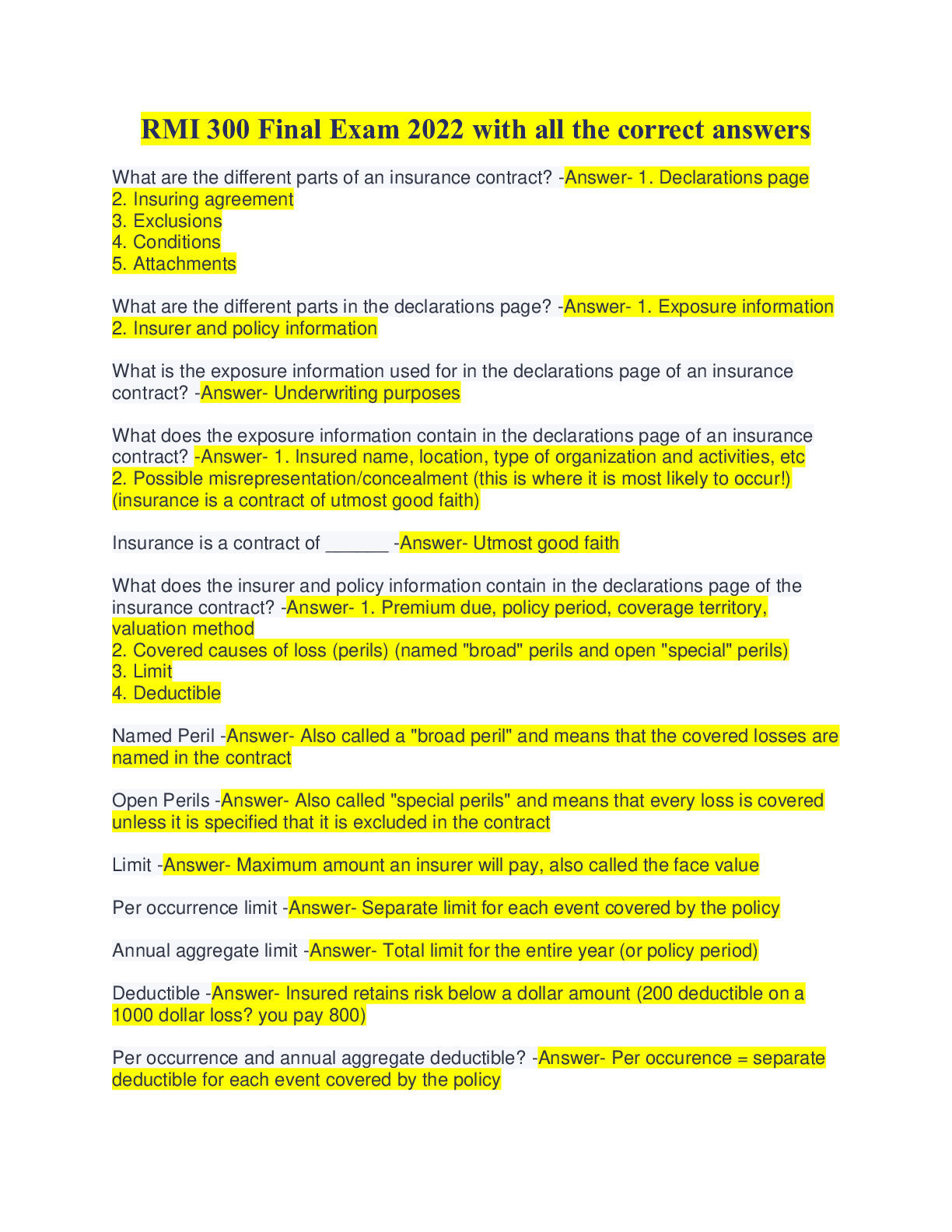
RMI 300 Final Exam 2022 with all the correct answers
What are the different parts of an insurance contract? -Answer- 1. Declarations page
2. Insuring agreement
3. Exclusions
4. Conditions
5. Attachments
What are the different parts in the declarations page? -Answer- 1. Exposure information
2. Insurer and policy information
What is the exposure information used for in the declarations page of an insurance contract? -Answer- Underwriting purposes
What does the exposure information contain in the declarations page of an insurance contract? -Answer- 1. Insured name, location, type of organization and activities, etc
2. Possible misrepresentation/concealment (this is where it is most likely to occur!) (insurance is a contract of utmost good faith)
Insurance is a contract of ______ -Answer- Utmost good faith
What does the insurer and policy information contain in the declarations page of the insurance contract? -Answer- 1. Premium due, policy period, coverage territory, valuation method
2. Covered causes of loss (perils) (named "broad" perils and open "special" perils)
3. Limit
4. Deductible
Named Peril -Answer- Also called a "broad peril" and means that the covered losses are named in the contract
Open Perils -Answer- Also called "special perils" and means that every loss is covered unless it is specified that it is excluded in the contract
Limit -Answer- Maximum amount an insurer will pay, also called the face value
Per occurrence limit -Answer- Separate limit for each event covered by the policy
Annual aggregate limit -Answer- Total limit for the entire year (or policy period)
Deductible -Answer- Insured retains risk below a dollar amount (200 deductible on a 1000 dollar loss? you pay 800)
Per occurrence and annual aggregate deductible? -Answer- Per occurence = separate deductible for each event covered by the policy
Annual aggregate = total deductible amount for the entire year
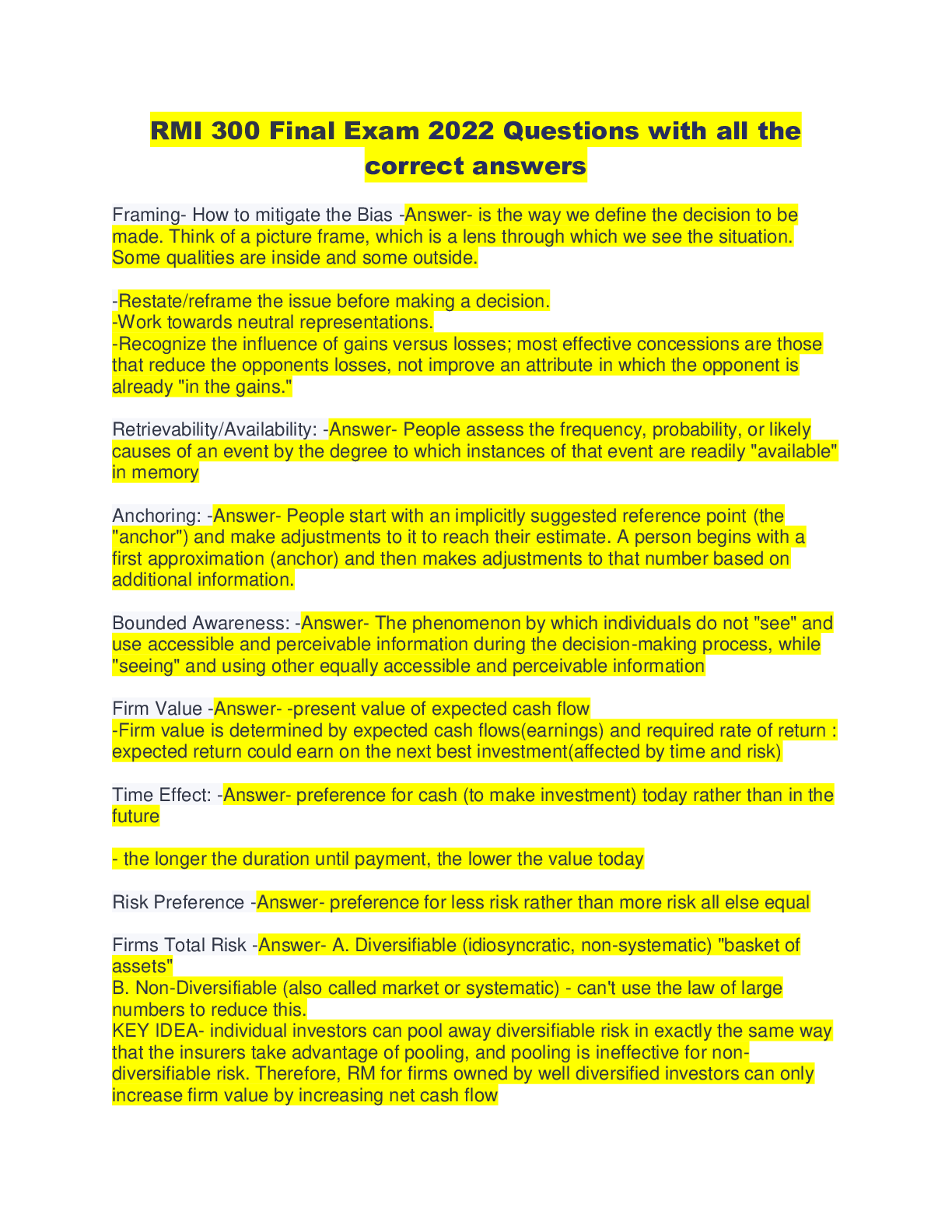
How is a deductible stated other than an actual number value? -Answer- Period of time or a percentage of loss (called a copay or coinsurance)
Limit of 100,000; loss of 80,000 and 5,000 deductible?
Limit of 100,000; loss of 110,000 and 5,000 deductible?
Limit of 100,000; loss of 80,000, deductible of 5,000 and copay of 20%?
What does insurance company pay? How much do you retain? -Answer- 75,000; 5000
100,000; 10,000
80,000-5000-(80,000-5000)*.2 = 60,000; 20,000
Stop loss agreement -Answer- Limits the total "out of pocket" expense
Why do we have deductibles? -Answer- 1. Limit moral hazard
2. Lowers our premiums (expected loss lower if we retain, which lowers premium)
Latent -Answer- Don't know until the future
Incontestability -Answer- In a life insurance contract, and it is that after 2 years of you experiencing a loss and the insurance company finds out you misrepresented something, they cannot come back and recover the money UNLESS you misrepresented your age
Manuscript policy -Answer- Policyholder has input into the insurance agreement, then it is not a contract of adhesion, which makes the court to not favor the contract towards the insured when interpreting the contract (just look at most reasonable interpretation)
Components of insuring agreement in the insurance contract? -Answer- 1. Insurer's consideration (giving up possible benefit of not having to pay you)
2. Types of losses
Types of losses under the insuring agreement in the insurance contract? -Answer- 1. Direct vs indirect (consequential)
2. Liability often covers legal defense costs (but not fines)
Why would an insurance company want to represent you in a lawsuit if you are covered for that lawsuit? -Answer- Moral hazard! You will be a lot more likely to settle because you know that you will not have to pay
Declaration -Answer- Statement about a truth
Insuring agreement -Answer- Promise of the insurance company
Exclusions -Answer- Loss situations not covered in the policy (categorized by purpose)
Components of exclusions under the insurance contract? -Answer- 1. Avoid insurer catastrophe
2. Standardize the risk
3. Limit duplicate coverage
4. Maintain fortuity
What is important about a catastrophe? -Answer- It has positive correlation (like a flood), so if one loss occurs, this means that more losses will occur and could put financial strain on the insurance company to pay
What does it mean to standardize the risk? -Answer- Assist in categorizing insureds to limit adverse selection (put into similar pools so then people won't leave because the premium is way too big)
Why does an insurance company want to limit duplicate coverage? -Answer- limit moral hazard; if you over indemnify someone, they will more likely cause a loss just because they know they will be better off after the loss than before
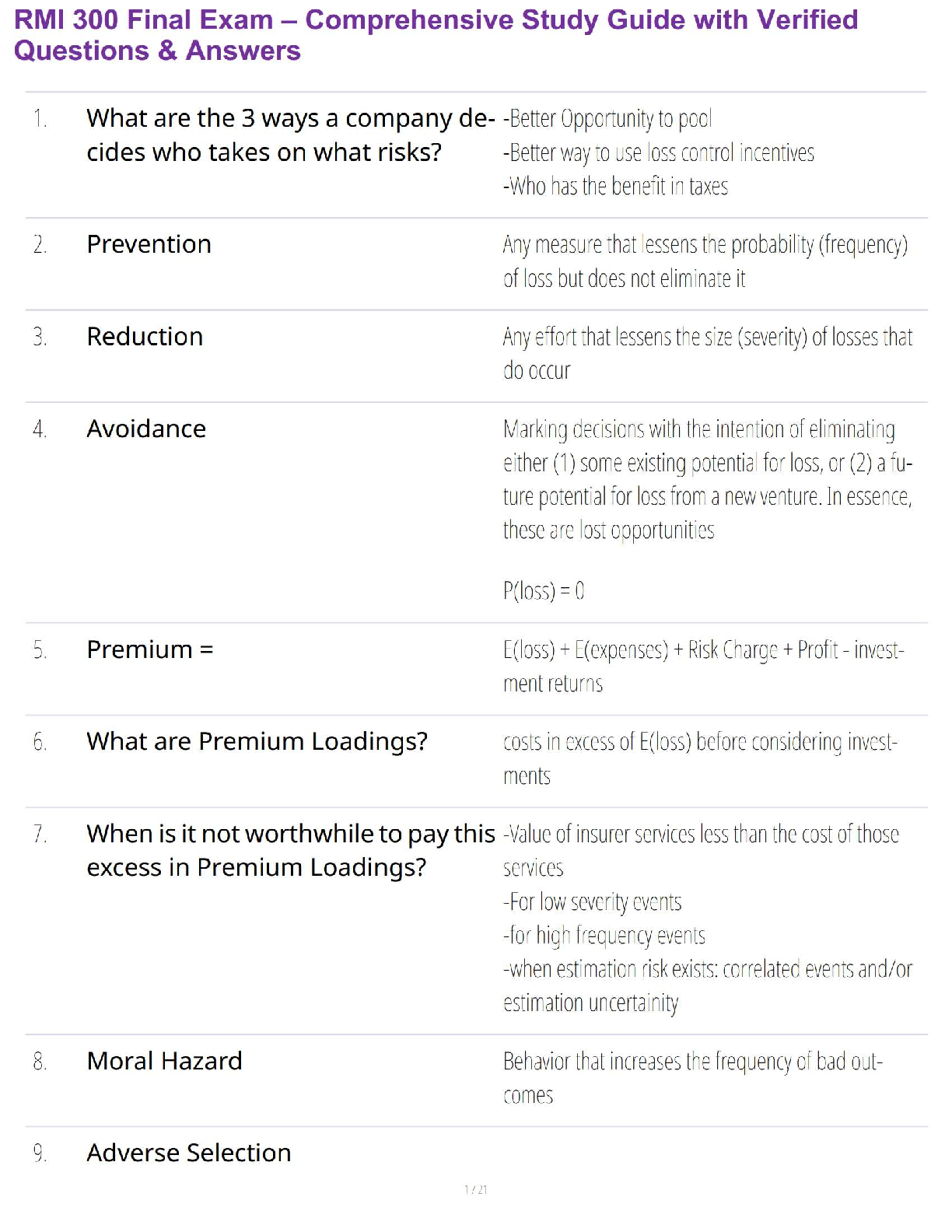
Components of the condition portion of the insurance contract? -Answer- 1.valuation (think the indemnity principle) AND 2.Other insurance provisions
3. Subrogation
How do you calculate the actual cash value of a property loss in order to correctly indemnify? -Answer- Replacement cost new - true depreciation on lost property (so this is going to be the amount they actually paid....less depreciation)
Insurable Interest -Answer- One who gets paid actually experienced the loss
Other insurance provisions in an insurance contracts under the conditions part? -Answer- Used when more than one policy is applicable
-Pro rata basis (proportionally) (calculated by dividing each limit by the sum of both of the limits)
-Primary/excess (first one pays all they can, and then the second pays the rest)
How to figure out the value of the loss to be paid by the insurer? (In the conditions portion of the insurance contract) -Answer- Depends on the coverage:First, need insurable interest, then think the value
1. Life: face value
2. Health: variety of ways
3. Disability: % of income
4. Liability: Pay on behalf of the insured for amounts the insured is legally responsible to pay plus also provide defense
5. Property: actual cash value (or replacement cost new...but is that indemnity? not really)
[Show More]


.png)
.png)