RMI 300 Final Exam 2022 Questions with all the correct answers
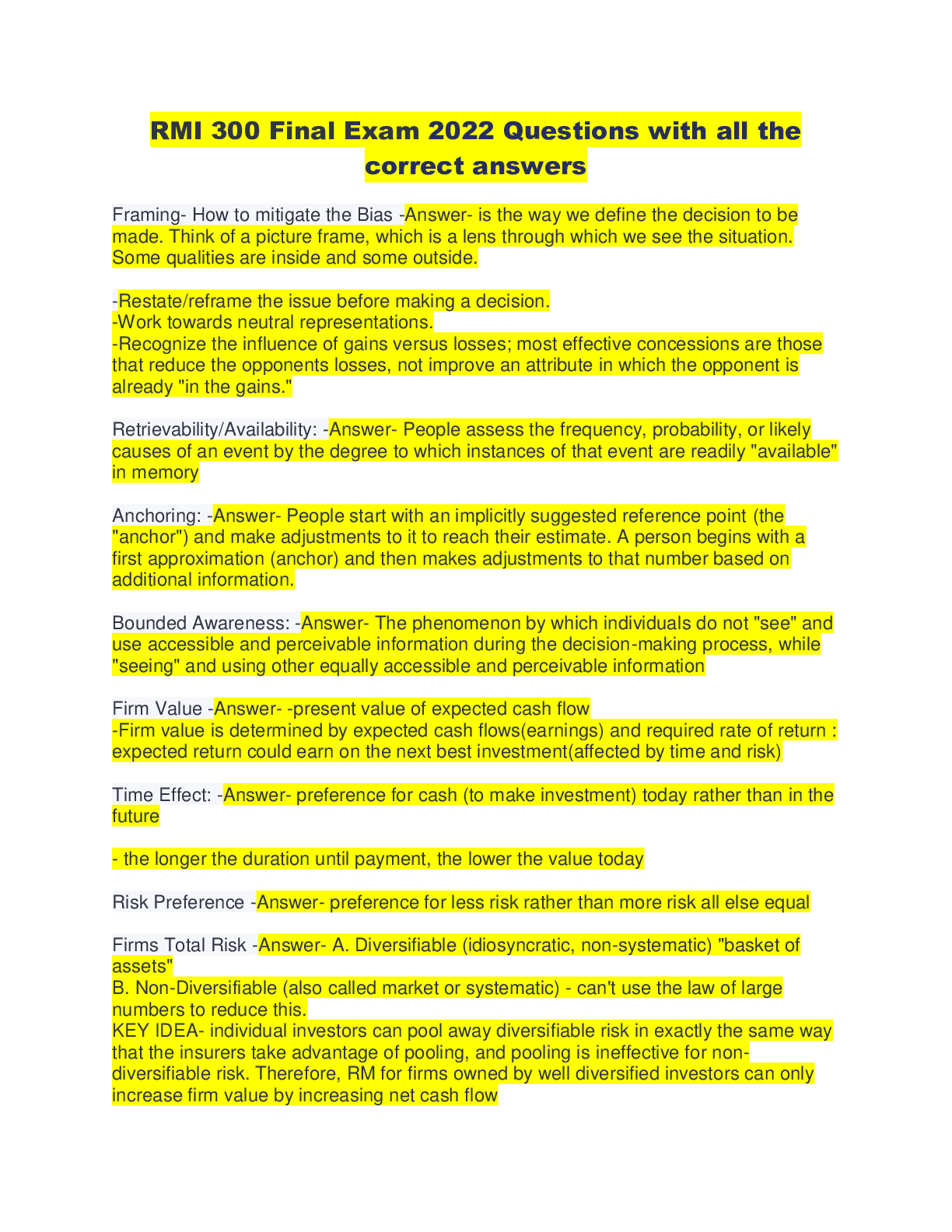
Framing- How to mitigate the Bias -Answer- is the way we define the decision to be made. Think of a picture frame, which is a lens through which we see th
...
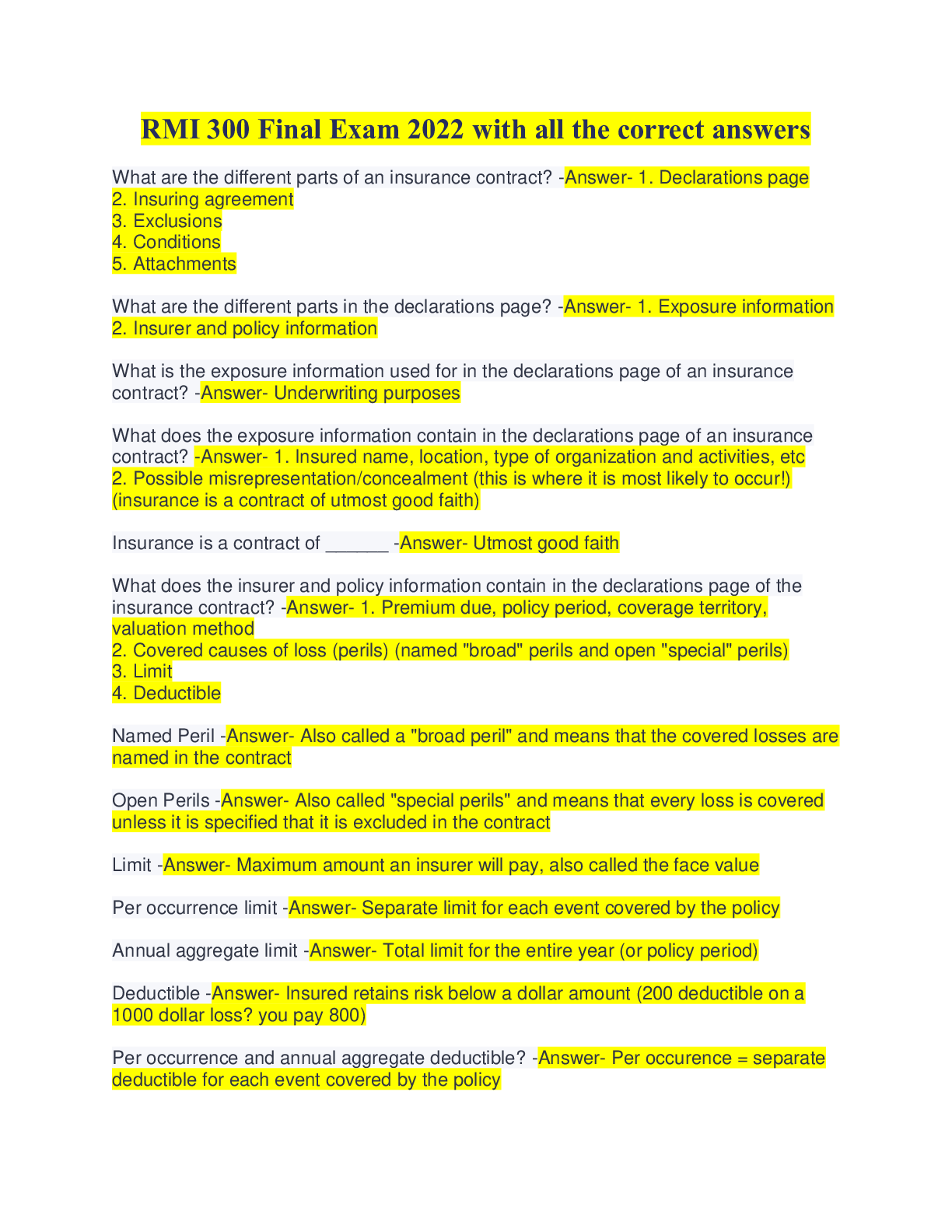
RMI 300 Final Exam 2022 Questions with all the correct answers
Framing- How to mitigate the Bias -Answer- is the way we define the decision to be made. Think of a picture frame, which is a lens through which we see the situation. Some qualities are inside and some outside.
-Restate/reframe the issue before making a decision.
-Work towards neutral representations.
-Recognize the influence of gains versus losses; most effective concessions are those that reduce the opponents losses, not improve an attribute in which the opponent is already "in the gains."
Retrievability/Availability: -Answer- People assess the frequency, probability, or likely causes of an event by the degree to which instances of that event are readily "available" in memory
Anchoring: -Answer- People start with an implicitly suggested reference point (the "anchor") and make adjustments to it to reach their estimate. A person begins with a first approximation (anchor) and then makes adjustments to that number based on additional information.
Bounded Awareness: -Answer- The phenomenon by which individuals do not "see" and use accessible and perceivable information during the decision-making process, while "seeing" and using other equally accessible and perceivable information
Firm Value -Answer- -present value of expected cash flow
-Firm value is determined by expected cash flows(earnings) and required rate of return : expected return could earn on the next best investment(affected by time and risk)
Time Effect: -Answer- preference for cash (to make investment) today rather than in the future
- the longer the duration until payment, the lower the value today
Risk Preference -Answer- preference for less risk rather than more risk all else equal
Firms Total Risk -Answer- A. Diversifiable (idiosyncratic, non-systematic) "basket of assets"
B. Non-Diversifiable (also called market or systematic) - can't use the law of large numbers to reduce this.
KEY IDEA- individual investors can pool away diversifiable risk in exactly the same way that the insurers take advantage of pooling, and pooling is ineffective for non-diversifiable risk. Therefore, RM for firms owned by well diversified investors can only increase firm value by increasing net cash flow
being efficient adds value- why do firms buy insurance -Answer- - not pooling- only other option is increasing expected CF
1.Insurer sometimes offers services more efficiently
(loss control, claims admin, investment, other)
2. Costs associated with financial distress might be reduced
3. Raising new funds may be less costly
-cost of obtaining new funds through issuing bonds, stocks, or getting a loan
-costs of using existing funds may take away from productive investments
4. tax payments may be delayed(and insurers can deduct reserves where as insured cannot)
Reinsurance -Answer- insurance purchased by primary insurers to transfer (cede) risk associated with their insurance business.
** if you were to keep following this chain"retrocession"
What reinsurance does -Answer- reinsurance can increase net cash flow if less costly than other forms of capital(insurer in Asia and Africa pool their risks)
1. increase the number of observations and reduce the size of each loss to individual insurer
2. lessen the level of positive correlation by sharing in different regions/domains
3. split single large valued exposure into multiple exposures (Lloyd's)
***add value by providing services, including evaluation of underlying insurers
Proportional -Answer- 20/80 indicated retention of 20% and ceding of 80% (copay)
Non-proportional- excess -Answer- $5 million excess $1 million (deductible)
Facultative -Answer- single exposure (Eiffel tower)
Treaty -Answer- book of business (strip malls of certain size)
Lloyds of London (insurance exchange rather than insurer) -Answer- Involved names (investors) with unlimited liability, eventually operating through syndicates which act as mini insurers and managed by managing underwriters
What is unique to Lloyds: -Answer- relationships, reverse law of large #, innovations
General justifications for government regulation -Answer- -Can both make things better and impede- can respond to imperfect market, can limit excess monopoly power
-Public policy rationale
Justifications specific to insurance for regulation -Answer- A. Insurance is integral to business and personal activity- important or mandatory
B. Insurance involves a long-term relationship (promise)
[Show More]