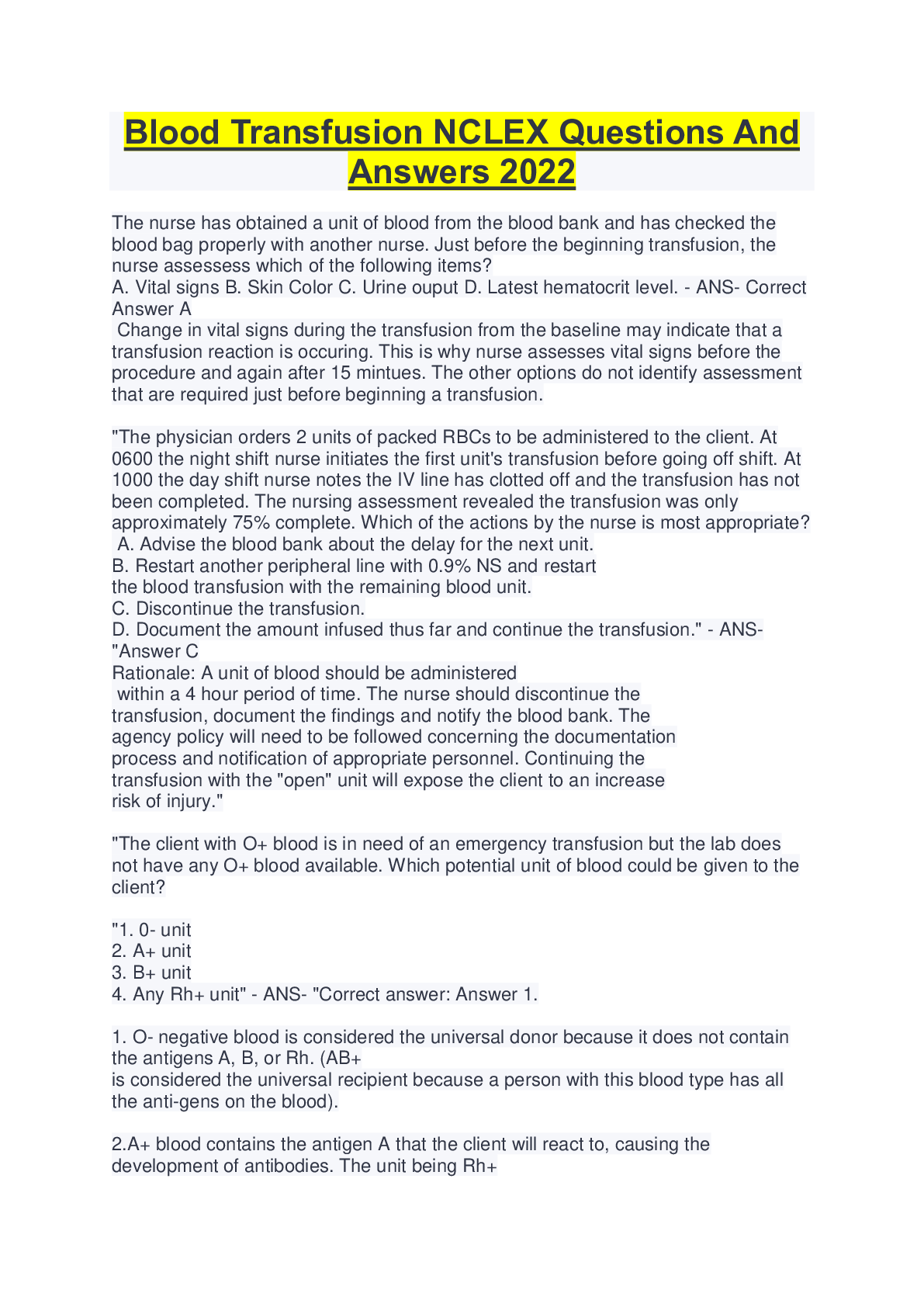
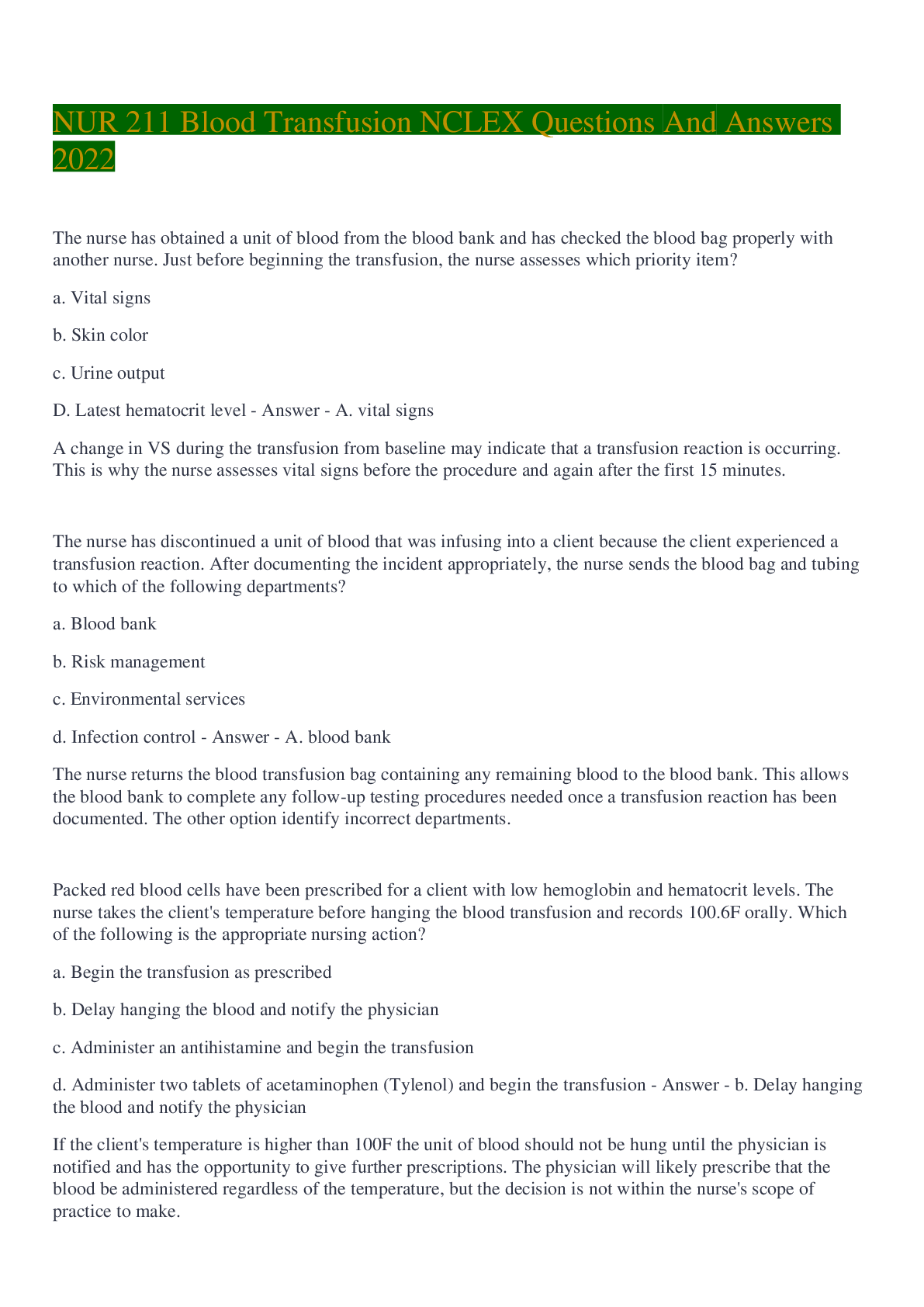
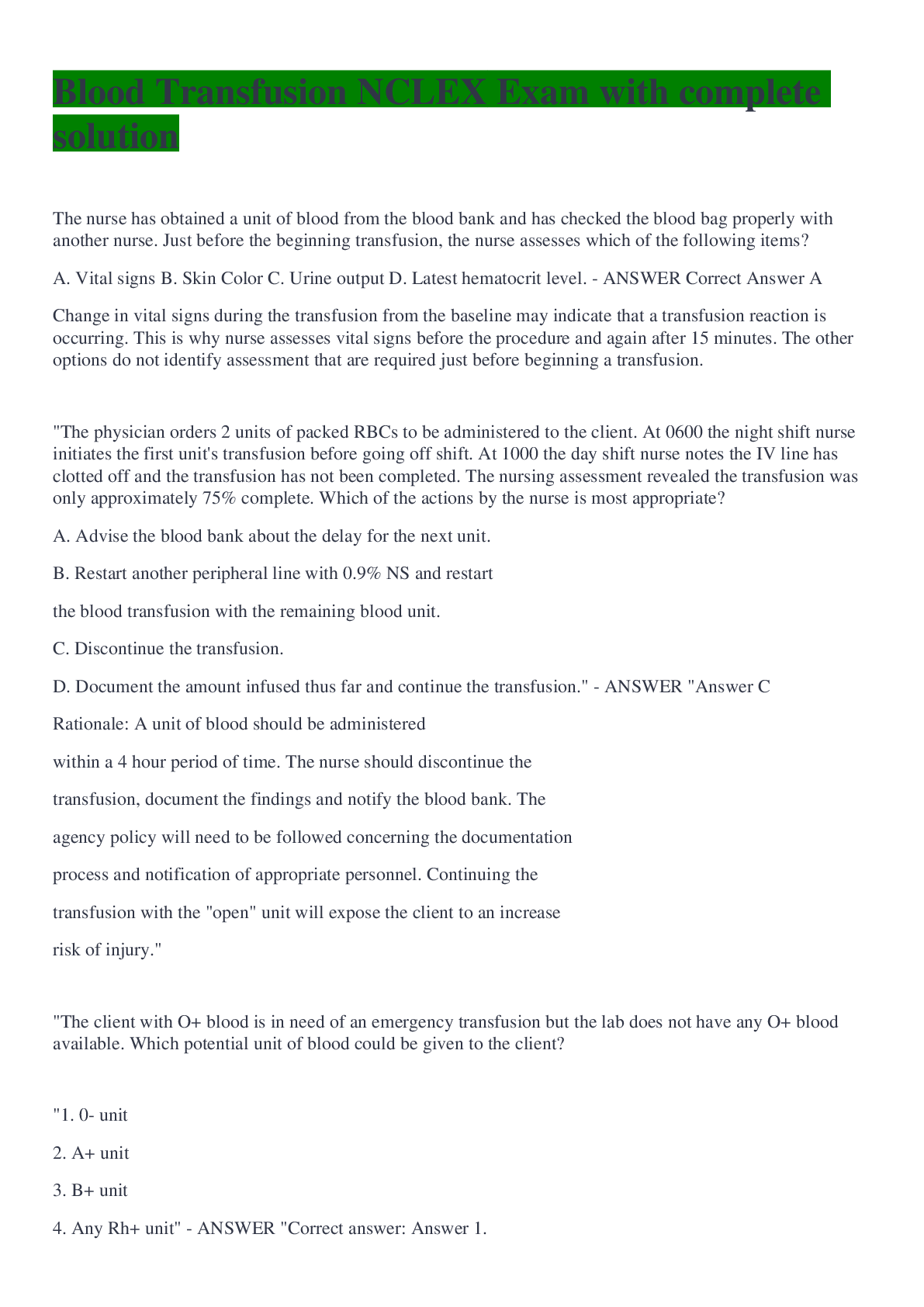
Blood Transfusion NCLEX Questions And
Answers 2022
The nurse has obtained a unit of blood from the blood bank and has checked the
blood bag properly with another nurse. Just before the beginning transfusion, the
n
...
Blood Transfusion NCLEX Questions And
Answers 2022
The nurse has obtained a unit of blood from the blood bank and has checked the
blood bag properly with another nurse. Just before the beginning transfusion, the
nurse assessess which of the following items?
A. Vital signs B. Skin Color C. Urine ouput D. Latest hematocrit level. - ANS- Correct
Answer A
Change in vital signs during the transfusion from the baseline may indicate that a
transfusion reaction is occuring. This is why nurse assesses vital signs before the
procedure and again after 15 mintues. The other options do not identify assessment
that are required just before beginning a transfusion.
"The physician orders 2 units of packed RBCs to be administered to the client. At
0600 the night shift nurse initiates the first unit's transfusion before going off shift. At
1000 the day shift nurse notes the IV line has clotted off and the transfusion has not
been completed. The nursing assessment revealed the transfusion was only
approximately 75% complete. Which of the actions by the nurse is most appropriate?
A. Advise the blood bank about the delay for the next unit.
B. Restart another peripheral line with 0.9% NS and restart
the blood transfusion with the remaining blood unit.
C. Discontinue the transfusion.
D. Document the amount infused thus far and continue the transfusion." - ANS-
"Answer C
Rationale: A unit of blood should be administered
within a 4 hour period of time. The nurse should discontinue the
transfusion, document the findings and notify the blood bank. The
agency policy will need to be followed concerning the documentation
process and notification of appropriate personnel. Continuing the
transfusion with the "open" unit will expose the client to an increase
risk of injury."
"The client with O+ blood is in need of an emergency transfusion but the lab does
not have any O+ blood available. Which potential unit of blood could be given to the
client?
"1. 0- unit
2. A+ unit
3. B+ unit
4. Any Rh+ unit" - ANS- "Correct answer: Answer 1.
1. O- negative blood is considered the universal donor because it does not contain
the antigens A, B, or Rh. (AB+
is considered the universal recipient because a person with this blood type has all
the anti-gens on the blood).
2.A+ blood contains the antigen A that the client will react to, causing the
development of antibodies. The unit being Rh+
is compatible with the client.
3.B+ blood contains the antigen B that the client will react to, causing the
development of anti-bodies. The unit being Rh+
is compatible with the client.
4.This client does not have antigens A or B on the blood. Administration of these
types would cause an antigen/antibody reaction within the client's body, resulting in a
massive hemolysis of the client's blood and death."
About ten minutes after the nurse begins an infusion of packed RBCs, the patient
complains of chills, chest and back pain, and nausea. His face is flushed, and he's
anxious. Which is the priority nursing action?
1. Administering antihistamines STAT for an allergic reaction.
2. Notifying the physician of a possible transfusion reaction.
3. Obtaining a urine and serum specimen to send to the lab immediately.
4. Stopping hte transfusion and maintaining a patent IV catheter." - ANS- The correct
answer is 4. The patietn is experiencing a transfusion reaction. The immediate
nursing action is to stop the transfusion and maintain a patent IV line. The other
options may be indicated but aren't the priority in this case.
"The nurse is administering packed red blood cells (PRBCs) to a client. The nurse
should first:
"1. Discontinue the I.V. catheter if a blood transfusion reaction occurs.
2. Administer the PRBCs through a percutaneously inserted central
catheter line with a 20-gauge needle. 3. Flush PRBCs with 5% dextrose
and 0.45% normal saline solution. 4. Stay with the client during the
first 15 minutes of infusion. - ANS- Correct: 4
The most likely time for a blood transfusion reaction to occur is during the first 15
minutes or first 50 mL of the infusion. If a blood transfusion reaction does occur, it is
imperative to keep an established I.V. line so that medication can be administered to
prevent or treat cardiovascular collapse in case of anaphylaxis. PRBCs should be
administered through a 19-gauge or larger needle; a peripherally inserted central
catheter line is not recommended, in order to avoid a slow flow. RBCs will hemolyze
in dextrose or lactated Ringer's solution and should be infused with only normal
saline solution.
". A unit of packed red blood cells has been prescribed for a client with low
hemoglobin and hematocrit levels. The nurse notifies the blood bank of the order,
and a blood specimen is drawn from the client for typing and cross-matching. The
nurse receives a telephone call from the blood bank and is informed that he unit of
blood is ready for administration. Arrange the actions in order of priority that the
nurse should take to administer the blood. (Letter A is the first and letter F is the last
action.)
a) hang the bag of blood
b) obtain the unit of blood from the bank
c) ensure that an informed consent has been signed
d) verify the physician's order for the blood transfusion
e) insert an 18 or 19-gauge IV catheter into the client
f) ask a licensed nurse to assist in confirming blood compatibility and verifying client
identity." - ANS- "F, D, B, A, C, E
- The nurse would first verify the physician's order for the blood transfusion and
ensure that the client has been informed about the procedure and has signed an
informed consent. Once this has been done, the nurse would ensure that at least an
18- or 19-gauge intravenous needle is inserted into the client. Blood has a thicker
and stickier consistency than intravenous solutions and using an 18- or 19-gauge
catheter ensures that the bore of the catheter is large enough to prevent damage to
the blood cells. Next, the blood is obtained from the blood bank, once the nurse is
sure that the client has been informed and has an adequate access for administering
the blood. Once the blood has been obtained, two registered nurses, or one
registered and a licensed practical nurse (depending on agency policy), must
together check the label on the blood product against the client's identification
number, blood group, and complete name. This minimizes the risk of error in
checking information on the blood bag and thereby minimizes the risk of harm or
injury to the client. The nurse should measure vital signs and assess lung sounds
and then hang the transfusion."`
The nurse enters a client's room to assess the client, who began receiving a blood
transfusion 45 minutes earlier, and notes that the client is flushed and dyspneic. On
assessment, the nurse auscultates the presence of crackles in the lung bases. The
nurse determines that this client most likely is experiencing which complication of
blood transfusion therapy?
1) Bacteriemia. 2) Hypovolemia. 3) Fluid overload 4) Transfusion reaction - ANS�Correct: 3
With fluid overload, the client has the presence of crackles in addition to dyspnea. An
allergic reation, a type of blood transfusion reaction, would produce symptoms such
as flushing, dyspnea, itching, and a generalized rash. Hypovolemia is not
complication of blood transfusions. With bacteriemia, the client would have fever, a
symptom not presented.
"Before starting a transfusion of packed red blood cells for an anemic patient, the
nurse would arrange for a peer to monitor his or her other assigned patients for how
many minutes when the nurse begins the transfusion?
A. 5 minutes
B. 15 minutes
C. 60 minutes
D. 30 minutes" - ANS- Correct B
Patients who are likely to have a transfusion reaction will more often exhibit signs
within the first 15 minutes that the blood is infusing
A 52-year-old woman is admitted with a new diagnosis of gastrointestinal (GI) bleed.
The physician has ordered the client to receive 2 units of packed red blood cells
(PRBCs) for a hemoglobin (Hgb) of 6.8g/dL. The nurse begins the infusion of the first
unit at 100mL/hr. Firfteen minutes after the start of the infusion, the client complains
that she is feeling chilled, is short of breath, and is experiencing lumbar pain rated 8
on a 1-10 scale. Whic of the following should be the nurse's FIRST action.
"1. Obtain vital signs and notify the physician of potential reaction
2. Slow the infusion to 75mL/hr and reassess in 15 minutes
3. Stop the infusion and run normal saline (NS) to keep the vein open (KVO)
4. Administer PRN pain medication as ordered, apply oxygen at 2 L/min, and provide
an additional blanket" - ANS- Correct: 3
"1. ""Obtain vital signs..."" - vital sings should be obtained, and the physician notified
after treatment is discontinue. The unit in quesiton should not be restarted, and any
other units that were issued should not be implemented.
2. ""Slow the infusion..."" - just slowing the infusino will not resolve the issue of an
allergic reaction to the treatment
3. ""Stop the infusion..."" - (CORRECT): The symptoms of feeling chilllded, being
short of breath, and having back pain coudl indicate an acute hemolytic reaction.
This medical emergency requires swift action on the part of the nurse, including
immediately discontinuing the infusion, flushing the IV site, and saving the unit of
blood in question for testing.
4. ""Administer PRN pain medication..."" - Treating the symptoms of the reaction will
not resolve the issue of an allergic reactio to the treatment"
The nurse is working in a blood bank facility procuring units of blood from donors.
Which client would not be a candidate to donate blood?
1.The client who had wisdom teeth removed a week ago.2.The nursing student who
received a measles immunization 2 months ago.3. The mother with a six (6)-week�old newborn.4.The client who developed an allergy to aspirin in childhood - ANS�Correct 3
"1. Oral surgeries are associated with transientbacteremia, and the client cannot
donate for 72hours after an oral surgery.2.The client cannot donate blood following
ubella immunizations for one (1) month.
3. CORRECT
The client cannot donate blood for 6months after a pregnancy because of
thenutritional demands on the mother.
4.Recent allergic reactions prevent donationbecause passive transference of
hypersensitiv-ity can occur. This client has an allergy thatdeveloped during
childhood"
"Which statement is the scientific rationale for infusing a unit of blood in less than
four (4) hours?
"1. The blood will coagulate if left out of the refrigerator for >four (4) hours.
2. The blood has the potential for bacterial growth if allowed to infuse longer.
3. The blood components begin to break down after four (4) hours.
4. The blood will not be affected; this is a laboratory procedure." - ANS- Correct 2
"1. Blood will coagulate if left out for an extended period of, but blood is stored with a
preservative that prevents this and prolongs the life of the blood.
2. (CORRECT). Blood is a medium for bacterial growth, and any bacteria
contaminating the unit will begin to grow if left outside of a controlled refrigerated
temperature for longer than four (4) hours, placing the client at risk for septicemia.
3. Blood components are stable and do not break down after four (4) hours.
4. These are standard nursing and laboratory procedures to prevent the complication
of septicemia."
"The nurse is caring for a patient who is to receive a transfusion of two units of
packed red blood cells. After obtaining the first unit from the blood bank, the nurse
would ask which of the following health team members in the nurses' station to assist
in checking the unit before adiminstration?
A: Unit Secretary
B: A Phlebotomist
C: A Physician's Assistant
D: Another Registered Nurse - ANS- Correct: D
Before hanging a transfusion, the registered nurse must check the unit with
ANOTHER RN or with a licensed practical (vocational) nurse, depending on agency
policy. Checking blood products is not in the unit secretary's or phlebotimist's scope
of practice. The physician assistant is not another RN or licensed practical nurse.
The nurse who is about to give a blood transfusion knows that blood cells start to
deteriorate after a certain period of time. Which of the following itens is important to
check regarding the age of blood cells before the transfusion is begun?
A. Expiration date
B. Presence of clots
C. Blood group and type
D. Blood identification number" - ANS- Correct A - no rationale
"The nurse is preparing to initiate a blood transfusion. The client has a peripheral
intravenous infusion in their left arm that the physician has ordered not be slowed or
rate reduced. The nurse prepares to start another line in the right arm. The client
asks the nurse to use the existing site to avoid the trauma of having another line
started. Which of the following statements by the nurse is correct?
A. ""That will be fine""
B. "I will need to infuse the blood through a separate IV line."
C. "I will let the physician know about your preferences."
D. "We will need to assess the line before I can make a determination about your
request."" - ANS- Answer: B "Rationale: A blood infusion must be administered via a
separate IV line. The other responses indicate to the client their request is
being considered"
"The nurse and unlicensed nursing assistant are caring for clients on an oncology
floor.
Which nursing task would be delegated to the unlicensed nursing assistant?
"1. Assess the urine output on a client who has had a blood transfusion reaction.
2. Take the first 15 minutes of vital signs on a client receiving a unit of PRBCs.
3. Auscultate the lung sounds of a client prior to a transfusion.
4. Assist a client who received ten (10) units of platelets in brushing teeth. - ANS�Correct: 4
"1. Unlicensed nursing assistants cannot assess. The nurse cannot delegate
assessment.
2. The likelihood of a reaction is the greatest
during the first 15 minutes of a transfusion.The nurse should never leave the client
until after this time. The nurse should take and assess the vital signs during this time.
3. Auscultation of the lung sounds and administering blood based on this information
are the
nurse's responsibility. Any action requiring nursing judgment cannot be delegated.
4. The unlicensed nursing assistant can assist a client to brush the teeth. Instructions
about using soft-bristle toothbrushes and the need to report to the nurse any pink or
bleeding should be given prior to delegating the procedure. (CORRECT)
TEST-TAKING HINT: The test taker must be aware of delegation guidelines. The
nurse cannot delegate assessment or any intervention requiring nursing judgment.
Options "1," "2," and "3" require judgment and cannot be
delegated to an unlicensed assistant."
"Which statement is the scientific rationale for infusing a unit of blood in less than
four (4) hours?
(Med Surg Success)" "1. The blood will coagulate if left out of the refrigerator for
longer than four(4)hours.
2. The blood has the potential for bacterial growth if allowed to infuse longer.
3. The blood components begin to break down after four (4) hours.
4. The blood will not be affected; this is a laboratory procedure. " - ANS- Correct: 2
"1,-Blood will coagulate if left out for an extended period, but blood is stored with a
preservative that prevents this and prolongs the life of the blood.
2.-Blood is a medium for bacterial growth, and any bacteria contaminating the unit
will begin to grow if left outside of a con- trolled refrigerated temperature for longer
than four (4) hours, placing the client at risk for septicemia.
.
3)Blood components are stable and do not break down at four
4.)These are standard nursing and laboratory procedures to prevent the complication
of septicemia."
"Cris asks the nurse whether all donor blood products are cross-matched with the
recipient to prevent a transfusion reaction. Which of the following always require
cross-matching?
a. packed red blood cells
b. platelets
c. plasma
d. granulocytes" - ANS- Correct: A
Red blood cells contain antigens and antibodies that must be matched between
donor and recipient. The blood products in options 2-4 do not contain red cells. Thus,
they require no cross-match.
"Complications of transfusions that can be decreased by the use of leukocyte
depletion or reduction of RBC transfusion are
a. chills and hemolysis.
b. leukostasis and neutrophilia.
c. fluid overload and pulmonary edema.
d. transmission of cytomegalovirus and fever. - ANS- Correct: D
Rationale: Infectious viruses, such as human immunodeficiency virus (HIV), human
herpesvirus, hepatitis B and C type 6 (HSV-6), Epstein-Barr virus (EBV), human T�cell leukemia virus type 1 (HTLV-1), and cytomegalovirus (CMV), and other agents,
such as the agent that causes malaria, can be transmitted by blood transfusion.
Leukocyte-reduced blood products drastically reduce the risk of blood transfusion�associated viral infections, including CMV.
During a blood transfusion a client develops chills and a headache, what is the
priority nursing action
A) cover the client B) stop the transfusion at once C) notify the physician immediately
D) decrease the rate of blood infusion - ANS- B) stop the transfusion because chills,
headache, and nausea are all signs of transfusion reaction
"A month after receiving a blood transfusion an immunocompromised male patient
develops fever, liver abnormalities, a rash, and diarrhea. The nurse would suspect
this patient has:
a. Nothing related to the blood transfusion
b. Graft-versus-host disease (GVHD)
c. Myelosuppression
d. An allergic response to a recent medication" - ANS- Correct: B
GVHD occurs when white blood cells in donor blood attack the tissues of an
immunocompromised recipient. This process can occur within a month of the
transfusion. Options 1 and 4 may be a thought, but the nurse must remember that
immunocompromised transfusion recipients are at risk for GVHD
"Which organ is at greatest risk due to the effects of hemolytic anemia?
"A. Heart
B. Spleen
C. Kidney
D. Liver - ANS- Correct: C
For all causes of hemolysis, a major focus of treatment is to maintain renal function.
When RBCs are hemolyzed, the hemoglobin molecule is released and filtered by the
kidneys. The accumulation of hemoglobin molecules can obstruct the renal tubules
and lead to acute tubular necrosis
"73. A client brought to the emergency department states that he has
accidentally been taking two times his prescribed dose of warfarin
(Coumadin) for the past week. After noting that the client has no
evidence of obvious bleeding, the nurse plans to do which of the
following?
1. Prepare to administer an antidote.
2. Draw a sample for type and crossmatch and transfuse the client.
3. Draw a sample for an activated partial thromboplastin time (aPTT) level.
4. Draw a sample for prothrombin time (PT) and international normalized ratio (INR)."
- ANS- Correct - 4 - no rationale
A new RN is preparing to administer packed red blood cells (PRBCs) to a client
whose anemia was caused by blood loss after surgery. Which action by the new RN
requires that you, as charge nurse, intervene immediately?
"a. The new RN waits 20 minutes after obtaining the PRBCs before starting the
infusion.
b. The new RN starts an intravenous line for the transfusion using a 22-gauge
catheter.
c. The new RN primes the transfusion set using 5% dextrose in lactated Ringer's
solution.
d. The new RN tells the client that the PRBCs may cause a serious transfusion
reaction." - ANS- Correct: C
ANSWER C - Normal saline, an isotonic solution, should be used when priming the
IV line to avoid causing hemolysis of RBCs. Ideally, blood products should be
infused as soon as possible after they are obtained; however, a 20-minute delay
would not be unsafe. Large-gauge IV catheters are preferable for blood
administration; if a smaller catheter must be used, normal saline may be used to
dilute the RBCs. Although it is appropriate to instruct clients to notify the nurse if
symptoms of a transfusion reaction such as shortness of breath or chest pain occur,
it will cause unnecessary anxiety to indicate that a serious reaction is likely to occur.
Focus: Prioritization
The nurse is caring for a 70-year-old client with hypovolemia who is receiving a
blood transfusion. Assessment findings reveal crackles on chest auscultation and
distended neck veins. What is the nurse's initial action?
A. Slow the transfusion.
B. Document the finding as the only action.
C. Stop the blood transfusion and turn on the normal saline.
D. Assess the client's pupils." - ANS- Answer A is correct. The client is exhibiting
symptoms of fluid volume excess; slowing the rate is the proper action. The nurse
would not stop the infusion of blood, as in answer C, and answers B and D would not
help.
CONTINUES...
[Show More]




.png)


 (1).png)


