Chapter 17 Fatty Acid Catabolism Questions with
Complete Solutions
1. Lipoprotein lipase acts in:
A) hydrolysis of triacylglycerols of plasma lipoproteins to supply fatty acids to various
tissues.
B) intestinal upta
...
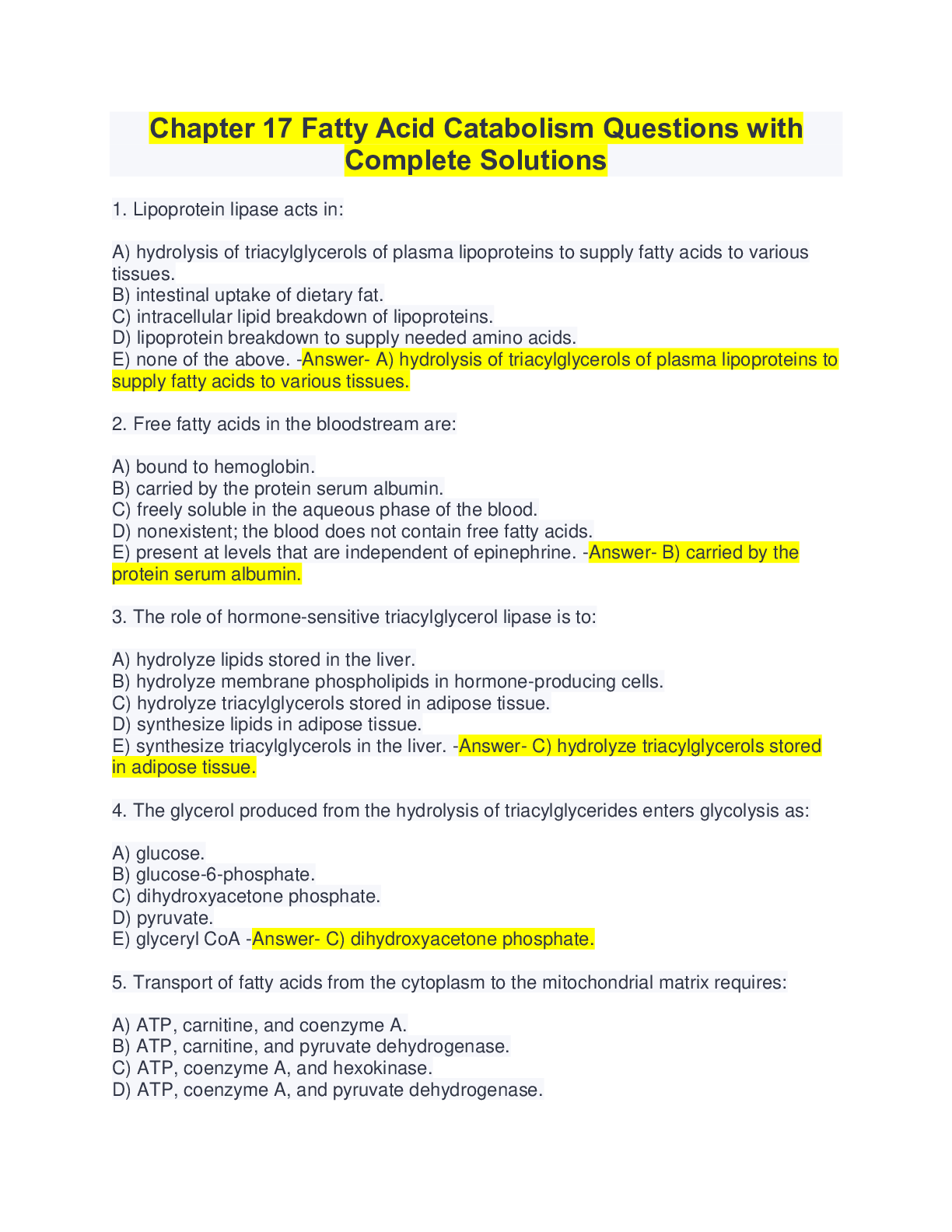
Chapter 17 Fatty Acid Catabolism Questions with
Complete Solutions
1. Lipoprotein lipase acts in:
A) hydrolysis of triacylglycerols of plasma lipoproteins to supply fatty acids to various
tissues.
B) intestinal uptake of dietary fat.
C) intracellular lipid breakdown of lipoproteins.
D) lipoprotein breakdown to supply needed amino acids.
E) none of the above. -Answer- A) hydrolysis of triacylglycerols of plasma lipoproteins to
supply fatty acids to various tissues.
2. Free fatty acids in the bloodstream are:
A) bound to hemoglobin.
B) carried by the protein serum albumin.
C) freely soluble in the aqueous phase of the blood.
D) nonexistent; the blood does not contain free fatty acids.
E) present at levels that are independent of epinephrine. -Answer- B) carried by the
protein serum albumin.
3. The role of hormone-sensitive triacylglycerol lipase is to:
A) hydrolyze lipids stored in the liver.
B) hydrolyze membrane phospholipids in hormone-producing cells.
C) hydrolyze triacylglycerols stored in adipose tissue.
D) synthesize lipids in adipose tissue.
E) synthesize triacylglycerols in the liver. -Answer- C) hydrolyze triacylglycerols stored
in adipose tissue.
4. The glycerol produced from the hydrolysis of triacylglycerides enters glycolysis as:
A) glucose.
B) glucose-6-phosphate.
C) dihydroxyacetone phosphate.
D) pyruvate.
E) glyceryl CoA -Answer- C) dihydroxyacetone phosphate.
5. Transport of fatty acids from the cytoplasm to the mitochondrial matrix requires:
A) ATP, carnitine, and coenzyme A.
B) ATP, carnitine, and pyruvate dehydrogenase.
C) ATP, coenzyme A, and hexokinase.
D) ATP, coenzyme A, and pyruvate dehydrogenase.E) carnitine, coenzyme A, and hexokinase. -Answer- A) ATP, carnitine, and coenzyme
A.
6. Fatty acids are activated to acyl-CoAs and the acyl group is further transferred to
carnitine because:
A) acyl-carnitines readily cross the mitochondrial inner membrane, but acyl-CoAs do
not.
B) acyl-CoAs easily cross the mitochondrial membrane, but the fatty acids themselves
will not.
C) carnitine is required to oxidize NAD+ to NADH.
D) fatty acids cannot be oxidized by FAD unless they are in the acyl-carnitine form.
E) None of the above is true. -Answer- A) acyl-carnitines readily cross the mitochondrial
inner membrane, but acyl-CoAs do not.
7. Carnitine is:
A) a 15-carbon fatty acid.
B) an essential cofactor for the citric acid cycle.
C) essential for intracellular transport of fatty acids.
D) one of the amino acids commonly found in protein.
E) present only in carnivorous animals. -Answer- C) essential for intracellular transport
of fatty acids.
8. Which of these is able to cross the inner mitochondrial membrane?
A) Acetyl-CoA
B) Fatty acyl-carnitine
C) Fatty acyl-CoA
D) Malonyl-CoA
E) None of the above can cross. -Answer- B) Fatty acyl-carnitine
9. What is the correct order of function of the following enzymes of β-oxidation?
1. β-Hydroxyacyl-CoA dehydrogenase
2. Thiolase
3. Enoyl-CoA hydratase
4. Acyl-CoA dehydrogenase
A) 1, 2, 3, 4
B) 3, 1, 4, 2
C) 4, 3, 1, 2
D) 1, 4, 3, 2
E) 4, 2, 3, 1 -Answer- C) 4, 3, 1, 2
10. If the 16-carbon saturated fatty acid palmitate is oxidized completely to carbon
dioxide and water (via the β-oxidation pathway and the citric acid cycle), and all of theenergy-conserving products are used to drive ATP synthesis in the mitochondrion, the
net yield of ATP per molecule of palmitate is:
A) 3.
B) 10.
C) 25.
D) 108.
E) 1000. -Answer- D) 108.
[Show More]