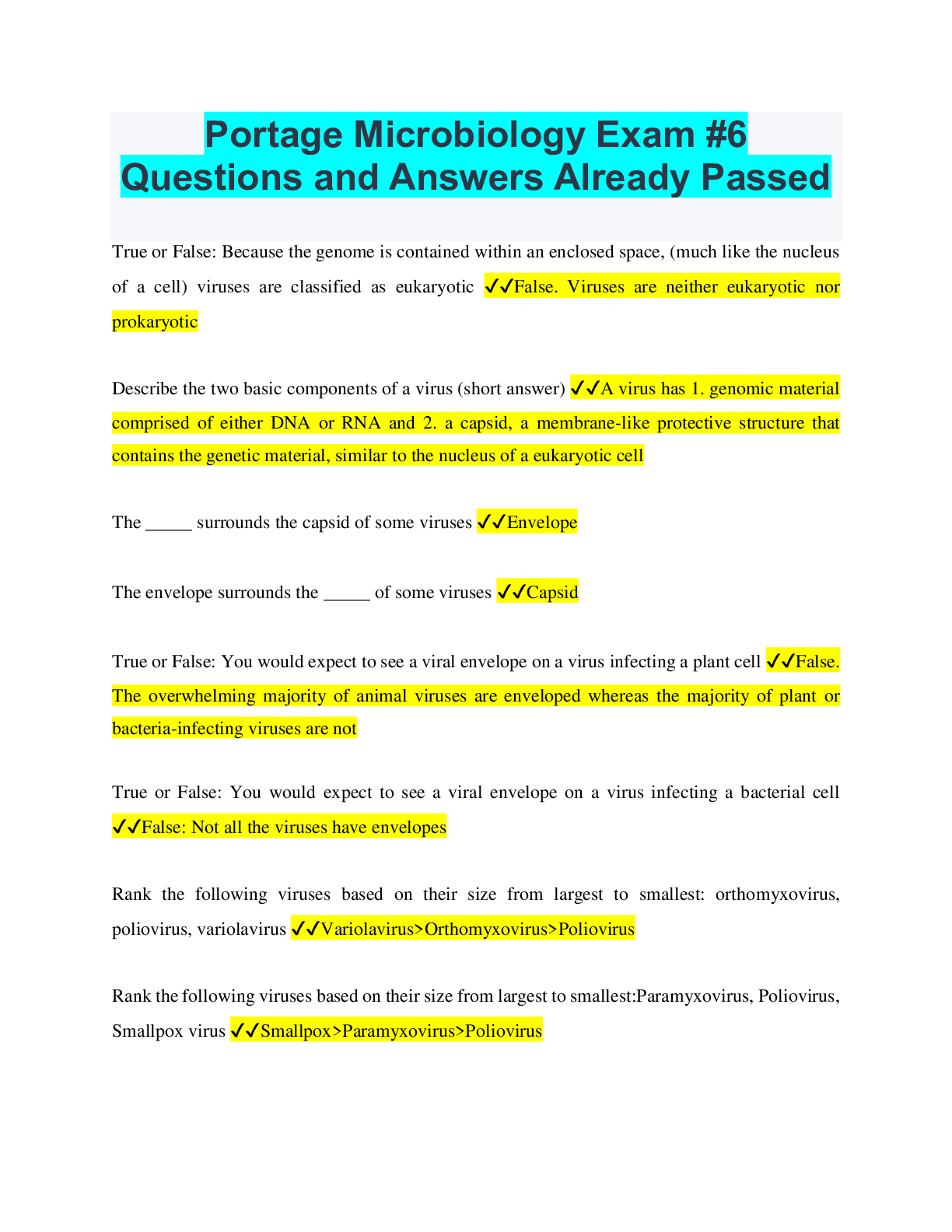
Portage Microbiology Exam #6
Questions and Answers Already Passed
True or False: Because the genome is contained within an enclosed space, (much like the nucleus
of a cell) viruses are classified as eukaryotic ✔✔False
...
Portage Microbiology Exam #6
Questions and Answers Already Passed
True or False: Because the genome is contained within an enclosed space, (much like the nucleus
of a cell) viruses are classified as eukaryotic ✔✔False. Viruses are neither eukaryotic nor
prokaryotic
Describe the two basic components of a virus (short answer) ✔✔A virus has 1. genomic material
comprised of either DNA or RNA and 2. a capsid, a membrane-like protective structure that
contains the genetic material, similar to the nucleus of a eukaryotic cell
The _____ surrounds the capsid of some viruses ✔✔Envelope
The envelope surrounds the _____ of some viruses ✔✔Capsid
True or False: You would expect to see a viral envelope on a virus infecting a plant cell ✔✔False.
The overwhelming majority of animal viruses are enveloped whereas the majority of plant or
bacteria-infecting viruses are not
True or False: You would expect to see a viral envelope on a virus infecting a bacterial cell
✔✔False: Not all the viruses have envelopes
Rank the following viruses based on their size from largest to smallest: orthomyxovirus,
poliovirus, variolavirus ✔✔Variolavirus>Orthomyxovirus>Poliovirus
Rank the following viruses based on their size from largest to smallest:Paramyxovirus, Poliovirus,
Smallpox virus ✔✔Smallpox>Paramyxovirus>Poliovirus
True or False: Viral replication occurs after it attaches and enters the host cell ✔✔True. The viral
genome is never replicated before attachment and entry
True or False: Highly infectious viruses undergo genome replication prior to viral attachment and
entry. ✔✔False. The viral genome is never replicated before attachment and entry regardless of
its level of infectivity.
Place the following viral life cycle steps in order beginning with viral attachment and provide a
description of each step (short answer) ✔✔Uncoating: the viral capsid disassembles
Release: New virus particles are produced and leave the cell
Replication: the viral genome is the 'blueprint' to make copies of itself
Attachment: viral receptors bind to host proteins on the surface of the cell
Entry: the virus fuses with the host membrane and enters the cell
New Infection: newly produced viruses that left the host cell now go on to infect new cells
A virus that infects bacteria is called a _____ and contains a _____ -side polygon capsid (fill in
the blank) ✔✔Bacteriophage; 20-sided
True or False: Structurally bacteriophages are similar to viruses that infect animals ✔✔False.
Bacteriophages have a distinct composition and structure
True or False. Structurally, bacteriophages are distinct from viruses that infect plant or animal
cells. ✔✔True. Bacteriophages are structurally distinct from viruses that infect plant and animals
cells.
Identify the following components of a bacteriophage (picture) ✔✔1. Capsid
2. Collar
3. Tail
4. Base
5. Tail fibers
Describe the main differences between lytic and temperate phages (short answer) ✔✔Lytic
bacteriophages replicate within the host bacteria until it ruptures, whereas temperate phages
primarily exist in a non-replicative state that does not kill the host cell
Lytic phages replicate all viral proteins needed for the assembly of new virus particles whereas
lysogenic phage genomes are integrated into the host genome but production of viral proteins is
suppressed
Based on the following image, would you expect the viral titer to be high or low? Why? (cloudy)
✔✔Low. As turbidity is a function of the number of intact bacterial cells present in the media, the
amount of virus contained within the above tube must be low. As the lytic continues more and
more bacterial cells will be destroyed, effectively clearing the media.
Which of the following cannot be spread via airborne particles
A. Measles
B. Mumps
C. Rubella
D. A and B
E. None of the above ✔✔E. Measles, mumps and rubella can all be spread via airborne particles
formed while coughing, sneezing, etc.
True or False: A patient infected with Rubella is considered infectious one week before and after
the appearance of the trademark rash ✔✔True
True or False. A patient infected with Rubella is only considered infectious when the trademark
rash is visible. ✔✔False. A patient infected with Rubella is infectious one week before and one
week after the appearance of the rash.
Which of the following diseases does a linear, double-stranded DNA virus cause?
A. Measles
B Mumps
C. Rubella
D. B and C
E. None of the above ✔✔E. Measles, mumps, and rubella are linear, single-stranded RNA virus
What linear, double-stranded, enveloped DNA virus is the first virus (as of Oct. 26, 1977) to be
officially declared eradicated? (short answer) ✔✔Smallpox
By whom and where was the first Polio vaccine developed? ✔✔Jonas Salk and his research team
developed the polio vaccine at the University of Pittsburgh in 1955
What diseases displays as a secondary characteristic swelling of the testes/ovaries and pancreas?
(short answer) ✔✔Mumps. They will have primary swelling in the parotid in the neck but will also
have swelling in the testes/ovaries and pancreas
What disease is best characterized by painful swelling of the parotid? (short answer) ✔✔Mumps.
A patient infected with mumps (aka epidemic parotitis) has swelling in the parotid (salivary
glands) located in the neck
A patient diagnosed with German measles may additionally experience what disease? Select all
that apply
A. Impetigo
B. Conjuctivitis
C. Rheumatic fever
D. Influenza-like symptoms ✔✔B and D
You go to visit a friend who has chickenpox. While visiting what are two things you will be sure
to avoid so you don't also become infected? ✔✔1. Y
[Show More]