VARCAROLIS CH. 27: ANGER, AGGRESSION, AND
VIOLENCE QUESTIONS AND ANSWERS LATEST UPDATE
2022
1. Which behavior best demonstrates aggression?
a. Stomping away from the nurses station, going to the hallway, and grabbi
...
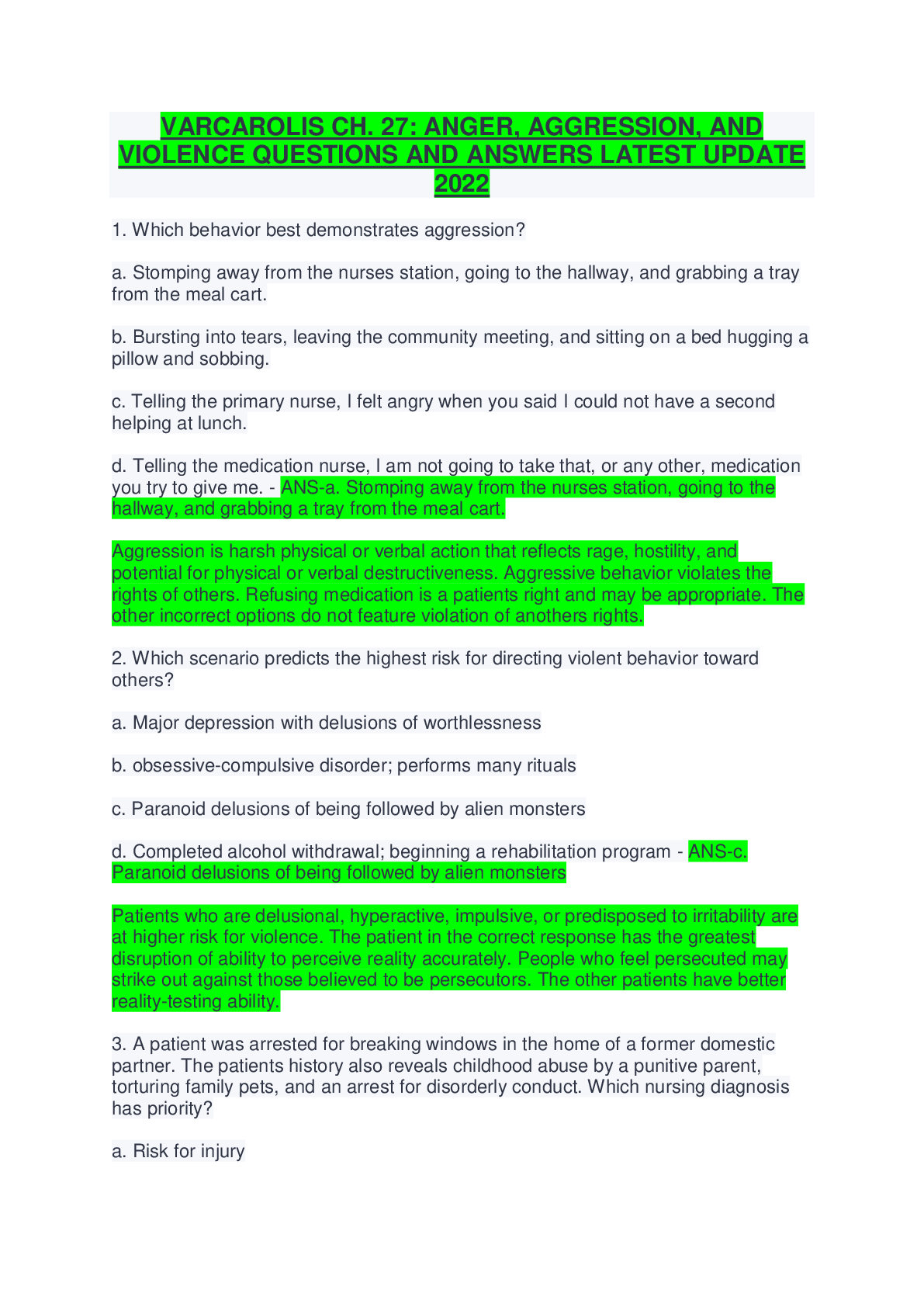
VARCAROLIS CH. 27: ANGER, AGGRESSION, AND
VIOLENCE QUESTIONS AND ANSWERS LATEST UPDATE
2022
1. Which behavior best demonstrates aggression?
a. Stomping away from the nurses station, going to the hallway, and grabbing a tray
from the meal cart.
b. Bursting into tears, leaving the community meeting, and sitting on a bed hugging a
pillow and sobbing.
c. Telling the primary nurse, I felt angry when you said I could not have a second
helping at lunch.
d. Telling the medication nurse, I am not going to take that, or any other, medication
you try to give me. - ANS-a. Stomping away from the nurses station, going to the
hallway, and grabbing a tray from the meal cart.
Aggression is harsh physical or verbal action that reflects rage, hostility, and
potential for physical or verbal destructiveness. Aggressive behavior violates the
rights of others. Refusing medication is a patients right and may be appropriate. The
other incorrect options do not feature violation of anothers rights.
2. Which scenario predicts the highest risk for directing violent behavior toward
others?
a. Major depression with delusions of worthlessness
b. obsessive-compulsive disorder; performs many rituals
c. Paranoid delusions of being followed by alien monsters
d. Completed alcohol withdrawal; beginning a rehabilitation program - ANS-c.
Paranoid delusions of being followed by alien monsters
Patients who are delusional, hyperactive, impulsive, or predisposed to irritability are
at higher risk for violence. The patient in the correct response has the greatest
disruption of ability to perceive reality accurately. People who feel persecuted may
strike out against those believed to be persecutors. The other patients have better
reality-testing ability.
3. A patient was arrested for breaking windows in the home of a former domestic
partner. The patients history also reveals childhood abuse by a punitive parent,
torturing family pets, and an arrest for disorderly conduct. Which nursing diagnosis
has priority?
a. Risk for injury
c. Impaired social interaction
b. Ineffective coping
d. Risk for other-directed violence - ANS-d. Risk for other-directed violence
Defining characteristics for risk for other-directed violence include a history of being
abused as a child, having committed other violent acts, and demonstrating poor
impulse control. There is no indicator that the patient will experience injury.
Ineffective coping and impaired social interaction have lower priorities.
4. A confused older adult patient in a skilled nursing facility was asleep when
unlicensed assistive personnel (UAP) entered the room quietly and touched the bed
to see if it was wet. The patient awakened and hit the UAP in the face. Which
statement best explains the patients action?
a. Older adult patients often demonstrate exaggerations of behaviors used earlier in
life.
b. Crowding in skilled nursing facilities increases an individuals tendency toward
violence.
c. The patient learned violent behavior by watching other patients act out.
d. The patient interpreted the UAPs behavior as potentially harmful. - ANS-d. The
patient interpreted the UAPs behavior as potentially harmful.
Confused patients are not always able to evaluate the actions of others accurately.
This patient behaved as though provoked by the intrusive actions of the staff.
5. A patient is pacing the hall near the nurses station, swearing loudly. An
appropriate initial intervention for the nurse would be to address the patient by name
and say:
a. What is going on?
b. Please be quiet and sit down in this chair immediately.
c. I'd like to talk with you about how you're feeling right now.
d. You must go to your room and try to get control of yourself. - ANS-c. I'd like to talk
with you about how you're feeling right now.
Intervention should begin with analysis of the patient and the situation. When anger
is escalating, a patients ability to process decreases. It is important to speak to the
patient slowly and in short sentences, using a low and calm voice. Use open-ended
statements designed to hear the patients feelings and concerns. This leads to the
next step of planning an intervention.
6. A patient who was responding to auditory hallucinations earlier in the morning now
approaches the nurse shaking a fist and shouts, Back off! and then goes to the day
room. While following the patient into the day room, the nurse should:
a. make sure there is adequate physical space between the nurse and patient.
b. move into a position that places the patient close to the door.
c. maintain one arms-length distance from the patient.
d. begin talking to the patient about appropriate behavior. - ANS-a. make sure there
is adequate physical space between the nurse and patient.
Making sure space is present between the nurse and the patient avoids invading the
patients personal space. Personal space needs increase when a patient feels
anxious and threatened. Allowing the patient to block the nurses exit from the room
may result in injury to the nurse. Closeness may be threatening to the patient and
provoke aggression. Sitting is inadvisable until further assessment suggests the
patients aggression is abating. One arms length is inadequate space.
7. An intramuscular dose of antipsychotic medication needs to be administered to a
patient who is becoming increasingly more aggressive and refused to leave the
dayroom. The nurse should enter the day room:
a. and say, Would you like to come to your room and take some medication your
health care provider prescribed for you?
b. accompanied by 3 staff members and say, Please come to your room so I can
give you some medication that will help you regain control.
c. and place the patient in a basket-hold and then say, I am going to take you to your
room to give you an injection of medication to calm you.
d. accompanied by a male security guard and tell the patient, Come to your room
willingly so I can give you this medication, or the guard and I will take you there. -
ANS-b. accompanied by 3 staff members and say, Please come to your room so I
can give you some medication that will help you regain control.
A patient gains feelings of security if he or she sees others are present to help with
control. The nurse gives a simple direction, honestly states what is going to happen,
and reassures the patient that the intervention will be helpful. This positive approach
assumes the patient can act responsibly and will maintain control. Physical control
measures are used only as a last resort.
8. After an assault by a patient, a nurse has difficulty sleeping, startles easily, and is
preoccupied with the incident. The nurse said, That patient should not be allowed to
get away with that behavior. Which response poses the greatest barrier to the nurses
ability to provide therapeutic care?
a. Startle reactions
c. A wish for revenge
b. Difficulty sleeping
d. Preoccupation with the incident - ANS-c. A wish for revenge
The desire for revenge signals an urgent need for professional supervision to work
through anger and counter the aggressive feelings. Feelings of revenge create a risk
for harm to the patient. The distracters are normal in a person who was assaulted.
They usually are relieved with crisis intervention, help the individual regain a sense
of control, and make sense of the event.
9. The staff development coordinator plans to teach use of physical management
techniques for use when patients become assaultive. Which topic should the
coordinator emphasize?
a. Practice and teamwork
c. Caution and superior size
b. Spontaneity and surprise
d. Diversion and physical outlets - ANS-a. Practice and teamwork
Intervention techniques are learned behaviors and must be practiced to be used in a
smooth, organized fashion. Every member of the intervention team should be
assigned a specific task to carry out before beginning the intervention. The other
options are useless if the staff does not know how to use physical techniques and
how to apply them in an organized fashion.
CONTINUES...
[Show More]