WGU - Information Systems
Management C724 Questions and
Answers Graded A
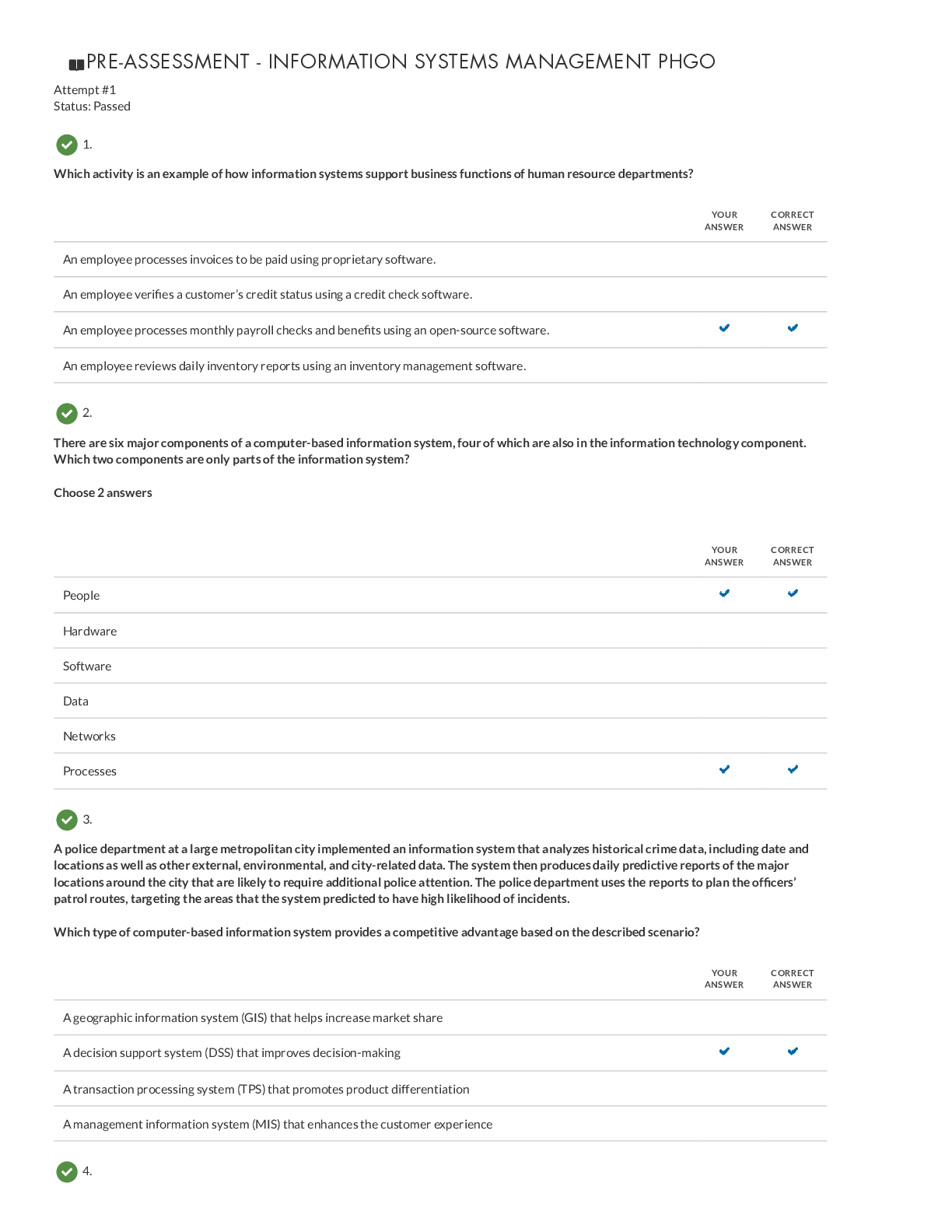
What are the 6 components of Information Systems?
Which ones just belong to Information Systems ✔✔1. People 2. Processes 3. Networks 4. Softwar
...
WGU - Information Systems
Management C724 Questions and
Answers Graded A
What are the 6 components of Information Systems?
Which ones just belong to Information Systems ✔✔1. People 2. Processes 3. Networks 4. Software
5. Hardware 6. Data
People and processes only belong to information systems
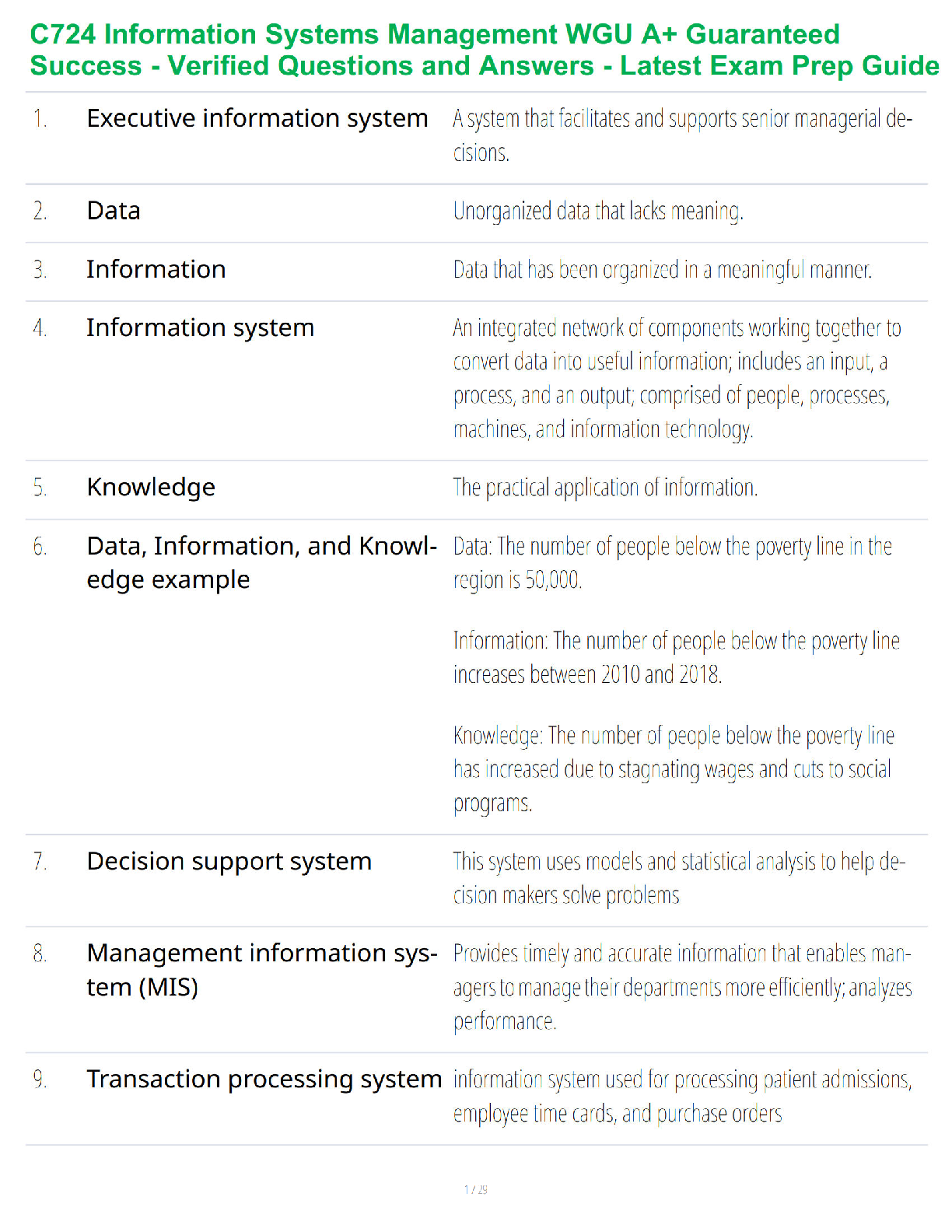
Executive Support Systems (ESS) ✔✔a type of management support system that facilitates and
supports senior executive information and decision-making needs. It provides easy access to
internal and external information relevant to organizational goals
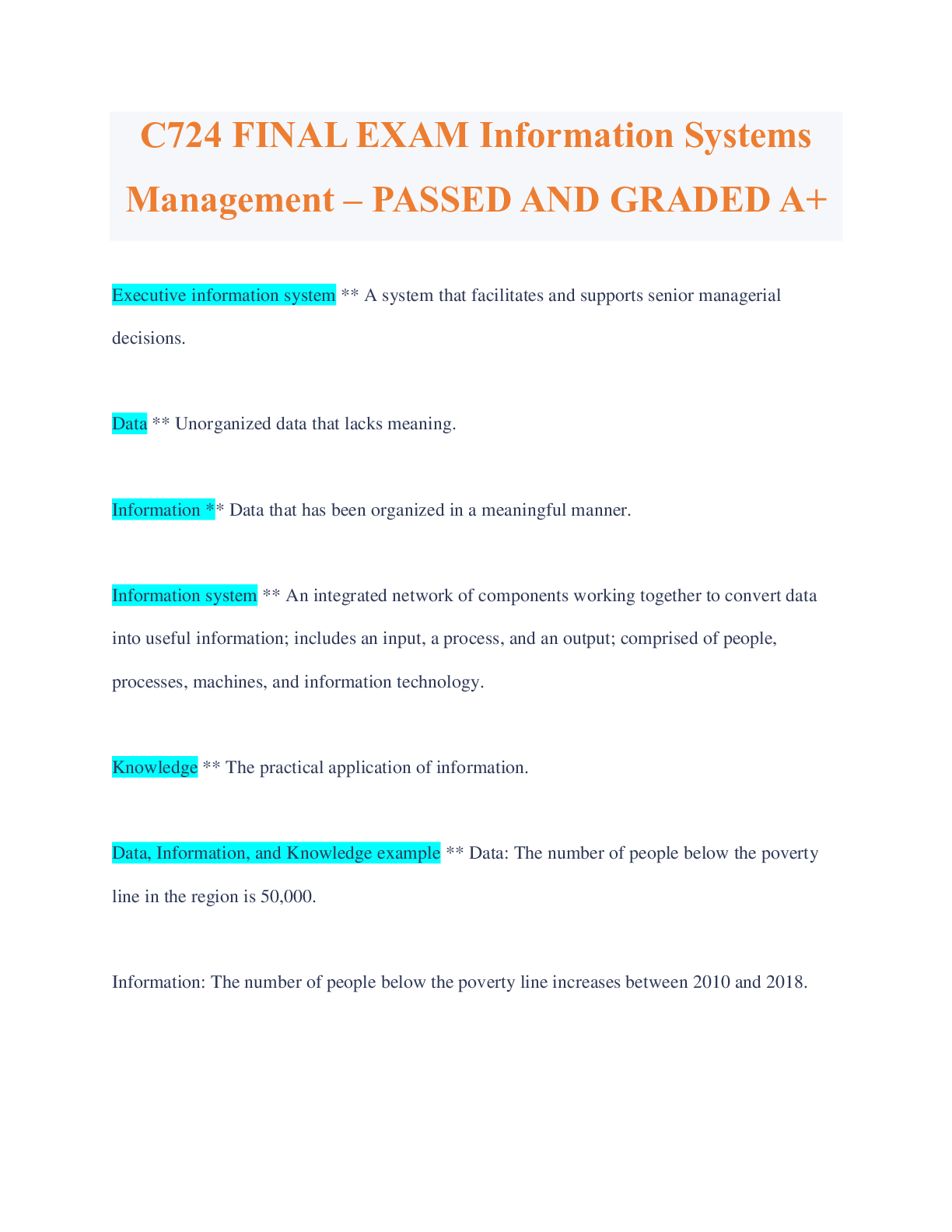
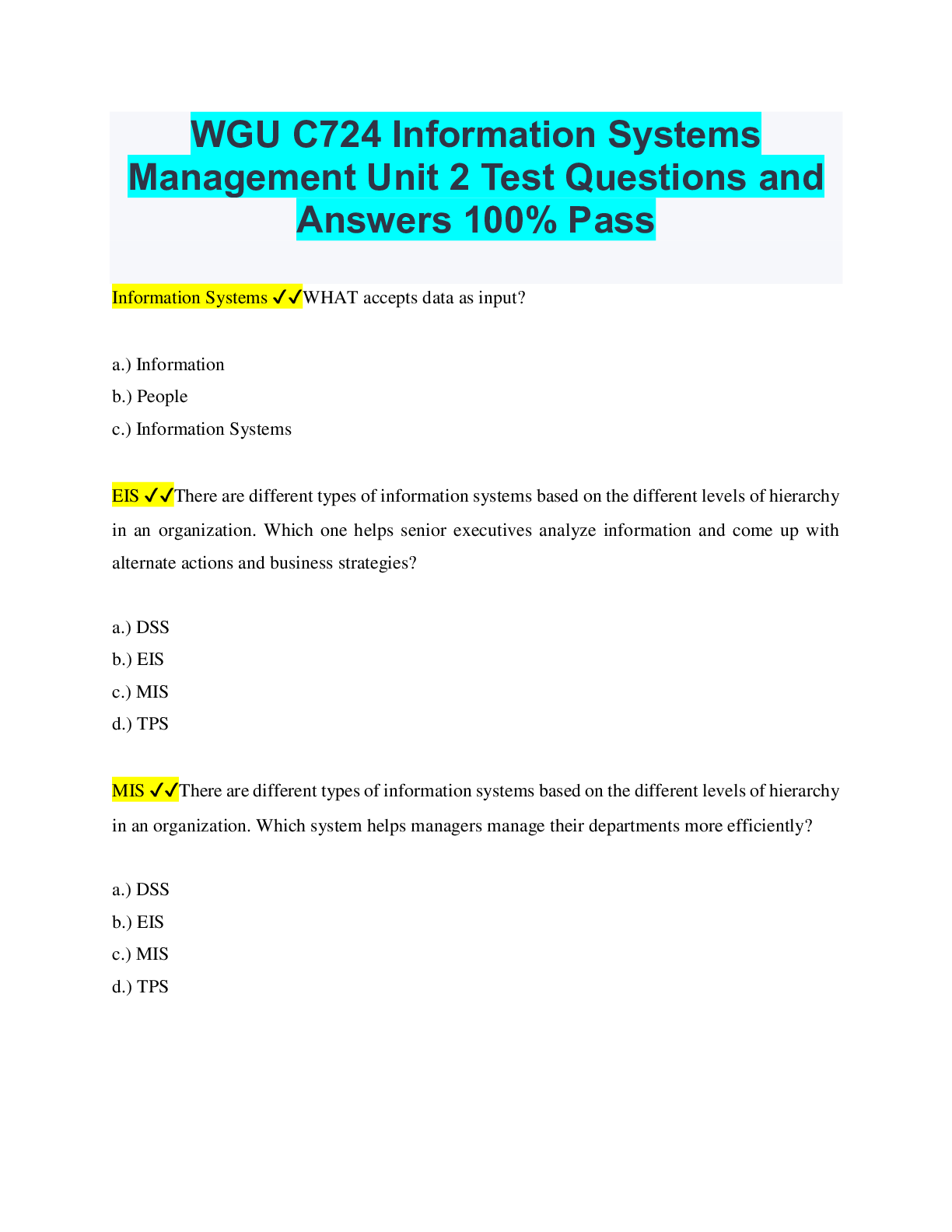
What is EIS - "Executive Information Systems?" ✔✔a specific class of DSS that support the
strategic decision-making process of top-level executives. These systems incorporate summarized
information from decision support systems and management information systems, along with
external factors to forecast and analyze trends.
What is DSS - "Decision Support Systems?" ✔✔focuses on supporting all phases of specific
decision-making processes and procedures for arriving at a solution. They are often developed to
handle unstructured problems at all levels.
What is MIS - "Management Information Systems?" ✔✔represent a category of IS that serve lower
to middle managers. They provide performance reports based on the results from transaction
processing systems, such as product cost data, sales data, and expense data.What is TPS - "Transaction Processing Systems?" ✔✔collect, store, update, and retrieve
transaction data within an organization. Common business transactions include: employee payroll,
customer sales, and supplier payments. Developed to: decrease costs, decrease processing time,
and increase accuracy. Achieve these benefits by: automating and recording routine business
transactions that are too tedious and monotonous for front-line employees to process manually in
an effective and efficient manner
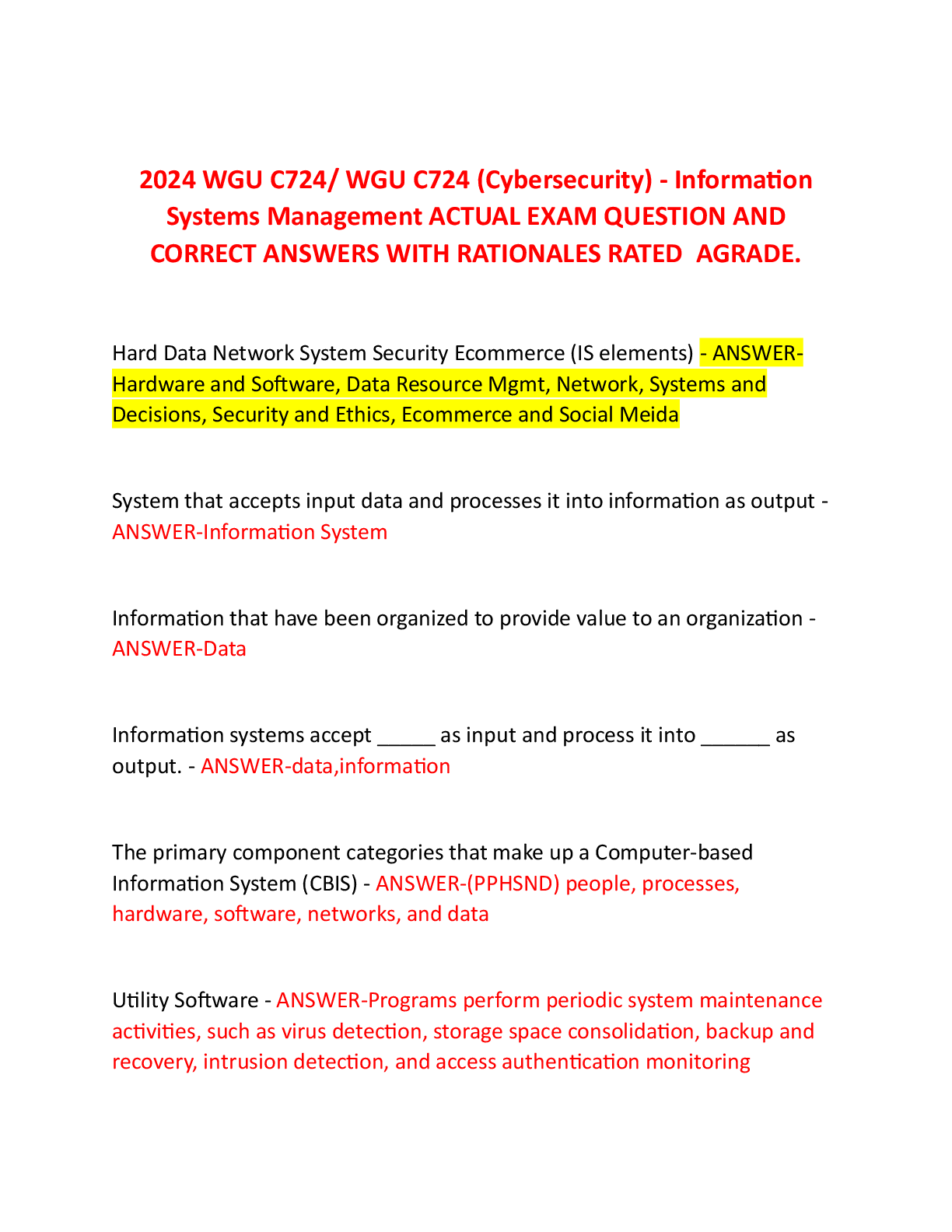
What is Information Systmes? ✔✔The purpose is to get useful information to the right people
within an organization to support decision making and operations. Effective information systems
can help companies streamline business processes and planning, as well as help with data storage,
data management, and data security.
Identify the 7 major reasons firms invest in information systems ✔✔1. Achieve operational
excellence 2. Develop new products and services 3. Attain customer intimacy and service 4.
Improve decision making 5. Promote competitive advantage 6. Ensure long-term survival 7.
Develop strong relationships with suppliers
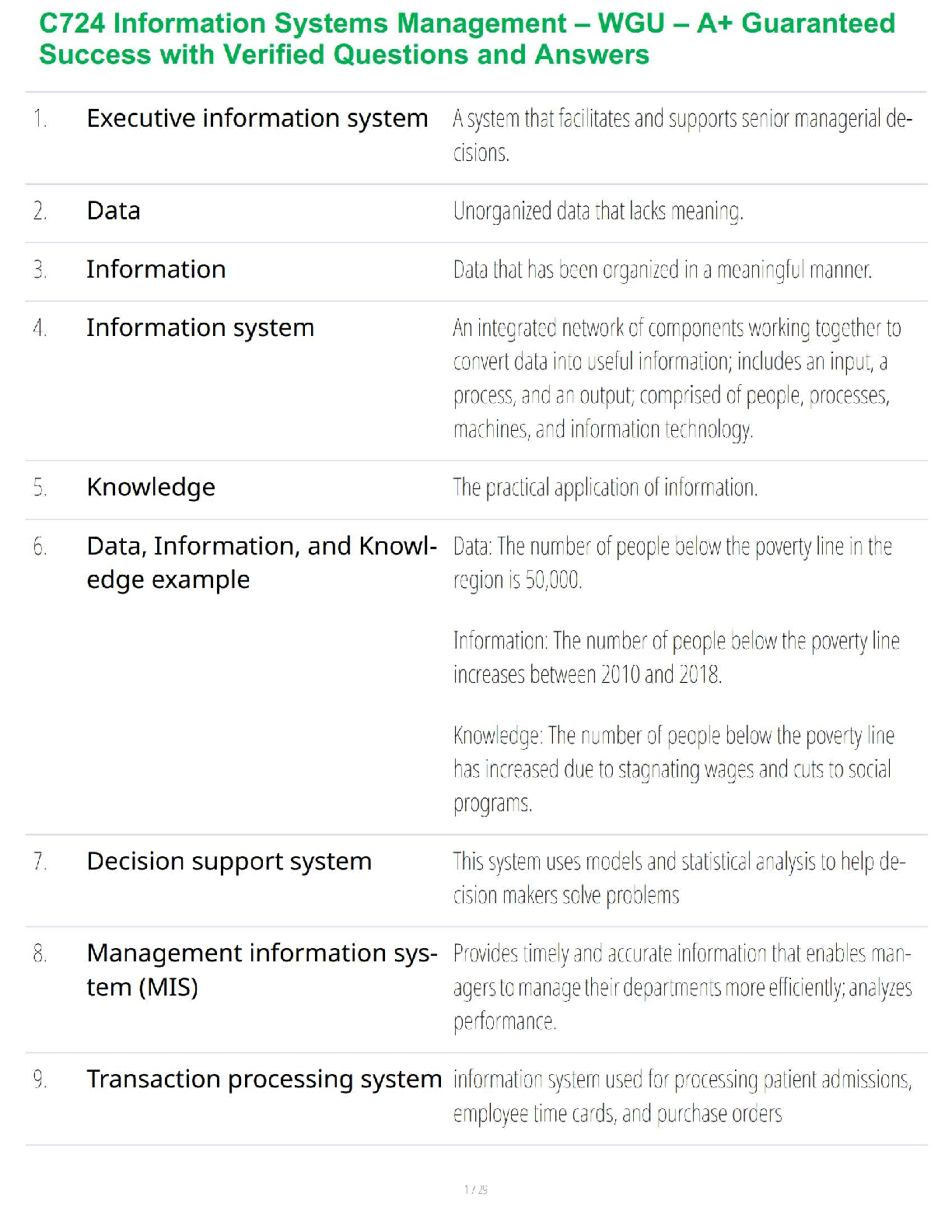
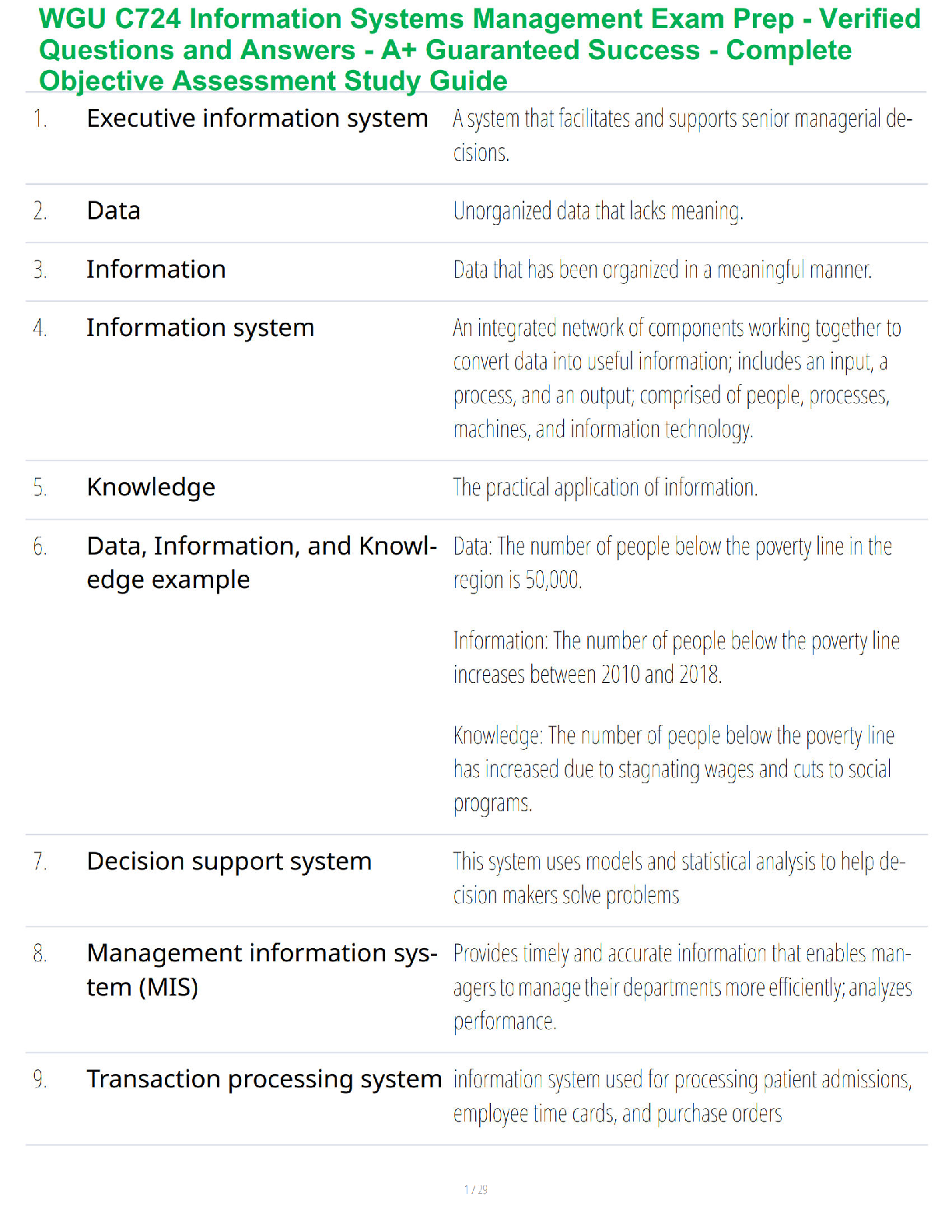
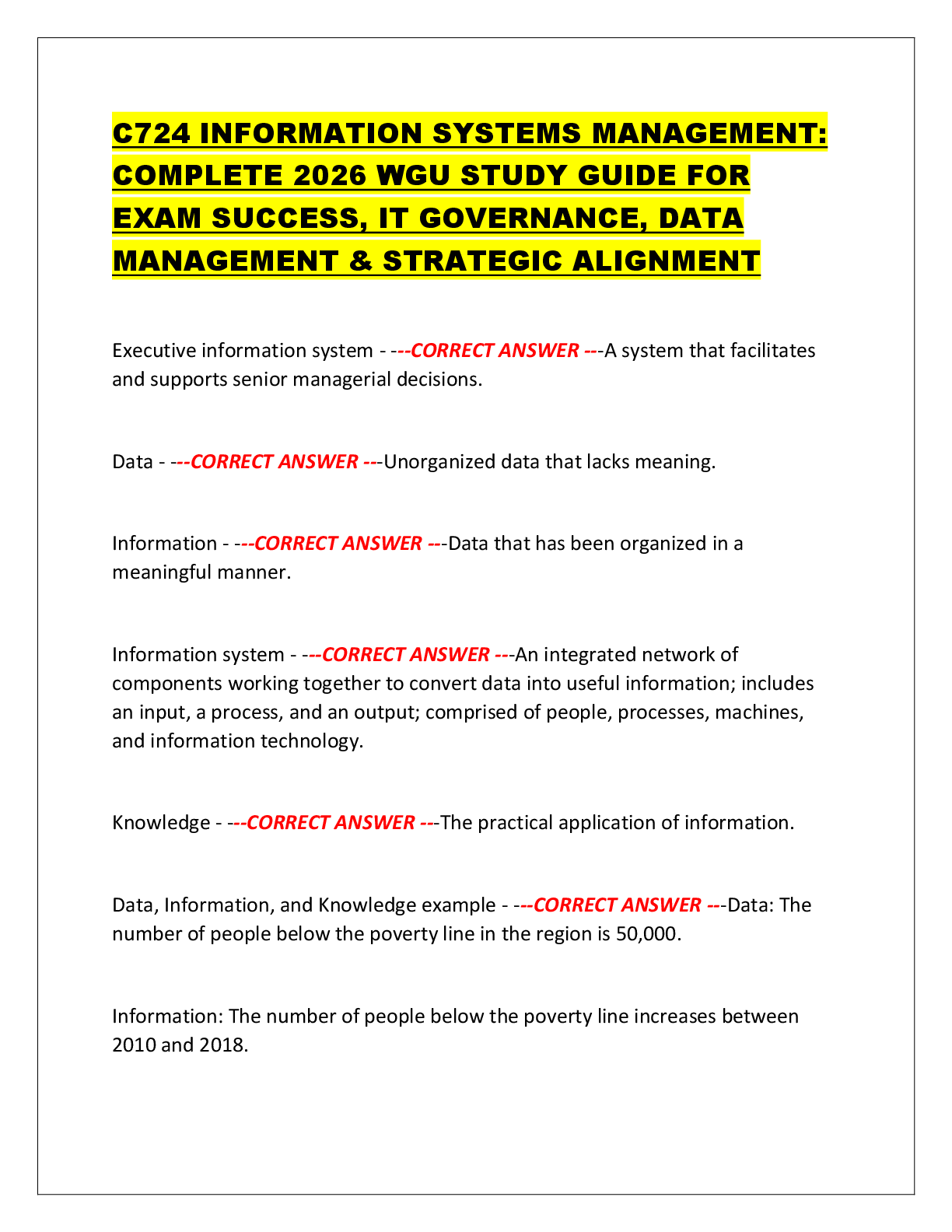
What is data? An example. ✔✔Data - Unorganized data that lacks meaning. Example: The number
of people below the poverty line in the region is 50,000
What is information? An example. ✔✔Information - Data that has been organized in a meaningful
manner. Example: The number of people below the poverty line increases between 2010 and 2018
What is knowledge? An example. ✔✔Knowledge - The practical application of information.
Example: The number of people below the poverty line has increased due to stagnating wages and
cuts to social programs
What does the functional area Human Resources do? ✔✔Recruiting, training, and maintaining
employees and their recordsWhat does the functional area Production, Operations & Quality Control do? ✔✔Functions range
from receiving raw material to shipping finished goods or from production itself to equipment
maintenance
What does the functional area Sales/Marketing do? ✔✔Planning, promoting, and selling of goods
and services to satisfy customer needs and the objectives of the organization
What does the functional area Accounting & Finance do? ✔✔Managing financial assets and
maintaining financial records
Accounts payable, accounts receivable
Budgeting, general ledgers, payroll
Cash flow financial transactions
What are Porter's 5 Forces? ✔✔1. Threat of New Entrants 2. Threat of Substitutes 3. Bargaining
Power of Customers (Buyers) 4. Bargaining Power of Suppliers 5. Competitive Rivalry
RAID " Redundant Array of Independent Disks" ✔✔storage uses multiple disks in order to provide
fault tolerance, to improve overall performance, and to increase storage capacity in a system
Cloud Computing ✔✔is facilitated by many computers meshed or connected together in what is
termed "cloud fabric," which provides common resources to service providers. Benefits include
redundancy, reliability, and scalability. Organizations that provide cloud computing are known as
cloud operators, which employ fabric controllers to administer operations within the fabric of
computer resources
Strategic-Oriented Evaluation ✔✔the determination of whether the information system outputs
enable management to make strategic decisions that will help develop and achieve the future
mission and vision of the organizationFunction-Oriented Evaluation ✔✔examines the performance of data, hardware, software,
networks, and human resources
System-Oriented Evaluation ✔✔the ability of an information system to discriminate between files
or data that are relevant to a user query, and those which are not relevant
Direct Implementation ✔✔the system is implemented and tested to ensure it performs properly.
Then the old system is removed and the new one put in its place without any overlap or limited
roll out
Service-Oriented Architecture (SOA) ✔✔is a software development model for distributed
application components that incorporates discovery, access control, data mapping and security
features
Parallel Adoption ✔✔a method of hardware or software migration that involves using the existing
and new systems simultaneously until the implementation is judged to be complete and satisfactory
Network Economics ✔✔The cost of adding another business participant to a business venture is
small, the potential gain is great
Virtual Company Model ✔✔Networks of people and resources join together to provide a service
or create a product without the traditional storefront boundaries
Business Ecosystems ✔✔Network of businesses involved in delivering a product through mutual
cooperation
Describe synergy. How does it benefit the business? ✔✔The cooperation between several
businesses to produce a better product or service than would be possible if each business worked
independently. When several businesses combine their expertise, they can offer better products for
lower costs and higher profits.Star Topology ✔✔all computers and devices are connected to a main hub or switch. The hub or
switch amasses and disburses the flow of data within the network. Star topology is the most
common type of network and follows the Ethernet standard
Bus Topology ✔✔in this arrangement computers and devices are connected to a single linear cable
called a trunk. The trunk is also referred to as the backbone or a segment. Each end of the trunk
must be discharged to prevent the signal from rebounding back up the cable
[Show More]





.png)
.png)
.png)