Psych 101 Final Exam Questions and
Answers Rated A
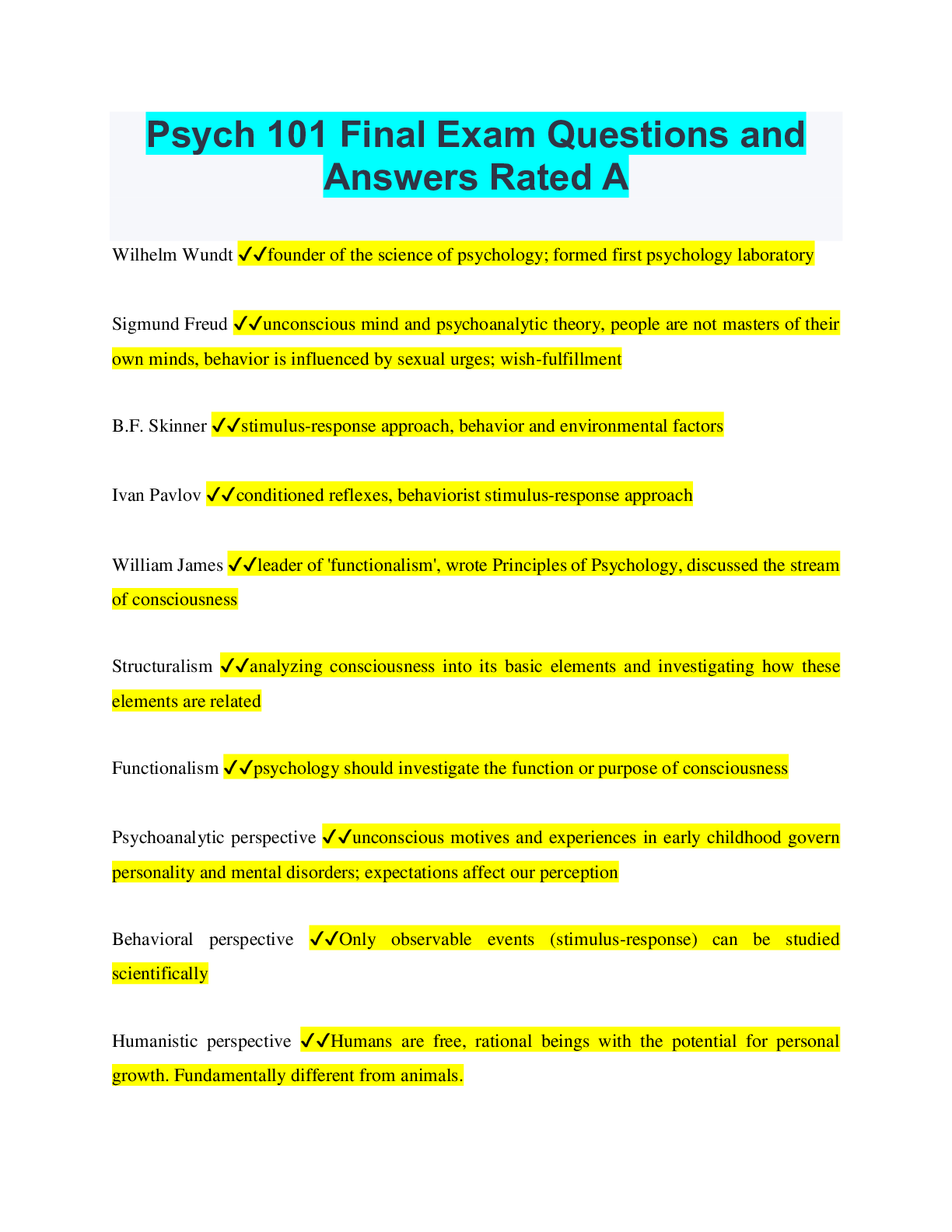
Wilhelm Wundt ✔✔founder of the science of psychology; formed first psychology laboratory
Sigmund Freud ✔✔unconscious mind and psychoanalytic theory, people are not ma
...
Psych 101 Final Exam Questions and
Answers Rated A
Wilhelm Wundt ✔✔founder of the science of psychology; formed first psychology laboratory
Sigmund Freud ✔✔unconscious mind and psychoanalytic theory, people are not masters of their
own minds, behavior is influenced by sexual urges; wish-fulfillment
B.F. Skinner ✔✔stimulus-response approach, behavior and environmental factors
Ivan Pavlov ✔✔conditioned reflexes, behaviorist stimulus-response approach
William James ✔✔leader of 'functionalism', wrote Principles of Psychology, discussed the stream
of consciousness
Structuralism ✔✔analyzing consciousness into its basic elements and investigating how these
elements are related
Functionalism ✔✔psychology should investigate the function or purpose of consciousness
Psychoanalytic perspective ✔✔unconscious motives and experiences in early childhood govern
personality and mental disorders; expectations affect our perception
Behavioral perspective ✔✔Only observable events (stimulus-response) can be studied
scientifically
Humanistic perspective ✔✔Humans are free, rational beings with the potential for personal
growth. Fundamentally different from animals.Cognitive perspective ✔✔Human behavior can't be understood without examining how people
acquire, store, and process information
Biological perspective ✔✔an organism's functioning can be explained through bodily structures
and bio-chemical processes
Evolutionary perspective ✔✔Behavior patterns have evolved to solve adaptive problems; natural
selection favors behaviors that enhance reproductive success
Critical (critical thinking) ✔✔being analytical and evaluating ideas
Anecdotal evidence ✔✔stories, NOT reliable evidence
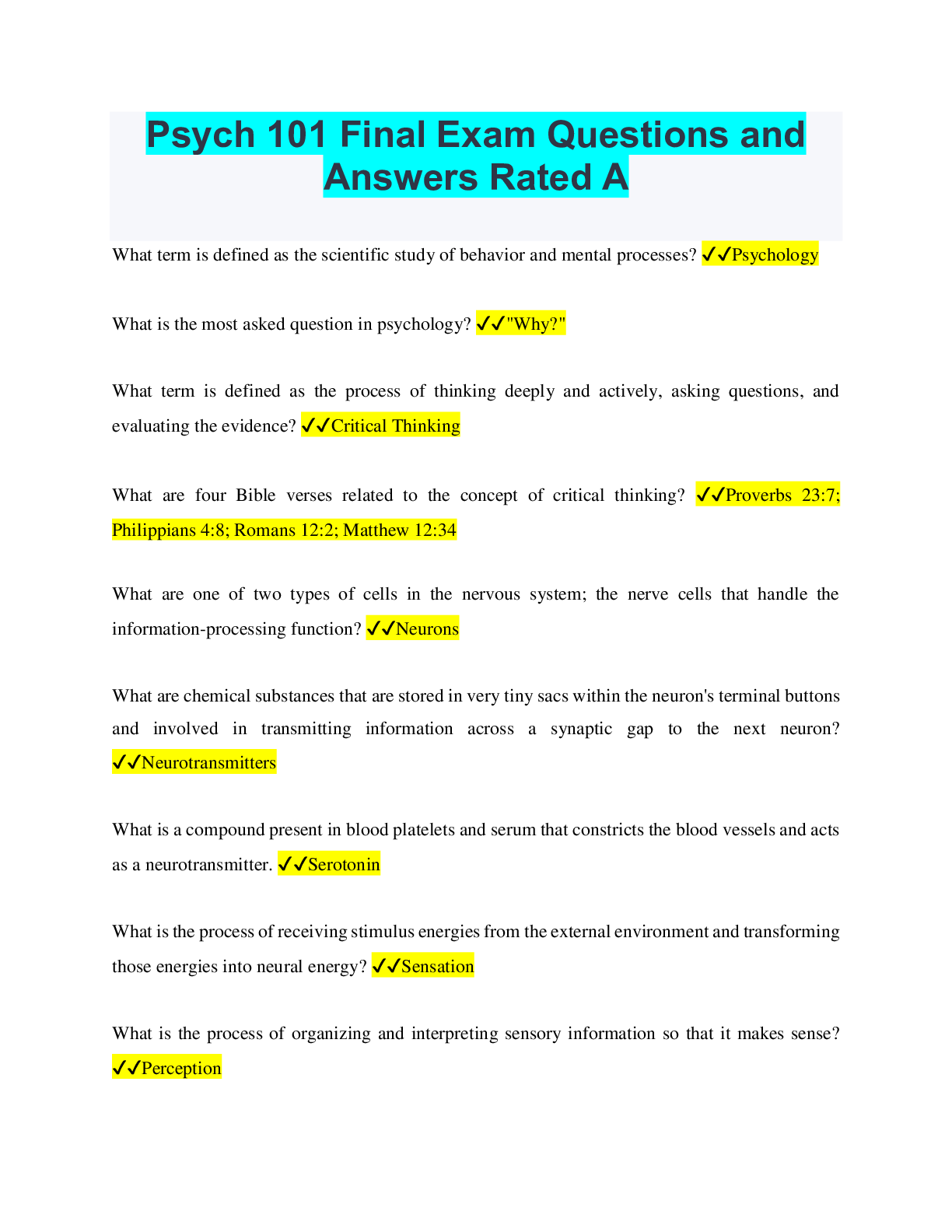
Neurons ✔✔individual cells in the nervous system that receive, integrate, and transmit information
Soma ✔✔cell body, contains the cell nucleus and chemical machinery
Dendrites ✔✔parts of a neuron specialized to receive information
Axon ✔✔fiber that transmits signals away from the soma and to other neurons, muscles, or glands
Myelin sheath ✔✔insulating material that encases some axons
Terminal buttons ✔✔small knobs that secrete chemicals called neurotransmitters
Synapse ✔✔junction where information is transmitted from one neuron to another
Glia (glue) ✔✔cells found throughout the nervous system that provide support for neurons (glue)Resting potential ✔✔a neuron's stable, negative charge when the cell is inactive
Action potential ✔✔brief shift in a neuron's electrical charge that travels along an axon
Absolute refractory period ✔✔minimum length of time after an action potential during which
another action potential cannot begin
All-or-None Law ✔✔action potentials are all the same size, though strength and firing rate can
vary
Synaptic cleft ✔✔gap between the terminal button of a neuron and the cell membrane of anther
neuron
Agonist ✔✔chemical that mimics action of a neurotransmitter
Antagonist ✔✔chemical that opposes the action of a neuro transmitter
Acetylcholine (ACh) ✔✔muscles, attention, arousal, memory; stimulated by nicotine
Dopamine ✔✔voluntary movement, elevated by cocaine and amphetamines
Norepinephrine (NE) ✔✔mood and arousal; elevated by cocaine and amphetamines
Serotonin ✔✔Sleep, wakefulness, eating, aggression; affected by antidepressants
GABA ✔✔inhibitory, anxiety, sleep/arousal; anti-anxiety drugs
Glutamate ✔✔excitatory, learning, memoryEndorphins ✔✔pain relief and stress response, eating behavior
Cerebrum ✔✔sensing, thinking, learning, emotion, consciousness, movement
Corpus callosum ✔✔bridge between cerebral hemispheres
Thalamus ✔✔relay center for cortex; handles incoming and outgoing signals
Cerebellum ✔✔fine muscle movement, balance; first brain structure depressed by alcohol
Reticular formation ✔✔group of fibers that deal with stimulation related to sleep and arousal
Spinal cord ✔✔transmitting info between brain and body
Medulla ✔✔Unconscious functions such as breathing and circulation
Pons ✔✔sleep and arousal
Hippocampus ✔✔memory; elongated and curves around the thalamus
Pituitary gland ✔✔"master gland" that regulates other endocrine glands
Hypothalamus ✔✔basic biological needs; hunger, thirst, temperature control
Amygdala ✔✔limbic system; emotion and aggression
Neurogenesis ✔✔formation of new neurons
Primary visual cortex ✔✔in occipital lobe; processing of visual signalsPrimary auditory cortex ✔✔in temporal lobe; auditory processing
Primary motor cortex ✔✔in frontal lobe; muscle movement
Primary somatosensory cortex ✔✔in parietal lobe; registers sense of touch
Sympathetic division of ANS ✔✔fight-or-flight response; slows digestive processes and drains
blood from periphery
Neuroplasticity ✔✔the flexibility and changeability of the brain's structure and organization
Prefrontal cortex ✔✔complex cognitive activities; planning, organization, paying attention
Broca's area ✔✔speech production
Wernicke's area ✔✔language comprehension
CT scans ✔✔x-ray of brain structure
MRI scan ✔✔magneticfields, radio waves, and enhancement to map out brain structure (BETTER
THAN CT)
PET ✔✔color-coded map indicating what brain areas become active when subjects do/think
certain things
fMRI ✔✔maps brain activity over time, more precise than PET
TMS ✔✔temporarily enhance or depress activity in a specific area of the brainUse it or lose it ✔✔the brain not being used would shrivel up and die
Amplitude ✔✔height
Nearsightedness ✔✔close objects are seen clearly but distant objects appear blurry
Farsightedness ✔✔distant objects are seen clearly but close objects appear blurry
[Show More]