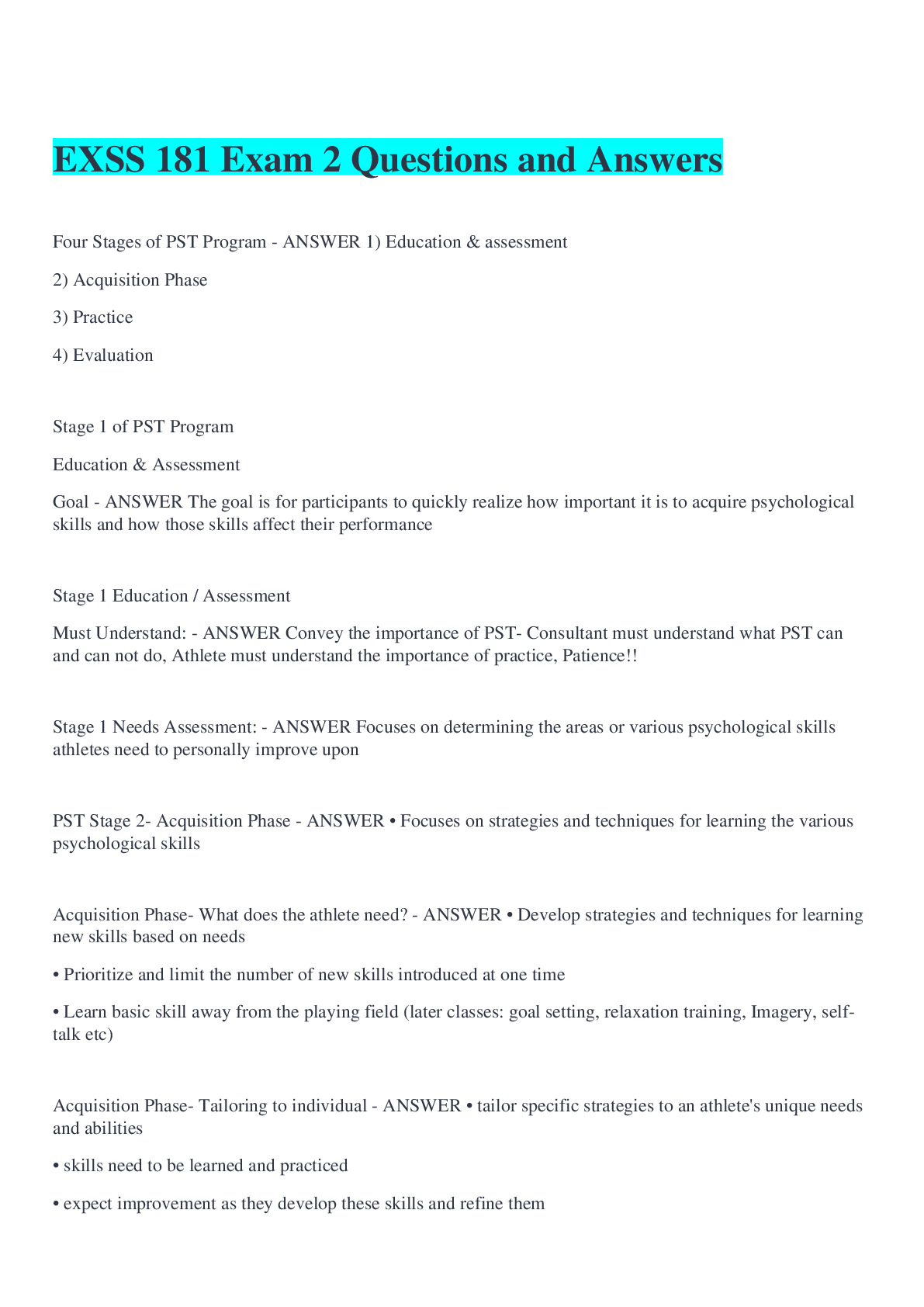
Four Stages of PST Program - ANSWER 1) Education & assessment
2) Acquisition Phase
3) Practice
4) Evaluation
Stage 1 of PST Program
Education & Assessment
Goal - ANSWER The goal is for participants to quickly rea
...
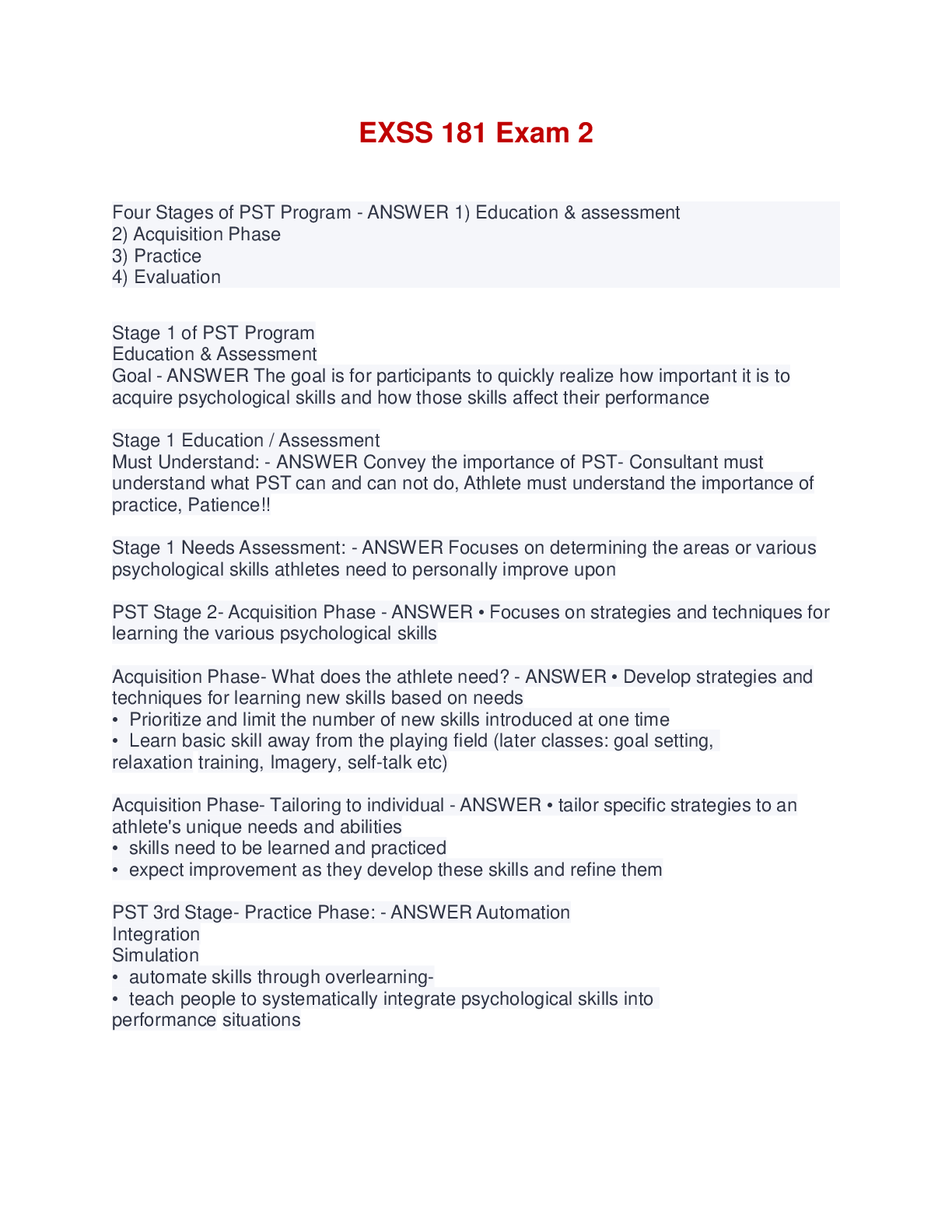
Four Stages of PST Program - ANSWER 1) Education & assessment
2) Acquisition Phase
3) Practice
4) Evaluation
Stage 1 of PST Program
Education & Assessment
Goal - ANSWER The goal is for participants to quickly realize how important it is to acquire psychological skills and how those skills affect their performance
Stage 1 Education / Assessment
Must Understand: - ANSWER Convey the importance of PST- Consultant must understand what PST can and can not do, Athlete must understand the importance of practice, Patience!!
Stage 1 Needs Assessment: - ANSWER Focuses on determining the areas or various psychological skills athletes need to personally improve upon
PST Stage 2- Acquisition Phase - ANSWER • Focuses on strategies and techniques for learning the various psychological skills
Acquisition Phase- What does the athlete need? - ANSWER • Develop strategies and techniques for learning new skills based on needs
• Prioritize and limit the number of new skills introduced at one time
• Learn basic skill away from the playing field (later classes: goal setting, relaxation training, Imagery, self-talk etc)
Acquisition Phase- Tailoring to individual - ANSWER • tailor specific strategies to an athlete's unique needs and abilities
• skills need to be learned and practiced
• expect improvement as they develop these skills and refine them
PST 3rd Stage- Practice Phase: - ANSWER Automation
Integration
Simulation
• automate skills through overlearning-
• teach people to systematically integrate psychological skills into performance situations
• simulate skills people will want to apply in actual competition
PST Practice Phase- Automation - ANSWER • Practicing until skill can be performed without a lot of higher-level cognitive control - "automatic"
PST Practice Phase - Integration - ANSWER • Use the skill, or version of it in practice, then competition
• Gradually introduce
• Find ways to adapt the skill to avoid disrupting performance
PST Practice Phase- Simulation - ANSWER • Re-create the situation that requires the use of the skill in a practice setting to get "real world" experience before using it in real competition
PST Stage 4- Evaluation Phase - ANSWER Was the PST program carried out as planned? by athlete, by coach by consultant?
Did the athlete improve their mental skill?
Did the athlete meet the goal of the program / solve the initial problem?
Subjective and performance feedback
Reassessment - ANSWER what could be modified or done next to deal with problems or aid further improvement?
Continue through steps again- Acquisition, Practice, Evaluation
Why is PST programs described in a circular process? - ANSWER One you complete the phases and evaluate, you reassessment and continue through the steps again, so this continues in a circular process until the goal of self-regulation is met
What is the ultimate goal of PST? - ANSWER Self-regulation
The ability to work toward one's short and long term goals by effectively monitoring and managing one's thoughts, feelings and behaviors.
5 Stage Self -Regulation Model - ANSWER Stage 1 Problem Identification
Stage 2 Commitment
Stage 3 Execution
Stage 4 Environmental Management
Stage 5 Generalization
Review real life example Slide 20 of Chap 17 - ANSWER
Common problems implementing a PST - ANSWER Lack of conviction by athlete
Lack of time by athlete
Lack of sport knowledge by consultant
Lack of follow-up (both)
Relaxation Training Method:
1) Deep Breathing - ANSWER • Easy, effective
• Breathing out decreases muscle tension.. but tendency in stressful situation to hold breath or increase breathing rate
• Deep, diapraghmatic breathing at a slow and controlled pace
- Complete breaths
- Rhythmic breaths: 4-4-4 count
• Best use in competition: during breaks in action
Relaxation Training Method:
2) Progressive Relaxation - ANSWER • objective is to teach/train contrast between tension and relaxation • Involves contracting and relaxing major muscle groups in a sequence progressing through the whole body
Major Premises of Progressive Relaxation - ANSWER • Tension and relaxation cannot occur simultaneously
• Relaxation of the muscles (body) contributes to relaxation of the mind
Progressive Relaxation- Practice & Integration - ANSWER Full program practice (30 min)
Abbreviated program (shorter time periods)
Relax on-site in competition
Relaxation Training-
3) Autogenic Training - ANSWER • Exercises aimed at producing 6 types of sensations
- Heaviness in extremities
- Warmth in extremities
- Regulation of heart rate
- Regulation of breathing
- Abdominal warmth
- Cool forehead
Longer time to learn, extensive practice
Relaxation Training -
4) Biofeedback - ANSWER • designed to teach control of physiological or autonomic responses
• Visual and / or auditory feedback of:
- muscle activity
- skin temperature
- brain wave
- heart rate
Coping - ANSWER • constantly changing cognitive and behavioral efforts used to manage specific external and / or internal demands that are appraised as taxing or exceeding the resources of the person
• Does not happen by accident..It only counts if it's something effortful, done in an attempt to manage the transaction
Problem-Focused coping: - ANSWER • Efforts directed at changing the transaction
(try to solve the problem)
Emotion-Focused coping - ANSWER • Efforts directed at changing the emotional response without changing the transaction
(manage your feelings about the problem)
Coping Strategies of Elite Athletes - ANSWER • Thought-stopping
• Narrowing focus
• Rational thinking & Self-talk
• Positive focus
• Social Support
• PST
• Time Management
• Training Hard and Smart
"On-site" Coping / Relaxation Tips - ANSWER • Smile in response to tension
• Enjoy the situation
• Slow Down
• Stay focused in the present
• Be prepared with a competition plan
Key: set up stressful situation in practice to develop these techniques
Arousal - Increasing Techniques
Sometimes it may be necessary to increase arousal - ANSWER • Increased breathing rate
• Act Energized
• Self-talk: mood words & positive self-statements
• Energizing music
• Energizing imagery
• Precompetitive workout
Imagery - ANSWER • Creating or recreating an experience on the mind. Put simply- visualization
• Involves recalling from memory pieces of information stores from experience and shaping those pieces into meaningful information
Imagery = - ANSWER = Recall + Construction
Internal or External?
What senses do you use in Imagery - ANSWER Visual
Auditory
Tactile
Olfactory
Characteristics of Imagery - ANSWER • Multisensory
• Internal vs external perspective
• Timing in imagery should match physical performance
Internal Imagery - ANSWER being the person actually going through the motions, so you have a keen sense of it
External Imagery - ANSWER As if you are the spectator or watching a video of yourself
Two keys to effective imagery - ANSWER • Vividness
• Controllability
Uses of Imagery - ANSWER Improve concentration
Enhance motivation
Build confidence
Control emotional responses
Develop sport skills
Acquire and practice strategy
Competition preparation
Cope with pain and injury
Solve Problems
Psychoneuromuscular Theory & Imagery - ANSWER Mental Imagery of an action provokes subliminal stimulation of the muscles that are used in the actual movement patterns being imaged
The neuromuscular system is given the opportunity to "practice" a movement pattern without really moving the muscle.
Has been used to explain why mental practice can enhance performance
Symbolic learning theory - ANSWER Theory states that mental practice and imagery work because the individual literally plans her actions in advance Motor sequence, task goals and alternative solutions are considered cognitively before a physical response is required
Bioinformational theory - ANSWER In imagery, the person focuses on making the image more vivid and real so that actual performance can be enhanced. Stored in long-term memory, visualization and mental imagery serve as both a stimulus and a response. Must be activated before they can be modified
Triple-code model of imagery - ANSWER 3 impacts of imagery
1) The picture itself, an interior feeling which is symbolic of the exterior world
2) somatic reaction, which is the psychophysiological reaction to the picture
3) connotation of the picture that is unique to the person
Imagery vs Physical Practice - ANSWER * Imagery should be used in addition to physical practice
• Physical practice is better than imagery practice
• Imagery practice is better than no practice (injury, travel etc)
• Imagery is not more effective than physical practice over same period of time but is effective when added above and beyond physical practice
What is Self-Confidence - ANSWER • the belief that you can successfully perform a desired behavior
• Generally considered a global and relatively stable trait
Sport Confidence Model:
Continuum of state-like to trait-like - ANSWER 1) Factors Influencing Sport Confidence
2) Sources of Sport Confidence
3) Constructs of Sport Confidence
4) Consequences of Sport Confidence
Factors Influencing Sport Confidence - ANSWER Demographics & personality
Organizational culture
Sources of Sport Confidence - ANSWER Achievement
Self-regulation
Social Climate
Constructs of Sport Confidence - ANSWER Confidence in decision making skills
Confidence in physical skills & training
Confidence in resiliency
Consequences of Sport Confidence - ANSWER ABC of sport psychology
Affect
Behavior
Cognition
Consequences - ANSWER Sport confidence is related to positive emotions, productive achievement patterns such as effort and persistence, more skilled and efficient use of cognitive resources such as attributional patterns, attentional skills and coping strategies.
Benefits of Self-Confidence - ANSWER Arouse Positive Emotions
Facilities Concentration
Affects Goals
Increases Effort
Affects Game Strategies
Affects Psychological Momentum
Affects Performance
5 Misconceptions about Confidence - ANSWER Either you have it or you don't
Only positive feedback can build confidence
Success always builds confidence
Confidence equals outspoken arrogance
Mistakes inevitably destroy confidence
Self-fulfilling Prophecy Effect - ANSWER perception of one's ability to perform a task successfully is a situation-specific form of self-confidence
Self-fulfilling Prophecy effect- 4 statements - ANSWER 1) Coaches form expectations based on-
person cues (size, gender, race, social skills)
[Show More]