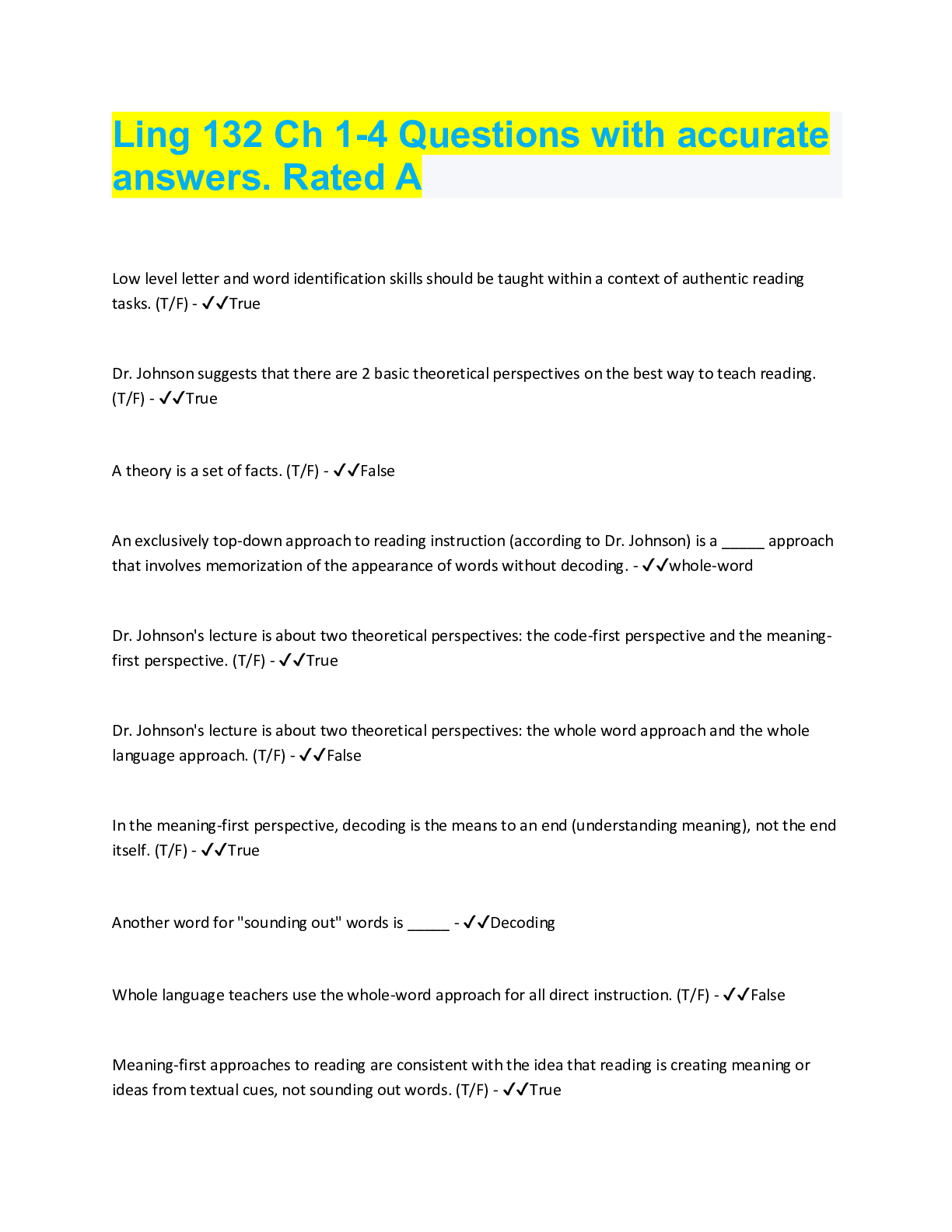
Ling 132 Ch 1-4 Questions with accurate answers. Rated A
Low level letter and word identification skills should be taught within a context of authentic reading tasks. (T/F) - ✔✔True
Dr. Johnson suggests that ther
...
Ling 132 Ch 1-4 Questions with accurate answers. Rated A
Low level letter and word identification skills should be taught within a context of authentic reading tasks. (T/F) - ✔✔True
Dr. Johnson suggests that there are 2 basic theoretical perspectives on the best way to teach reading. (T/F) - ✔✔True
A theory is a set of facts. (T/F) - ✔✔False
An exclusively top-down approach to reading instruction (according to Dr. Johnson) is a _____ approach that involves memorization of the appearance of words without decoding. - ✔✔whole-word
Dr. Johnson's lecture is about two theoretical perspectives: the code-first perspective and the meaning-first perspective. (T/F) - ✔✔True
Dr. Johnson's lecture is about two theoretical perspectives: the whole word approach and the whole language approach. (T/F) - ✔✔False
In the meaning-first perspective, decoding is the means to an end (understanding meaning), not the end itself. (T/F) - ✔✔True
Another word for "sounding out" words is _____ - ✔✔Decoding
Whole language teachers use the whole-word approach for all direct instruction. (T/F) - ✔✔False
Meaning-first approaches to reading are consistent with the idea that reading is creating meaning or ideas from textual cues, not sounding out words. (T/F) - ✔✔True
Cueing System: Meaning of words, phrases, and sentences - ✔✔Semantic
Cueing System: grammar and word order - ✔✔syntactic
Cueing System: sounds - ✔✔phonological
Cueing System: pictures and images - ✔✔Not a cueing system
Low level letter and word identification skills should be taught in a way that isolates them from authentic reading. (T/F) - ✔✔False
Sight words are words that are irregular in their spellings and they can be learned without decoding, through a whole-word approach. (T/F) - ✔✔True
A complete, balanced reading ideology accommodates researchers and teachers who find that a "focus on form" approach helps students learn.to read better. (T/F) - ✔✔True
For the Whole Language advocates, reading is top-down in that the meaning of the text is dependent upon the background knowledge and understanding that the reader brings. (T/F) - ✔✔True
The phonics approach is focused on teaching low-level linguistic knowledge and processing strategies. (T/F) - ✔✔True
This book takes the position that supplementing top-down cognitive reading instruction with a bottom-up focus on language makes for ___________ . - ✔✔a balanced (or truly whole language) approach
At first, Douglass' mistress started teaching him the abcs. (T/F) - ✔✔True
The first letters that Douglass learned to write were L, A, S, and F. (T/F) - ✔✔True
Douglass embarked on a literacy plan by making friends with white boys in the street and making them his teachers. (T/F) - ✔✔True
One lesson to be taken from the story of Frederick Douglass and how he learned to write is that reading and writing are key skills that make people free. (T/F) - ✔✔True
Douglass wanted to find a teacher to teach him how to read because he thought he couldn't learn by himself. (T/F) - ✔✔False
Douglass' mistress did not let him read the newspaper. (T/F) - ✔✔True
Douglass got the idea of how to learn to write in a ship‐yard because he saw the ship carpenters wrote the name of a part of the ship on the wood. (T/F) - ✔✔True
A key lesson from the story of how Frederick Douglass learned to read and write is that personal motivation is crucial. (T/F) - ✔✔True
Frederick Douglass talks about his "master." Frederick Douglass was born a slave. (T/F) - ✔✔True
Douglass "tricked" the boys he knew in the street into teaching how to write more letters. - ✔✔True
Stage 2 is where readers use automatic, fluent and unconscious reading strategies to decode; therefore they can devote more attention to higher-level processing. (T/F) - ✔✔True
Providing maximum support for ESL and EFL readers' higher level processing to supplement deficiencies at the lower-level with language is an idea that should not be discarded. (T/F) - ✔✔True
Processing strategies may be consciously or unconsciously applied to mediate between text and the knowledge base in order to read successfully. (T/F) - ✔✔True
Phonological strategies allow us to recognize the letter shapes in the alphabet and match them with the sounds of the language. (T/F) - ✔✔False
Phonological strategies - ✔✔Allow us to recognize the sounds of our language in speech
Lexical Strategies - ✔✔Allow us to recognize words and access their meanings.
Orthographic Strategies - ✔✔Allow us to recognize letters and match them with sounds
Syntactic Strategies - ✔✔Allow us to arrange words into meaningful phrases
Chall Stage 0 - ✔✔Readers, or more properly, prereaders pretend to read a book using cognitive strategies like guessing from the pictures.
Chall Stage 1 - ✔✔Readers learn that the letter shapes are symbols that encodes sounds
Chall Stage 2 - ✔✔Readers start to read fluently and automatically
[Show More]






.png)









