LCDC Test Questions Compilation
A client tells a counselor that she is unhappy with the way her treatment is progressing. The
Counselor should? - ANS - Discuss these concerns with the client and make necessary changes
...
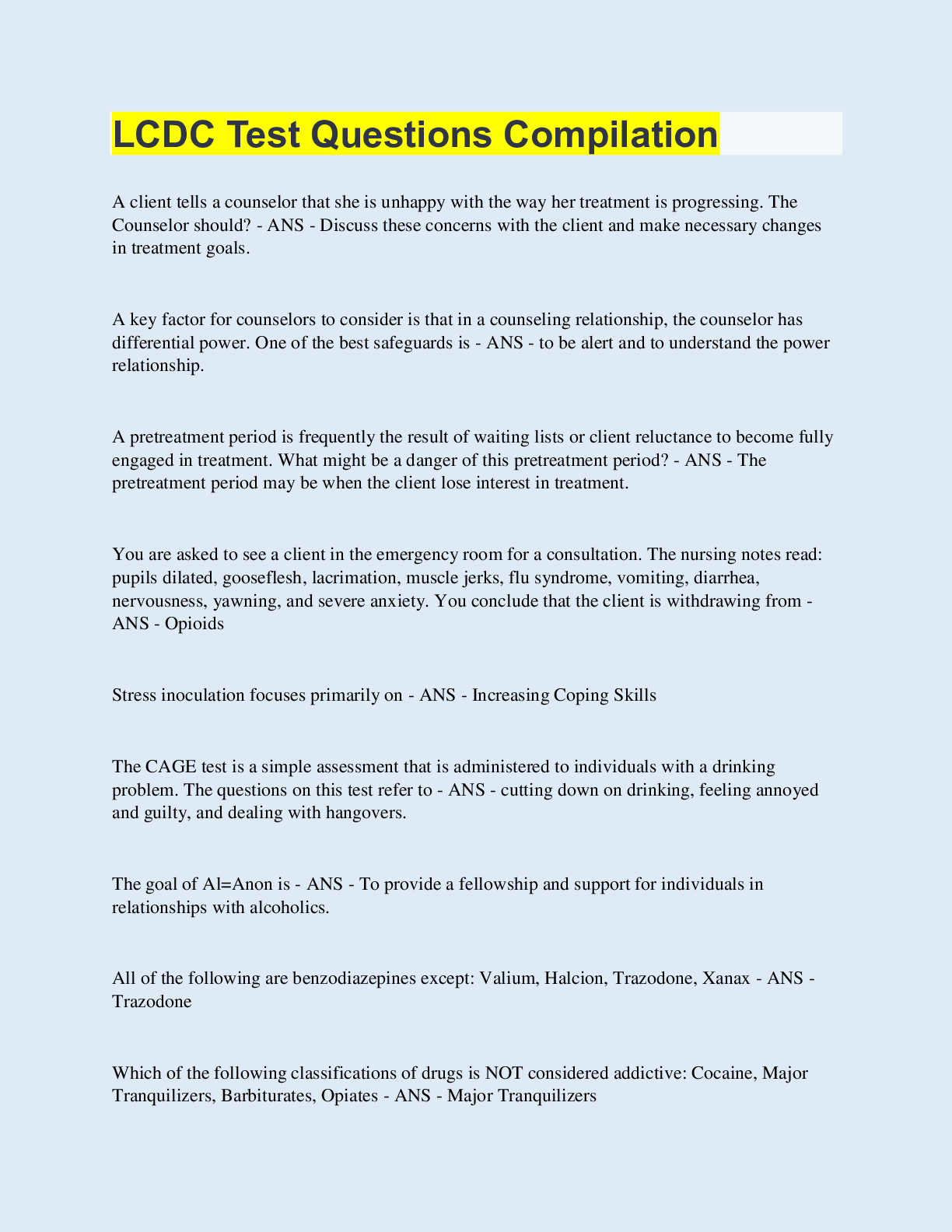
LCDC Test Questions Compilation
A client tells a counselor that she is unhappy with the way her treatment is progressing. The
Counselor should? - ANS - Discuss these concerns with the client and make necessary changes
in treatment goals.
A key factor for counselors to consider is that in a counseling relationship, the counselor has
differential power. One of the best safeguards is - ANS - to be alert and to understand the power
relationship.
A pretreatment period is frequently the result of waiting lists or client reluctance to become fully
engaged in treatment. What might be a danger of this pretreatment period? - ANS - The
pretreatment period may be when the client lose interest in treatment.
You are asked to see a client in the emergency room for a consultation. The nursing notes read:
pupils dilated, gooseflesh, lacrimation, muscle jerks, flu syndrome, vomiting, diarrhea,
nervousness, yawning, and severe anxiety. You conclude that the client is withdrawing from -
ANS - Opioids
Stress inoculation focuses primarily on - ANS - Increasing Coping Skills
The CAGE test is a simple assessment that is administered to individuals with a drinking
problem. The questions on this test refer to - ANS - cutting down on drinking, feeling annoyed
and guilty, and dealing with hangovers.
The goal of Al=Anon is - ANS - To provide a fellowship and support for individuals in
relationships with alcoholics.
All of the following are benzodiazepines except: Valium, Halcion, Trazodone, Xanax - ANS -
Trazodone
Which of the following classifications of drugs is NOT considered addictive: Cocaine, Major
Tranquilizers, Barbiturates, Opiates - ANS - Major Tranquilizers
Most of the alcohol ingested passes into the blood stream from the - ANS - Small Intestine
The MAST is most commonly used to screen for - ANS - Alcoholism
Homogeneity in a therapy group means - ANS - Only members who share the intended purpose
for the group should be in it
What are examples of cognitive distortion? - ANS - Dichotomous thinking, over-generalizing
and catastrophizing
All of the following are members of the Benzodiazepine family - ANS - Librium, Xanax,
Dalmane, Ativan
Client appears at her sessions lethargic, the whites of her eyes are red, and she seems to easily
lose track of the conversation. What drug is probable cause of her condition? - ANS - Marijuana
Characteristics does the Michigan Alcoholism Screening Test (MAST) poossess - ANS - It is
difficult for the client to fake and It may easily identify as alcoholics individuals who are not.
Child who does poorly in school, class clown, and tends to distract other children plays a role as
- ANS - Mascot
Despite vast personality differences, virtually all substance abusers experience - ANS - Remorse,
Self-hatred and Shame
Which theory are characterized by directive counseling which focuses on the here and now while
working to modify client thinking - ANS - Rational Emotive Therapy
Which theory is characterized by directive, interpretive counseling which focuses on what and
how not why and views dreams as important information - ANS - Gestalt Therapy
Which theory is characterized by the importance of counselor/client rapport, client selfevaluation and goal setting, and focuses on behavior, not emotion? - ANS - Reality Therapy
Twelve-Step self help programs can help a client in what following areas - ANS - Improving
social skills, establishing positive peer influence, establishing ongoing therapy, and improving
self-esteem
Which concept is not part of AA philosophy of alcoholism - ANS - Alcoholism can be cured by
will power
The process of a family rallying together to blame one member for all the family's problems is
called - ANS - Scapegoating
Providing crisis intervention, early diagnosis, crisis monitoring, and referral information to other
professionals is considered what type of prevention strategy - ANS - Secondary
Case management is - ANS - a coordinated approach to the delivery of health, substance abuse,
mental health, and social services so that clients are linked with appropriate services to
address specific needs and achieve stated goals (CSAT, 2000, p. 1).
The International
Certification & Reciprocity Consortium (IC&RC) includes case management as one of - ANS -
the 12 core functions, describing it as activities that bring services, agencies, resources or
people together within a planned framework of action toward the achievement of
established goals.
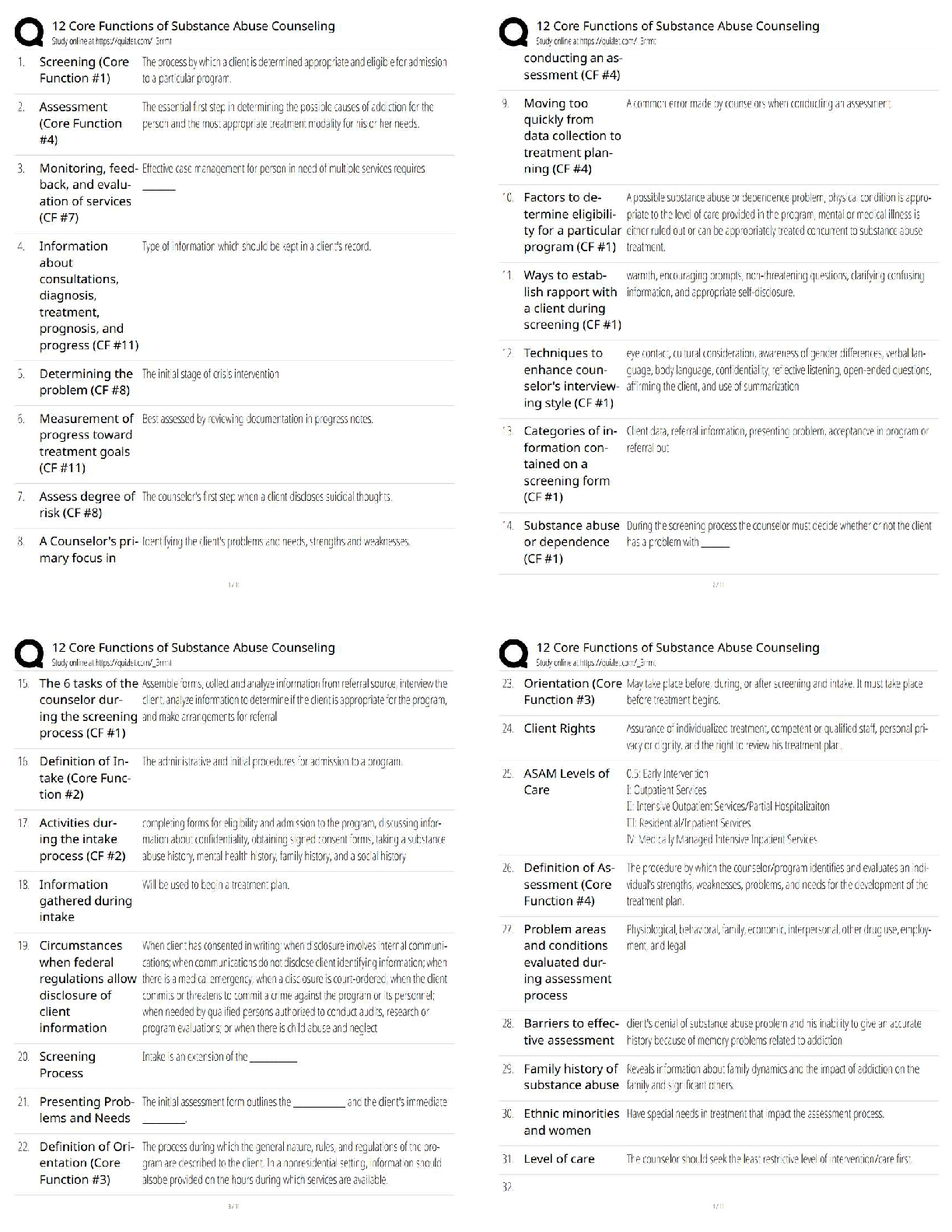
Which of the 12 core functions is case management? - ANS - Seven
Case management is one of the 12 core functions, the IC&RC - ANS - describes it as activities
that bring services, agencies, resources or
people together within a planned framework of action toward the achievement of
established goals.
A counselor may act as his or her clients' case manager, or a dedicated staff member may
be assigned case management duties for several counselors' clients. - ANS - In either situation,
case management is important because, in most cases, several different people are
involved in a client's comprehensive care, and they need to work together in a
coordinated way.
Clients' co-occurring disorders, physical illnesses, and disabilities - ANS - must
be considered in planning case management.
Case management is necessary - ANS - because
clients often have multiple needs, and it is rare that all of the necessary services are found
in one place.
Counselors need to explain - ANS - this rationale for case management to their
clients.
There are how many Functions of Case Management - ANS - Five
Assessment - ANS - Identify clients' strengths,
[Show More]