FINAL Chapter 27: Lower Respiratory Problems Lewis:
Medical-Surgical Nursing, 10th Edition 2022
After assessment of a patient with *pneumonia*, the nurse identifies a nursing
diagnosis of *ineffective airway clearan
...
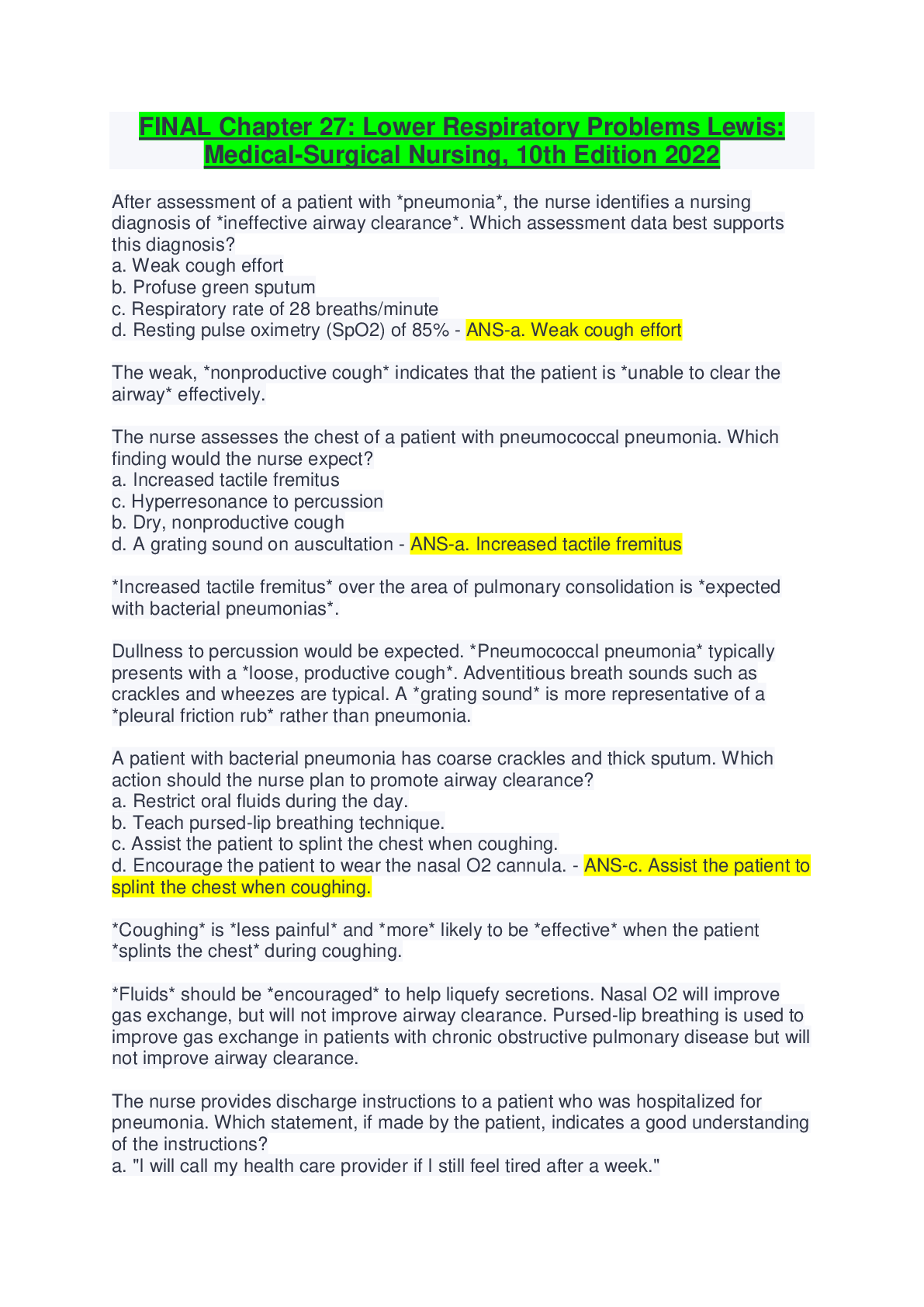
FINAL Chapter 27: Lower Respiratory Problems Lewis:
Medical-Surgical Nursing, 10th Edition 2022
After assessment of a patient with *pneumonia*, the nurse identifies a nursing
diagnosis of *ineffective airway clearance*. Which assessment data best supports
this diagnosis?
a. Weak cough effort
b. Profuse green sputum
c. Respiratory rate of 28 breaths/minute
d. Resting pulse oximetry (SpO2) of 85% - ANS-a. Weak cough effort
The weak, *nonproductive cough* indicates that the patient is *unable to clear the
airway* effectively.
The nurse assesses the chest of a patient with pneumococcal pneumonia. Which
finding would the nurse expect?
a. Increased tactile fremitus
c. Hyperresonance to percussion
b. Dry, nonproductive cough
d. A grating sound on auscultation - ANS-a. Increased tactile fremitus
*Increased tactile fremitus* over the area of pulmonary consolidation is *expected
with bacterial pneumonias*.
Dullness to percussion would be expected. *Pneumococcal pneumonia* typically
presents with a *loose, productive cough*. Adventitious breath sounds such as
crackles and wheezes are typical. A *grating sound* is more representative of a
*pleural friction rub* rather than pneumonia.
A patient with bacterial pneumonia has coarse crackles and thick sputum. Which
action should the nurse plan to promote airway clearance?
a. Restrict oral fluids during the day.
b. Teach pursed-lip breathing technique.
c. Assist the patient to splint the chest when coughing.
d. Encourage the patient to wear the nasal O2 cannula. - ANS-c. Assist the patient to
splint the chest when coughing.
*Coughing* is *less painful* and *more* likely to be *effective* when the patient
*splints the chest* during coughing.
*Fluids* should be *encouraged* to help liquefy secretions. Nasal O2 will improve
gas exchange, but will not improve airway clearance. Pursed-lip breathing is used to
improve gas exchange in patients with chronic obstructive pulmonary disease but will
not improve airway clearance.
The nurse provides discharge instructions to a patient who was hospitalized for
pneumonia. Which statement, if made by the patient, indicates a good understanding
of the instructions?
a. "I will call my health care provider if I still feel tired after a week."
b. "I will continue to do deep breathing and coughing exercises at home."
c. "I will schedule two appointments for the pneumonia and influenza vaccines."
d. "I will cancel my follow-up chest x-ray appointment if I feel better next week." -
ANS-b. "I will continue to do deep breathing and coughing exercises at home."
Which action should the nurse plan to prevent aspiration in a high-risk patient?
a. Turn and reposition an immobile patient at least every 2 hours.
b. Place a patient with altered consciousness in a side-lying position.
c. Insert a nasogastric tube for feeding a patient with high calorie needs.
d. Monitor respiratory symptoms in a patient who is immunosuppressed. - ANS-b.
Place a patient with altered consciousness in a side-lying position.
With loss of consciousness, the gag and cough reflexes are depressed, and
aspiration is more likely to occur. The risk for aspiration is decreased when patients
with a decreased level of consciousness are placed in a side-lying or upright
position.
A patient with right lower-lobe pneumonia has been treated with IV antibiotics for 3
days. Which assessment data obtained by the nurse indicates that the treatment is
effective?
a. Bronchial breath sounds are heard at the right base.
b. The patient coughs up small amounts of green mucus.
c. The patient's white blood cell (WBC) count is 9000/μL.
d. Increased tactile fremitus is palpable over the right chest. - ANS-c. The patient's
white blood cell (WBC) count is 9000/μL.
The normal WBC count indicates that the antibiotics have been effective. All the
other data suggest that a change in treatment is needed.
The health care provider writes an order for bacteriologic testing for a patient who
has a positive tuberculosis skin test. Which action should the nurse take?
a. Teach about the reason for the blood tests.
b. Schedule an appointment for a chest x-ray.
c. Teach the patient about providing specimens for 3 consecutive days.
d. Instruct the patient to collect several separate sputum specimens today. - ANS-c.
Teach the patient about providing specimens for 3 consecutive days.
Sputum specimens are obtained on 2 to 3 consecutive days for bacteriologic testing
for Mycobacterium tuberculosis. The patient should not provide all the specimens at
once. Blood cultures are not used for tuberculosis testing.
A patient is admitted with *active tuberculosis* (TB). The nurse should *question* a
health care provider's order to *discontinue airborne precautions* unless which
assessment finding is documented?
a. Chest x-ray shows no upper lobe infiltrates.
b. TB medications have been taken for 6 months.
c. Mantoux testing shows an induration of 10 mm.
d. Sputum smears for acid-fast bacilli are negative. - ANS-d. Sputum smears for
acid-fast bacilli are negative.
CONTINUES...
[Show More]