NYS Licensing Exam, Questions with accurate Answers. 100% verified.
Insurance - ✔✔institution or business that transfers risk by the accumulation of capital from the many to pay for the losses of the few
Property
...
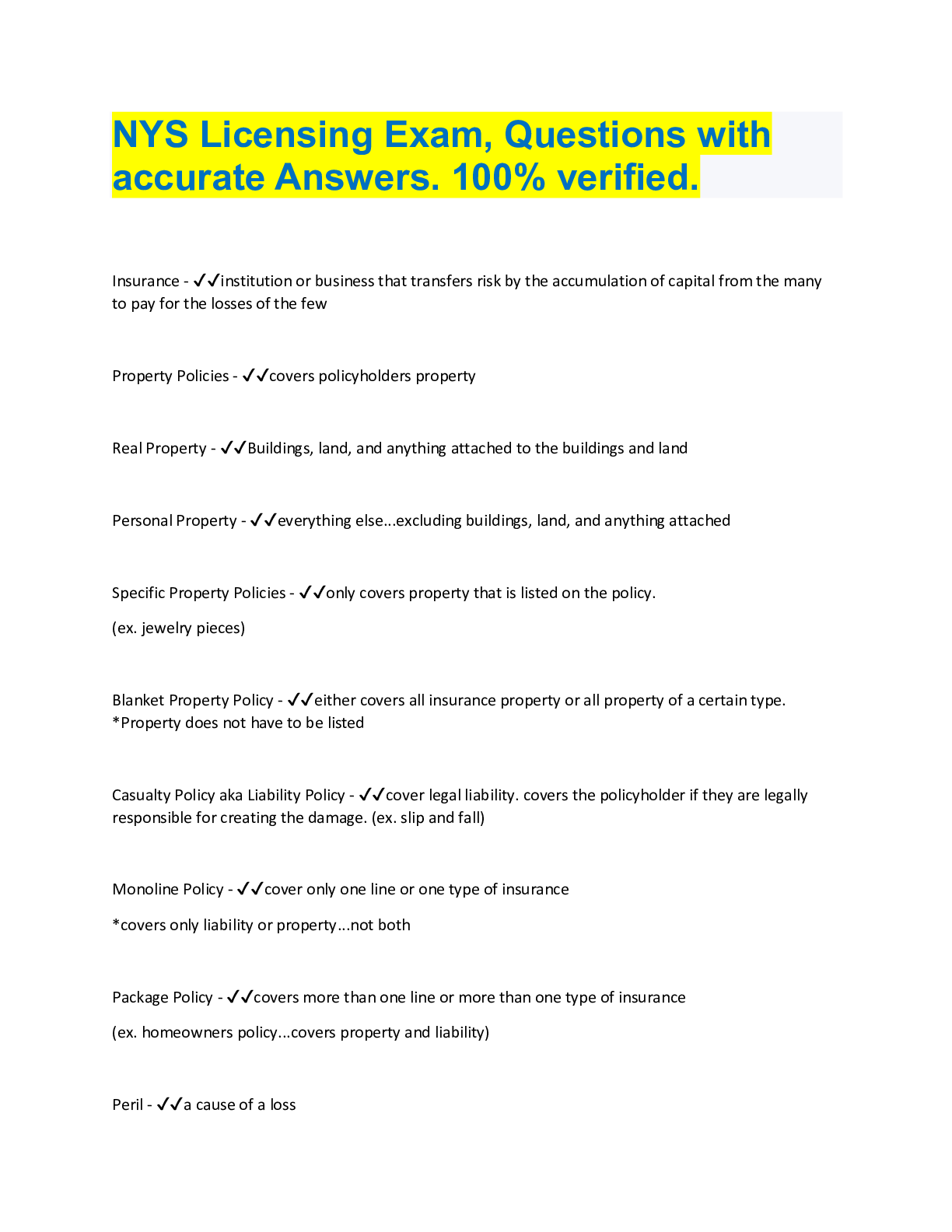
NYS Licensing Exam, Questions with accurate Answers. 100% verified.
Insurance - ✔✔institution or business that transfers risk by the accumulation of capital from the many to pay for the losses of the few
Property Policies - ✔✔covers policyholders property
Real Property - ✔✔Buildings, land, and anything attached to the buildings and land
Personal Property - ✔✔everything else...excluding buildings, land, and anything attached
Specific Property Policies - ✔✔only covers property that is listed on the policy.
(ex. jewelry pieces)
Blanket Property Policy - ✔✔either covers all insurance property or all property of a certain type. *Property does not have to be listed
Casualty Policy aka Liability Policy - ✔✔cover legal liability. covers the policyholder if they are legally responsible for creating the damage. (ex. slip and fall)
Monoline Policy - ✔✔cover only one line or one type of insurance
*covers only liability or property...not both
Package Policy - ✔✔covers more than one line or more than one type of insurance
(ex. homeowners policy...covers property and liability)
Peril - ✔✔a cause of a loss
(ex. fire, wind, rain...)
Named Peril Policy - ✔✔only covers perils that are listed on the policy. there will be a list. if its not on the list...its not covered. **if there is a dispute over whether a peril is covered it would be the policyholders responsibility to prove the coverage.
Proximate Cause - ✔✔first peril in an unbroken chain of events
Special Peril/Open Peril (All Risk) - ✔✔cover all perils except for those that are specifically excluded. If it doesn't state its not covered then it is covered. **if there is a dispute over whether something is covered it would be the insurance company's job to prove its not covered.
Loss - ✔✔unintentional decline, disappearance, or reduction in the value of property.
Direct Loss - ✔✔physical loss to property resulting from a peril. (ex. fire damage to a home)
Indirect Loss/Consequential Loss - ✔✔economic loss caused by a direct loss. (ex. hotel room because house burned down)
Risk - ✔✔uncertainty concerning loss. The chance of loss.
Speculative Risk - ✔✔chance of loss and the chance of gain. (ex. gambling)
*is NOT insurable
Pure Risk - ✔✔the chance of loss with no chance of gain. (ex. getting into an accident) * this IS insurable
Exposure - ✔✔condition or situation that presents the possibility of a loss. (ex. things..6 trucks = 6 exposures)
Hazard - ✔✔condition that increases the chance of a loss. (ex. basement filled with garbage)
Moral Hazard - ✔✔a hazard caused by policyholder's dishonesty. (ex. think about commiting a crime)
Morale Hazard - ✔✔a hazard caused by the policyholder's poor attitude. (doesn't care)
Physical Hazard - ✔✔caused by a material, structural, or operational condition. (frayed wires)
Offer and Acceptance - ✔✔(Agreement) one party must make an offer and the other party must accept the offer.
Offer - ✔✔is the policyholder submitting their application
Acceptance - ✔✔the insurance company issues a binder
Binder - ✔✔temporary contract for insurance. It can be written or verbal.
Competent Parties - ✔✔both parties must be mentally capable of understanding the contract.
Legal Purpose - ✔✔cannot have a binding contract on something illegal (ex. can't insure a warehouse w/ illegal drugs.)
Consideration - ✔✔each party must provide something to the other party. (ex. money, services, promises) *the minimum consideration that the policyholder can provide is the promise to pay premiums.*
Adhesion - ✔✔any ambiguity in the language of the contract will be interpreted in the favor of the policyholders.
Reasonable Expectations - ✔✔policy must cover what a reasonable policyholder would expect it to cover.
Indemnity Contract - ✔✔under an insurance contract payment is limited to financial loss. the policyholder should not gain from insurance...*put policyholder back into same position they were in before the loss**
Utmost Good Faith - ✔✔both parties are expected to act honestly and cooperate with each other.
Representation - ✔✔an affirmative statement that something is true at the time the statement was made. **true as of right now**
Misrepresentation - ✔✔the act of providing false information. can be intentinal or not.
Concealment - ✔✔withholding or hiding information. **very close to misrepresentation.
Fraud - ✔✔deliberate misrepresentation or concealment that does harm.
Claim Payment & Cancellation in regards to Misrepresentation, Concealment, or Fraud - ✔✔If the insurance company can prove that the fraud is material and because of this they would not have written the policy coverage can be denied. Applies when a policyholder tries to file a claim.
Warranty - ✔✔an affirmative statement that something is true and will be true for the entire policy (ex. working fire alarm system)
Insurable Interest - ✔✔financial stake in property at the time of the loss. (ex. own home at time of claim)
Waiver - ✔✔intentional and voluntary relinquishment of a right caused by actions taken or not taken.
Estoppel - ✔✔prevents a party from asserting a right that they already waived.
Aleatory - ✔✔insurance contracts are written on a contingent basis for the loss. One pary only required to act if something happens. (ex. insurance companies)
Personal Contracts - ✔✔they dont really pay for lost property. they pay for loss to insurable interest. (ex. building worth $200,000 insured for $200,000) **if you only owe 50% of building you will only get 50% of claim**
Unilateral Contracts - ✔✔insurance contracts are written by one party or one side. **because they are unilateral if anything is unclear the policyholder will be paid**
Conditional Contracts - ✔✔insurance policies contain a number of provisions that both parties must abide by. **if there is a loss the policyholder must report immediately**
Liberalizations - ✔✔any change in a policy that benefits new policyholders at no extra cost must be provided to all current policyholders. (ex. emergency roadside assistance)
Subrogation - ✔✔assignment of the policyholder's right to proceed against a neglegent third party to the insurance company. ***you give up your right to the insurance company to go after guilty party** It is to prevent policy holder from collecting twice and holds neglegent party responsible for their actions
Constructive Total Loss - ✔✔situation where the loss is not a total loss but for the practical reasons the insurance company pays a total loss.
Salvage - ✔✔applies when the insurance company pays total loss and then takes possession of the property. They take it so they can profit from it. **can apply to total loss
Named Insured - ✔✔any party listed as an insured on the policy *if named insured dies the coverage and rights transfer over to their legal rep*
First Named Insured - ✔✔the first name that is listed on the policy. **the insurance company is only required to communicate with the first named on policy. **if the first name is removed the second becomes the first and so on. ***in case of death the legal rep gets all the rights.
Additional Interest - ✔✔party who is listed on the policy because of their interest in the property. (ex. lien holder)
Loss Payable Clause - ✔✔adds additional interest to the policy
Assignment - ✔✔(a rule) transfer..the policyholder cannot assign insurance coverage without the insurance company's consent
Abandonment - ✔✔the policyholder cannot abandon property to the insurance company without the insurance company's consent (ex. brand new car gets in accident and policyholder demands new car)
Policy Period/Policy Term - ✔✔the effective date of policy to the expiration date of policy. **usually one year policy**
Policy Territory - ✔✔almost every insurance policy will have a territory clause. where the policy is effective
Standard - ✔✔policy is effective in the USA, USA possesions, Puerto Rico, and Canada (poss: US Virgin Islands, Guam, American Samoa)
Worldwide - ✔✔some policies provide coverage worldwide
Notice Given - ✔✔stop a policy before the expiration. a policyholder can cancel at any time. **the insurance company must always give notice. **non-payment of premiums = 15 days, any other reason = 20 days notice**
Non-Renewal - ✔✔policy will expire and the insurance company will not renew policy. ***insurance company must mail paperwork between 60-45 days before policy is up..must be mailed in 15 day window**
Pro Rate/Pro Rata - ✔✔the insurance company keeps earned premium and returns the rest. **if insurance company cancels they must give back at least the pro rate back.
Earned Premium - ✔✔premium for time policy was effective
Flat Rate - ✔✔full premium return. **applies when policy never took effect.
Rescession - ✔✔annulment of the policy. as if the policy never existed. usually flat rate return
Loss Valuation/Basis of Recovery - ✔✔method the insurance company uses to value property. **the way insurance company values property decides how much policyholder gets back**
Market Value - ✔✔selling price of property. **it is almost never used for insurance purposes**
Replacement Cost - ✔✔cost to replace property with a new version of property **most homeowners policy give customers replacement cost**
Functional Replacement Cost - ✔✔cost to replace property using modern materials and construction methods. **insurance company says they will build a house with the same functionality**
Stated Amount/Agreed Value - ✔✔both parties agree on value of property before the policy starts. **used for items difficult to value-collectible, antique cars***required appraisal**
Actual Cash Value (ACV) - ✔✔cost to replace property with property of the same like, kind, and quality. **depreciation of product taken into consideration**
[Show More]