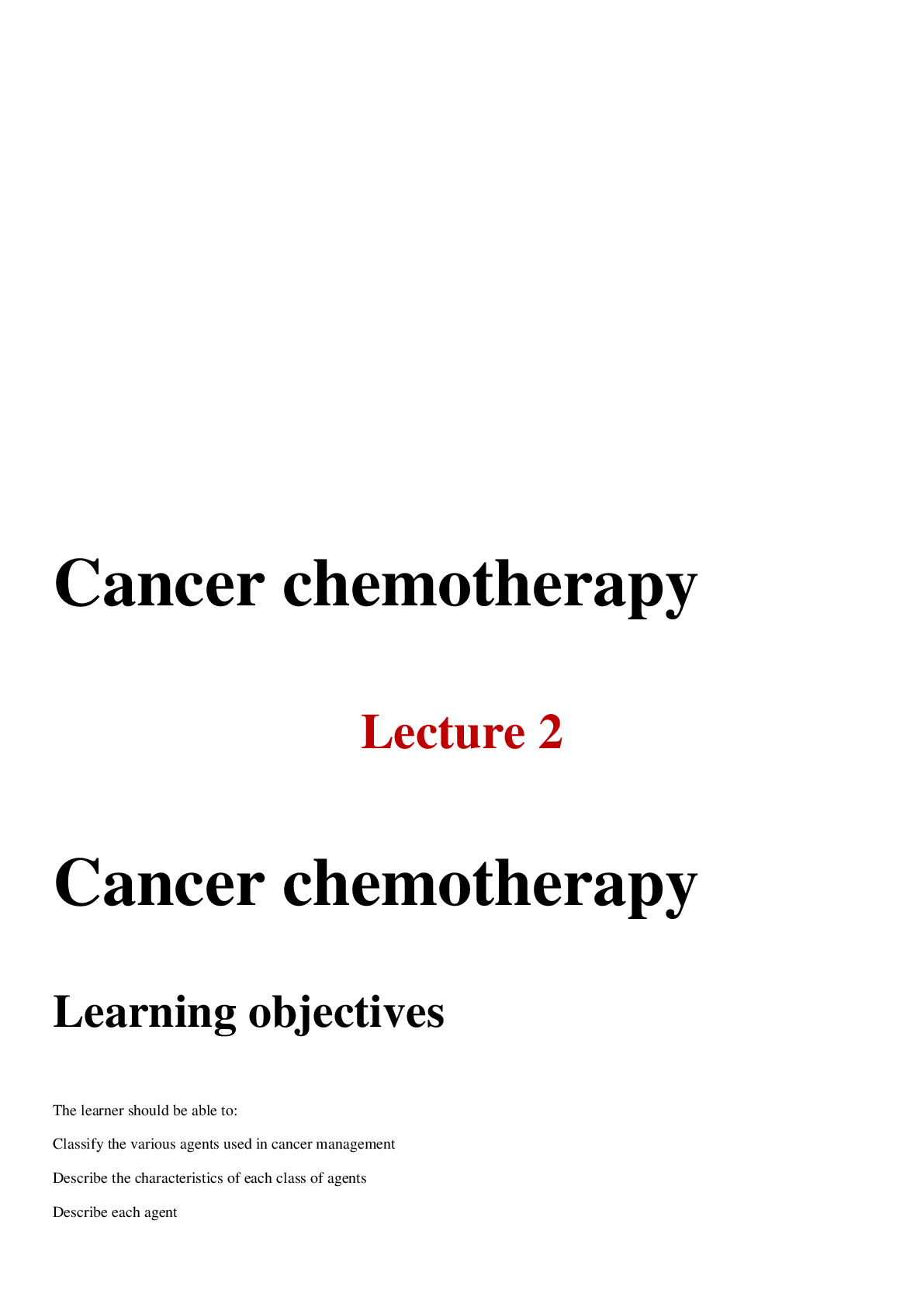
Pharmacology > LECTURE SLIDES/NOTES > Cancer chemotherapy Detailed Notes (All)
Classification of anticancer agents Classes • Alkylating agents • Anti metabolites • Plant derived agents & derivatives • Antibiotics • Enzymes • Hormones & analogues • Targeted ... Therapies • Miscellaneous ALKYLATING AGENTS Sub-classes • Nitrogen mustards e.g. mechlorethamine synomyn nitrogen mustard, cyclophosphamide, ifosfamide , trofosfamide, melphalan (L-sarcolysine), chlorambucil, Uramustine (uracil mustard), bendamustine (mechlorethamine derivative) • Alkyl sulphonates – Busulfan • Nitrosoureas – Carmustine (BCNU) Lomustine (CCNU) semustine (methyl CCNU) – Streptozocin (streptozotocin) • Triazenes – Dacarbazine ( or DTIC) • Ethyleneimines & methylmelamines– Triethylenemelamine (TEM) thiopeta (Triethylene thiophosphoramide) Hexamethylmelamine (HMM) • Platinum containing complexes- Cisplatin,carboplatin, Oxaliplatin General Mechanism of Action • Effects of these compounds to some extent resembles those of X-ray radiation and for this reason, they are sometimes referred to as radiomimetics • undergo strongly electrophilic chemical reactions through the formation of carbonium ion intermediates or formation of transition complexes with the target molecules • Readily form covalent linkages (i.e. alkylation) with various nucleophilic cell constituents such as phosphates, amino, sulfhydryl, hydroxyl, carboxyl and imidazole groups. General Mechanism of Action • The main target for expression of cytotoxic effect is the DNA • The 7 nitrogen atom of guanine is strongly nucleophillic and therefore particularly susceptible to the formation of a covalent bond with both monofunctional and bifunctional alkylators and is the main purine base that is affected. • other atoms in the purine and pyrimidine bases of DNA e.g. the 1 or 3 nitrogens of adenine, the 3-nitrogen of cytosine, and the 6 – oxygen of guanine alkylated but to a lesser degree, • phosphate atoms of the DNA chains and proteins associated with DNA can also be alkylated. General Mechanism of Action • Naturally, Guanine exists predominantly as the Keto tautomer in DNA • readily forms bases pairs by hydrogen bonding with cytosine residues. • 7 nitrogen alkylated to become a quartenary ammonium nitrogen • becomes more acidic and the enol tautomer predominates. • guanine then forms base pairs with thymine instead of cytosine 1. Miscoding may follow with the ultimate substitution of adenine thymine base pair for guanine-cytosine base pair. 2. Alkylation of the 7 nitrogen labializes the imidazole ring – the ring opens while still remaining part of the DNA molecule – or excision of guanine residue (guanine expelled) from the DNA chain, – either effect leads to serious damage to the DNA molecule with the later case making the DNA molecule unstable and may break. 3. Bifunctional agents e.g. nitrogen mustard [Show More]
Last updated: 3 years ago
Preview 1 out of 24 pages
Buy this document to get the full access instantly
Instant Download Access after purchase
Buy NowInstant download
We Accept:
Detailed notes on tumor markers and some of the most commonly used chemotherapeutic agents.
By SmartDr 3 years ago
$25.5
4
Can't find what you want? Try our AI powered Search
Connected school, study & course
About the document
Uploaded On
Oct 14, 2022
Number of pages
24
Written in
All
This document has been written for:
Uploaded
Oct 14, 2022
Downloads
0
Views
186
Scholarfriends.com Online Platform by Browsegrades Inc. 651N South Broad St, Middletown DE. United States.
We're available through e-mail, Twitter, Facebook, and live chat.
FAQ
Questions? Leave a message!
Copyright © Scholarfriends · High quality services·