*NURSING  >  QUESTIONS & ANSWERS  >  Chapter 49: Endocrine Problems Lewis: Medical-Surgical Nursing, 10th Edition (All)

Chapter 49: Endocrine Problems Lewis: Medical-Surgical Nursing, 10th Edition

Document Content and Description Below

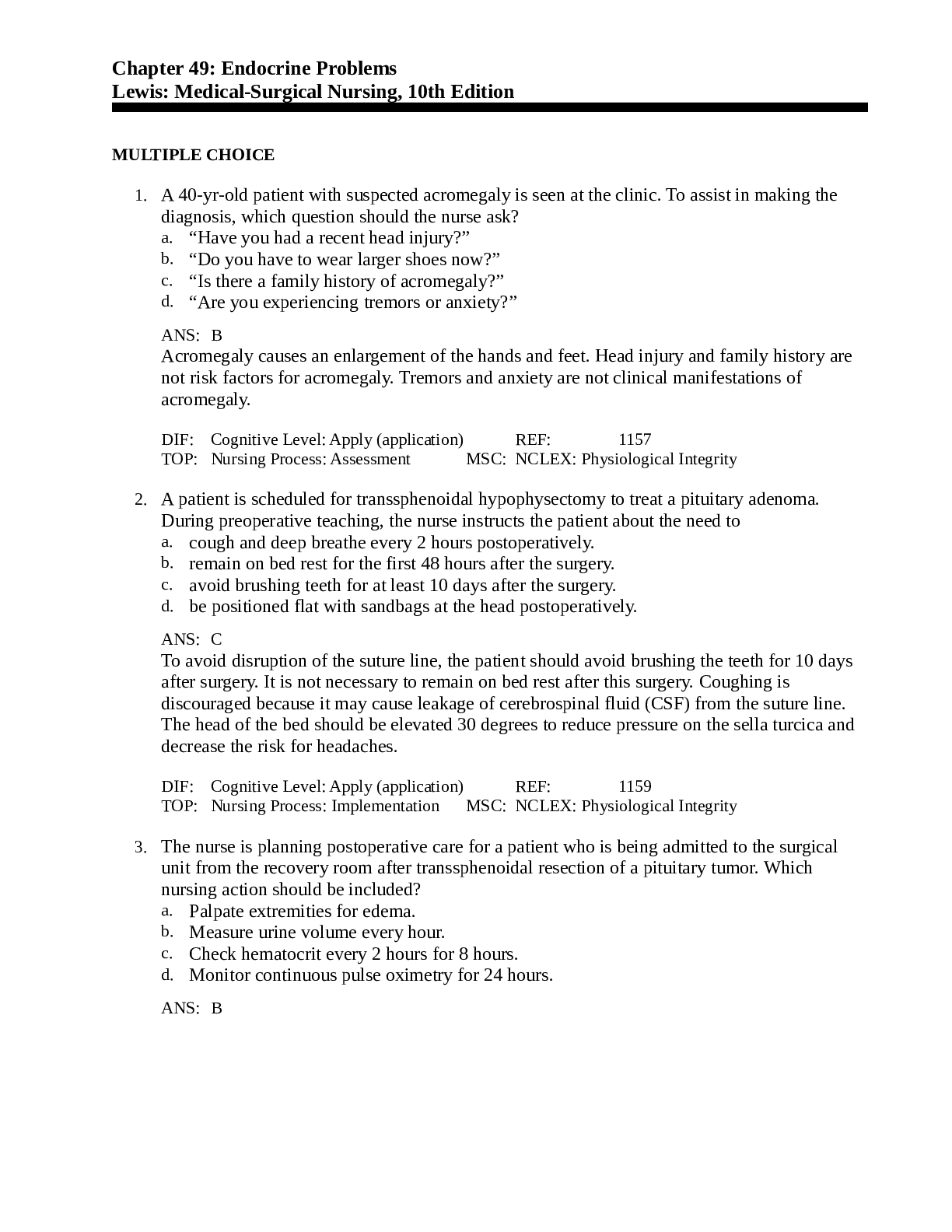
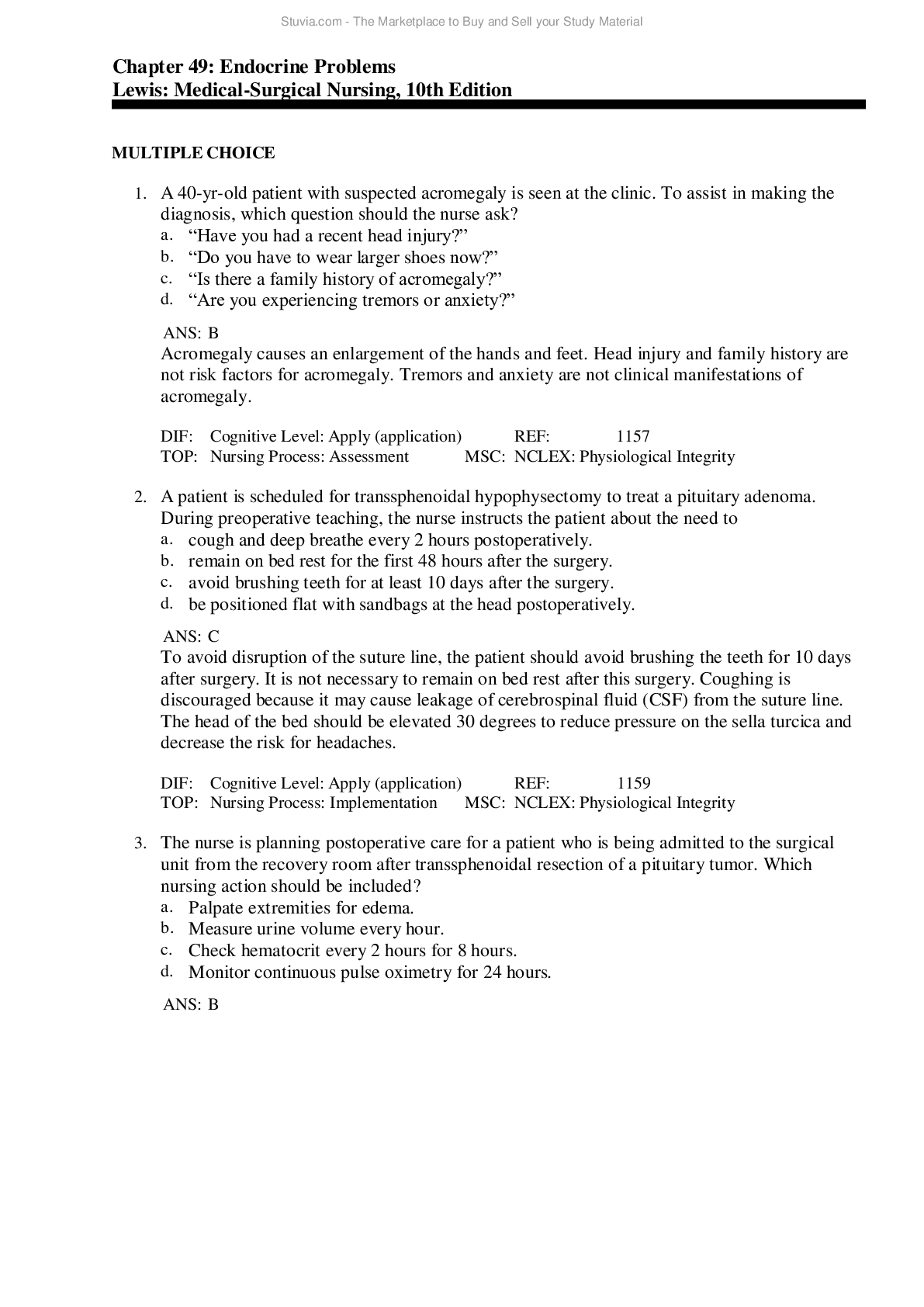
Chapter 49: Endocrine Problems Lewis: Medical-Surgical Nursing, 10th Edition MULTIPLE CHOICE 1. A 40-yr-old patient with suspected acromegaly is seen at the clinic. To assist in making the diagnos ... is, which question should the nurse ask? a. “Have you had a recent head injury?” b. “Do you have to wear larger shoes now?” c. “Is there a family history of acromegaly?” d. “Are you experiencing tremors or anxiety?” ANS: B Acromegaly causes an enlargement of the hands and feet. Head injury and family history are not risk factors for acromegaly. Tremors and anxiety are not clinical manifestations of acromegaly. DIF: Cognitive Level: Apply (application) REF: 1157 TOP: Nursing Process: Assessment MSC: NCLEX: Physiological Integrity 2. A patient is scheduled for transsphenoidal hypophysectomy to treat a pituitary adenoma. During preoperative teaching, the nurse instructs the patient about the need to a. cough and deep breathe every 2 hours postoperatively. b. remain on bed rest for the first 48 hours after the surgery. c. avoid brushing teeth for at least 10 days after the surgery. d. be positioned flat with sandbags at the head postoperatively. ANS: C To avoid disruption of the suture line, the patient should avoid brushing the teeth for 10 days after surgery. It is not necessary to remain on bed rest after this surgery. Coughing is discouraged because it may cause leakage of cerebrospinal fluid (CSF) from the suture line. The head of the bed should be elevated 30 degrees to reduce pressure on the sella turcica and decrease the risk for headaches. DIF: Cognitive Level: Apply (application) REF: 1159 TOP: Nursing Process: Implementation MSC: NCLEX: Physiological Integrity 3. The nurse is planning postoperative care for a patient who is being admitted to the surgical unit from the recovery room after transsphenoidal resection of a pituitary tumor. Which nursing action should be included? a. Palpate extremities for edema. b. Measure urine volume every hour. c. Check hematocrit every 2 hours for 8 hours. d. Monitor continuous pulse oximetry for 24 hours. ANS: B After pituitary surgery, the patient is at risk for diabetes insipidus caused by cerebral edema. Monitoring of urine output and urine specific gravity is essential. Hemorrhage is not a common problem. There is no need to check the hematocrit hourly. The patient is at risk for dehydration, not volume overload. The patient is not at high risk for problems with oxygenation, and continuous pulse oximetry is not needed. DIF: Cognitive Level: Apply (application) REF: 1159 TOP: Nursing Process: Planning MSC: NCLEX: Physiological Integrity 4. The nurse is assessing a male patient diagnosed with a pituitary tumor causing panhypopituitarism. Assessment findings consistent with panhypopituitarism include a. high blood pressure. c. elevated blood glucose. b. decreased facial hair. d. tachycardia and palpitations. ANS: B Changes in male secondary sex characteristics such as decreased facial hair, testicular atrophy, diminished spermatogenesis, loss of libido, impotence, and decreased muscle mass are associated with decreases in follicle-stimulating hormone (FSH) and luteinizing hormone (LH). Fasting hypoglycemia and hypotension occur in panhypopituitarism as a result of decreases in adrenocorticotropic hormone (ACTH) and cortisol. Bradycardia is likely due to the decrease in thyroid-stimulating hormone (TSH) and thyroid hormones associated with panhypopituitarism. DIF: Cognitive Level: Apply (application) REF: 1158 TOP: Nursing Process: Assessment MSC: NCLEX: Physiological Integrity 5. Which information will the nurse include when teaching a 50-yr-old male patient about somatropin (Genotropin)? a. The medication will be needed for 3 to 6 months. b. Inject the medication subcutaneously every day. c. Blood glucose levels may decrease when taking the medication. d. Stop taking the medication if swelling of the hands or feet occurs. ANS: B Somatropin is injected subcutaneously on a daily basis, preferably in the evening. The patient will need to continue on somatropin for life. If swelling or other common adverse effects occur, the health care provider should be notified. Growth hormone will increase blood glucose levels. DIF: Cognitive Level: Apply (application) REF: 1158 TOP: Nursing Process: Implementation MSC: NCLEX: Physiological Integrity 6. The nurse determines that demeclocycline is effective for a patient with syndrome of inappropriate antidiuretic hormone (SIADH) based on finding that the patient’s a. weight has increased. c. peripheral edema is increased. b. urinary output is increased. d. urine specific gravity is increased. ANS: B Demeclocycline blocks the action of antidiuretic hormone (ADH) on the renal tubules and increases urine output. An increase in weight or an increase in urine specific gravity indicates that the SIADH is not corrected. Peripheral edema does not occur with SIADH. A sudden weight gain without edema is a common clinical manifestation of this disorder. DIF: Cognitive Level: Apply (application) REF: 1160 TOP: Nursing Process: Evaluation MSC: NCLEX: Physiological Integrity [Show More]

Last updated: 3 years ago

Preview 1 out of 15 pages

Buy Now

Instant download

We Accept:

Payment methods accepted on Scholarfriends (We Accept)
Preview image of Chapter 49: Endocrine Problems Lewis: Medical-Surgical Nursing, 10th Edition document

Buy this document to get the full access instantly

Instant Download Access after purchase

Buy Now

Instant download

We Accept:

Payment methods accepted on Scholarfriends (We Accept)

Reviews( 0 )

$6.50

Buy Now

We Accept:

Payment methods accepted on Scholarfriends (We Accept)

Instant download

Can't find what you want? Try our AI powered Search

183
0

Document information


Connected school, study & course


About the document


Uploaded On

Oct 16, 2022

Number of pages

15

Written in

All

Seller


Profile illustration for Professor Lynne
Professor Lynne

Member since 4 years

372 Documents Sold

Reviews Received
34
13
4
0
4
Additional information

This document has been written for:

Uploaded

Oct 16, 2022

Downloads

 0

Views

 183

Document Keyword Tags

More From Professor Lynne

View all Professor Lynne's documents »

$6.50
What is Scholarfriends

Scholarfriends.com Online Platform by Browsegrades Inc. 651N South Broad St, Middletown DE. United States.

We are here to help

We're available through e-mail, Twitter, and live chat.
 FAQ
 Questions? Leave a message!


Copyright © Scholarfriends · High quality services·