ATI PSYCHOLOGY EXAM REVISION NOTES 2022
Cognitive Approach
(Cognitive approach concentrates on how our mind works – looks at internal mental processes such as attention, thinking and memory. It sees human mind like
...
ATI PSYCHOLOGY EXAM REVISION NOTES 2022
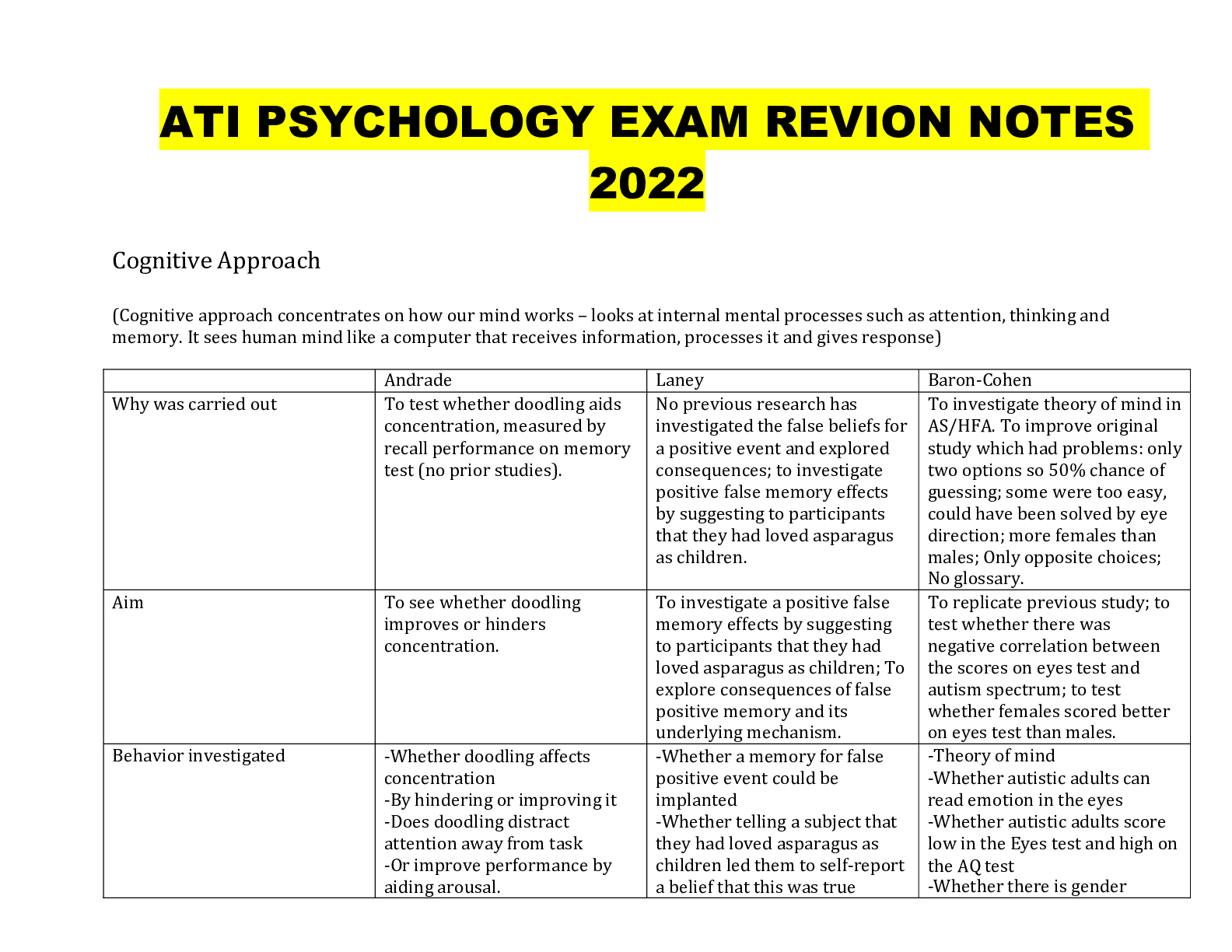
Cognitive Approach
(Cognitive approach concentrates on how our mind works – looks at internal mental processes such as attention, thinking and memory. It sees human mind like a computer that receives information, processes it and gives response)
Andrade Laney Baron-Cohen
Why was carried out To test whether doodling aids concentration, measured by recall performance on memory test (no prior studies). No previous research has investigated the false beliefs for a positive event and explored consequences; to investigate positive false memory effects by suggesting to participants that they had loved asparagus as children. To investigate theory of mind in AS/HFA. To improve original study which had problems: only two options so 50% chance of guessing; some were too easy, could have been solved by eye direction; more females than males; Only opposite choices;
No glossary.
Aim To see whether doodling improves or hinders concentration. To investigate a positive false memory effects by suggesting to participants that they had loved asparagus as children; To explore consequences of false positive memory and its
underlying mechanism. To replicate previous study; to test whether there was negative correlation between the scores on eyes test and autism spectrum; to test whether females scored better
on eyes test than males.
Behavior investigated -Whether doodling affects concentration
-By hindering or improving it
-Does doodling distract attention away from task
-Or improve performance by aiding arousal. -Whether a memory for false positive event could be implanted
-Whether telling a subject that they had loved asparagus as children led them to self-report a belief that this was true -Theory of mind
-Whether autistic adults can read emotion in the eyes
-Whether autistic adults score low in the Eyes test and high on the AQ test
-Whether there is gender
memory
-Whether a false positive belief for asparagus led to consequences such as
willingness to order it in restaurant. difference.
Why cognitive approach Andre studies cognitive process of attention and how a secondary task such as doodling may hinder/improve performance on a primary task, if doodling will aid concentration assessed by memory task. Laney studies cognitive process of memory. Tries to implant positive false memory for loving asparagus as a child and the consequences of this in terms of whether someone would order it in restaurant and in exp.2 whether the
picture of asparagus made it more appealing. Baron-Cohen is investigating cognitive process of Theory of mind in AS/HFA through eyes test, which measures first stage of theory of mind – attributing a relevant mental state.
IV and DV IV: doodling and non-doodling DV: Mean correct recall, false alarms and memory scores. IV: love group and control group; believers and non- believers
DV: ratings on critical items on both questionnaires in sessions 1&2, comparison. IV: autistic or not; males or females
DV: Scores on eyes test and AQ.
Sample Opportunity sampling; 40 subjects, only 5 males; UK. Volunteer sampling; received credit for participating; 128 undergraduates 77% females (exp.1); 103 undergraduates – received course credits (exp. 2) Group 1-volunteer sampling via magazine, 15 males AS/HFA; Group 2-opportunity sampling, 122 normal adults from Exeter or Cambridge public library users;
Group 3-opportunity sampling, 103 undergraduates at
Cambridge university (53
males 50 females);
Group 4-random sampling, 14 randomly selected adults who were matched for IQ with group 1.
How was data collected (Quantitative data) By asking them to listen to tape and write down the names of ppl attending party; in surprise memory test asked them to recall names of ppl and places mentioned in the tape. Questionnaires: FHI; Restaurant questionnaires and others; then same questionnaires again and others (like food cost questionnaire; memory or
belief), exp.2 rated photographs. +Questionnaires. Some participants were asked to complete AQ test (self-report questionnaire), all of them had to look at pictures of people and complete eyes test – multiple-choice questionnaires.
Findings -In number of correct names written down doodling scored more (7.8) than control (7.1)
-On memory test on names doodling scored mean more (7.5) than Control (5.8). -In exp.1 subjects in love condition had higher mean rating (4.20) for loving asparagus in the post test compared to pre-test results (1.70) in FHI
-In post test FHI participants in love condition had higher mean score (4.20) than control group
(2.52) -In Eyes test AS/HFA group (1) scored 21.9 wile matched group (4) scored significantly higher 30.9
-In AQ test AS/HFA group (1) scored 34.4 while matched group scored significantly lower 18.9.
Conclusions -People in doodling condition concentrated better on primary task than ppl who only listened to tape, nothing else
-Doodling aids concentration
-Doodling may help to stabilize -Exp. 1 concluded that it is possible to implant false positive memory
-Exp. 1 concluded that implanting false positive beliefs
leads to consequences (e.g. -AS/HFA group score significantly high on AQ test but significantly low on eyes test compared to general population
-AS/HFA has difficulties in
arousal
-May reduce daydreaming more likely to order in restaurant)
-Exp. 2 concluded that those who believed false feedback were more likely to rate asparagus more appetizing and
less disgusting. reading peoples feelings through their eyes/attribution stage of theory of mind
-Females are more likely to read others emotions since they scored better on eyes test.
-Application to everyday life Useful for students when they are revising (doodling will help to concentrate) For children who are “fussy eaters”. If they don’t like healthy food (fruits/vegetables), doctors
could use similar procedure to make them believe they love healthy food and change habits
to eat better. Use eyes test as a way of teaching autistic individuals how to read emotions in the eyes. This could also be used as a diagnostic aid for autism.
Cognitive Approach
(Cognitive approach concentrates on how our mind works – looks at internal mental processes such as attention, thinking and memory. It sees human mind like a computer that receives information, processes it and gives response)
Andrade Laney Baron-Cohen
Why was carried out To test whether doodling aids concentration, measured by recall performance on memory test (no prior studies). No previous research has investigated the false beliefs for a positive event and explored consequences; to investigate positive false memory effects by suggesting to participants that they had loved asparagus as children. To investigate theory of mind in AS/HFA. To improve original study which had problems: only two options so 50% chance of guessing; some were too easy, could have been solved by eye direction; more females than males; Only opposite choices;
No glossary.
Aim To see whether doodling improves or hinders concentration. To investigate a positive false memory effects by suggesting to participants that they had loved asparagus as children; To explore consequences of false positive memory and its
underlying mechanism. To replicate previous study; to test whether there was negative correlation between the scores on eyes test and autism spectrum; to test whether females scored better
on eyes test than males.
Behavior investigated -Whether doodling affects concentration
-By hindering or improving it
-Does doodling distract attention away from task
-Or improve performance by aiding arousal. -Whether a memory for false positive event could be implanted
-Whether telling a subject that they had loved asparagus as children led them to self-report a belief that this was true -Theory of mind
-Whether autistic adults can read emotion in the eyes
-Whether autistic adults score low in the Eyes test and high on the AQ test
-Whether there is gender
memory
-Whether a false positive belief for asparagus led to consequences such as
willingness to order it in restaurant. difference.
Why cognitive approach Andre studies cognitive process of attention and how a secondary task such as doodling may hinder/improve performance on a primary task, if doodling will aid concentration assessed by memory task. Laney studies cognitive process of memory. Tries to implant positive false memory for loving asparagus as a child and the consequences of this in terms of whether someone would order it in restaurant and in exp.2 whether the
picture of asparagus made it more appealing. Baron-Cohen is investigating cognitive process of Theory of mind in AS/HFA through eyes test, which measures first stage of theory of mind – attributing a relevant mental state.
IV and DV IV: doodling and non-doodling DV: Mean correct recall, false alarms and memory scores. IV: love group and control group; believers and non- believers
DV: ratings on critical items on both questionnaires in sessions 1&2, comparison. IV: autistic or not; males or females
DV: Scores on eyes test and AQ.
Sample Opportunity sampling; 40 subjects, only 5 males; UK. Volunteer sampling; received credit for participating; 128 undergraduates 77% females (exp.1); 103 undergraduates – received course credits (exp. 2) Group 1-volunteer sampling via magazine, 15 males AS/HFA; Group 2-opportunity sampling, 122 normal adults from Exeter or Cambridge public library users;
Group 3-opportunity sampling, 103 undergraduates at
Cambridge university (53
males 50 females);
Group 4-random sampling, 14 randomly selected adults who were matched for IQ with group 1.
How was data collected (Quantitative data) By asking them to listen to tape and write down the names of ppl attending party; in surprise memory test asked them to recall names of ppl and places mentioned in the tape. Questionnaires: FHI; Restaurant questionnaires and others; then same questionnaires again and others (like food cost questionnaire; memory or
belief), exp.2 rated photographs. +Questionnaires. Some participants were asked to complete AQ test (self-report questionnaire), all of them had to look at pictures of people and complete eyes test – multiple-choice questionnaires.
Findings -In number of correct names written down doodling scored more (7.8) than control (7.1)
-On memory test on names doodling scored mean more (7.5) than Control (5.8). -In exp.1 subjects in love condition had higher mean rating (4.20) for loving asparagus in the post test compared to pre-test results (1.70) in FHI
-In post test FHI participants in love condition had higher mean score (4.20) than control group
(2.52) -In Eyes test AS/HFA group (1) scored 21.9 wile matched group (4) scored significantly higher 30.9
-In AQ test AS/HFA group (1) scored 34.4 while matched group scored significantly lower 18.9.
Conclusions -People in doodling condition concentrated better on primary task than ppl who only listened to tape, nothing else
-Doodling aids concentration
-Doodling may help to stabilize -Exp. 1 concluded that it is possible to implant false positive memory
-Exp. 1 concluded that implanting false positive beliefs
leads to consequences (e.g. -AS/HFA group score significantly high on AQ test but significantly low on eyes test compared to general population
-AS/HFA has difficulties in
arousal
-May reduce daydreaming more likely to order in restaurant)
-Exp. 2 concluded that those who believed false feedback were more likely to rate asparagus more appetizing and
less disgusting. reading peoples feelings through their eyes/attribution stage of theory of mind
-Females are more likely to read others emotions since they scored better on eyes test.
-Application to everyday life Useful for students when they are revising (doodling will help to concentrate) For children who are “fussy eaters”. If they don’t like healthy food (fruits/vegetables), doctors
could use similar procedure to make them believe they love healthy food and change habits
to eat better. Use eyes test as a way of teaching autistic individuals how to read emotions in the eyes. This could also be used as a diagnostic aid for autism.
[Show More]




 (1).png)