1. Question :
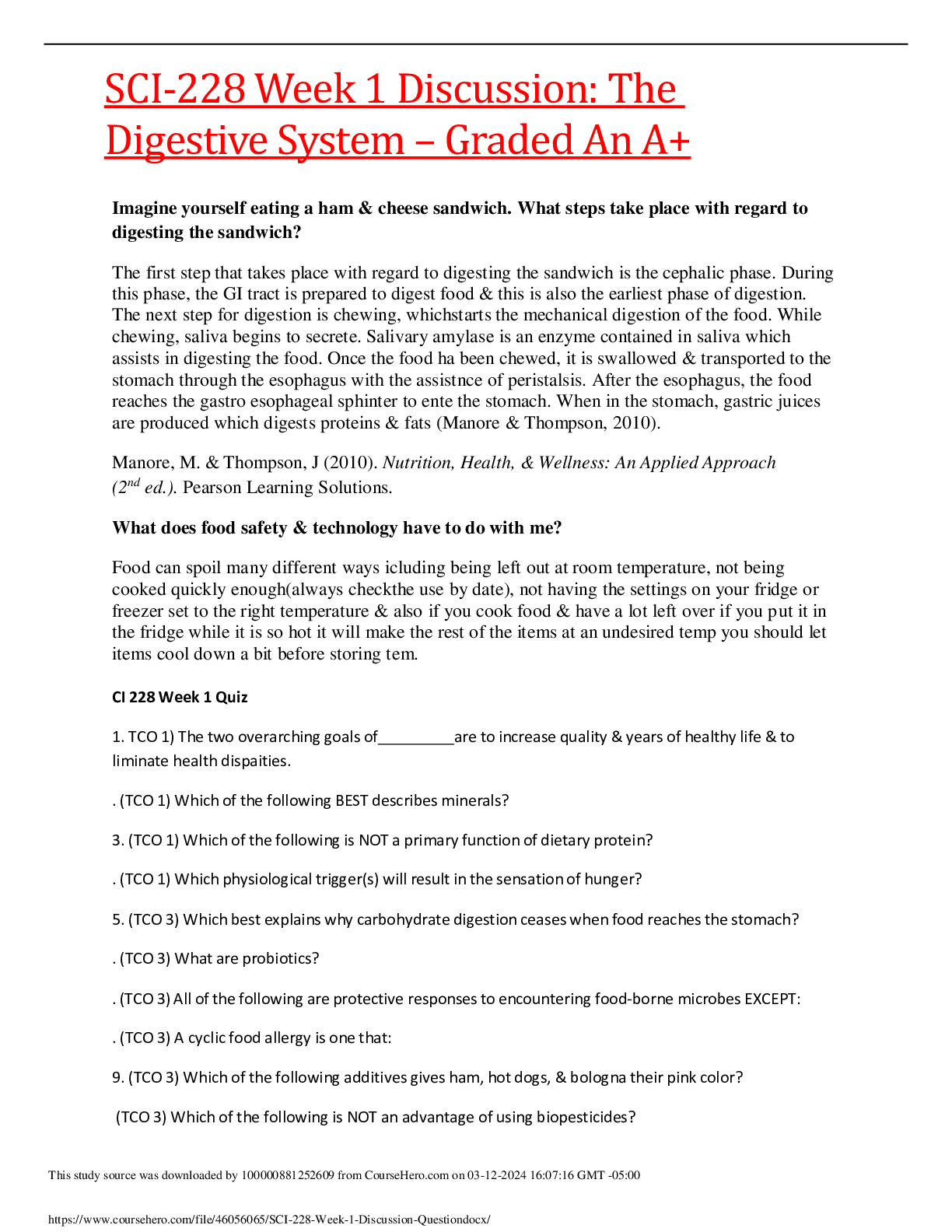
(TCO 1) Which of the following BESTdescribes minerals?
Student Answer:
Micronutrients that are broken down easily during digestion Micronutrients that are easily destroy
...
1. Question :
(TCO 1) Which of the following BESTdescribes minerals?
Student Answer:
Micronutrients that are broken down easily during digestion Micronutrients that are easily destroyed by heat & light Inorganic micronutrients found in a variety of foods
Nutrients that are needed in large amounts by the body
Instructor Explanation: Chapter 1
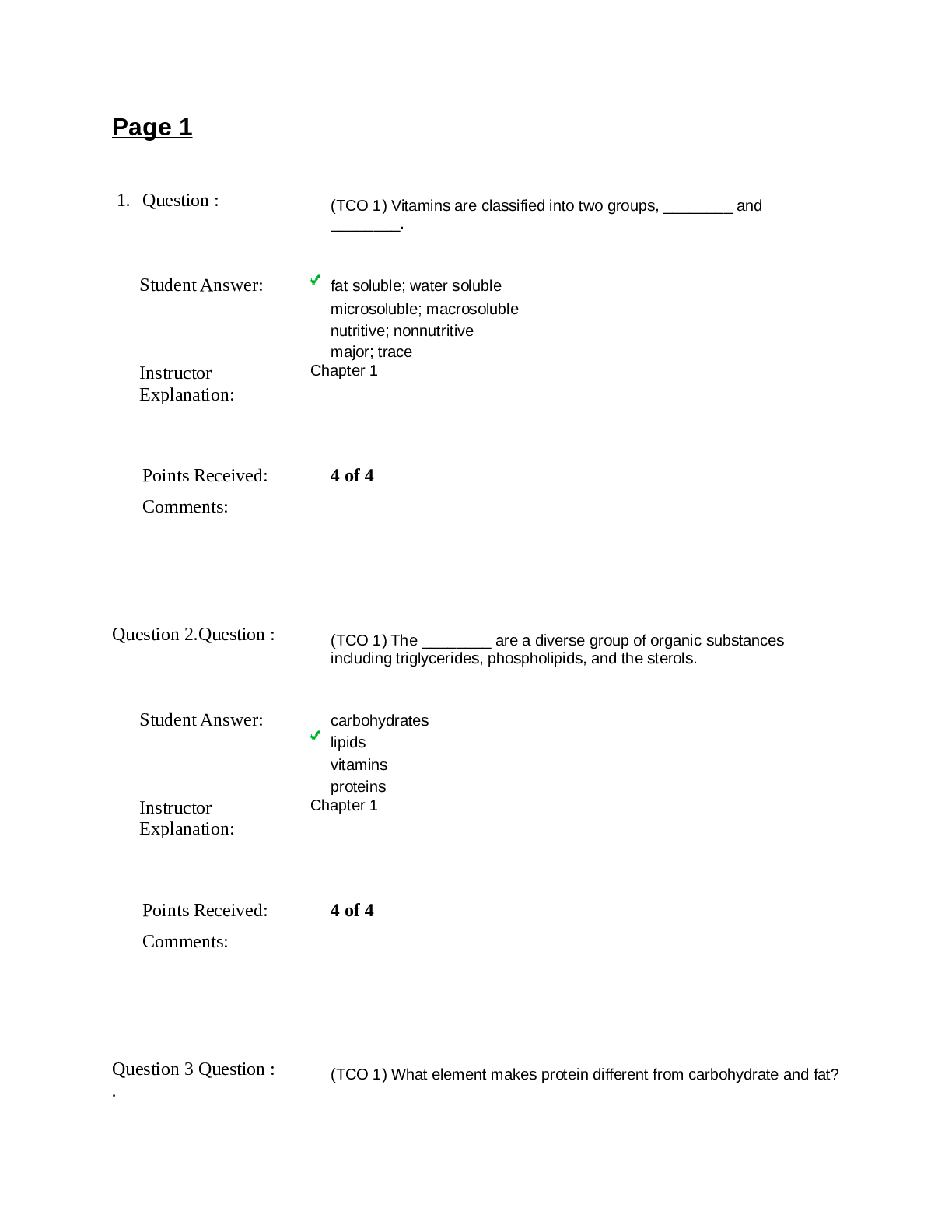
2. Question :
(TCO 1) The two overarching goals of are to increase quality & years of healthy life & to eliminate health disparities.
Student Answer:
Dietary Reference Intakes (DRIs) the USDA
Healthy People 2010
the American Dietetic Association (ADA)
Instructor Explanation: Chapter 1
3. Question :
(TCO 1) What element makes protein different from carbohydrate & fat?
Student Answer:
Carbon Hydrogen Nitrogen
Oxygen
Instructor Explanation: Chapter 1
4. Question :
(TCO 1) For dinner, Bill consumes 255 grams of carbohydrate, 70 grams of protein, & 50 grams of fat. In addition, Bill decides that he wants a glass of wine with his meal. If he drinks one glass of wine containing 8 grams of alcohol, how many total kilocalories does he consume in this meal?
Student Answer:
56 kilocalories
540 kilocalories
1,675 kilocalories
1,806 kilocalories
Instructor Explanation: Chapter 1
5. Question :
(TCO 1) Jose's lunch contains 121 grams of carbohydrate, 40 grams of protein, & 25 grams of fat. What percent of kilocalories in this meal come from fat?
Student Answer:
19%
26%
34%
42%.
Instructor Explanation: Chapter 1
6. Question :
(TCO 1) Which of the following is an example of disease that is directly caused by a nutritional deficiency?
Student Answer:
Anemia Cancer Osteoporosis
Heart disease
Instructor Explanation: Chapter 1
7. Question :
(TCO 2) Which of the following snacks will have the highest satiety value, assuming the calories & relative size are similar?
Student Answer:
slice of whole-grain bread piece of cheese
glass of whole milk
glass of skim milk
Instructor Explanation: Chapter 2
8. Question :
(TCO 2) The percent daily values (%DV) on food labels are based on the:
Student Answer:
DRIs. RDIs.
DRVs.
all of these
Instructor Explanation: Chapter 2
9. Question :
(TCO 2) The government agency that regulates food labeling in the United States is the:
Student Answer:
USDA. FDA. CDC.
all of these
Instructor Explanation: Chapter 2
10. Question :
(TCO 2) The standard used to estimate the daily nutrient needs of half of all healthy individuals is:
Student Answer:
EAR. AI. RDA.
UL.
Instructor Explanation: Chapter 1
11. Question :
(TCO 2) The smallest units of matter that normally cannot be broken down are:
Student Answer:
atoms. molecules. cells.
lipids.
Instructor Explanation: Chapter 2
12. Question :
(TCO 2) The Dietary Guidelines to Americans has defined physically active as a:
Student Answer:
minimum of 60 minutes of moderate activity most days. minimum of 30 minutes of moderate activity most days. minimum of 15 minutes of intense activity most days.
total of 8 hours of moderate activity per week.
Instructor Explanation: Chapter 2
13. Question :
(TCO 3) In which organ does the majority of water absorption occur?
Student Answer:
mouth stomach small intestine
large intestine
Instructor Explanation: Chapter 3
14. Question :
(TCO 3) Which of the following would be an appropriate treatment approach for someone suffering from GERD?
Student Answer:
surgical removal of the gallbladder omission of all lactose foods antibiotic therapy
lose weight & quit smoking
Instructor Explanation: Chapter 3
15. Question :
(TCO 3) The first section of the small intestine is called the:
Student Answer:
bile duct. duodenum. jejunum.
ileum.
Instructor Explanation: Chapter 3
16. Question :
(TCO 3) Digestion & absorption occur at the level.
Student Answer:
tissue organ system
organism
Instructor Explanation: Chapter 3
17. Question :
(TCO 3) What is the term that describes the process in which nutrients pass through the wall of the gastrointestinal tract?
Student Answer:
digestion absorption elimination
segmentation
Instructor Explanation: Chapter 3
1. Question :
(TCO 4) In the absence of carbohydrate, are produced from the incomplete breakdown of body fat.
Student Answer:
amyloses amylases
ketones
bacteria
Instructor Explanation: Chapter 4
2. Question :
(TCO 4) Without sufficient , the colon gets too little exercise & becomes weak.
Student Answer:
calories protein fiber
water
Instructor Explanation: Chapter 4
3. Question :
(TCO 4) Diabetes is a condition in which the body doesn't process
properly.
Student Answer:
vitamins protein carbohydrate
fat
Instructor Explanation: Chapter 4
4. Question :
(TCO 4) After a meal, which hormone is responsible for moving glucose into the body's cells?
Student Answer:
glucagon estrogen CCK
insulin
Instructor Explanation: Chapter 4
5. Question :
(TCO 4) The term complex carbohydrates refers to:
Student Answer:
monosaccharides. disaccharides. polysaccharides.
glucose.
Instructor Explanation: Chapter 4
6. Question :
(TCO 4) Which of the following carbohydrates is the end product of photosynthesis?
Student Answer:
glycogen galactose lactose
glucose
Instructor Explanation: Chapter 4
7. Question :
(TCO 4) Over 16 million Americans have diabetes. Which of the following is the most prevalent form of diabetes?
Student Answer:
type 1
type 2 gestational
pediatric
Instructor Explanation: Chapter 4
8. Question :
(TCO 4) In the body, the major storage sites for glycogen are the:
Student Answer:
muscles & liver. kidney & muscles. liver & kidney.
liver & pancreas.
Instructor Explanation: Chapter 4
9. Question :
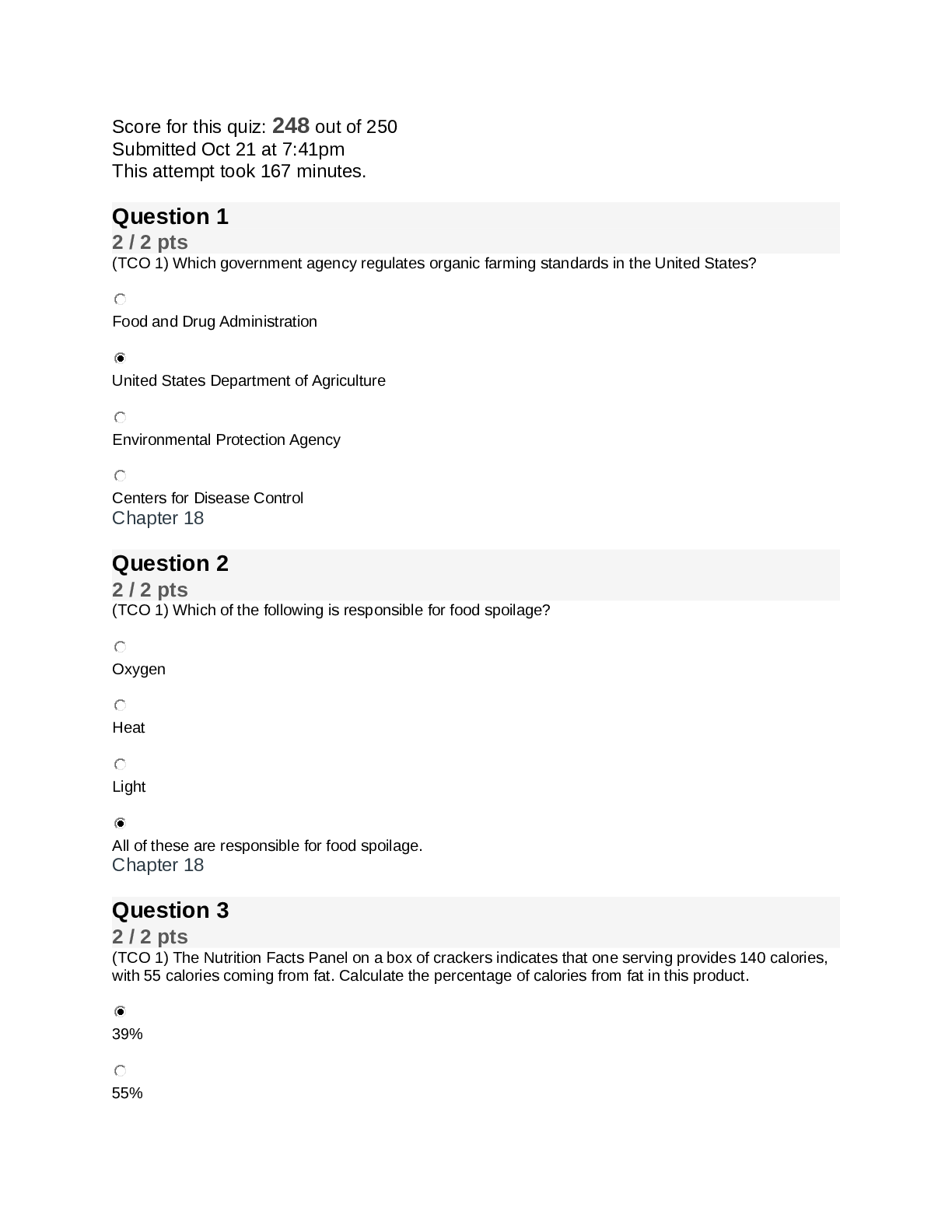
(TCO 1-6) All of the following are protective responses to encountering
food-borne microbes EXCEPT:
Student Answer:
vomiting & diarrhea.
increased production of white blood cells. fever.
decreased metabolic rate.
Instructor Explanation: Chapter 18
10. Question :
(TCO 1-6) The main symptom associated with Clostridium botulinumintoxication is:
Student Answer:
diarrhea. paralysis. anemia.
jaundice.
Instructor Explanation: Chapter 18
11. Question :
(TCO 1-6) An estimated of all chicken eggs in the U.S. are contaminated with Salmonella.
Student Answer:
one-fifth one-fourth one-third
one-half
Instructor Explanation: Chapter 18
12. Question :
(TCO 1-6) Which of the following additives gives ham, hot dogs, & bologna their pink color?
Student Answer:
sulfites BHT/BHA
nitrates/nitrites
propionic acid
Instructor Explanation: Chapter 18
13. Question :
(TCO 1-6) Why do fungi rarely cause food infection?
Student Answer:
Few species of fungi cause serious illness. Fungal growth makes food look unappealing. Fungal growth makes food taste unappealing.
All of these are reasons fungi rarely cause food infection.
Instructor Explanation: Chapter 18
14. Question :
(TCO 1-6) The primary symptom of Giardia infection is:
Student Answer:
jaundice. diarrhea. dementia.
anemia.
Instructor Explanation: Chapter 18
15. Question :
(TCO 1-6) The primary method used to preserve seafood is:
Student Answer:
adding salt. smoking. drying.
adding sugar.
Instructor Explanation: Chapter 18
16. Question :
(TCO 1-6) Hepatitis A is a food-borne virus that can result in
damage.
Student Answer:
nerve intestinal liver
muscle
Instructor Explanation: Chapter 18
17. Question :
(TCO 1-6) Bovine spongiform encephalopathy is a food-borne illness also known as:
Student Answer:
mad cow disease. typhoid fever.
Norwalk virus.
hepatitis A.
Instructor Explanation: Chapter 18
1. Question :
(TCO 5) What is the primary form of lipid in the diet?
Student Answer:
Sterols Triglycerides Phospholipids
Glycerols
Instructor Explanation: Chapter 5
2. Question :
(TCO 5) Which of the following statements is FALSE regarding the process of hydrogenation?
Student Answer:
Hydrogenation creates trans fatty acids.
Hydrogenation is the process in which hydrogen atoms are added to double bonds.
Hydrogenation creates a heart-healthy product.
Hydrogenation makes a product more solid at room temperature.
Instructor Explanation: Chapter 5
3. Question :
(TCO 5) Which of the following ingredients would alert you to the presence of trans-fatty acids in a product?
Student Answer:
Hydrogenated vegetable oil Lecithin
Liquid corn oil
Vitamin E
Instructor Explanation: Chapter 5
4. Question :
(TCO 5) The two essential fatty acids are:
Student Answer:
cholesterol & bile.
linoleic & alpha-linolenic acid. butyric & stearic acid.
cis & trans.
Instructor Explanation: Chapter 5
5. Question :
(TCO 5) The process of adding hydrogen to an unsaturated fatty acid &
creating a more solid fat is called:
Student Answer:
emulsification. pressurization. hydrogenation.
deamination.
Instructor Explanation: Chapter 5
6. Question :
(TCO 5) To facilitate the digestion of dietary fats, the gallbladder stores & releases a substance known as:
Student Answer:
lipase. bile.
hydrochloric acid.
bicarbonate.
Instructor Explanation: Chapter 5
7. Question :
(TCO 5) Where in the body are the majority of triglycerides stored for future energy needs?
Student Answer:
Lipoproteins
Beta cells of the pancreas Liver
Adipose tissue
Instructor Explanation: Chapter 5
8. Question :
(TCO 5) As of January , 2006, the U.S. Food & Drug Administration will
require food manufactuers to list content on the Nutrition Facts Panel of their proucts.
Student Answer:
phospholipid sterol
essential fatty acid
trans fatty acid
Instructor Explanation: Chapter 5
9. Question :
(TCO 6) The absorption of proteins occurs in the:
Student Answer:
stomach. small intestine. large intestine.
liver.
Instructor Explanation: Chapter 6
10. Question :
(TCO 6) Which of the following statements is FALSE?
Student Answer:
HCl denatures protein to allow digestive enzymes to break down the protein.
HCl inhibits the digestion of fat so it does not compete with protein digestion.
HCl untangles the strands of protein & breaks the peptide bonds.
HCl activates pepsin from pepsinogen.
Instructor Explanation: Chapter 6
11. Question :
(TCO 6) Two amino acids are joined together by a peptide bond to form a dipeptide. What is the by-product of this process?
Student Answer:
Ammonia Water
Carbon dioxide
Hydrochloric acid
Instructor Explanation: Chapter 6
12. Question :
(TCO 6) Which of the following health problems has been associated with high protein intakes?
Student Answer:
Elevated blood cholesterol Marasmus
Edema
Sickle cell anemia
Instructor Explanation: Chapter 6
13. Question :
(TCO 6) Which of the following is a genetic disorder resulting in debilitating protein abnormalities?
Student Answer:
Cystic fibrosis Mad cow disease Acidosis
Kwashiorkor
Instructor Explanation: Chapter 6
1. Question :
(TCO 6) The process through which mRNA copies genetic information from DNA & carries it to the ribosome is called:
Student Answer:
translation. deamination. denaturation.
transcription.
Instructor Explanation: Chapter 6
15. Question :
(TCO 6) Proteases are:
Student Answer:
protein messengers that are released from storage in response to an alteration in the body's homeostasis.
transport proteins that move substances throughout the body. defense proteins that attack foreign bacteria, viruses, & toxins.
enzymes that break down protein.
Instructor Explanation: Chapter 6
16. Question :
(TCO 6) During the process of protein synthesis, is the step in which messenger RNA is decoded into an amino acid sequence at the cell's ribosome.
Student Answer:
transcription translation deamination
denaturation
Instructor Explanation: Chapter 6
(TCO 3) Which of the following diseases has been linked to free
Student Answer:
Cancer
Heart disease Diabetes
All of these
Instructor Explanation: Chapter 8
2. Question :
(TCO 3) The smallest & most unique unit of matter is a(n):
Student Answer:
molecule.
atom.
free radical. element.
Instructor Explanation: Chapter 8
3. Question :
(TCO 7) Who is at risk for a Vitamin E deficiency?
Student Answer:
Premature infants Postmenopausal women Male athletes
The elderly
Instructor Explanation: Chapter 8
4. Question :
(TCO 7) Which of the following nutrients requires the most frequent consumption to assure adequate body stores?
Student Answer:
Vitamin A
Vitamin E
Vitamin C
Beta-carotene
Instructor Explanation: Chapter 8
5. Question :
(TCO 7) Which of the following symptoms is associated with consuming a megadose of Vitamin C?
Student Answer:
Night blindness Scurvy
Nausea & diarrhea
Erythrocyte hemolysis
Instructor Explanation: Chapter 8
6. Question :
(TCO 8) The retinoid that has the most important physiological role in the human body is:
Student Answer:
retinol. retinoic acid. retinal.
beta-carotene.
Instructor Explanation: Chapter 8
7. Question :
(TCO 8) Assuming equal serving sizes, which of the following foods would be the poorest source of calcium?
Student Answer:
Skim milk
Whole milk Cheddar cheese
Cottage cheese
Instructor Explanation: Chapter 9
8. Question :
(TCO 8) Individuals who have diseases that result in the malabsorption of are at risk for a Vitamin D deficiency.
Student Answer:
carbohydrates
fat
minerals protein
Instructor Explanation: Chapter 9
9. Question :
(TCO 9) Bob's physician has just diagnosed him with iron-deficiency anemia. All of the following would be good advice for Bob to utilize more dietary iron EXCEPT:
Student Answer:
eat meat with beans & vegetables.
drink a glass of orange juice with your breakfast cereal.
drink a glass of milk with your iron supplement.
cook your foods in cast-iron pans.
Instructor Explanation: Chapter 10
10. Question :
(TCO 9) Which of the following is NOT a vitamin?
[Show More]


.png)


.png)



.png)