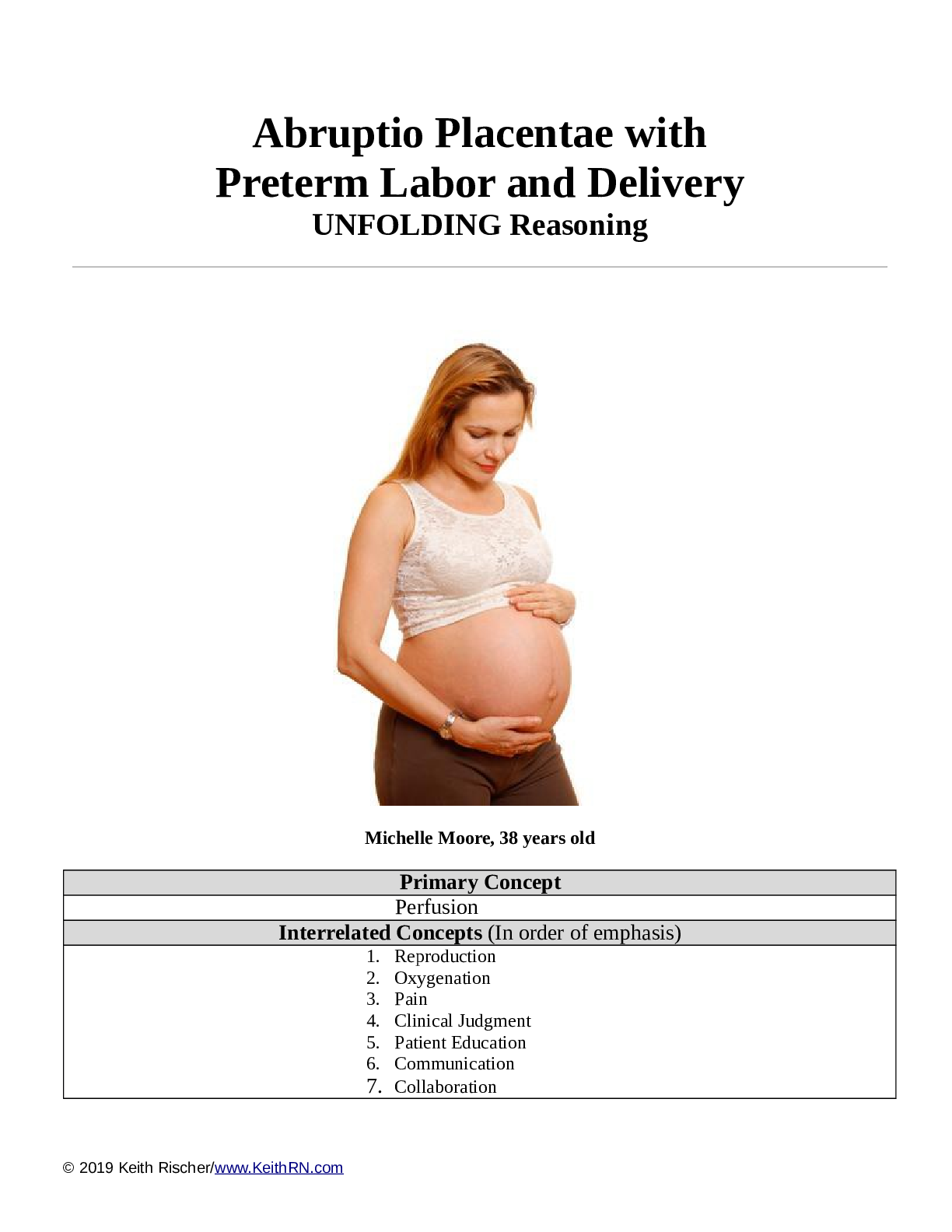
Abruptio Placentae with Preterm Labor and Delivery UNFOLDING Reasoning Michelle Moore, 38 years old
Abruptio Placentae with
Preterm Labor and Delivery
UNFOLDING Reasoning
Michelle Moore, 38 years old
Primary Conce
...
Abruptio Placentae with Preterm Labor and Delivery UNFOLDING Reasoning Michelle Moore, 38 years old
Abruptio Placentae with
Preterm Labor and Delivery
UNFOLDING Reasoning
Michelle Moore, 38 years old
Primary Concept
Perfusion
Interrelated Concepts (In order of emphasis)
1. Reproduction
2. Oxygenation
3. Pain
4. Clinical Judgment
5. Patient Education
6. Communication
7. Collaboration
© 2019 Keith Rischer/www.KeithRN.comUNFOLDING Reasoning Case Study: ANSWER KEY
Abruptio Placentae with Preterm Labor and Delivery
History of Present Problem:
Michelle Moore is a 38-year-old who is 29 weeks pregnant. She began prenatal care at 18 weeks gestation because she
was waiting to become insured. She is currently in the Labor and Delivery Unit of the hospital following a call to her
primary care provider. She reported that she had a sudden onset of constant severe uterine pain and began to notice that
she had vaginal bleeding that bright red, soaked a maxi pad and then began soaking through her underwear. Her baby has
not been moving as actively as normal since the pain and bleeding started.
Personal/Social History:
Michelle works at a fast-food restaurant, standing on her feet for long hours. She usually works in the evenings and
weekends. She is estranged from the father of the baby. Michelle’s father is able to help her with childcare once or
twice a week. Michelle denies substance use including alcohol during her pregnancy. Michelle smokes 10 cigarettes
daily, and says that she has decreased usage, but the stress of the pregnancy and having little support makes it difficult
for her to quit.
Michelle reports that she usually eats at work to save money, and most meals consist of fried foods and diet sodas.
Michelle has a small apartment, but says she often has difficulty paying the rent on time, since child care is so expensive.
She has a six-year old son who was born prematurely at 35 weeks. Michelle was diagnosed with a partial abruption
during that delivery.
Past Medical History (PMH): Home Meds: Pharm.
Classification:
Expected Outcome:
Gravida 4, Para 1 with a partial
abruption at 35 weeks
Two spontaneous abortions in the first
trimester
Menses began at age 12, are usually
29 days apart, lasting for 4-5 days,
with moderate-to-light flow.
Successfully breast fed her first child
for 11 months.
Vaccinations are up to date.
Michelle is biracial: African
American and Asian, and she was
tested for sickle cell trait. Lab results
reveal Michelle is a carrier of the
trait. It is unknown if the father of the
baby is also a carrier.
1.Prenatal vitamin 1
tab PO daily
2.Acetaminophen 650
mg PO PRN every 6
hours for infrequent,
mild headaches
1. Multivitamin
2. Analgesic
1. Pt will maintain
adequate iron and
vitamin levels during
pregnancy
2. Pt will be free of mild
headaches
What data from the histories are RELEVANT and must be interpreted as clinically significant by the nurse?
RELEVANT Data from Present Problem: Clinical Significance:
38 yrs old
29 weeks pregnant
Present at PCP direction
Severe uterine pain
Bright red vaginal bleeding
Reduced fetal movement since onset of
bleeding and pain
Maturity of handling situation
If situation escalates to delivery, will need to take required steps
and mobilize appropriate personnel
Adds immediate validity to situation – facilitates communication
Uterine pain with bright red blood is an indication of possible
placental abruption
Reduction of fetal movement is indication of possible fetal distress
RELEVANT Data from Social History: Clinical Significance:
Works long and night/weekend hours
Baby’s father not involved; her father
has limited time to help
Smokes
Stress of work combined with poor nutrition, and smoking can
negatively impact fetal development
Support network is insufficient
Inability to meet financial needs can add psychosocial stress Eats at work
Difficulty paying rent/expensive
childcare
Hx of premature birth
Hx of placental abruption
Increased stress hormones can negatively impact pregnancy
Hx increases odds of both premature and placental abruption
occurring in subsequent pregnanciesPatient Care Begins:
Current VS: P-Q-R-S-T Pain Assessment (5th VS):
T: 98.5 F/ 36.9 C (oral) Provoking/Palliative: Constant, nothing makes it worse or better
P: 122 (regular) Quality: “knife-like”
R: 24 (regular) Region/Radiation: abdominal
BP: 132/64
MAP: 87
Severity: 9/10
O2 sat: 96% room air Timing: constant
What VS data are RELEVANT and must be recognized as clinically significant by the nurse?
RELEVANT VS Data: Clinical Significance:
Slightly pyretic
Tachycardic
Tachypnic
Increased BP
O2Sat
Pain 9/10, severe
and constant/no
relief
Main vital signs all support patient report of pain
Elevated HR could be due to hemorrhage
Constant pain and severity levels need to be immediately addressed
O2 level indicates good oxygenation which is the first step to make sure baby is as well
Current Assessment:
GENERAL
APPEARANCE:
5’ 4” (162.5 cm) tall and weighs 165 pounds (75 kg), including 25 pounds (11.4 kg) she
gained during this pregnancy. Appears uncomfortable, groaning and holding abdomen
RESP: Breath sounds clear with equal aeration bilaterally, labored respiratory effort
CARDIAC: Pale, cool/dry, no edema, heart sounds regular with no abnormal beats, equal with palpation
at radial/pedal/post-tibial landmarks
NEURO: Alert and oriented to person, place, time, and situation (x4)
FETAL Monitoring:
Electronic Fetal
Monitoring:
Fetal heart rate 150, minimum variability trending towards absent variability around the
baseline, late decelerations, no accelerations noted. Contractions are frequent: every 1-2
minutes; uterus is board-like upon palpation.
What assessment data are RELEVANT and must be recognized as clinically significant by the nurse?
RELEVANT Assessment Data: Clinical Significance:
Pt physically uncomfortable and
holding abdomen
Respiration labored, but clear
airway
A/Ox4
FHR approaching 160
Minimal variability with late
decelerations
Frequent contractions
Hard uterus
Patient focus is on abdomen/fetus – will need to give support
Airway is patent; oxygenation source is viable
Pt alertness will help in comprehension of situation and decision
making
All FHR information is non-reassuring and requires intervention
Uterine tension indicates internal bleedingFetal Monitoring Strip:
Interpretation:
FHR baseline between 110-160, minimal variation with constant late decelerations. Category 3
Contractions are frequent and generally constant with rest periods being equal to duration of contraction
Clinical Significance:
Late decels are indicating placental oxygenation insufficiency
Repositioning of mother and oxygenation are indicated
Need to maintain monitoring for changes
Medical Management: Rationale for Treatment and Expected Outcomes
Care Provider Orders: Rationale: Expected Outcome:
Prepare for immediate cesarean
section in operating room (OR)
Oxygen 10 liters/minute via
nonrebreather
Continuous fetal monitoring
Strict I&O
Insert urinary catheter
Lactated Ringers (LR) 1000 mL
bolus
Type and screen for “maternal
pack” that includes 6 units PRBCs,
4 units FFP, 1 apheresis pack of
platelets. This ratio can be
repeated as needed
Internal bleeding is apparent w/ fetal distress
and poor oxygenation
To maintain maternal oxygen levels
To quickly identify any worsening of
condition and take appropriate action
Pt needs to maintain fluid balance - I/O,
catheter, LR
To be prepared for possible blood
transfusion if needed
Successful delivery of
healthy fetus
Maximum oxygenation of
placenta/fetus
Fetal safety will be
maintained
Pt will avoid adverse
metabolic conditions
Pt will be able to void
Pt will maintain adequate
supply of bloodPRIORITY Setting: Which Orders Do You Implement First and Why?
Care Provider Orders: Order of Priority: Rationale:
Oxygen -10 liters/minute vis
non-rebreather
Continuous fetal monitoring
Insert urinary catheter with
urometer for hourly I and O
Lactated Ringers (LR) IV 1000
mL bolus
Type and screen for “maternal
pack” that includes 6 units
PRBCs, 4 units FFP, 1 apheresis
pack of platelets. This ratio can be
repeated as needed based on labs
(Drawn per policy, usually every
4 hours for 24).
1. O2
2. LR
3. Catheter
4. FM
5. Type/Screen
Need to maintain adequate oxygenation to both
mother/fetus
LR/Cath required to maintain fluid balance
Fetal monitoring required to ID any further
distress/change of conditions that require
immediate action
In case of c/s and transfusion needed
Lab Results:
Complete Blood Count (CBC:) (Pregnancy Values) Current: High/Low/WNL? Previous:
WBC (5,000 – 15,000 mm 3) 15.1 H 14.8
Hgb (11.5-14 g/dL) 9.5 L 11.2
Platelets (150-350 x103/µl) 101 L 122
What lab results are RELEVANT and must be recognized as clinically significant by the nurse?
RELEVANT Lab(s): Clinical Significance: TREND:
Improve/Worsening/Stable:
Hgb = 9.5
Platelets = 101
Both factors indicated bleeding and possible
hemorrhage
Worsening trend
Coags: Current: High/Low/WNL?
PT/INR (0.9–1.1 nmol/L): 1.7 H
PTT (29-35 seconds): 45 H
Fibrinogen (<80 mg/dL): 44 L
Kleihauer-Betke test (Positive if
>0.01 mL of fetal blood in the
maternal circulation)
Positive
What lab results are RELEVANT and must be recognized as clinically significant by the nurse?
RELEVANT Lab(s): Clinical Significance: TREND:
Improve/Worsening/Stable:
PT/INR = 1.7
PTT = 45
Fibrinogen = 44
All clotting factors are at levels that reduce clotting
abilities and put the mother at risk for hemorrhage
Worsening trendUrine Analysis (UA:) Current: WNL/Abnormal? Previous:
Color (yellow) Dark amber Abnormal Clear yellow
Protein (neg) Neg Normal Neg
Glucose (neg) Neg Normal Neg
What lab results are RELEVANT and must be recognized as clinically significant by the nurse?
RELEVANT Lab(s): Clinical Significance: TREND:
Improve/Worsening/Stable:
1. Urine = Dark
Amber
1. Color indicates dehydration issues Worsening trend
Lab Planning: Creating a Plan of Care with a PRIORITY Lab:
Lab: Normal
Value:
Clinical Significance: Nursing Assessments/Interventions Required:
KleihauerBetke
Positive
Critical Value:
Clinical Reasoning Begins…
1. What is the primary problem that your patient is most likely presenting with?
Abruptio Placentae
2. What is the underlying cause/pathophysiology of this primary problem?
Abruptio Placentae occurs when the placenta is partially or fully separated from the uterus, which if not
addressed can progress to hemorrhage and death.
3. What nursing priority (ies) will guide your plan of care? (if more than one-list in order of PRIORITY)
Hemorrhage, safe fetal delivery
4. What interventions will you initiate based on this priority?
Nursing Interventions: Rationale: Expected Outcome:
1. Continual Monitor of all VS
2. Continually assess blood loss, amount, and
any changes to content
3. Monitor pt A/O
4. Continue to palpate uterus
To monitor for any changes that indicate a
progressing negative trend
Pt will not experience
significant hemorrhage or
go into shock5. What psychosocial needs will this patient and/or family likely have that will need to be addressed?
Support resources. Pt has limited support network and will need appropriate community referrals
6. How can the nurse address these psychosocial needs?
Supply support and financial community resources for single mothers.
Provide emotional support and education
7. What body system(s) will you assess most thoroughly based on the primary/priority concern?
Cardio/respiratory and reproductive
8. What is the worst possible/most likely complication to anticipate?
Death of fetus, mother or both
9 What nursing assessments will identify this complication EARLY if it develops?
VS, Fluid/blood loss
10. What nursing interventions will you initiate if this complication develops?
Administer fluids, assist to c/s delivery, blood transfusion if necessary
11. If the worst possible/most likely complication was recognized by the nurse, when would you decide to notify
rapid response team to evaluate further?
Significant increase of blood loss, further change to fetal VS/heart tracings, LOC
Evaluation: Sixty minutes later…
Michelle delivered a viable baby boy at 29 weeks gestation, via emergency Cesarean Section. Her quantitative blood loss
was 1500 mL.
What data are RELEVANT and must be interpreted as clinically significant by the nurse?
RELEVANT Data from Present Problem: Clinical Significance:
c/s delivery @29wks
blood loss = 1500mL
blood transfusion required
Initial Assessment:
GENERAL
APPEARANCE:
29 weeks gestation. Dusky with weak respiratory effort.
RESP: Weak respiratory effort with grunting and sternal/intercostal retractions
CARDIAC: Heart rate above 100 with no murmur. Weak pulses
NEURO: Responds to stimuli, moves all extremities
GI: Abdomen soft and flat, umbilical cord clamped
SKIN: No lanugo,1/3 of foot has plantar creases, vessels visible under skinINFANT-Initial APGAR (1 minute):
0 Points 1 Point 2 Points
Activity: X some flexion
Pulse: X 110
Grimace: X gag
Appearance: X dusky
Respiration: X weak
Total: 5
Current Assessment:
GENERAL
APPEARANCE:
29 weeks gestation. Marked acrocyanosis with weak respiratory effort. Central
cyanosis noted.
RESP: Weak respiratory effort with grunting, nasal flaring and retractions
CARDIAC: Heart rate above 100 with no murmur. Weak pulses
NEURO: Responds to stimuli, moves all extremities
GI: Abdomen soft and flat, umbilical cord clamped
SKIN: No lanugo, vessels visible
APGAR: 5 Minutes:
0 Points 1 Point 2 Points
Activity: X some flexion
Pulse: x130
Grimace: X with stimulation
Appearance: X marked
acrocyanosis
Respiration: X weak cry
Total: 7
What assessment data are RELEVANT and must be recognized as clinically significant by the nurse?
RELEVANT Assessment Data: Clinical Significance:
APGAR: 51, 75
c/s @29wks
acrocyanosis
respiration
Intervention needed
Developmental expectations
Acrocyanosis/respiration need to be addressed right away to
increase perfusion
INFANT: Umbilical Cord Arterial
Arterial Blood Gas: Current: High/Low/WNL?
pH (7.35–7.45) 7.29 L
pCO2 (35–45) 55 H
pO2 (80–100) 76 L
HCO3 (18–26) 18 WNL
O2 sat (>92%) 91% L
Interpretation:What lab results are RELEVANT and must be recognized as clinically significant by the nurse?
RELEVANT Lab(s): Clinical Significance:
pH: L
pCO2: H
pO2: L
O2 sat: L
At risk for uncompensated respiratory acidosis
The baby has been transferred to the NICU and is receiving respiratory support through CPAP
at this time. Michelle has just been admitted to her room from PACU.
MOTHER Assessment Data:
Current VS: Most Recent: Current PQRST:
T: 99.1 F/37.3 C (oral) T: 98.5 F/ 36.9 C (oral) Provoking/Palliative: Movement/Lying still
P: 102 (regular) P: 122 (regular) Quality: ache
R: 16 (regular) R: 20 (regular) Region/Radiation: Incision
BP: 110/74
MAP: 86
BP: 102/64
MAP: 77
Severity: 2/10
O2 sat: 94 % room air O2 sat: 96% room air Timing: Ongoing
Current Assessment:
GENERAL
APPEARANCE:
Resting quietly, pale
RESP: Breath sounds clear with equal aeration bilaterally, non-labored respiratory effort
CARDIAC: Pale, clammy, no edema, heart sounds regular with no abnormal beats, equal with palpation
at radial/pedal/post-tibial landmarks. Pulse is thready.
NEURO: Alert and oriented to person, place, time, and situation (x4)
BUBBLE
BREAST: Lactating; soft, non-tender with evidence of colostrum
UTERUS: Boggy and several quarter sized clots expressed with massage
BLADDER: 25 mL in last hour, dark amber
BOWELS: Abdomen tender; bowel sounds audible per auscultation in all four quadrants
LOCHIA: 50 mL blood on peri pad in last 30 minutes
EPISIOTOMY: Perineum intact; abdomen with surgical dressing on abdomen which is clean, dry, and intact
1. What VS data are RELEVANT and must be recognized as clinically significant by the nurse?
RELEVANT VS Data: Clinical Significance:
T: 99.1
BP: 110/74
O2 sat: 94%
With rising T/BP – keep close eye for s/s of infection
Needs O2 to bring up sat level
RELEVANT Assessment Data: Clinical Significance:
Uterus – boggy w/ clots
Bladder – insufficient void
Lochia – 50mL blood in 30min
Pt in danger of hypovolemic shock
Needs fluids2. Has the status improved or not as expected to this point?
Though most signs are good, the overall trend indicate status is not improved
3. Does your nursing priority or plan of care need to be modified in any way after this evaluation assessment?
Same plan should address the issues of concern
4. Based on your current evaluation, what are your nursing priorities and plan of care?
Continue to monitor for s/s of unusual bleeding and continue fluid management
It is now time to transfer your patient. Effective and concise handoffs are essential to excellent
care and if not done well can adversely impact the care of this patient. You have done an
excellent job to this point, now finish strong and give the following SBAR report to the nurse
who will be caring for this patient:
Situation:
Name/age:
Michelle Moore / 38yrs
BRIEF summary of primary problem:
Pt presented w/ severe uterine pain w/ bright read vaginal bleeding
Day of admission/post-op #:
18 Nov 2020
Background:
Primary problem/diagnosis:
Abruptio Placentae
RELEVANT past medical history:
Hx of premature birth (35wks) and abruptio placentae
RELEVANT background data:
Insufficient support network, Employment: long off hours on feet, poor nutrition, active smoker
Assessment:
Vital signs:
T: 99.1, P: 102 (regular), R: 16 (regular), BP: 110/74, O2 sat: 94% on rm air, Pain: 2/10 ache
RELEVANT body system nursing assessment data:
Uterus: Boggy and several quarter sized clots expressed with massage; Bladder: 25 mL in last hour, dark
amber; 50 mL blood on peri pad in last 30 minutes; Perineum intact; abdomen with surgical dressing on abdomen which
is clean, dry, and intact
RELEVANT lab values: UA: dark amber color
TREND of any abnormal clinical data (stable-increasing/decreasing): INTERPRETATION of current clinical
status (stable/unstable/worsening): Pt status is on a worsening trend and @risk of fluid loss, infection
Recommendation:
Suggestions to advance plan of care:
Continue fluid monitor/management, have PCP eval for pharm intervention of blood loss, monitor VSEducation Priorities/Discharge Planning
1. What will be the most important discharge/education priorities you will reinforce with his/her
medical condition to prevent future readmission with the same problem?
When pregnant again, start prenatal care earlier
Find employment opportunities that get her off her feet
Smoking cessation
Improve diet – nutrition
Importance of developing a support network
2. What are some practical ways you as the nurse can assess the effectiveness of your teaching with this patient?
Have her teach back the purpose of each topic covered
Follow up care (social worker, etc)
Caring and the “Art” of Nursing
1. What is the patient likely experiencing/feeling right now in this situation?
Anxiety of current downward trending condition
Worry for baby
2. What can you do to engage yourself with this patient’s experience, and show that he/she matter to you as
a person?
Praise for coming through the situation
Development of therapeutic relationship
Help with contacting appropriate referrals and making f/u appointments at the appropriate time
Listen to any concerns she may have and take action to help as able/appropriate
Use Reflection to THINK Like a Nurse
Reflection-IN-action (Tanner, 2006) is the nurse’s ability to accurately interpret the patient’s response to an intervention
in the moment as the events are unfolding to make a correct clinical judgment.
[Show More]