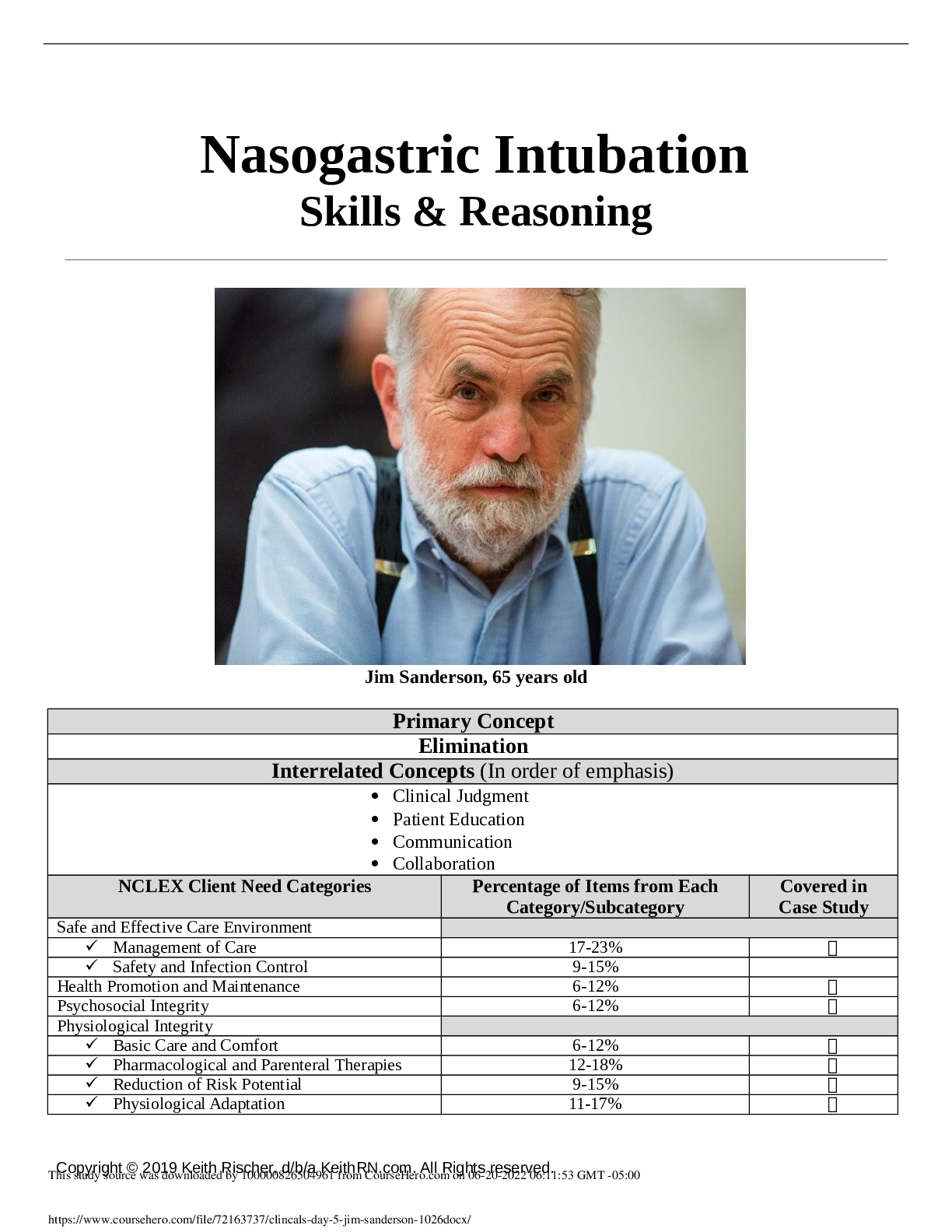
Total Knee Arthroplasty (TKA) UNFOLDING Reasoning John Roberts, 68 years old
Total Knee Arthroplasty (TKA)
UNFOLDING Reasoning
John Roberts, 68 years old
Primary Concept
Infection
Interrelated Concepts (In order
...
Total Knee Arthroplasty (TKA) UNFOLDING Reasoning John Roberts, 68 years old
Total Knee Arthroplasty (TKA)
UNFOLDING Reasoning
John Roberts, 68 years old
Primary Concept
Infection
Interrelated Concepts (In order of emphasis)
Perfusion
Tissue Integrity
Pain
Clinical Judgment
Patient Education
Communication
NCLEX Client Need Categories Percentage of Items from Each
Category/Subcategory
Covered in
Case Study
Safe and Effective Care Environment
Management of Care 17-23%
Safety and Infection Control 9-15%
Health Promotion and Maintenance 6-12%
Psychosocial Integrity 6-12%
Physiological Integrity
Basic Care and Comfort 6-12%
Pharmacological and Parenteral Therapies 12-18%
Reduction of Risk Potential 9-15%
Physiological Adaptation 11-17% UNFOLDING Reasoning
History of Present Problem:
John Roberts is a 68-year-old Caucasian male who is 6 feet tall (180 cm) and weighs 260 lbs. (118.2 kg) (35.3
BMI). He has a history of diabetes, hypertension, and hyperlipidemia and smokes one pack per day since the age
of 18 (50 pack- years). He has osteoarthritis (OA) in his right knee and the pain has significantly increased over
the past year.
John had a right total knee arthroplasty (TKA) four days ago and refused to go to a rehabilitation center because of
the expense and distance from his home. He decided to have physical and occupational therapy home health
services. You are the home health nurse that will be caring for him, and you have arrived for his first home
visit.
Personal/Social History:
John is a retired lumberjack who enjoys being outdoors. He has become increasingly frustrated because he is not able
to do the outdoor activities he once did. He has been married for 50 years to Mary and lives in the rural
Appalachian Mountains and must travel a long distance for basic medical care.
What data from the histories are RELEVANT and must be interpreted as clinically significant by the nurse?
RELEVANT Data from Present Problem: Clinical Significance:
Diabetic
Hypertension
Hyperlipidemia
50 pack year smoker
Total knee arthroplasty 4 days ago
Osteoarthritis in right knee
Untreated diabetes, hypertension, and hyperlipidemia can lead to poor
peripheral circulation due to plaque build up. This can exacerbate
preexisting conditions like osteoarthritis because without proper blood
flow the bones and knee joint will not get the proper nutrients to heal
Years of smoking also negatively affect the peripheral circulation, smokers
tend to take longer to heal
Osteoarthritis is deteriorative joint condition
RELEVANT Data from Social History: Clinical Significance:
Retired lumberjack, active lifestyle until
recently
Married for 50 years
Rural living
Lumberjack is a physically demanding job, so he may have developed a
high pain tolerance. Might have a tendency to under-report his pain.
Rural living—access to medical care may be limited, he may choose not
seek medical help due to long commute and time it takes
Patient Care Begins:
Current VS: P-Q-R-S-T Pain Assessment:
T: 100.1 F/37.8 C (oral) Provoking/Palliative: Movement of the knee increases pain; Ice and pain med relieve
P: 80 (regular) Quality: Constant, dull, throbbing
R: 14 (regular) Region/Radiation: Right Knee
BP: 140/85 Severity: 7/10
O2 sat: 92% RA Timing: Constant ache, but continuous after activity
What VS data are RELEVANT and must be interpreted as clinically significant by the nurse?
RELEVANT VS Data: Clinical Significance:
P: moving right knee increases
pain, RICE and pain med
relieve
Q: constant, dull, throbbing
S: 7/10
T: constant ache that is
continuous after activity
BP may be elevated due to pain.
Pain (PQRST) assessment is significant because it lets me know what makes it better and
what makes it worst
The pain in is his right knee impedes him from being as active as he would normally be
7/10 suggest that the pain is getting worst not better like it should. 4 days after surgery pain
should be well controlled and more mild/less severeBP: 140/85Current Assessment:
GENERAL
APPEARANCE:
Sitting, appears tense and grimaces with movement of right lower leg
RESP: Breath sounds with crackles at bases that clear with a cough, nonlabored respiratory effort
CARDIAC: Pink, warm & dry, no edema, heart sounds regular with no abnormal beats, pulses strong,
equal to palpation at radial/pedal/post-tibial landmarks, brisk cap refill
NEURO: Alert & oriented to person, place, time, and situation (x4)
GI: Abdomen flat, soft/nontender, bowel sounds audible per auscultation in all four quadrants
GU: Voiding without difficulty, urine clear/yellow
SKIN: Skin warm and clammy, 8-inch (20 cm) right knee incision closed w/staples, erythema, and
edema surrounding, hypersensitivity to touch in the area surrounding incision as well as the
entire knee; occlusive dressing removed to reveal a large amount of serous drainage with
tinges of yellow drainage
What assessment data is RELEVANT and must be interpreted as clinically significant by the nurse?
RELEVANT Assessment Data: Clinical Significance:
GA: sitting, appears tense and grimaces
with movement of RLL
RESP: crackles at bases that clear after
cough
SKIN: skin warm and clammy, 8 in incision
on right knee closed c/staples, erythema
and edema surrounding site, hypersensitive
to touch; dressing removed revealing large
amount of serous drainage c some yellow
drainage
Demonstrates typical/classical signs of being in pain, can tell that something is
bothering him
Crackles that clear suggest that he has some bronchial deficit due to years of
somking
Tinges of yellow drainage, serous drainage, warm clammy skin and sensitivity
to touch suggest infection at site of incision
Collaborative Care: Medical Management
Care Provider Orders: Rationale:
Complete Blood Count
(CBC)
Basic Metabolic Panel
(BMP)
Lactate
Blood culture x2 sites
Swab of incisional site for
culture and sensitivity
Urinalysis (UA)
Take collected labs to the
nearest hospital for
immediate interpretation
CBC will provide information about RBC, WBC, etc; let me know if he is actively
fighting an infection.
BMP shows kidney function and electrolytes; will let us know if he is dehydrated
and how well his kidneys are functioning since being a diabetic they can be taxed
Lactate acid will show us if he is sepsis
Blood cultures, UA, and culture and sensitivity swab at incision site will help
determine what type of infection it is. Is it bacterial, viral, fungal, etc.
Immediate interpretation since he is high risk, need to know what type of infection
it is so that the right treatment can get started ASAP
Because the clinical data the nurse has collected suggests an infection, the RN
receives the following orders from the orthopedic primary care provider:Lab Results:
Complete Blood Count (CBC:) Current: High/Low/WNL? Prior to Hospital
Discharge:
WBC (4.5–11.0 mm 3) 16.8 high 10.5
Neutrophil % (42–72) 88 high 60
Hgb (12–16 g/dL) 12.5 WNL 11.5
Platelets (150-450 x103/µl) 306 WNL 300
What lab results are RELEVANT and must be recognized as clinically significant by the nurse?
RELEVANT Lab(s): Clinical Significance: TREND:
Improve/Worsening/Stable:
WBC: 16.8
Neutrophil: 88%
Increasing WBC is positive proof that he does have
an infection
Neutrophillia signifies that the most likely cause of
infection is bacterial
Worsening
worsening
Basic Metabolic Panel (BMP:) Current: High/Low/WNL? Prior to Hospital
Discharge:
Sodium (135–145 mEq/L) 137 WNL 136
Potassium (3.5–5.0 mEq/L) 4.0 WNL 4.3
Glucose (70–110 mg/dL) 160 High 115
Creatinine (0.6–1.2 mg/dL) 1.1 WNL 1.2
What lab results are RELEVANT and must be recognized as clinically significant by the nurse?
RELEVANT Lab(s): Clinical Significance: TREND:
Improve/Worsening/Stable:
Glucose Stress from infection increasing blood glucose levels in body Worsening
Misc. Labs: Current: High/Low/WNL? Previous:
Lactate (0.5-2.2 mmol/L) 2.2 WNL n/a
RELEVANT Lab(s): Clinical Significance: TREND:
Improve/Worsening/Stable:
Lactate Negative for sepsis StableUrine Analysis (UA:) Current: WNL/Abnormal?
Color (yellow) Yellow WNL
Clarity (clear) Clear WNL
Specific Gravity (1.015-1.030) 1.025 WNL
LET (Leukocyte Esterase) (neg) Neg WNL
MICRO:
RBC’s (<5) 0 WNL
WBC’s (<5) 2 WNL
Bacteria (neg) Neg Neg
Epithelial (neg) Neg Neg
What lab results are RELEVANT and must be recognized as clinically significant by the nurse?
RELEVANT Lab(s): Clinical Significance:
Kidney functions is normal not a urinary tract infection
Lab Planning: Creating a Plan of Care with a PRIORITY Lab:
Lab: Normal
Value:
Clinical Significance: Nursing Assessments/Interventions Required:
WBC
Value:
16.8
Critical
Value:
<1.0 K
or
>50 K
WBC increase as immune
system continues to fight
infection
Monitor temperature and vital signs
Monitor WBC via CBC
Encourage fluid intake
Monitor intake and output
Monitor for signs and symptoms of worsening
infection
Administer antibiotics STAT
Dressing change, assess site
Clinical Reasoning Begins…
1. What is the primary problem your patient is most likely presenting? The primary problem my patient is most likely
presenting is an infection at the surgical site
2. What is the underlying cause/pathophysiology of this primary problem?
The underlying cause of this primary problem is surgical infection site provided entry for bacterial pathogen.Collaborative Care: Admission Orders/Medical Management
Care Provider Orders: Rationale: Expected Outcome:
Dx: Infection s/p Rt TKA
Admission orders:
Inpatient status –
telemetry Vital Signs: per
policy
Activity: Bed rest
Physical therapy (PT)
evaluation and treatment
1800 ADA 2 gram Na diet
Establish peripheral IV and
start 0.9% NS at 100
mL/hour
NKDA
Home Medications:
*metformin 500 mg PO BID
*aspirin 81 mg PO daily
*lisinopril 20 mg PO daily
*lovastatin 40 mg PO daily
*meloxicam 15mg PO daily
Clindamycin 600mg IV
every 8 hours
Pantoprazole 40mg IV daily
Morphine 2-4mg IV PRN
pain every 4 hours
acetaminophen 325 mg 2
tabs PO every 4-6 hours
PRN fever >101 F/38.3 C
Blood glucose before meals
and HS
Oxygen per nasal cannula.
Titrate to O2 sat >95%
I & O
Labs:
CBC, BMP repeat in 4 hours
Lactic Acid
Telemetry to monitor heart rate and heart rhythm
Bed rest will promote rest and relaxation, decrease
pain exhibited from surgical site infection
PT will help with exercise to promote circulation
and help keep strength
Low sodium diet will help decrease retention of
fluid
IV peripheral site to administer fluids and
antibiotics quickly
Metformin is an antidiabetic med
Aspirin helps with pain
Lisinopril helps with BP
Lovastatin will help treat hyperlipidemia
Meloxicam is an NSAID used to treat
osteoarthritis
Clindamycin is an antibiotic
Pantoprazole prevents GERD
Morphine provides added pain relief
Acetaminophen for fever
Blood glucose AC HS to monitor blood sugar
levels
Supplemental O2 incase oxygen saturation
decreases and he demonstrates difficulty breathing
Intake and outtake monitor for fluid retention
Labs—CBC, BMP, and Lactate to track if
infection is improving or worsening
CXR to see if any fluid in lungs
Heart rate and rhythm will be
stable, no signs of dysrhythmias
Pt will state a decrease in pain
Pt will be able to do exercises
prescribed by PT
Pt strength in affected limb will
increase
Low sodium diet will decrease BP,
fluid retention
Fluids and antibiotics will be
administered promptly, iv site will
be free from signs of infiltration
Pt will take his antidiabetic
medication as prescribed, blood
sugar level will decrease and
become stable
Pain will decrease
Triglyceride panel will show a
decrease in hyperlipidemia
WBC will decrease as antibiotics
treat infection
Fever will decrease
Oxygen saturation will stay >95%
Pt will be free of signs or
symptoms of dehydration, fluid
overload
Labs will show that infection is
decreasing, WBCs will decrease,
Lactate will not be positive of
sepsis and BMP will show
improved kidney function and
electrolyte levels
Lung sounds will be clear
bilaterallyChest x-rayPRIORITY Setting: Which Orders Do You Implement First and Why?
Care Provider Orders: Order of Priority: Rationale:
Oxygen per nasal cannula.
Titrate to O2 sat >95%
Blood glucose before
meals and HS
Vital signs
Establish peripheral IV
and start 0.9% NS at 100
mL/hour
Clindamycin 600 mg IV
every 8 hours
Morphine 2-4 mg IV PRN
O2 sat >95%,VS, Establish
IV, Clindamycin 600 mg IV,
Morphine 2-4 mg IV PRN,
and BGL AC HS
Oxygen saturation >95% is primary implementation because
with the crackles heard upon auscultation of lung, a lower
oxygenation saturation percentage can signify that
oxygenated blood is not getting to vital organ. VS signs is
important because need to monitor in case his condition is
worsening. Peripheral IV access is important for quick access
for treatment with medicine. Clindamycin will treat the
infection which is a bigger concern than pain is. Morphine
can be administer when patient declares he is in pain. BGL
AC HS to see if blood glucose levels are stabilizing or getting
worst. If it is getting worst need to treat, check for signs of
hyperglycemia, treat before DKA
Collaborative Care: Nursing
3. What nursing priority (ies) will guide your plan of care? (if more than one-list in order of PRIORITY)
Oxygen saturation >95%, infection, pain, blood sugar checks
4. What interventions will you initiate based on this priority?
Nursing Interventions: Rationale: Expected Outcome:
Administer supplemental Oxygen via nasal
canula until O2 saturation >95%
Monitor VS for signs and symptoms of
worsening infection
Monitor WBC, neutrophil levels
Ask patient about pain level
Monitor VS for increasing sign of pain
Give medication for treat,
Teach relaxation methods for pain
Check blood sugar 30 minutes before meals
and bed
O2 sat <95% could signify body is not getting
oxygenated blood to vital organs
Increase temperature = fever; a sign that
infection could be worsening as body is
fighting harder to treat it.
Increase heart and blood pressure could signal
that pt is in pain
Medications like morphine and NSAID are
used to treat pain
If you he fearfull of becoming addicted;
methods like meditation have shown to reduce
pain.
Checking BGL before meals and bed time
allows to see if it getting better or worst
O2 >95%
Temperature will be
stable, <101 °F
Heart rate will remain
WNL, BP will be
stable (130/80 mm
Hg)
Pt will report
decrease in pain
BGL will be stable
5. What body system(s) will you assess most thoroughly based on the primary/priority concern? I will assess the
respiratory, integumentary and musculoskeletal systems based on the primary concern.
6. What is the worst possible/most likely complication to anticipate? The worst possible/most likely complication to
anticipate would be the infection spreading, becoming systemic and evolving into sepsis and cardiogenic shock.
7. What nursing assessments will identify this complication EARLY if it develops?
Nursing assessment that will identify this early will be labs. His lactate acid will increase, WBC and neutrophils will increase.
Temperature will increase, the skin around the incision will become more sensitive to touch, redder. The wound itself will have
more serous drainage with yellow crust. Bp will continue to decline, hear rate increase. At risk at developing cardiac
dysrhythmias
8. What nursing interventions will you initiate if this complication develops? Nursing interventions that I will initiate if
this complication develops is septic protocol. I will continue to monitor his VS, especially his temperature, heart rate andrhythm. I will also assess his oxygen saturation and lung sounds to see if he is having more difficulty breathing. I will
have an ambul bag ready incase he needs to be intubated emergently. Assess his skin and see if there is any new skin
breakdown, assess his wound to see how worst it has gotten. I would teach him how to turn and cough and deep breathe
to open up his airways. Continue to monitor blood pressure, ask for ABGs. Consult respiratory about BiPAP or
intubation.
9. What psychosocial needs will this patient and/or family likely have that will need to be addressed? Psychosocial needs
that this patient and family may have are if family and friends are allowed to visit if he needs to go to the hospital. A
place to stay since they live far way from the hospital.
10. How can the nurse address these psychosocial needs?
Being honest about how severe his infection is. Telling his wife the hours for visitation. Where the wife can stay, which hotels
have discounted rates for families with loved ones in the hospital.Evaluation: Two hours later…
Current VS: Most Recent: Current PQRST:
T: 101 F/38.3 C (oral) T: 100.1 F/37.8 C (oral) Provoking/Palliative: IV morphine relieved
P: 94 regular P: 80 regular Quality: Throbbing
R: 22 regular R: 14 regular Region/Radiation: Right knee
BP: 105/90 BP: 140/85 Severity: 4/10
O2 sat: 93% 2 liters n/c O2 sat: 95% RA Timing: With movement
Current Assessment:
GENERAL
APPEARANCE:
Restless, appears to be repositioning self often
RESP: Breath sounds clear, but respirations are rapid
CARDIAC: Warm, dry skin with no edema, heart sounds are regular with no abnormal beats, pulses
thready but palpable at radial/pedal/post-tibial landmarks, sluggish cap refill
NEURO: Alert & oriented to person, place; disorientation to time and why he is in the hospital
GI: Abdomen flat, soft/nontender, bowel sounds audible per auscultation in all four quadrants
GU: Voided 40 mL past 2 hours, urine dark yellow
SKIN: Skin integrity intact, skin turgor elastic, no tenting present, 8-inch (20 cm) right knee
incision closed w/staples, erythema and edema surrounding, hypersensitivity to touch in the
area surrounding incision as well as the entire knee; occlusive dressing removed to reveal a
large amount of serous drainage with tinges of yellow drainage
Radiology Reports: Chest x-ray
What diagnostic results are RELEVANT and must be recognized as clinically significant by the nurse?
RELEVANT Results: Clinical Significance:
No infiltrates or other
abnormalities. No changes from
last previous
No signs of pneumonia, pneumothorax or PE
Lab Results:
Complete Blood Count (CBC:) Current: High/Low/WNL? Admission:
WBC (4.5–11.0 mm 3) 18.5 high 16.8
Neutrophil % (42–72) 92 High 88
Hgb (12–16 g/dL) 12.4 WNL 12.5
Platelets (150-450 x103/µl) 302 WNL 306
What lab results are RELEVANT and must be recognized as clinically significant by the nurse?
RELEVANT Lab(s): Clinical Significance: TREND:
Improve/Worsening/Stable:
WBC
Neutrophils
Increasing; sign that immune system is fighting an infection
Increasing; possible bacterial infection
Worsening
Worsening
Evaluate the response of your patient to nursing and medical interventions
during your shift. All physician orders have been implemented that are
listed under medical management.Basic Metabolic Panel (BMP:) Current: High/Low/WNL? Admission:
Sodium (135–145 mEq/L) 139 WNL 137
Potassium (3.5–5.0 mEq/L) 4.4 WNL 4.0
Glucose (70–110 mg/dL) 178 High 160
Creatinine (0.6–1.2 mg/dL) 1.5 High 1.1
What lab results are RELEVANT and must be recognized as clinically significant by the nurse?
RELEVANT Lab(s): Clinical Significance: TREND:
Improve/Worsening/Stable:
Glucose
Creatinine
Increasing due to stress from infection
Kidney function is stressed, infection may have spread to
kidneys
Worsening
Worsening
Misc. Labs: Current: High/Low/WNL? Previous:
Lactate (0.5-2.2 mmol/L) 2.9 High 2.2
RELEVANT Lab(s): Clinical Significance: TREND:
Improve/Worsening/Stable:
Lactate Greater the lactate acid value, greater possibility the patient is
becoming septic
Worsening
1. What data is RELEVANT and must be interpreted as clinically significant by the nurse?
RELEVANT VS Data: Clinical Significance:
T:101°F (38.3 °C)
P:94 bpm, regular
R:22, regular
BP:105/90 mm Hg
O2 sat: 93% on 2 L n/c
P: IV morphine relieved
Q:throbbing
S: 4/10
T: pain with movement
Temperature increasing = fever, immune system trying to fight infection
Pulse has increased to compensate for decrease BP
RR has increase as O2 saturation has decrease; on 2 L supplemental O2 when
before he was saturating at 95 % on room air
BP decrease due to medication
PQRST important because it shows morphine has helped to relieve the pain but
it also informs the RN that any movement is painful now unlike before when it
was just with activity. Suggest that infection is getting more localize, more
severe.
RELEVANT Assessment Data: Clinical Significance:
GEN: restless, repositions self often
CARDIO: sluggish cap refill, thread
peripheral pulses
NEURO: disorientated to time and why he
is at hospital
GU: produced 40 mL or urine over 2 hours;
dark yellow
Painful can’t get comfortable to rest; without proper rest wont be able to work
with PT in morning due to not having energy
May be going into cardiogenic shock
Change in level of consciousness along with increase oxygen demands suggest
brain and other vital organs are not getting enough oxygenated blood
May have developed a kidney infection; acute kidney injury
2. Has the status improved or not as expected to this point? The patient’s status has gotten worst. Though his pain has
being relieved to a certain point with morphine; the infection has spread and he is at risk of developing sepsis and
cardiogenic shock.3. Does your nursing priority or plan of care need to be modified in any way after this evaluation assessment? Yes, I
would not worry too much about pain as that is under control, though I would still administer pain medications as
needed. I would monitor his blood pressure and heart rate and rhythm for sign that he is developing cardiogenic shock. I
would continue to monitor labs CBC for increase in WBC and neutrophils, lactate acid to see if he is at risk for sepsis.
Monitor blood glucose AC HS, monitor his surgical incision and take note of the drainage and swelling by drawing
border on skin with skin marker, ABGs and maintain an oxygenation saturation >95%
4. Based on your current evaluation, what are your nursing priorities and plan of care?
Nursing priorities will be to continue to titrate his O2 saturation >95%, monitor his heart rate and rhythm and look for signs that
he may be developing cardiogenic shock. I would continue to monitor WBC and neutrophils via CBC and lactate to see if he is
progressing towards sepsis. Continue to medicate for pain, try to bring his temperature down so I would continue to monitor VS.
Contact HCP to get ABGs drawn. Try and make him comfortable by teaching him relaxation techniques. Continue to monitor
creatinine, intake and output to see how kidney function is trending. Encourage fluids to prevent dehydration. Daily weights to
see if he is fluid overloaded or dehydrated.After interpreting relevant clinical data, you recognize that a problem is present and
immediately contact the primary care provider and the give the following SBAR:
Situation:
Name/age: John Roberts, 68 years old
BRIEF summary of primary problem:
Infection at recent incision site on right knee
from total knee arthroplasty
Day of admission/post-op #: Day 1
readmission, Day 5 post op
Background:
Primary problem/diagnosis:
Infection related to TKA
RELEVANT past medical history:
osteoarthritis right knee, diabetic,
hypertension and hyperlipidemia
RELEVANT background data: smoker, lives out in the country, lifelong lumberjack
Assessment:
Most recent vital signs:
T:101°F (38.3 °C)
P:94 bpm, regular
R:22, regular
BP:105/90 mm Hg
O2 sat: 93% on 2 L n/c
P: IV morphine relieved
Q:throbbing
R: Right knee
S: 4/10
T: pain with movement
RELEVANT body system nursing assessment data: GEN: restless, repositions self often
CARDIO: sluggish cap refill, thread peripheral pulses
NEURO: disorientated to time and why he is at hospital
GU: produced 40 mL or urine over 2 hours; dark yellow
RELEVANT lab values: Glucose: 178 mg/dL,
Creatinine: 1.5 mg/dL, Lactate: 2.9 mmol/L, WBC:
18.5 mm 3, Neutrophils: 92%
TREND of any abnormal clinical data (stable-increasing/decreasing):
Neutrophil is increasing, Creatinine is increasing, Lactate is increasing,
WBC is increasing, and Glucose is increasing
How have you advanced the plan of care? Pt is now on 2L of
supplemental O2 to improve O2 saturation to 95%, morphine is helping manage
pain, started IV Clidamycin for infection, on telemetry for heart rate and rhythm,
monitoring VS for signs and symptoms of worsening infection, lactate acid to
see if he is becoming sepsis. Pt has been ordered to work with him to increase
strength and ROM as tolerated in right leg
INTERPRETATION of current clinical status (stable/unstable/worsening): Worsening
Recommendation:
Suggestions to advance the plan of care: ABGs, continue to monitor lactate acid, WBC, neutrophils for signs of
worsening infection and possible sepsis. Monitor heat rate, heart rhythm and blood pressure for sign that he might go
into cardiogenic shock. Monitor temperature for signs of increasing fever. Try methods bring his temperature back down,
like ice packs, fans, lower the thermostat. Increase titration of supplemental oxygen until O2 sat >95%. Talk to RT aboutgetting high flow device or BiPAP to help if pt O2 saturation continues to decline, nebulizer treatment. Continue to
monitor intake and output and creatinine values to see how kidney function is progressing. Encourage fluids to prevent
dehydration
Education Priorities/Discharge Planning
1. What educational/discharge priorities will be needed to develop a teaching plan for this patient and/or family
after his condition stabilizes? I would educate him about how smoking can exacerbate conditions like hypertension,
diabetes and hyperlipidemia, that it significantly increases his risk of having a stroke or pulmonary emboli. I would
educate him and his wife how to perform proper dressing changes and how to clean the site to prevent another
infection. I would mention the importance of finishing entire prescription of antibiotics to prevent recurrence and to
prevent bacteria from developing resistance. If he goes home with morphine, I will explain to him and his wife how
to count respirations and use a portable oximeter to measure oxygen saturation. I would also explain to them when
to call his primary care doctor if his respiration gets too low. If he asked why he is taking a PPI even though he does
not have GERD, I will tell it is because NSAIDs and opioids can be hard on the stomach mucosal lining and cause
ulcers to form and a PPI will help prevent that by inhibiting proton pumps from releasing hydrogen ions into
stomach acid making thereby decreasing the chance of ulcer forming. I would also explain to him that PPI should
only be used for 2 weeks others it can cause harm to the stomach. If he feels he needs more or that he is having
gastric pain he should contact his doctor and they can work together to find a different medication to help. To help
regain his strength and range of motion in his right leg, I will relay to his physical therapist that he is out of the
hospital and coordinates dates to come over for house visits, in the mean time I will print off some exercises for him
to do until they visit. If he is sent home on supplemental oxygen, I would demonstrate how to use it properly, that the
container should never be laying on the floor since it is can explode if ruptured. I will also educate him on the
importance of not smoking while using the device or near by the device since oxygen is highly flammable. I will
reinforce the benefits of low sodium diet to Mr. Rogers and his wife. I will educate them on how to monitor intake
and output and the importance of daily weights. Educate him about the progression of osteoarthritis and the kind
activities he can do to help lessen the pain like swimming and low impact sports and weight-bearing exercises. The
importance of keeping his strength and muscle mass up as that decreases with age compared to overall body weight.
I would explain to Mr. Rogers how using an incentive spirometer correctly and TCDB exercises help open up his
airways.
2. How can the nurse assess the effectiveness of patient and/or family teaching and discharge instructions?
I would have re-explain how smoking can make hypertension, diabetes and hyperlipidemia worst. I will have them explain the
signs and symptoms of strokes and pulmonary emboli. They will demonstrate proper dressing change technique, tell me the signs
and symptoms that the incision site is infected again and need to call doctor. Mr. Roberts will show interest in quitting smoking
by asking for a pamphlet or number to call. Mr. Roberts and his wife will demonstrate proper cleaning technique of the
incision. Mr. Roberts will show interest in continuing rehabilitation at home with PT, will demonstrate strength exercise and
ROM exercises from the handout I provided. He will explain to me the benefits of taking a PPI and when he would call a doctor
. He and his wife will demonstrate how to use oximeter properly and his wife will demonstrate how to count respiration . She
will also explain when she would call the ER if his respiration rate is to low. She will verbalize what the low limit and high limit
of respiration rate is, and the low limit of oxygen saturation. Mr. Rogers will explain the benefits of taking all his antibiotics
regardless if he feels better. They demonstrate proper use and storage of supplemental oxygen tank. He will explain the benefit of
a low sodium diet and how it can help with his hypertension. He will demonstrate how to monitor intake and output and will
state the benefit of daily weights. He will explain the benefits of low impact activities like swimming in relationship to the
progression of osteoarthritis. How keeping his strength up by doing strength exercises can retard the progression of that disease.
Demonstrate proper use of incentive spirometer and TCDB exercises.Caring and the “Art” of Nursing
1. What is the patient likely experiencing/feeling right now in this situation? I would imagine he is feeling relieved that
the infection was caught in time before it develops into sepsis. He is thankful for the work the nurses did caring for him
and getting him through this rough experience. Thankful for his wife driving him to the hospital, realized if he waited
longer, he would more than likely have died. I imagined he might have realized that he is not invincible and that he
should not rush into getting back into the thick of things, his body needs time to properly heal or he might be back here
with another infection.
2. What can you do to engage yourself with this patient’s experience, and show that he/she matters to you as a
person?
I would assist when possible with teaching him how to do isometric exercise for his infected leg if he can tolerate them.
Understand that due to his background as a lumberjack he might be stoic in dealing with his pain, so I would educate him on
how pain medicines work and that when they are used correctly are not addictive. If he still doesn’t want any pain meds but is
still in pain I would try some music therapy or aromatherapy to help distract him from the pain and being stuck in the hospital
bed. I would encourage him to try and walk, sit up and work on ROM exercises whenever possible. Ask him what has helped him
deal with pain in the past when he was a lumberjack. Give him options, don’t approach in a authoritative way.
Use Reflection to THINK Like a Nurse
Reflection-IN-action (Tanner, 2006) is the nurse’s ability to accurately interpret the patient’s response to an intervention
at the moment as the events are unfolding to make a correct clinical judgment.
1. What did I learn from this scenario? I learned that surgical incision are perfect entry point for bacteria to get in and
that even a site that looked well and on it’s way to a fast normal recovery can become infected quickly and take a turn for
the worst. Comorbidities and underlying conditions/ailments can also affect the how well the wound heals
2. How can I use what has been learned from this scenario to improve patient care in the future? This scenario will help
me explain to patients the importance of not rushing the healing process. It also highlights how unrelated ailments like
osteoarthritis and hyperlipidemia or diabetes and hypertension can slow down the healing process, making it easier for
bacteria to infiltrate wound and cause and infection. This case study also show me that it doesn’t take long for an
infection to progress into worst condition like sepsis and cardiogenic shock. It teaches me how to approach people who
under report their pain due to beliefs or from a life time of physical work.Lastly, create a Shift Summary Nursing Note.
The below are recommended subject areas:
Reason for hospitalization:
Abnormal and pertinent normal on nursing assessment:
Nursing Interventions for shift:
Patient Education:
Discharge plan:
Mr. John Roberts was admitted to hospital with a possible infection at the surgical incision from the total knee
arthroplasty he had a week ago (he was D/C 4 days ago). Upon obtaining his medical history, it is revealed that he is a
diabetic, suffers from hyperlipidemia and hypertension. Has been a smoker for the past 50 years and is still married to his
wife of 50 years. Physical assessment revealed a temperature of 100.1 °F (37.8°C), HR: 80 bpm, BP:140/85 mm Hg and a
O2 Sat of 95% on room air. General appearance suggest pain as he appears tense while sitting and grimaces upon
movement of right leg. He rate his pain 7/10 and says it gets worst with activity and that RICE method and pain
medication helps relieve it. He is alert and orientated to place, purpose, time and self. Auscultation of lungs find crackles
at bases that clear with cough. Skin is clammy and warm, inspection of surgical site reveals amount of serous drainage
with yellow tinge. Labs reveal elevated WBCs, neutrophil, glucose and lactate acid. 2 hours after initial assessment, VS
are 101 °F, 94 bpm, 22 breaths per minute, BP 105/90 and O2 saturation of 93% on 2 L n/c. Another CBC reveals that
WBC and neutrophils continue to increase, signaling immune system actively trying to fight infection. Lactate acid has
increased as well triggering sepsis protocol. He no longer was alert and orientated to time and purpose.
Patient was placed on telemetry to monitor heart and rhythm. A peripheral IV site was obtained to administer morphine
and clindamycin. He was also started on metformin and blood sugar check AC Hs to monitor and control his diabetes.
Home medications were continued as well. He was taught how TCDB exercises help open airways up. Mr. Roberts was
encouraged to do isometric exercises prescribe by PT as tolerated. VS were monitored for increase signs and symptoms of
sepsis and cardiogenic shock. ABGs were ordered. WBC, neutrophils and lactate acid were monitor to observe for any
trends. Intake and output were monitored for signs of fluid retention and diet was switched to a low sodium diet to
decrease strain on kidneys. Instructed patient to incentive spirometer to open airways. Respiratory therapists were
consulted about nebulizer treatment, high flow nasal canula and the possibility of BiPAP or intubation if condition
worsens.
Patient was educated about how continued smoking can increase chance of stroke or pulmonary emboli occurring. It also
worsens preexisting conditions like hypertension, hyperlipidemia and diabetes. He was educated on low impact activities
he can participate in until his knee has fully recovered. He and his wife were educated on proper dressing changing
technique and care of incision site. His wife was educated on how to count respirations and when to go to the doctor if
respiration get too low. What the normal range of respiration is for a male his age. They were educated on the morphine
and its side effects and when to call the doctor. Mr.Roberts was also informed about taking his entire prescription of
antibiotics as ordered regardless if feeling better. I educated him on proper use of IS, TCDB, and alternative pain relief
methods like meditation and music therapy. Educated about signs and symptoms of infection to prevent this from
reoccurring. Educated about benefits of low sodium diet in relationship to his diabetes and hypertension. Educated about
proper use of supplemental oxygen tank and how to use oximeter. I talked to him about the importance of giving his body
the time necessary to heal properly and prevent further complications
.
[Show More]



, UNFOLDING Reasoning, John Roberts, 68 years old, (Latest 2021) Correct Study Guide, Download to Score A.png)