Q&A Chapter 16 Nursing Management
During the Postpartum Period Exam
Solution 2022/2023
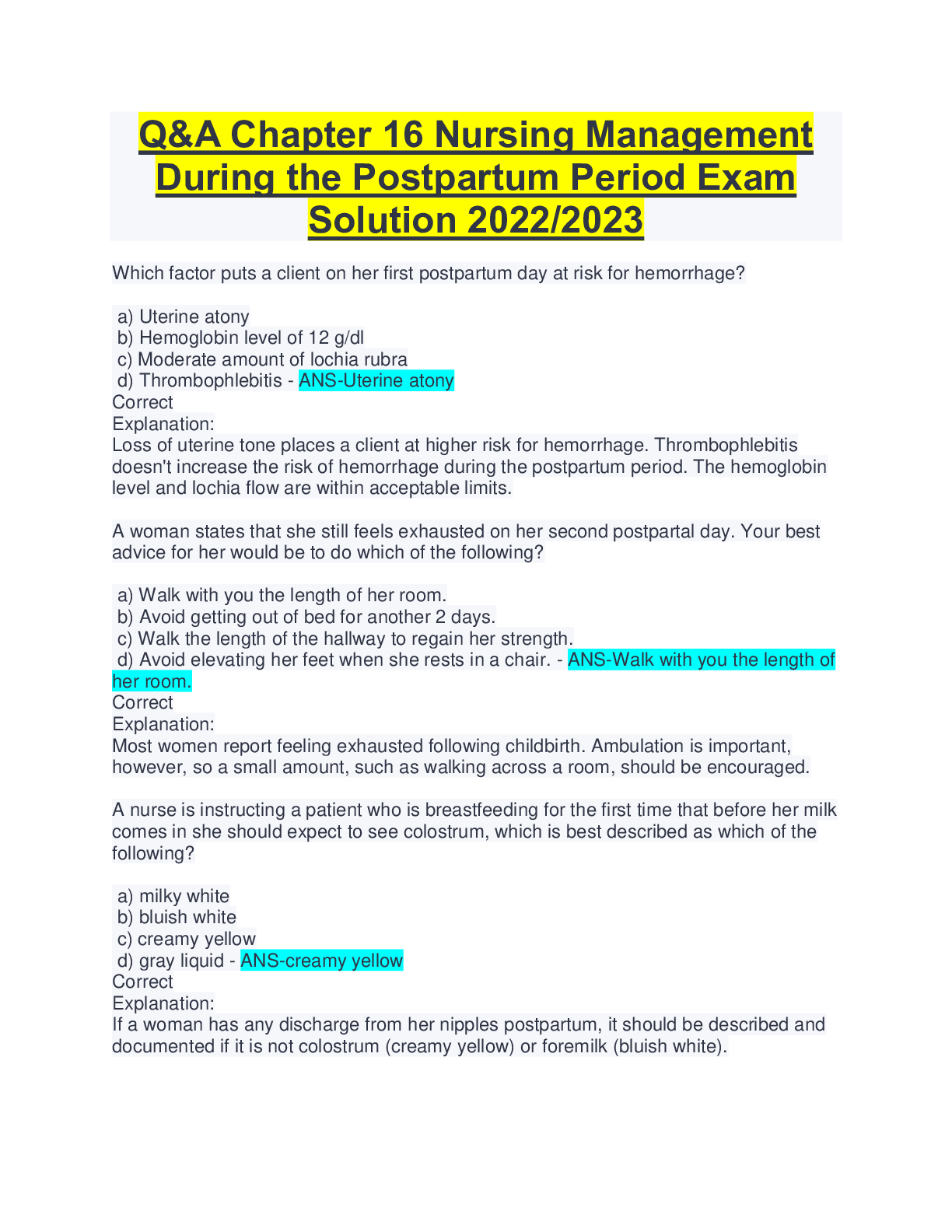
Which factor puts a client on her first postpartum day at risk for hemorrhage?
a) Uterine atony
b) Hemoglobin level of 12 g/dl
...
Q&A Chapter 16 Nursing Management
During the Postpartum Period Exam
Solution 2022/2023
Which factor puts a client on her first postpartum day at risk for hemorrhage?
a) Uterine atony
b) Hemoglobin level of 12 g/dl
c) Moderate amount of lochia rubra
d) Thrombophlebitis - ANS-Uterine atony
Correct
Explanation:
Loss of uterine tone places a client at higher risk for hemorrhage. Thrombophlebitis
doesn't increase the risk of hemorrhage during the postpartum period. The hemoglobin
level and lochia flow are within acceptable limits.
A woman states that she still feels exhausted on her second postpartal day. Your best
advice for her would be to do which of the following?
a) Walk with you the length of her room.
b) Avoid getting out of bed for another 2 days.
c) Walk the length of the hallway to regain her strength.
d) Avoid elevating her feet when she rests in a chair. - ANS-Walk with you the length of
her room.
Correct
Explanation:
Most women report feeling exhausted following childbirth. Ambulation is important,
however, so a small amount, such as walking across a room, should be encouraged.
A nurse is instructing a patient who is breastfeeding for the first time that before her milk
comes in she should expect to see colostrum, which is best described as which of the
following?
a) milky white
b) bluish white
c) creamy yellow
d) gray liquid - ANS-creamy yellow
Correct
Explanation:
If a woman has any discharge from her nipples postpartum, it should be described and
documented if it is not colostrum (creamy yellow) or foremilk (bluish white).
A patient who delivered twins 6 hours ago becomes restless and nervous. Her blood
pressure falls from 130/80 to 96/50. Her pulse drops from 80 to 56. She was induced
earlier in the day and experienced abruptio placentae. Based on this information, what
postpartum complication would the nurse expect is happening?
a) fluid volume overload
b) pulmonary emboli
c) infection
d) hemorrhage - ANS-hemorrhage
Correct
Explanation:
Some risk factors for developing hemorrhage after delivery include precipitous labor,
uterine atony, placenta previa and abruptio placentae, labor induction, operative
procedures, retained placenta fragments, prolonged third stage of labor, multiparity, and
uterine overdistention.
Many patients experience a slight fever after delivery especially during the first 24
hours. To what should the nurse attribute this elevated temperature?
a) fluid volume overload
b) dehydration
c) infection
d) change in the temperature from the delivery room - ANS-dehydration
Explanation:
Many women experience a slight fever (100.4 degrees F) during the first 24 hours after
delivery. This results from dehydration because of fluid loss during labor. With the
replacement of fluids the temperature should return to normal after 24 hours.
Two days after giving birth, a client is to receive RhoGAM. The client asks the nurse
why this is necessary. The most appropriate response from the nurse is:
a) "RhoGAM suppresses antibody formation in a woman with Rh-negative blood who
gave birth to a baby with Rh-negative blood."
b) "RhoGAM suppresses antibody formation in a woman with Rh-positive blood who
gave birth to a baby with Rh-negative blood."
c) "RhoGAM suppresses antibody formation in a woman with Rh-negative blood who
gave birth to a baby with Rh-positive blood."
d) "RhoGAM suppresses antibody formation in a woman with Rh-positive blood who
gave birth to a baby with Rh-positive blood." - ANS-"RhoGAM suppresses antibody
formation in a woman with Rh-negative blood who gave birth to a baby with Rh-positive
blood."
Correct
Explanation:
RhoGAM is indicated to suppress antibody formation in women with Rh-negative blood
who gave birth to babies with Rh-positive blood. RhoGAM is also given to women with...
[Show More]