Molecular Orbital Theory
While FMO theory allows prediction of reactions (by thermodynamics, regio or stereochemistry),
all predictions seen so far have been qualitative
We have predicted that HOMO or LUMO levels rais
...
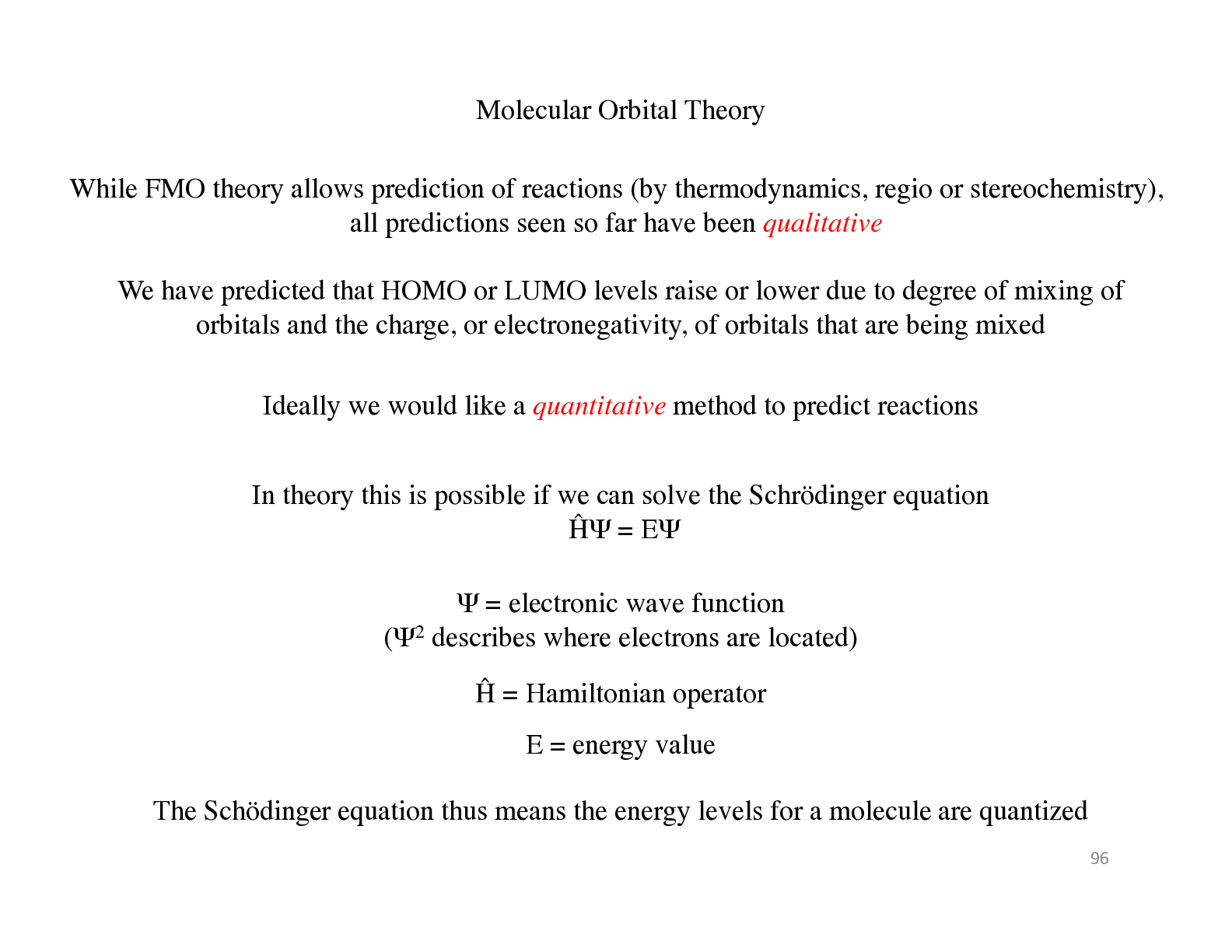
Molecular Orbital Theory
While FMO theory allows prediction of reactions (by thermodynamics, regio or stereochemistry),
all predictions seen so far have been qualitative
We have predicted that HOMO or LUMO levels raise or lower due to degree of mixing of
orbitals and the charge, or electronegativity, of orbitals that are being mixed
Ideally we would like a quantitative method to predict reactions
In theory this is possible if we can solve the Schrödinger equation
ĤΨ = EΨ"
Ψ = electronic wave function
(Ψ2 describes where electrons are located)
Ĥ = Hamiltonian operator
E = energy value
The Schödinger equation thus means the energy levels for a molecule are quantized
96#
Molecular Orbital Theory
To solve the Schrödinger equation, first use the Born-Oppenheimer approximation which
states that we can fix the location of the nuclei and consider only motion of the electrons
(if everything is moving like in reality, then there are far too many unknowns
for the number of equations, impossible to solve)
ĤΨ = EΨ"
Multiple each side by Ψ and then integrate over all space
∫ ΨĤΨ dτ = ∫ ΨEΨ dτ
Since E is only a number, it can be brought out of the integral and solve for E
E = ∫ ΨĤΨ dτ
∫ ΨΨ dτ
If consider a diatomic molecule with LCAO, ΨMOL = c1φ1 + c2φ2
E = ∫ (c1φ1 + c2φ2)Ĥ(c1φ1 + c2φ2) dτ
∫ (c1φ1 + c2φ2)2 dτ
97#
Molecular Orbital Theory
E = ∫ (c1φ1Ĥc1φ1 + c1φ1Ĥc2φ2 +c2φ2Ĥc1φ1 + c2φ2Ĥc2φ2) dτ
∫ (c1
2φ1
2 + 2c1φ1c2φ2 + c2
2φ2
2) dτ
If we rewrite equation after multiplying with the operator term:
Some common terms:
1) ∫ φaφb dτ = Sab
Overlap Integral
(related to overlap of atomic orbitals)
2) ∫ φaĤφa dτ = Haa
Coulomb Integral
(related to binding energy of electron in an orbital)
3) ∫ φaĤφb dτ = Hab
Resonance Integral
(related to energy of an electron in the field of 2 or more nuclei) 98#
Molecular Orbital Theory
E =
c1
2H11 + 2c1c2H12 + c2
2H22
c1
2S11 + 2c1c2S12 + c2
2S22
Substitute these common terms into energy solutions
This equation will thus hold valid for each valid solution,
the different solutions for E correspond to the different MO energy levels
To obtain the solutions, need to undertake a partial derivative
with respect to each coefficient to minimize the energy with respect to the coefficient
δE / δC1 = 0 δE / δC2 = 0
For the partial derivative with respect to C1:
E(2C1S11 + 2C2S12) = 2C1H11 + 2C2H12
C1(H11 – ES11) + C2(H12 – ES12) = 0
For the partial derivative with respect to C2:
C1(H12 – ES12) + C2(H22 – ES22) = 0 99#
Molecular Orbital Theory
The solutions of the partial derivatives were written by grouping the terms for each
coefficient to write the equation in a secular equation form
C1(H11 – ES11) + C2(H12 – ES12) = 0
C1(H12 – ES12) + C2(H22 – ES22) = 0
Secular
Equations
This allows the equations to be written in a secular determinant
H11 – ES11 H12 – ES12
H12 – ES12 H22 – ES22
= 0
Secular
Determinant
Diagonal elements: Coulomb integrals
(terms dealing with each nuclei)
Off-Diagonal elements: Resonance integrals
(terms dealing with different nuclei)
Remember that this secular determinant was formed considering
the mixing of two atom
[Show More]














.png)
.png)