Cationic Rearrangements
When a SN1 reaction occurs, carbocations are formed as intermediate structures
H3C
H3C CH3
CH3
Br
AgNO3
H3C
H3C CH3
CH3
Reaction Coordinate
Energy
SM
2˚ 3˚
Product
3˚ cation is more
...
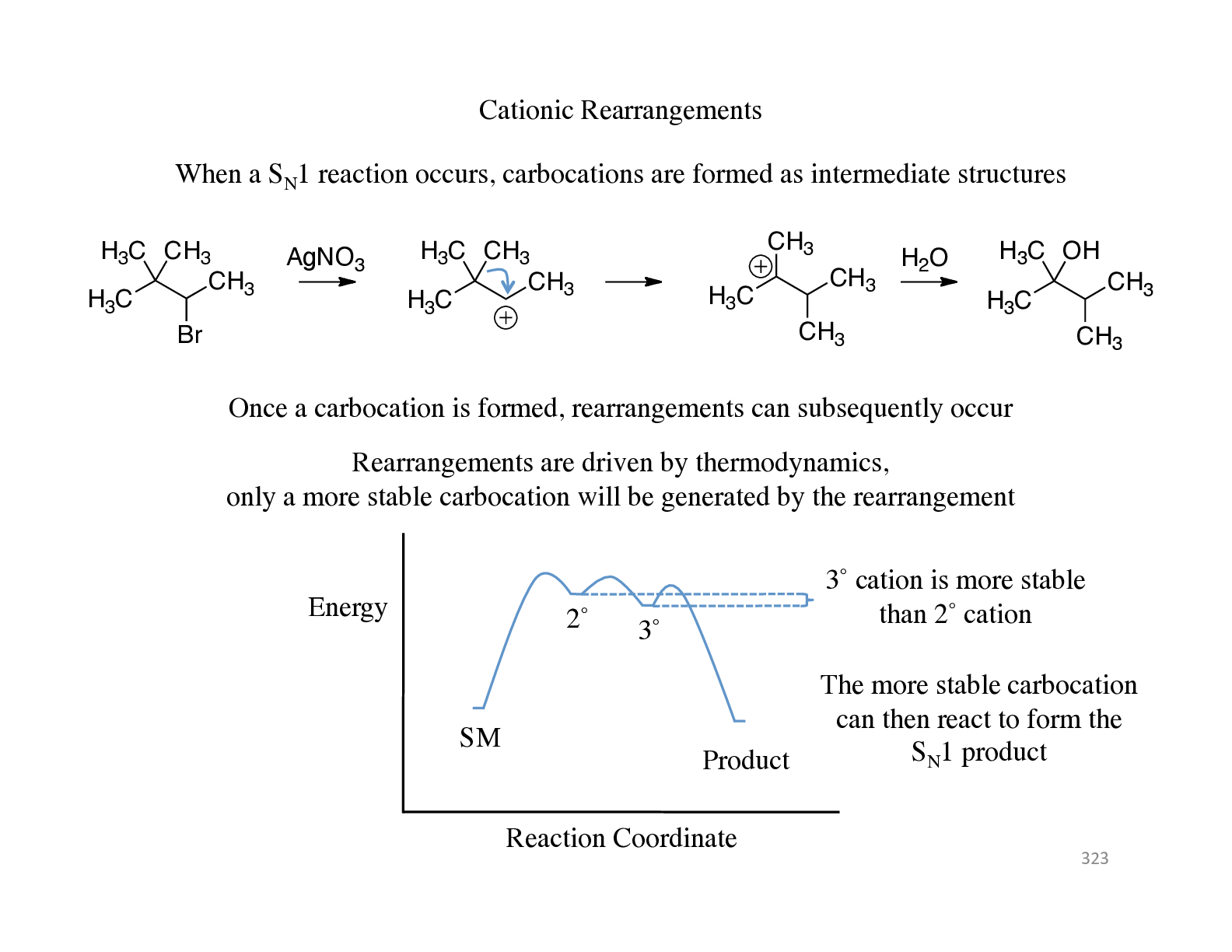
Cationic Rearrangements
When a SN1 reaction occurs, carbocations are formed as intermediate structures
H3C
H3C CH3
CH3
Br
AgNO3
H3C
H3C CH3
CH3
Reaction Coordinate
Energy
SM
2˚ 3˚
Product
3˚ cation is more stable
than 2˚ cation
H3C CH3
CH3
CH3 H2O
H3C
H3C OH
CH3
CH3
Once a carbocation is formed, rearrangements can subsequently occur
Rearrangements are driven by thermodynamics,
only a more stable carbocation will be generated by the rearrangement
The more stable carbocation
can then react to form the
SN1 product
323#
Cationic Rearrangements
Rearrangements are known to occur by migrating a hydrogen, alkyl groups, or aryl groups
(when an alkyl or aryl group migrates, it is called a Wagner-Meerwein shift)
A 1,2 shift is the most common type of rearrangement
In order to allow a rearrangement to occur, the bonding orbital of the migrating group
needs to be coplanar with the carbocation orbital
H
H
H
H3C
H3C H H
H
H3C CH3
Newman projection
Only in this conformer is
hydrogen aligned with
empty p orbital
H
H
H3C
H3C
H
The orbital of the C-H bond
must be aligned with the
empty p orbital to allow a
rearrangement to occur
324#
Cationic Rearrangements
Rearrangements only occur with cations, not with anions or radicals
Process occurs with an orbital on an adjacent atom interacting
with the empty p orbital of the carbocation
H3C
H
H
CH3
CH3
CH3 CH3
H
H3C
H
CH3
CH3
H
H3C
H
Consider the orbital interactions for the transition state for this process
Bonding molecular orbital
Antibonding molecular orbital
In a cation rearrangement, 2 electrons are involved in a bonding molecular orbital
In a radical or anion rearrangement, additional electrons would be placed in antibonding
molecular orbitals (therefore a less stable process) 325#
Cationic Rearrangements
Carbocations are generally unstable species so therefore they are intermediate structures,
not final products
After generation and possible rearrangements,
the carbocations must react to form a stable product
H3C
H3C CH3
CH3
Br
AgNO3
H3C
H3C CH3
CH3 H3C CH3
CH3
H3C H
H2O
H3C CH3
CH3
CH3
Two of the common pathways for the
carbocation to react is either reacting
with a base to form an E1 product
H3C
H3C OH
CH3
CH3
H2O
Or to react with a nucleophile
to form an SN1 product
SN1 E1
326#
Cationic Rearrangements
A third possibility to form products in carbocation reactions
is to form a strong bond after the formation of the carbocation
This is the energetic driving force in pinacol rearrangements
HO OH
H3C CH3
H3C CH3
Pinacol
H+ H2O OH
H3
[Show More]













.png)
.png)