ACSM Clinical Exercise Physiologist Exam 2022 with
complete solution
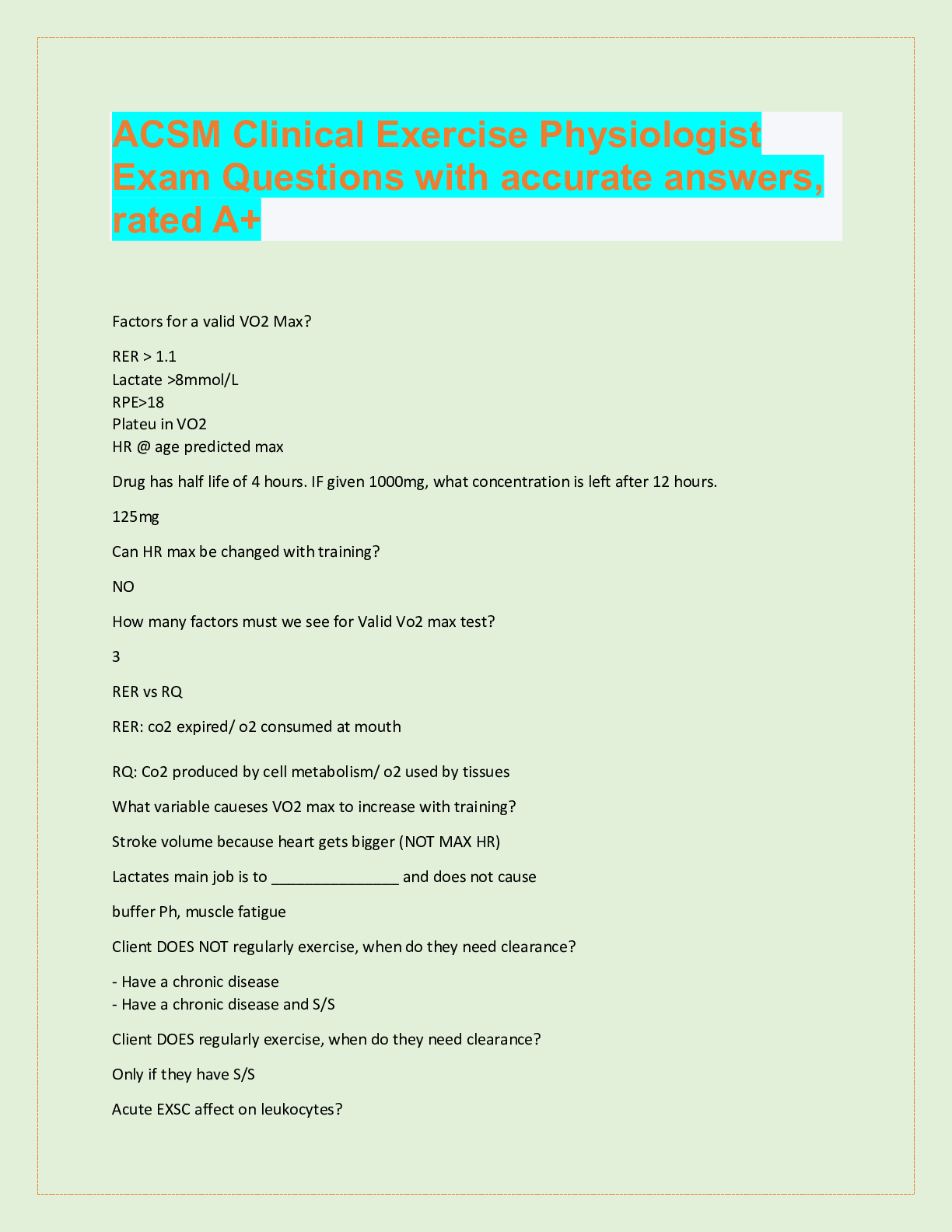
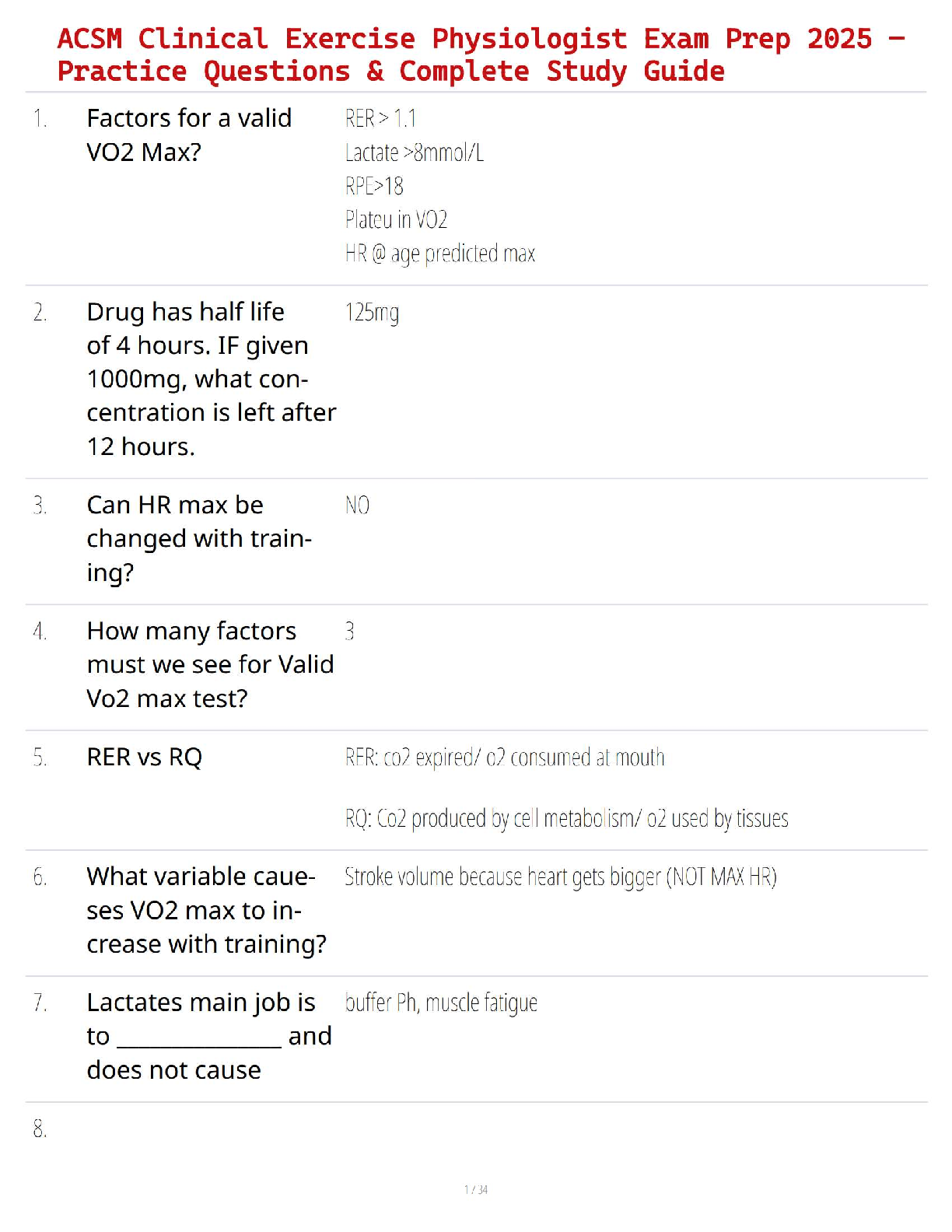
Factors for a valid VO2 Max? -Answer- RER > 1.1
Lactate >8mmol/L
RPE>18
Plateu in VO2
HR @ age predicted max
Drug has half life of 4 hours. IF g
...
ACSM Clinical Exercise Physiologist Exam 2022 with
complete solution
Factors for a valid VO2 Max? -Answer- RER > 1.1
Lactate >8mmol/L
RPE>18
Plateu in VO2
HR @ age predicted max
Drug has half life of 4 hours. IF given 1000mg, what concentration is left after 12 hours.
-Answer- 125mg
Can HR max be changed with training? -Answer- NO
How many factors must we see for Valid Vo2 max test? -Answer- 3
RER vs RQ -Answer- RER: co2 expired/ o2 consumed at mouth
RQ: Co2 produced by cell metabolism/ o2 used by tissues
What variable caueses VO2 max to increase with training? -Answer- Stroke volume
because heart gets bigger (NOT MAX HR)
Lactates main job is to _______________ and does not cause -Answer- buffer Ph,
muscle fatigue
Client DOES NOT regularly exercise, when do they need clearance? -Answer- - Have a
chronic disease
- Have a chronic disease and S/S
Client DOES regularly exercise, when do they need clearance? -Answer- Only if they
have S/S
Acute EXSC affect on leukocytes? -Answer- INC concentration
Gold std for diagnosing cardiac issues -Answer- Cardiac catheterization
ST segment elevation vs depression -Answer- Elevation: Myocardial infarction
Depression: ischemia
2 cases when you should not do a regular exsc stress test: -Answer- - Client uses Beta
Agonist
- Client uses dipyridamole (a vasodilator)What BP level contraindicated during exsc test -Answer- 250/115
Patient w/ CAD will exhibit what symptom relating to HR and BP after EXSC? -AnswerVERY slow to return to resting levels
Primary cause of type 2! diabetes? -Answer- Inflammation
S/S of diabetes mellitus: -Answer- Polydipsia (thirst)
Polyuria (urination)
Polyphagia (hunger)
Which diabetic medications is contraindicated for exercise? -Answer- Insulin (if
exercising at peak insulin effect)
When programming EXSC for clinical population, what variables should be progressed
first? -Answer- Frequency, then duration, then intensity
*When adjusting intensity, duration should be dropped back to baseline
Primary cause of obesity -Answer- Hypercaloric Diet
Obesity BMI classifications -Answer- >30 = OBESE
30-34=mild
34-39=moderate
>40=morbid
waist circumference -Answer- > 40 Males
>35 Females
INCREASED RISK
What type of adiposity is most inflammatory? -Answer- Central (visceral) adiposity
Most effective method for losing weight? -Answer- Surgical intervention
NIH's weight loss goal for obese individuals (what is clinically significant) -Answer- 5-
10%
What is exercises effect on weight loss? -Answer- LITTLE TO NONE!
BMI qualifications for pharmacotherapy/surgery -Answer- Pharma:
BMI >27 w/comorbidities
BMI >30Surgery:
BMI>35-39 w/comorbidities
BMI>40
Average weight loss with bariatric surgery? -Answer- 25%
BP classifications -Answer- Normal: 120/80
Elevated: 120-129/80
St 1 Hypertension: 130-139/80-89
St 2 Hypertension:
>140/>90
Which physiological variable has greatest impact on BP? -Answer- Blood vessel radius
Atherosclerosis vs. Arteriosclerosis -Answer- Athero: Thickening (Via damage to media
of BV being patched by LDL cholesterol)
Arterio: Stiffening (vascular remodeling due to high BP, inflammation and
hyperglycemia)
What does a higher DBP mean? -Answer- Pt has a better elastic recoil
What is the best predictor of future cardiovascular events? -Answer- Arterial stiffness
score (PP/Pulse wave velocity)
BP changes during EXSC -Answer- Aerobic: SBP inc, DBP dec
Resistance: SBP inc, DBP inc
ACE inhibitors -Answer- stop conversion of angiotensin 1 to angiotensin 2 ---
VASODILATE
ARB's -Answer- Block angiotensin 2 from binding to its receptor on artery --
VASODILATE
which hypertension medication effects exercise? -Answer- B-Blockers
EXSC affect on blood lipid profile -Answer- Decrease TG, Increase HDL
Statin effect on lipids -Answer- Decrease LDL, TG
Increase HDL
what drug decreases TG -Answer- FibratesYou need 2/3 of these criteria to diagnose heart attack -Answer- Chest pain >30 mins
EKG shows ST Segment elevation / T wave inversion
Presence of biomarkers in blood
Fibrinolytics -Answer- Streptokinase, Tenecteplase (TNKase)
Clot buster used in emergencies
Aspirin -Answer- Inhibits thromboxane A2 (inhibiting clot formation)
Recovery time after heart attack before EXSC -Answer- 1-2 days
What intensity should you exercise ACS/Heart attack patients -Answer- 10 BPM below
their ischemic threshold (elicits chest pain)
Types of congestive heart failure: -Answer- Right side: due to increased pulmonary
pressure
Left side: due to peripheral resistance
- Systolic:
<30% EF
<30 SV
Right side:
<60 EF
<30 SV
Ejection fraction equation -Answer- EF=(EDV−ESV)/EDV
Edema is more prevalent in _________ sided heart failure -Answer- Right sided
(because there is a back up in venous return)
gold std for diagnosis congestive heart failure -Answer- Echocardiogram
Which common medication is a negative chronotropic and how does it effect exercise -
Answer- B blocker
When pt on B-blocker, must lower expectation of HR for a given intensity (lower hr for
given intensity)
What is PAD? -Answer- Blockage of leg arteries by plaqueWhich population are at highest risk of PAD? -Answer- Diabetics
Diagnosis of PAD? -Answer- Ankle Brachial index
Ankle/brachial USUALLY = 1
Ankle/brachial of <.9 diagnostic of PAD
What should you stress while EXSC someone with PAD? -Answer- Push through leg
pain!!
Risk Stratification NOT a regular EXSCer -Answer- Disease or S/S: CLEARANCE
NO Disease or S/S: NO CLEARANCE
Risk stratification REGULAR EXSCer -Answer- NO disease or S/S: NO CLEARANCE
Disease Asymptomatic: NO CLEARANCE
Disease or S/S: CLEARANCE
Cardiovascular disease Risk Factors -Answer- NEGATIVE:
Age: Men >45 Women >55
Family History: Myocardial infarct, coronary revascularization, sudden death before 55
father or 65 mother
Cigarette Smoking: Current, quit within 6mo, secondhand smoke
Sedentary lifestyle: doesnt exercise 30 minutes moderate intensity 3 days per week for
3 mo
Obesity: BMI >30 / Waist Circ 40 male 35 female
Hypertension: SBP >130 and or DBP >90 / antihypertensive meds
Dyslipidemia: LDL >130 / HDL<40 / Lipid lowering meds
Diabetes: Fasting BG >126 / OGTT >200
POSITIVE:
HDL>60
Lipid Classifications -Answer- LDL: >130 highHDL: <40 low
TC: >200 high
TG: >200 high
General Indications for Stopping an Exercise Test -Answer- - Angina
- Drop in SBP >10 with increase in workload
- Systolic >250/110
- SOB, wheezing, leg cramps, claudication
- Poor perfusion: Light headed, confused, naseua, cyanosis
- HR fails to increase with increased intensity
- Change in heart rhythm
- Subject requests to stop
- Failure of equipment
- Visually severely fatigued
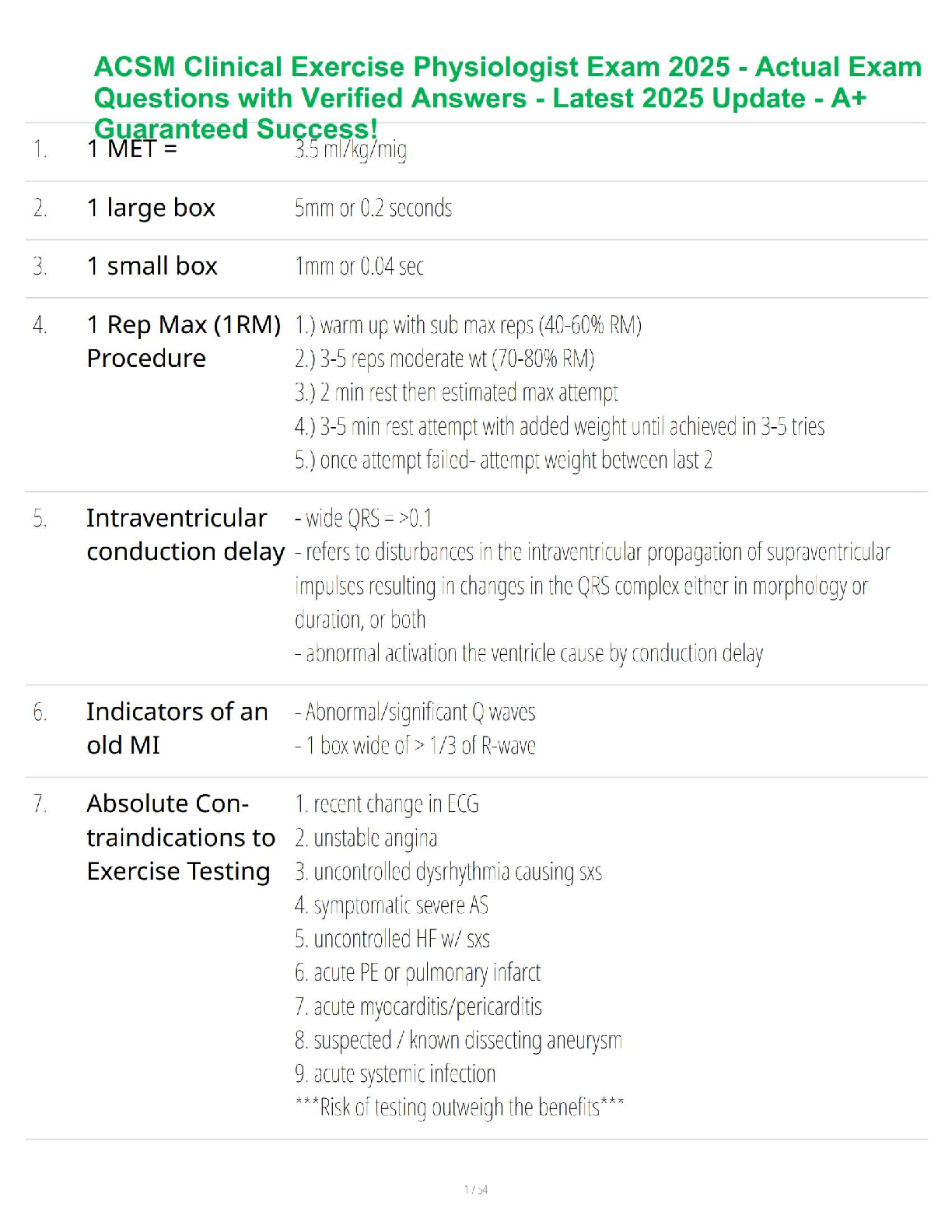
Absolute contraindications to exercise testing -Answer- - Acute myocardial infarction
within 2 days
- Unstable Angina
- Uncontrolled arrhythmia
- Active endocarditis
- Symptomatic aortic stenosis
- Pulmonary embolism, infarction, deep vein thrombosis
- Acute Aortic Dissection
Relative Contraindications to Exercise Testing -Answer- - Known obstructive left main
coronary artery stenosis
- Moderate aortic stenosis
- Taccharythmias
- Advanced or complete heart block
- Recent stroke
- resting hypertension: >200/110
- Uncorrected medical conditions: electrolyte imbalaces, significant anemia,
hyperthyroidism
Terminating a symptom limiting max exercise test -Answer- ABSOLUTE:
- ST elevation >1
- Drop in systolic >10 w/ increased workload
- Moderate/severe angina
- Ataxia, diziness, syncope
- poor perfusion (cyanosis, pallor)
- Sustained V-tach
- 2nd or 3rd degree block
- Technical difficulties measuring ECG/BP
- subject requests to stop
HRR Equation -Answer- Target HR = [intensity x (HRmax-HRrest)] + HRrestAerobic FITT-VP for healthy adults -Answer- F: 5 days of moderate / 3 days of vigorous
I: Moderate/Vigorous
T: 30-60 min moderate / 20-60 min Vigorous
T: Major muscle groups, continuous, rhythmic
V: >500-100 Metmins / >7000 steps
P: One continuous session or multiple sessions >10 mins
flexibility FITT-VP for healthy adults -Answer- F: >2-3 days a week
I: Stretch until discomfort
T: 10-30 second hold (30-60 more beneficial)
T: Major muscle groups
V: Total of 60 s for each exercise
P: repeat each exsc 2-4 times
Absolute contraindications for testing during pregnancy -Answer- - Hemodynamically
significant heart disease
- Restrictive lung disease
- Incompetent cervix
- Risk for premature labor
- Persistent 2nd or 3rd trimester bleeding
- placenta previa after 26 wk gestation
- Ruptured membranes
- Preeclampsia / pregnancy induced hypertension
FIT for Cardiorespiratory Fitness Programming -Answer- F: 3-5 days/wk
I:Mod to vig (40-80%)
T: 20-60 min
FIT for PAD -Answer- F: 3-5 days/wk
I: moderate (40-60%) / 3-4 on claudication pain scale
T: 30-45 min
T: Ideally weight bearing
Diagnostic criteria for Diabetes -Answer- Normal:
- A1c: <5.7
- FPG: <100
Pre-diabetes:
- A1c: 5.7-6.4
- FPG: 100-125
Diabetes:
- A1c: >6.5
- FPG: >126Health Belief Model -Answer- People will engage in a given behavior when:
- they perceive threat of disease
**Involved cues to action and Self-Efficacy
Transtheoretical Model -Answer- People progress through 5 stages at varying rates
(and can move back and forth between them)
- Precontemplation: No intention to change
- Contemplation: Intention to start exsc within 6 mo
- Preparation: Some participation in exsc / not enough to meet guidlines
- Action: exsc that meets guidlines for <60mo
- Maintenance: exsc that meets guidlines for >6mo
social cognitive theory -Answer- Observational: we learn by watching others model
behavior (and have expectations as to their benefits from engaging in said behavior)
Self-Efficacy: confidence of performing a specific behavior
Managing emotional arousal:
- Cognitive restructuring: thinking about the problem in a constructive way
Vicarious reinforcement: Seeing other people benefit from a certain behavior
Common Cardiovascular Medications -Answer- B-Blockers: hypertension, angina
- acebutolol, atenolol, botaxolol, carvedilol, nadalol
Ace Inhibit: Hypertension, CAD
- Benazepril, captopril, enalapril
Angiotensin receptor blocker (ARB): HTN, Neuropathy
- azilsartan, candesartan, eprosartan
Calcium channel blocker: HTN, angina
- Amlodipine, clevidipine, felodipine,
Diuretics: Edema, HTN, HF
- Bendroflumethiazide, chlorothiazide
Nitrates: Angina, Acute MI, HF
- amyl nitrate, isosorbide mononitrate,Antiarrythmatic agents: surpress A-fib
- disophyramide, quinidine, Lidocaine
Antilipidemic: Elevated TC/LDL, low HDL
- Bile acid sequestriants: Cholestyramine, colesevelam
Inhaled corticosteriods: Asthma
- Beclomethasone, budesonide
B2 agonists: CPD, Asthma
- Albuterol
Biguanides: Diabetes(decrease sugar prod by liver)
- Metformin
Joint classifications -Answer- Fibrous- sutures
Cartilaginous- discs
Synovial (diarthroses) - freely movable - Hip, elbow
Synarthroses - Immovable
Amphiarthroses - slightly movable
skinfold locations -Answer- *ALL ON RIGHT SIDE
Chest: Diagonal halfway between nipple and anterior axillary line
Midaxillary: Vertical on midixaillary line
Abdominal: Vertial 2cm right of umbilicus
Suprailiac: Diagonal 2cm above suprailiac crest
Subscapular: Diagonal 2cm below inferior angle of scap
Triceps: Vertical halfway
Biceps: Vertical - roughly halfway up biceps- 1 cm above tricep measurement
Thigh: Vertical halfway anterior midline
Medial calf: Vertical halfway
[Show More]


.png)
![Preview of eBook [PDF] Barash, Cullen, and Stoelting's Clinical Anesthesia 9th Edition By Bruce F. Cu](https://browseimages.nyc3.digitaloceanspaces.com/paper-images/2024/Aug/29/8DF2QRTq2024-08-29-10-3966d0259b7c4b5.png)
![Preview of eBook [PDF] Burns' Pediatric Primary Care 7th Edition BY Dawn Lee Garzon Maaks,, Nancy Bar](https://browseimages.nyc3.digitaloceanspaces.com/paper-images/2024/Aug/26/WR2rowXX2024-08-26-02-0966cc625bea839.png)




![Preview of eBook [PDF] AACN Essentials of Progressive Care Nursing 5th Edition By Sarah A. Delgado](https://browseimages.nyc3.digitaloceanspaces.com/paper-images/2024/Aug/29/ipbdJSTN2024-08-29-11-1466d02df30fc96.png)
![Preview of [eTextbook] [PDF] Labor Economics 9th Edition By George Borjas](https://browseimages.nyc3.digitaloceanspaces.com/paper-images/2025/Jan/13/JcsHZtUb2025-01-13-07-42678542822cb77.png)