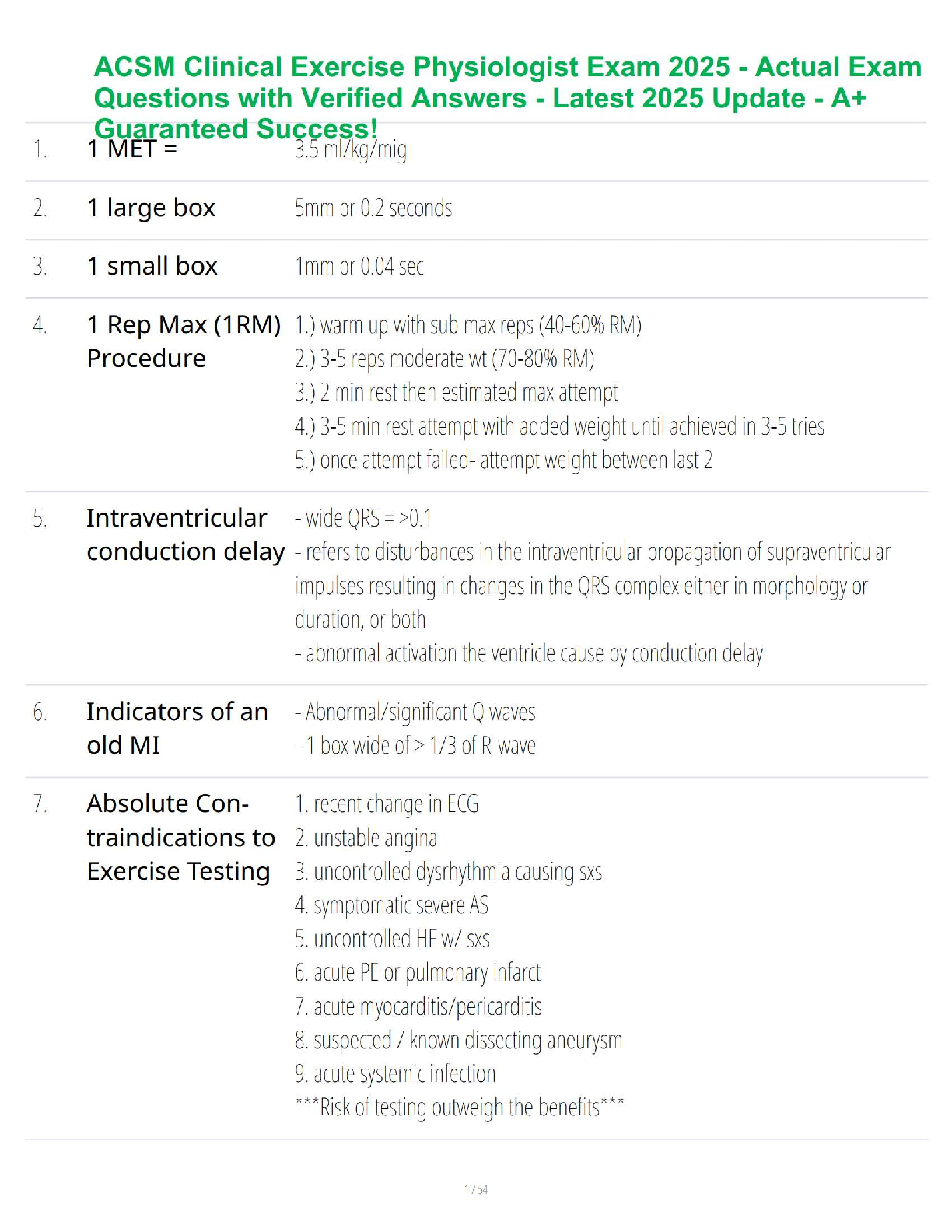
ACSM Clinical Exercise Physiologist
Exam Questions with accurate answers,
rated A+
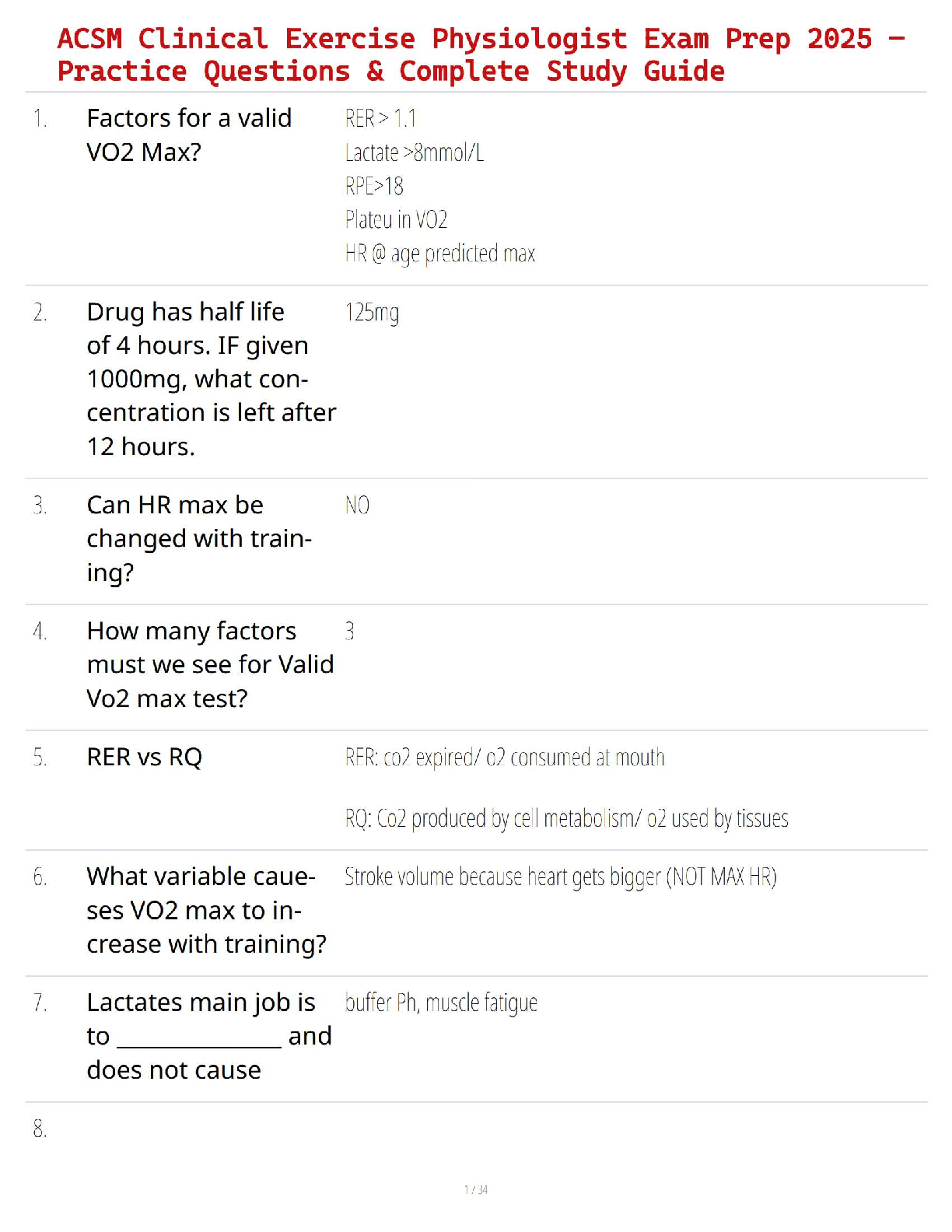
Factors for a valid VO2 Max?
RER > 1.1
Lactate >8mmol/L
RPE>18
Plateu in VO2
HR @ age predicted max
Drug has half life of 4 ho
...
ACSM Clinical Exercise Physiologist
Exam Questions with accurate answers,
rated A+
Factors for a valid VO2 Max?
RER > 1.1
Lactate >8mmol/L
RPE>18
Plateu in VO2
HR @ age predicted max
Drug has half life of 4 hours. IF given 1000mg, what concentration is left after 12 hours.
125mg
Can HR max be changed with training?
NO
How many factors must we see for Valid Vo2 max test?
3
RER vs RQ
RER: co2 expired/ o2 consumed at mouth
RQ: Co2 produced by cell metabolism/ o2 used by tissues
What variable caueses VO2 max to increase with training?
Stroke volume because heart gets bigger (NOT MAX HR)
Lactates main job is to _______________ and does not cause
buffer Ph, muscle fatigue
Client DOES NOT regularly exercise, when do they need clearance?
- Have a chronic disease
- Have a chronic disease and S/S
Client DOES regularly exercise, when do they need clearance?
Only if they have S/S
Acute EXSC affect on leukocytes?
INC concentration
Gold std for diagnosing cardiac issues
Cardiac catheterization
ST segment elevation vs depression
Elevation: Myocardial infarction
Depression: ischemia
2 cases when you should not do a regular exsc stress test:
- Client uses Beta Agonist
- Client uses dipyridamole (a vasodilator)
What BP level contraindicated during exsc test
250/115
Patient w/ CAD will exhibit what symptom relating to HR and BP after EXSC?
VERY slow to return to resting levels
Primary cause of type 2! diabetes?
Inflammation
S/S of diabetes mellitus:
Polydipsia (thirst)
Polyuria (urination)
Polyphagia (hunger)
Which diabetic medications is contraindicated for exercise?
Insulin (if exercising at peak insulin effect)
When programming EXSC for clinical population, what variables should be progressed first?
Frequency, then duration, then intensity
*When adjusting intensity, duration should be dropped back to baseline
Primary cause of obesity
Hypercaloric Diet
Obesity BMI classifications
>30 = OBESE
30-34=mild
34-39=moderate
>40=morbid
waist circumference
> 40 Males
>35 Females
INCREASED RISK
What type of adiposity is most inflammatory?
Central (visceral) adiposity
Most effective method for losing weight?
Surgical intervention
NIH's weight loss goal for obese individuals (what is clinically significant)
5-10%
What is exercises effect on weight loss?
LITTLE TO NONE!
BMI qualifications for pharmacotherapy/surgery
Pharma:
BMI >27 w/comorbidities
BMI >30
Surgery:
BMI>35-39 w/comorbidities
BMI>40
Average weight loss with bariatric surgery?
25%
BP classifications
Normal: 120/80
Elevated: 120-129/80
St 1 Hypertension: 130-139/80-89
St 2 Hypertension:
>140/>90
Which physiological variable has greatest impact on BP?
Blood vessel radius
Atherosclerosis vs. Arteriosclerosis
Athero: Thickening (Via damage to media of BV being patched by LDL cholesterol)
Arterio: Stiffening (vascular remodeling due to high BP, inflammation and hyperglycemia)
What does a higher DBP mean?
Pt has a better elastic recoil
What is the best predictor of future cardiovascular events?
Arterial stiffness score (PP/Pulse wave velocity)
BP changes during EXSC
Aerobic: SBP inc, DBP dec
Resistance: SBP inc, DBP inc
ACE inhibitors
stop conversion of angiotensin 1 to angiotensin 2 --- VASODILATE
ARB's
Block angiotensin 2 from binding to its receptor on artery -- VASODILATE
which hypertension medication effects exercise?
B-Blockers
EXSC affect on blood lipid profile
Decrease TG, Increase HDL
Statin effect on lipids
Decrease LDL, TG
Increase HDL
what drug decreases TG
Fibrates
You need 2/3 of these criteria to diagnose heart attack
Chest pain >30 mins
EKG shows ST Segment elevation / T wave inversion
Presence of biomarkers in blood
Fibrinolytics
Streptokinase, Tenecteplase (TNKase)
Clot buster used in emergencies
Aspirin
Inhibits thromboxane A2 (inhibiting clot formation)
Recovery time after heart attack before EXSC
1-2 days
What intensity should you exercise ACS/Heart attack patients
10 BPM below their ischemic threshold (elicits chest pain)
Types of congestive heart failure:
Right side: due to increased pulmonary pressure
Left side: due to peripheral resistance
- Systolic:
<30% EF
<30 SV
Right side:
<60 EF
<30 SV
Ejection fraction equation
EF=(EDV−ESV)/EDV
Edema is more prevalent in _________ sided heart failure
Right sided (because there is a back up in venous return)
gold std for diagnosis congestive heart failure
Echocardiogram
Which common medication is a negative chronotropic and how does it effect exercise
B blocker
When pt on B-blocker, must lower expectation of HR for a given intensity (lower hr for given intensity)
What is PAD?
Blockage of leg arteries by plaque
Which population are at highest risk of PAD?
Diabetics
Diagnosis of PAD?
Ankle Brachial index
Ankle/brachial USUALLY = 1
Ankle/brachial of <.9 diagnostic of PAD
What should you stress while EXSC someone with PAD?
Push through leg pain!!
Risk Stratification NOT a regular EXSCer
Disease or S/S: CLEARANCE
NO Disease or S/S: NO CLEARANCE
Risk stratification REGULAR EXSCer
NO disease or S/S: NO CLEARANCE
Disease Asymptomatic: NO CLEARANCE
Disease or S/S: CLEARANCE
Cardiovascular disease Risk Factors
NEGATIVE:
Age: Men >45 Women >55
Family History: Myocardial infarct, coronary revascularization, sudden death before 55 father or 65
mother
Cigarette Smoking: Current, quit within 6mo, secondhand smoke
Sedentary lifestyle: doesnt exercise 30 minutes moderate intensity 3 days per week for 3 mo
Obesity: BMI >30 / Waist Circ 40 male 35 female
Hypertension: SBP >130 and or DBP >90 / antihypertensive meds
Dyslipidemia: LDL >130 / HDL<40 / Lipid lowering meds
Diabetes: Fasting BG >126 / OGTT >200
POSITIVE:
HDL>60
Lipid Classifications
LDL: >130 high
HDL: <40 low
TC: >200 high
TG: >200 high
General Indications for Stopping an E
[Show More]


.png)