QUESTION 1
1. For the next two numbers, consider a family of four with a total mass of 200 kg step
into their 1200-kg car, the car spring’s compress 3.0 cm.
What is the spring constant of the car’s springs, assuming t
...
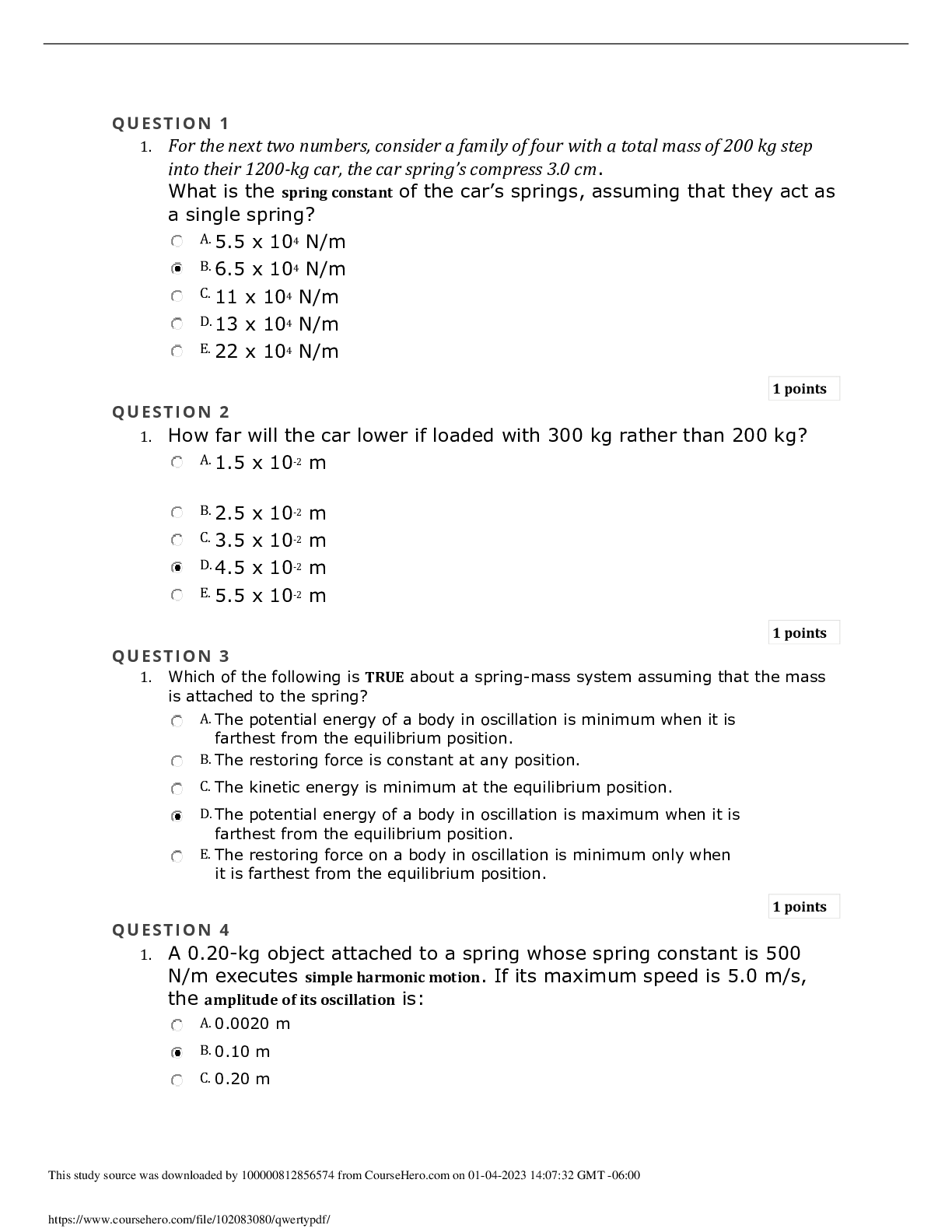
QUESTION 1
1. For the next two numbers, consider a family of four with a total mass of 200 kg step
into their 1200-kg car, the car spring’s compress 3.0 cm.
What is the spring constant of the car’s springs, assuming that they act as
a single spring?
A.5.5 x 104 N/m
B.6.5 x 104 N/m
C. 11 x 104 N/m
D.13 x 104 N/m
E. 22 x 104 N/m
1 points
QUESTION 2
1. How far will the car lower if loaded with 300 kg rather than 200 kg?
A.1.5 x 10-2 m
B.2.5 x 10-2 m
C. 3.5 x 10⁻² m
D.4.5 x 10-2 m
E. 5.5 x 10⁻² m
1 points
QUESTION 3
1. Which of the following is TRUE about a spring-mass system assuming that the mass
is attached to the spring?
A. The potential energy of a body in oscillation is minimum when it is
farthest from the equilibrium position.
B. The restoring force is constant at any position.
C. The kinetic energy is minimum at the equilibrium position.
D.The potential energy of a body in oscillation is maximum when it is
farthest from the equilibrium position.
E. The restoring force on a body in oscillation is minimum only when
it is farthest from the equilibrium position.
1 points
QUESTION 4
1. A 0.20-kg object attached to a spring whose spring constant is 500
N/m executes simple harmonic motion. If its maximum speed is 5.0 m/s,
the amplitude of its oscillation is:
A. 0.0020 m
B. 0.10 m
C. 0.20 m
D.25 m
E. 250 m
1 points
QUESTION 5
1. A 3-kg block, attached to a spring, executes simple harmonic motion
according to x = 2 cos[(50 rad/s)t] where x is in meters and t is in
seconds. The spring constant of the spring is:
A. 1 N/m
B. 100 N/m
C. 150 N/m
D.3750 N/m
E. 7500 N/m
1 points
QUESTION 6
1. For the five numbers, consider a spring that stretches 0.150 m when a 0.300 kg mass is
gently lowered on it. The spring is then set up horizontally with the 0.300 kg mass
resting on a frictionless table. The mass is pulled so that the spring is stretched 0.100 m
from the equilibrium point, and released from rest.
Determine the spring constant.
A.9.8 N/m
B.14.7 N/m
C. 19.6 N/m
D.24.5 N/m
E. 34.3 N/m
1 points
QUESTION 7
1. Determine the amplitude of the horizontal oscillation.
A.0.100 m
B.0.150 m
C. 0.200 m
D.0.250 m
E. 0.300 m
1 points
QUESTION 8
1. Determine the maximum speed.
A. 0.404 m/s
B. 0.505 m/s
C. 0.606 m/s
D.0.707 m/s
E. 0.808 m/s
1 points
QUESTION 9
1. Determine the speed when the mass is 0.050 m from equilibrium.
A. 0.35 m/s
B. 0.40 m/s
C. 0.70 m/s
D.0.80 m/s
E. 0.90 m/s
1 points
QUESTION 10
1. Determine the magnitude of the maximum acceleration.
A. 4.63 m/s2
B. 5.52 m/s2
C. 6.53 m/s2
D.11.0 m/s2
E. 13.1 m/s2
1 points
QUESTION 11
1. A weight suspended from an ideal spring oscillates up and down with a
period T. If the amplitude of the oscillation is doubled, the period will be_____.
A. T/4
B. T/2
C. T
D.2 T
E. 4 T
1 points
QUESTION 12
1. The pendulum of a grandfather's clock swings from left to right once every two
seconds and may be approximated as a simple pendulum. How long is the length of the
pendulum? Hint: Determine the period of oscillation first.
A.
B.
C.
D.
E.
1 points
QUESTION 13
1. What should be the length of a simple pendulum if the frequency desired is 2.50 Hz?
Let g = 32 ft/s2
A. 0.032 ft
B. 0.064 ft
C. 0.130 ft
D.0.260 ft
E. 0.420 ft
1 points
QUESTION 14
1. A 2-kg object is attached to a spring. The force constant of the spring is k = 196
N/m. The object is held a distance 5 cm from the equilibrium position and is released
at t = 0. Write x as a function of time.
A.
B.
C.
D.
E.
1 points
QUESTION 15
1. A proud deep-sea fisherman hangs a 65.0-kg fish from an ideal spring having
negligible mass. The fish stretches the spring 0.120 m. What is the force constant of
the spring?
A. 0.67 x 10³ N/m
B. 1.33 x 10³ N/m
C. 3.98 x 10³ N/m
D.5.31 x 103 N/m
E. 7.97 x 10³ N/m
1 points
QUESTION 16
1. A guitar string vibrates at a frequency of 440 Hz. A point at its center moves in SHM
with an amplitude of 3.0 mm and a phase angle of zero. What are the maximum
values of the magnitudes of the velocity and acceleration of the center of the string?
A. 2.1 m/s; 0.6 x 10⁴ m/s2
B. 2.1 m/s; 1.2 x 10⁴ m/s2
C. 4.2 m/s; 1.2 x 10⁴ m/s2
D.4.2 m/s; 2.3 x 10⁴ m/s2
E. 8.3 m/s; 2.3 x 10⁴ m/s2
1 points
QUESTION 17
1. A body of unknown mass is attached to an ideal spring with force constant 120 N/m.
It is found to vibrate with a frequency of 6.00 Hz. Find the period and the angular
frequency.
A. 0.334 s; 18.9 rad/s
B. 0.334 s; 37.7 rad/s
C. 0.167 s; 18.9 rad/s
D.0.167 s; 37.7 rad/s
E. 0.167 s; 75.4 rad/s
1 points
QUESTION 18
1. A 100g object is suspended from a spring whose force constant is 50
N/m. What is the period of oscillation of the system?
A. 0.140 s
B. 0.281 s
C. 3.56 s
D.7.14 s
E. 14.2 s
1 points
QUESTION 19
1. How long should a pendulum be if it is to have a period of one second at a place on Earth where the
acceleration due to gravity is 9.81m/s2?
A. 0.248 m
B. 0.497 m
C. 1.02 m
D.2.04 m
E. 3.06 m
1 points
QUESTION 20
1. A harmonic oscillator has a mass of 0.500 kg and an ideal spring with force constant
140 N/m. Find the period of oscillation.
A. 0.125 s
B. 0.375 s
C. 0.469 s
D.0.750 s
E. 0.934 s
1 points
QUESTION 21
1. Consider a spring that stretches 0.250 m when a 0.400 kg mass is gently lowered on
it. The spring is then set up horizontally with the 0.400 kg mass resting on a
frictionless table. The mass is pulled so that the spring is stretched 0.200 m from the
equilibrium point, and released from rest. Determine the magnitude of the maximum
velocity.
A. 1.25 m/s
B. 1.50 m/s
C. 1.75 m/s
D.2.00 m/s
E. 2.5 m/s
1 points
QUESTION 22
1. A 3-kg object attached to a spring oscillates with an amplitude of 4 cm and a period
of 2 s. Find the maximum speed that the object can have.
A. 0.126 m/s
B. 0.252 m/s
C. 1.57 m/s
D.3.14 m/s
E. 78.5 m/s
1 points
QUESTION 23
1. A 0.150-kg toy is undergoing simple harmonic motion on the end of a horizontal
spring with force constant k = 300 N/m. When the object is 0.012 m from its
equilibrium position, it is observed to have a speed of 0.300 m/s. Find the maximum
acceleration that the toy can have during its motion.
A. 0.612 m/s2
B. 1.22 m/s2
C. 9.81 m/s2
D.13.7 m/s2
E. 27.4 m/s2
1 points
QUESTION 24
1. A 3-kg object attached to a spring oscillates with an amplitude of 4 cm and a period
of 2 s. At what displacement away from the equilibrium positionis the speed equal to
half its maximum value?
A. 0.89 cm
B. 1.73 cm
C. 2.60 cm
D.3.46 cm
E. 6.92 cm
1 points
QUESTION 25
1. An object is undergoing simple harmonic motion with period 1.200 s and amplitude
of 0.600 m. At t = 0 the object is at x = 0. How far is the object from the equilibrium
position when t = 0.480s?
A. 0.353 m
B. 0.441 m
C. 0.530 m
D.0.618 m
E. 0.706 m
1 points
QUESTION 26
1. A certain simple pendulum has a period on earth of 1.60 s. What is its period on the
surface of Mars, where g = 3.71 m/s2?
A. 1.30 s
B. 2.60 s
C. 3.90 s
D.5.20 s
E. 6.50 s
1 points
QUESTION 27
1. Consider a spring that stretches 0.250 m when a 0.400 kg mass is gently lowered on
it. The spring is then set up horizontally with the 0.400 kg mass resting on a
frictionless table. The mass is pulled so that the spring is stretched 0.200 m from the
equilibrium point, and released from rest. What is the spring constant?
A. 9.8 N
B. 7.9 N
C. 15.7 N
D.23.6 N
E. 31.4 N
1 points
QUESTION 28
1. A spring 0.40 m long is stretched 0.25 m when a 100.0 N force is
applied. The spring constant is ___.
A. 160 N/m
B. 250 N/m
C. 320 N/m
D.400 N/m
E. 500 N/m
1 points
QUESTION 29
1. A 3-kg object attached to a spring oscillates with an amplitude of 4 cm and a period
of 2 s. What is the total energy?
A. 3.56 x 10⁻² J
B. 2.37 x 10⁻² J
C. 1.78 x 10⁻² J
D.1.19 x 10-2 J
E. 0.593 x 10⁻² J
1 points
QUESTION 30
1. A 0.150-kg toy is undergoing simple harmonic motion on the end of a horizontal
spring with force constant k = 300 N/m. When the object is 0.012 m from its
equilibrium position, it is observed to have a speed of 0.300 m/s. What is the total
energy of the object at any point of its motion?
A. 0.71 x 10⁻² J
B. 1.42 x 10⁻² J
C. 2.84 x 10⁻² J
D.4.26 x 10-2 J
E. 5.68 x 10⁻² J
[Show More]