Pennsylvania Leadership Charter School
Physics/Engineering Exam
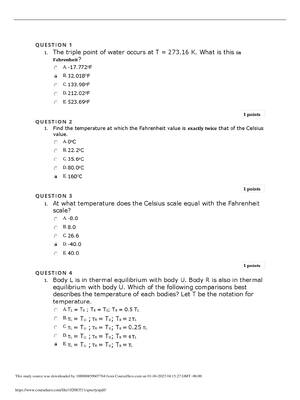
QUESTION 1
1. The triple point of water occurs at T = 273.16 K. What is this in
Fahrenheit?
A. -17.7720F
B. 32.0180F
C. 133.980F
D.212.020F
E
...
Pennsylvania Leadership Charter School
Physics/Engineering Exam
QUESTION 1
1. The triple point of water occurs at T = 273.16 K. What is this in
Fahrenheit?
A. -17.7720F
B. 32.0180F
C. 133.980F
D.212.020F
E. 523.690F
1 points
QUESTION 2
1. Find the temperature at which the Fahrenheit value is exactly twice that of the Celsius
value.
A. 00C
B. 22.20C
C. 35.60C
D.80.00C
E. 1600C
1 points
QUESTION 3
1. At what temperature does the Celsius scale equal with the Fahrenheit
scale?
A. -8.0
B. 8.0
C. 26.6
D.-40.0
E. 40.0
1 points
QUESTION 4
1. Body L is in thermal equilibrium with body U. Body R is also in thermal
equilibrium with body U. Which of the following comparisons best
describes the temperature of each bodies? Let T be the notation for
temperature.
A. TL = TU ; TR = TU; TR = 0.5 TL
B. TL = TU ; TR = TU; TR = 2 TL
C. TL = TU ; TR = TU; TR = 0.25 TL
D. TL = TU ; TR = TU; TR = 4 TL
E. TL = TU ; TR = TU; TR = TL
1 points
QUESTION 5
1. Which of the following processes requires absorption of heat?
A. Condensation and Freezing
B. Evaporation and Melting
C. Condensation and Melting
D.Evaporation and Freezing
E. All four processes requires heat absorption.
1 points
QUESTION 6
1. How much energy is needed to change the temperature of 2.00 kg of
liquid water from 30.0ºC to 33.0 ºC? The specific heat of water is 4186
J/kg.0C.
A. 50.2 x 10³ J
B. 92.0 J
C. 184 J
D.25.1 x 103 J
E. 0 J
1 points
QUESTION 7
1. Which of the following statements is TRUE as ice changes phase to liquid water?
I. Heat is released as ice increases its temperature from a negative value to 00C.
II. Heat is released to change the phase of solid ice to liquid water.
III. Heat is absorbed by ice as it changes phase to liquid at increasing temperature.
A. I only
B. II only
C. III only
D.II and III
E. All three statements are false.
1 points
QUESTION 8
1. Which of the following processes involves changes in temperature?
A. Freezing of liquid water to ice
B. Condensation of water vapor to liquid dews
C. Evaporation of ocean water
D.Sublimation of moth balls
E. None of the four processes involve changes in temperature.
1 points
QUESTION 9
1. Which of the following processes releases heat?
A. Melting of solid ice to liquid water
B. Evaporation of liquid water to steam
C. Slight increase in your body temperature
D.Freezing of a molten magma
E. either A and B
1 points
QUESTION 10
1. How much energy is needed to change the phase of 2.00 kg of liquid
water at 0.0 ºC to ice? The latent heat of fusion of water is
334,000 J/kg.
A. 668,000 J
B. -668,000 J
C. 334,000 J
D.0 J
E. -334,000 J
1 points
QUESTION 11
1. A small electric immersion heater is used to heat 1 kg of water for a cup of instant
coffee. The heater is labeled “150 watts” (it converts electrical energy to thermal
energy at this rate). Calculate the time required to bring all this water from 250C to
1000C, ignoring any heat losses.
A. 176.6 s
B. 188.4 s
C. 1354 s
D.1962 s
E. 2093 s
1 points
QUESTION 12
1. Materials A, B, and C are solids that are at their melting temperatures.
Material A requires 200 J to melt 4 kg, material B requires 300 J to
melt 5 kg, and material C requires 400 J to melt 6 kg. Which of the
three materials has the highest heat of fusion?
A. A
B. B
C. C
D.A and B
E. A and C
1 points
QUESTION 13
1. Which of the following processes will require the greatest amount of heat?
The specific heats of water and steam are 4186 J/(kg·K) and 1860 J/(kg·K),
respectively and the latent heats of fusion and vaporization of water are 334,000 J/kg and 2,256,000
J/kg, respectively.
A. Raising the temperature of 1.0 kg steam by 100C
B.Melting of 1.0 kg ice at 00C
C. Raising the temperature of 1.0 kg water by 100C
D.Vaporizing 1.0 kg water at 1000C
E. All of the above will require the same amount of heat.
1 points
QUESTION 14
1. What is the minimum amount of iron needed to melt 1.45 kg of ice initially
at -2.35 ˚C if the iron is initially heated to a temperature of 75.0 ˚C?
specific heat of iron= 470 J/(kg·K)
specific heat of ice (near 0 °C) = 2,100 J/(kg·K)
latent of fusion of water= 334,000 J/kg
A. 0.203 kg
B. 0.404 kg
C. 12.7 kg
D.13.9 kg
E. 17.1 kg
1 points
QUESTION 15
1. A 10 kg of ice at 0 °C is mixed with 4 kg of steam at 100 °C in a thermally isolated container and
allowed to reach thermal equilibrium. What is the amount of heat needed to melt the ice? The
latent heats of fusion and vaporization of water is 334000 J/kg and 2256000 J/kg,
respectively and the specific heat of liquid water is 4186 J/kg.K.
A. 167,000 J
B. 334,000 J
C. 3,340,000 J
D.2,256,000 J
E. 22,560,000 J
1 points
QUESTION 16
1. A 10 kg of ice at 0 °C is mixed with 4 kg of steam at 100 °C in a thermally isolated container and
allowed to reach thermal equilibrium. What is the amount of heat released to condense the steam
into liquid water? The latent heats of fusion and vaporization of water is 334000 J/kg
and 2256000 J/kg, respectively and the specific heat of liquid water is 4186 J/kg.K.
A. -668,000 J
B. 1,336,000 J
C. -1,336,000 J
D.9,024,000 J
E. -9,024,000 J
1 points
QUESTION 17
1. A 10 kg of ice at 0 °C is mixed with 4 kg of steam at 100 °C in a thermally isolated container and
allowed to reach thermal equilibrium. What is the final temperature of the resulting
mixture? Hint: ice melts into water while steam condenses to water before the total
mixture reaches thermal equilibrium. The latent heats of fusion and vaporization of
water is 334000 J/kg and 2256000 J/kg, respectively and the specific heat of liquid
water is 4186 J/kgK.
A. 273 K
B. 300 K
C. 373 K
D.399 K
E. 689 K
1 points
QUESTION 18
1. One way to keep the contents of a garage from becoming too cold on a
night when a severe subfreezing temperature is forecast is to put a tub
of water in the garage. If the mass of the water is 120 kg and its initial
temperature is 250C, how much energy must the water transfer to its
surroundings in order to freeze completely? For water, its latent heat
of fusion is 330000 J/kg and it freezes at 00C and its specific heat
is 4186 J/kg.0C.
A. 12.6 x 10⁶ J
B. 27.4 x 10⁶ J
C. 40.0 x 10⁶ J
D. 52.1 x 10⁶ J
E. 60.0 x 10⁶ J
1 points
QUESTION 19
1. Most materials expands when heated except ______.
A. Aluminum
B. Brass
C. Iron
D.Steel
E. Water
1 points
QUESTION 20
1. The ratio of the change in length with the change in temperature is equal to _____.
Let α be the coefficient of linear expansion and Lo is the original length.
A. α
B. Lo
C. αLo
D. α/Lo
E. Lo/α
1 points
QUESTION 21
1. The ratio of the change in volume of a solid to its initial volume gives _____.
A. the coefficient of volume expansion
B. the coefficient of linear expansion
C. the change in temperature
D.the product of the coefficient of linear expansion and the change in temperature
E. the product of the coefficient of volume expansion and the change in
temperature
1 points
QUESTION 22
1. A steel ruler of has mass 50.000 g and length 30.000 cm at 27.000oC. What is its length at 77oC?
Coefficient of linear expansion of steel is α = 1.2000 x 10⁻⁵/K.
A. 29.964 cm
B. 29.982 cm
C. 30.000 cm
D.30.018 cm
E. 30.036 cm
1 points
QUESTION 23
1. Jonard is carrying a steel meterstick (with 1.0000 m) while waiting
along the corridors (with temperature 35 °C). He then enters the
physics lab where the stick shrinks to 0.9997 m. What is the temperature inside
the lab?
Note that for steel: α = 12 x 10-6/0C
A. 100C
B. 200C
C. 300C
D. 260C
E. 140C
1 points
QUESTION 24
1. A steel ruler of has mass 50.000 g and length 30.000 cm at 27.000oC. At what temperature will its
length becomes 30.026 cm? Coefficient of linear expansion of steel is α = 1.2000 x 10⁻⁵ /K.
A. 00C
B. 270C
C. 730C
D.1000C
E. 1270C
1 points
QUESTION 25
1. A metal rod is 200.00 cm long at 00C and 200.28 cm long at 600C.
What is its coefficient of linear expansion?
A. 11 x 10-6/0C
B. 17 x 10-6/0C
C. 23 x 10-6/0C
D. 28 x 10-6/0C
E. 51 x 10-6/0C
1 points
QUESTION 26
1. What temperature change would require a 0.101% increase in length of a
copper wire with initial length 1.25 m? Coefficient of linear expansion
of copper, a = 1.70 x10⁻⁵ /K.
A. 32.5 K
B. 47.5 K
C. 59.4 K
D.215 K
E. 752 K
1 points
QUESTION 27
1. A round hole of 6.000 cm in diameter at 00C is cut in a sheet of
brass(alpha = 0.000018 /0C). Find the new diameter of the hole at 500C.
A. 3.002 cm
B. 6.004 cm
C. 0.302 cm
D.0.604 cm
E. 0.032 cm
1 points
QUESTION 28
1. The coefficient of linear expansion of steel is α=11 × 10-6/C°. A steel
ball has a volume of exactly 100 cm3 at 0º C. When heated to 100°
C, its volume increases by:
A. 1.23 cm3
B. 0.33 cm3
C. 0.0033 cm3
D.0.0011 cm3
E. 0.000011 cm3
1 points
QUESTION 29
1. A glass bottle (βglass = 2.6 x 10⁻⁵ /0C) is half-filled with oil (βoil = 70 x 10-
5 /0C). Suppose that your eyes are able to detect very minute changes
in dimensions. If the temperature is increased by 1000C, what would you
observe?
A.The glass bottle’s volume would decrease.
B.The glass bottle’s volume would not change.
C. The glass bottle’s volume would appear half empty.
D.The oil’s level would increase.
E. The oil’s level would decrease.
1 points
QUESTION 30
1. A steel ball with a radius of 3.50 cm undergoes expansion after its temperature
increased by 27.3 K. What is the change in its volume? Coefficient of linear expansion
of steel, a = 1.20 x 10⁻⁵/K.
A. 2.54 cm3
B. 3.56 cm3
C. 4.68 cm3
D.0.177 cm3
E. 0.00588 cm3
[Show More]