IHI PS 103 Questions and Answers
Already Graded A
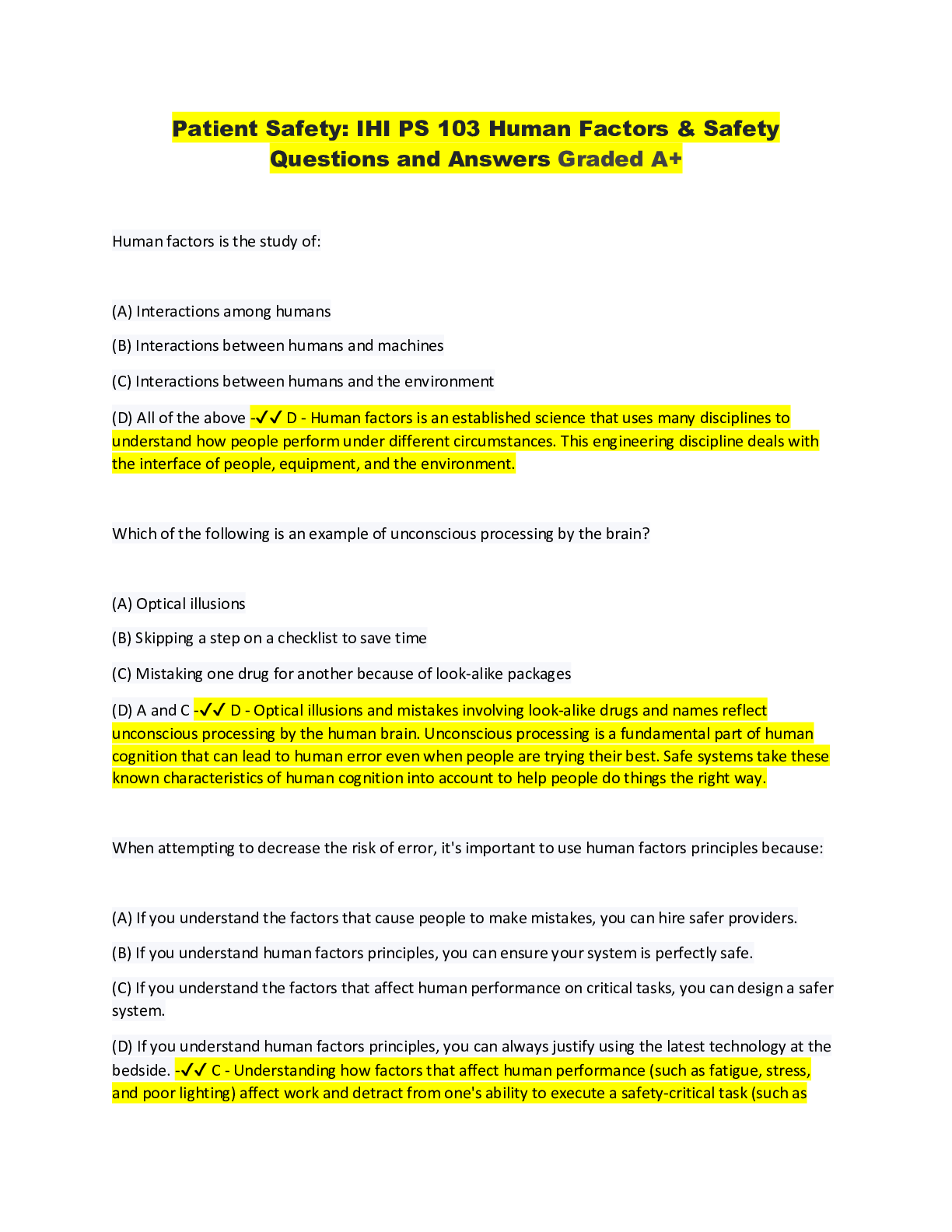
Human factors is the study of:
(A) Interactions among humans
(B) Interactions between humans and machines
(C) Interactions between humans and the environment
(D) Al
...
IHI PS 103 Questions and Answers
Already Graded A
Human factors is the study of:
(A) Interactions among humans
(B) Interactions between humans and machines
(C) Interactions between humans and the environment
(D) All of the above ✔✔(D) All of the above
Which of the following is an example of unconscious processing by the brain?
(A) Optical illusions
(B) Skipping a step on a checklist to save time
(C) Mistaking one drug for another because of look-alike packages
(D) A and C ✔✔(D) A and C
When attempting to decrease the risk of error, it's important to use human factors principles
because:
(A) If you understand the factors that cause people to make mistakes, you can hire safer
providers.
(B) If you understand human factors principles, you can ensure your system is perfectly safe.
(C) If you understand the factors that affect human performance on critical tasks, you can design
a safer system.
(D) If you understand human factors principles, you can always justify using the latest
technology at the bedside. ✔✔(C) If you understand the factors that affect human performance
on critical tasks, you can design a safer system.
Which of the following types of errors is associated with controlled thinking?
(A) Errors of memory storage
(B) Errors of planning
(C) Skill-based errors
(D) A and C ✔✔(B) Errors of planning
At the end of a double shift, an experienced nurse with an excellent track record gives a
medication to the wrong patient. Based on human factors principles, what would you guess was
the biggest contributor to this error?
(A) The nurse's training was out-of-date.
(B) The nurse was prone to error because she was tired.
(C) The nurse had become complacent and stopped trying hard.
(D) The nurse deliberately ignored protocol. ✔✔(B) The nurse was prone to error because she
was tired.
Which of the following is a basic strategy for minimizing the opportunity for error in a process?
(A) Reducing reliance on technology
(B) Standardizing how the process is completed
(C) Trying harder to perform the process correctly
(D) A and C ✔✔(B) Standardizing how the process is completed
Which of the following statements about redundancies within processes is always true?
(A) They are needlessly inefficient.
(B) They remove the opportunity for error.
(C) They require two people to do the work of one.
(D) None of the above ✔✔(D) None of the above
Your hospital is implementing an electronic health record (EHR) and is teaching all staff how to
use it. As you go through the EHR training, you notice that it takes five clicks to bring up the
vital signs for a patient. In the past, when you wanted to see a patient's vital signs, you could
simply look at the sheet of paper clipped onto the end of the bed.
Which of the following likely needs to be improved about the new process to review vital signs?
(A) It needs to be simplified.
(B) It needs to be standardized.
(C) It needs redundancies added.
(D) It needs to avoid reliance on memory. ✔✔(A) It needs to be simplified.
At the end of your training session on the new EHR, you are handed a two-sided laminated card
titled "Quick Start Guide." It provides step-by-step instructions for basic tasks such as entering
orders and writing daily notes in the EHR. This is an example of:
(A) Using forcing functions and constraints
(B) Automating carefully
(C) Simplifying
(D) Avoiding reliance on memory ✔✔(D) Avoiding reliance on memory
The first time you admit a patient to the hospital using the new EHR, you see a screen pop up as
you are attempting to enter orders. At the top it says, "You must enter orders for DVT (blood
clot) prevention before completion of this admission order set. Click here to complete this
order." This pop-up box is an example of the use of:
(A) A forcing function
(B) Simplification
(C) Redundancy
(D) A and B ✔✔(A) A forcing function
You're working in an outpatient clinic that recently started using an electronic health record
(EHR). You are entering a prescription for an antibiotic into the EHR to treat Mrs. Jones's
urinary tract infection. As you enter the order, a warning screen pops up saying that she has
chronic kidney disease, and the medication dose should be adjusted based upon her last recorded
creatinine level (a measure of kidney function). However, you know that Mrs. Jones's most
recent creatinine level — recorded at a different clinic and therefore not available in your EHR
— came back normal. When you attempt to move past the warning, the system will not allow
you to proceed.
Which of the following concepts does this scenario demonstrate?
(A) Technology can introduce unintended problems.
(B) Technology should facilitate how you do your work, not dictate it.
(C) Human beings must still be very present when interacting with technology to ensure its
proper and effective use.
(D) All of the above ✔✔(D) All of the above
As a caregiver, which of the following common health IT issues would you be in the best
position to help solve?
(A) Incomplete data entries into the computer
(B) Delays due to connectivity issues
(C) Out-of-date software
(D) None of the above ✔✔(A) Incomplete data entries into the computer
Which of the following is the best example of using technology to improve safety and prevent
errors?
(A) Providing inpatients with electronic tablets so that they can keep in better touch with the
outside world
(B) Giving nursing assistants electronic tablets to ensure there's no delay in recording patients'
vital signs
(C) Switching to an electronic health record (EHR) platform that is of comparable quality but
lower cost
(D) Implementing redundancies, in which providers double-check each other's electronic inputs
✔✔(B) Giving nursing assistants electronic tablets to ensure there's no delay in recording
patients' vital signs
Effective ways for addressing defects in the human-technology interface include:
(A) Providing in-person user training on using the technology
(B) Testing the technology in real-world situations
(C) Encouraging users to find workarounds
(D) All of the above ✔✔(B) Testing the technology in real-world situations
You're caring for a patient with diabetes who was admitted to your hospital with an elevated
blood glucose level. She is on an insulin pump that is programmed to deliver one unit of insulin
per hour through her intravenous (IV) line. How does this technology help make her care safer?
(A) The pump eliminates the need for providers to be involved in her care.
(B) The pump eliminates the possibility of a medication error.
(C) The pump helps automate a complex care process.
(D) All of the above ✔✔(C) The pump helps automate a complex care process.
[Show More]
.png)
.png)

.png)
.png)
.png)