PS 102: From Error to Harm Questions
and Answers Rated A
Swiss cheese model of accident causation ✔✔the idea that harm is caused by a series of systemic
failures in the presence of hazard.
Latent conditions ✔✔are def
...
PS 102: From Error to Harm Questions
and Answers Rated A
Swiss cheese model of accident causation ✔✔the idea that harm is caused by a series of systemic
failures in the presence of hazard.
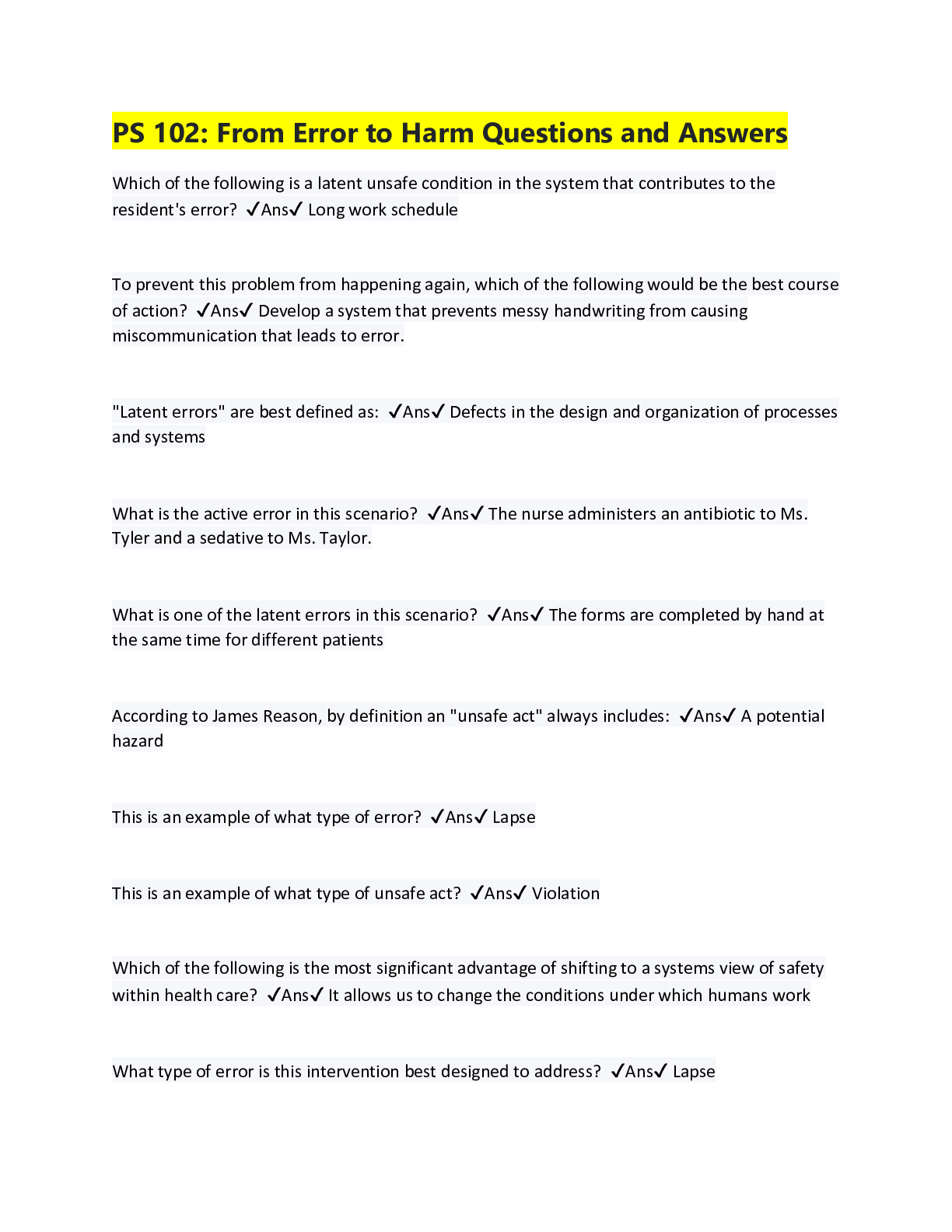
Latent conditions ✔✔are defects in the design and organization of processes and systems; things
like poor equipment design, inadequate training, or insufficient resources. These errors are often
unrecognized or just become accepted aspects of the work, and their effects are delayed.
Active failures ✔✔errors whose effects are felt immediately. Active failures are generally
readily apparent — e.g., someone pushing an incorrect button or ignoring a warning light — and
almost always involve someone at the front line. While the person on the front line — the doctor,
nurse, or pharmacist — might be the proximal "cause" of the active error, the real root causes of
the error have often been present within the system for a long time
Two women — one named Camilla Tyler, the other named Camilla Taylor — arrive at a
particularly busy emergency department at about the same time. Ms. Tyler needs a sedative, and
Ms. Taylor needs an antibiotic. The doctor orders the medications but mixes up the patients
when filling out the order sheets. The pharmacist dispenses the medications as ordered, and the
nurse administers an antibiotic to Ms. Tyler and a sedative to Ms. Taylor.
What is one of the latent errors in this scenario?
(A) The emergency department is particularly busy.
(B) The nurse administers an antibiotic to Ms. Tyler and a sedative to Ms. Taylor.
(C) The forms are completed by hand at the same time for different patients.
(D) The two patients in this case have very similar names. ✔✔The forms are completed by hand
at the same time for different patients.
Latent errors would include any systemic problems that allowed the potential for an active error
to occur and lead to patient harm. In this case, the fact that the forms were completed by hand at
the same time for different patients turned out to be a latent error. The busy department and
patients with similar names were not errors; they are just inherently challenging qualities of the
system.
What is the active error in this scenario?
(A) The forms are completed by hand at the same time for different patients.
(B) The emergency department is particularly busy.
(C) The pharmacist doesn't notice that the order sheets are incorrectly filled out.
(D) The nurse administers an antibiotic to Ms. Tyler and a sedative to Ms. Taylor. ✔✔The nurse
administers an antibiotic to Ms. Tyler and a sedative to Ms. Taylor.
The active error is the human error that led to patient harm. In this case, it's the nurse
administering an antibiotic to Ms. Tyler and a sedative to Ms. Taylor.
"Knowledge-based errors" are best defined as:
(A) Errors in the design and organization of processes and systems
(B) Errors in problem-solving and decision making
(C) Errors in patient care that don't result in injury and thus go undetected
(D) Errors in automatic functioning ✔✔
[Show More]
.png)
.png)

.png)
.png)
.png)


.png)