Caspi et al Questions & Answers
What outcomes can the Caspi study be used for? - ✔✔1. With reference to relevant research
studies, discuss the extent to which genetic inheritance influences human behaviour
2. Discuss
...
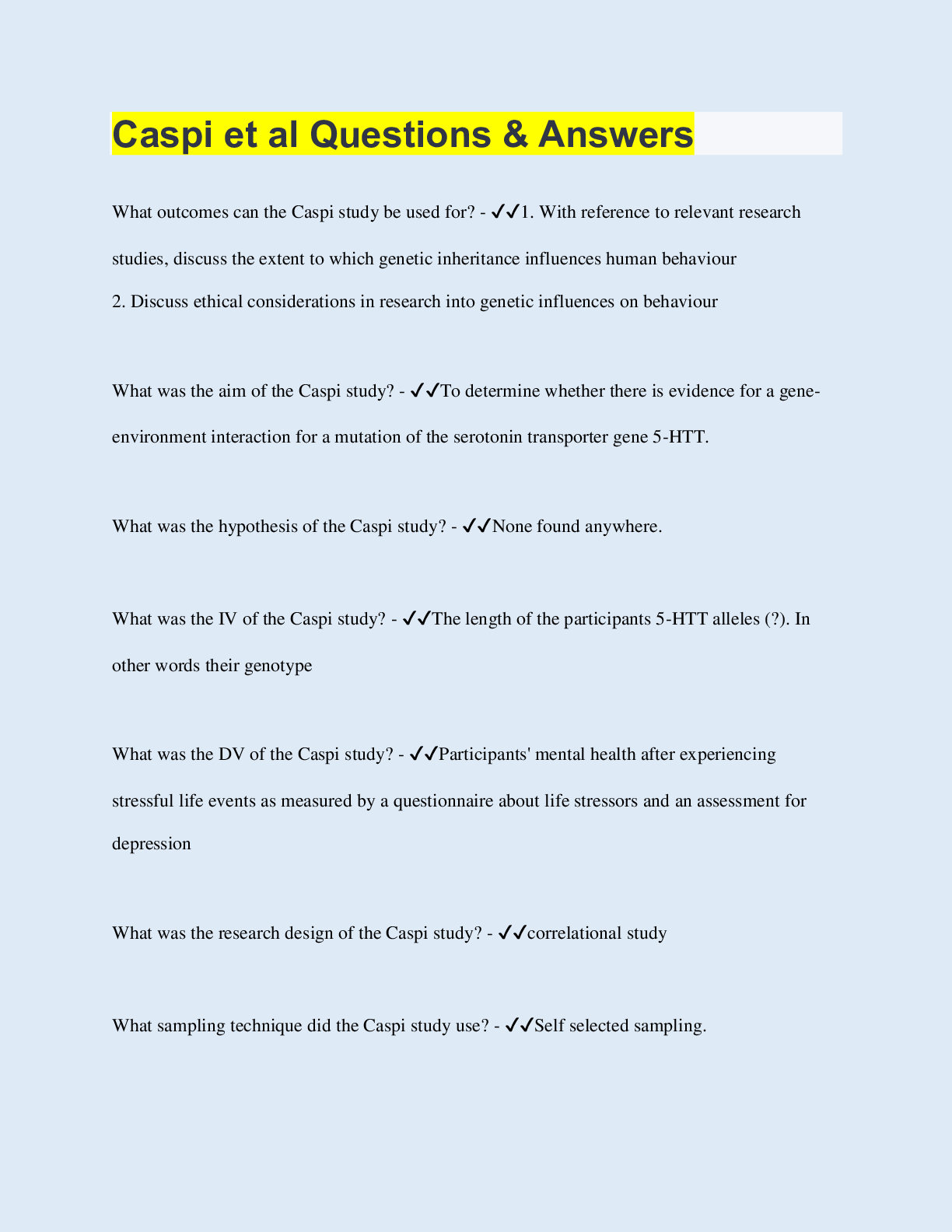
Caspi et al Questions & Answers
What outcomes can the Caspi study be used for? - ✔✔1. With reference to relevant research
studies, discuss the extent to which genetic inheritance influences human behaviour
2. Discuss ethical considerations in research into genetic influences on behaviour
What was the aim of the Caspi study? - ✔✔To determine whether there is evidence for a geneenvironment interaction for a mutation of the serotonin transporter gene 5-HTT.
What was the hypothesis of the Caspi study? - ✔✔None found anywhere.
What was the IV of the Caspi study? - ✔✔The length of the participants 5-HTT alleles (?). In
other words their genotype
What was the DV of the Caspi study? - ✔✔Participants' mental health after experiencing
stressful life events as measured by a questionnaire about life stressors and an assessment for
depression
What was the research design of the Caspi study? - ✔✔correlational study
What sampling technique did the Caspi study use? - ✔✔Self selected sampling.
What was the procedure of the Caspi study? - ✔✔Caspi and his team looked at a sample of 847
New Zealand 26-year-olds. All were members of a cohort that had been assessed for mental
health on an every-other-year basis until they were 21.
They were divided into three groups based on their 5-HTT alleles:
Group 1 had two short alleles;
Group 2 had one short and one long allele;
Group 3 had two long alleles.
The participants were asked to fill in a "Stressful life events" questionnaire which asked them
about the frequency after their 21st birthday and before their 26th of 14 different events -
including financial, employment, health and relationship stressors - between the ages of 21 and
26. They were also assessed for depression.
What were the results of the Caspi study? - ✔✔Caspi et al concluded that people with one or two
copies of this short allele exhibited more depressive symptoms, diagnosable depression and
suicidal ideation in relation to stressful life-events than individuals who carried the long allele of
5-HTT.
(In a later study by Moffitt & Caspi, the researchers looked at DNA samples from 127 people
who are part of a longitudinal prospective study looking at mental health. The sample had been
monitored for over 25 years. At five-year intervals scientists recorded any major life events and
signs of depression. They found that 80 per cent of those with two short 5-HTT genes became
depressed after three or more negative life events in a year, whereas those with two long genes
appeared resilient - only 30 per cent developed the illness in similar situations. They also found
that childhood maltreatment predicted adult depression only among individuals carrying a short
allele and not among those carrying the longer allele.
However, much more research is needed before a clear relationship between a gene and a
depression can be established.)
What are the pros of the Caspi study? - ✔✔1. The theory acknowledges the interaction between
both biological and environmental factors in depression. This is a more holistic approach, not
reductionist.
2. Later studies have been able to show similar results. It appears that the study has high
reliability.
What are the cons of the Caspi study? - ✔✔1. The study is correlational, so no cause and effect
relationship can be determined.
2. The study makes an assumption that serotonin causes depression.
3. There were some participants who did not carry the gene mutation who became depressed;
therefore, we cannot say that gene expression alone can cause expression.
What year was the Caspi study done in? - ✔✔2003
Who were the participants of the Caspi study? - ✔✔847 New Zealand 26-year-olds who were
members of a different longitudinal study that had been assessed for mental health on an everyother-year basis until they were 21.
[Show More]