Pharmaceutical Dosage Forms Laboratory Manual
13
Section: 1E-PH Date: 6
February 2021
PREPARATION # 3: PARACETAMOL TABLETS
Post Lab Questions:
Describe the mechanisms of action of the following materials? Give
ex
...
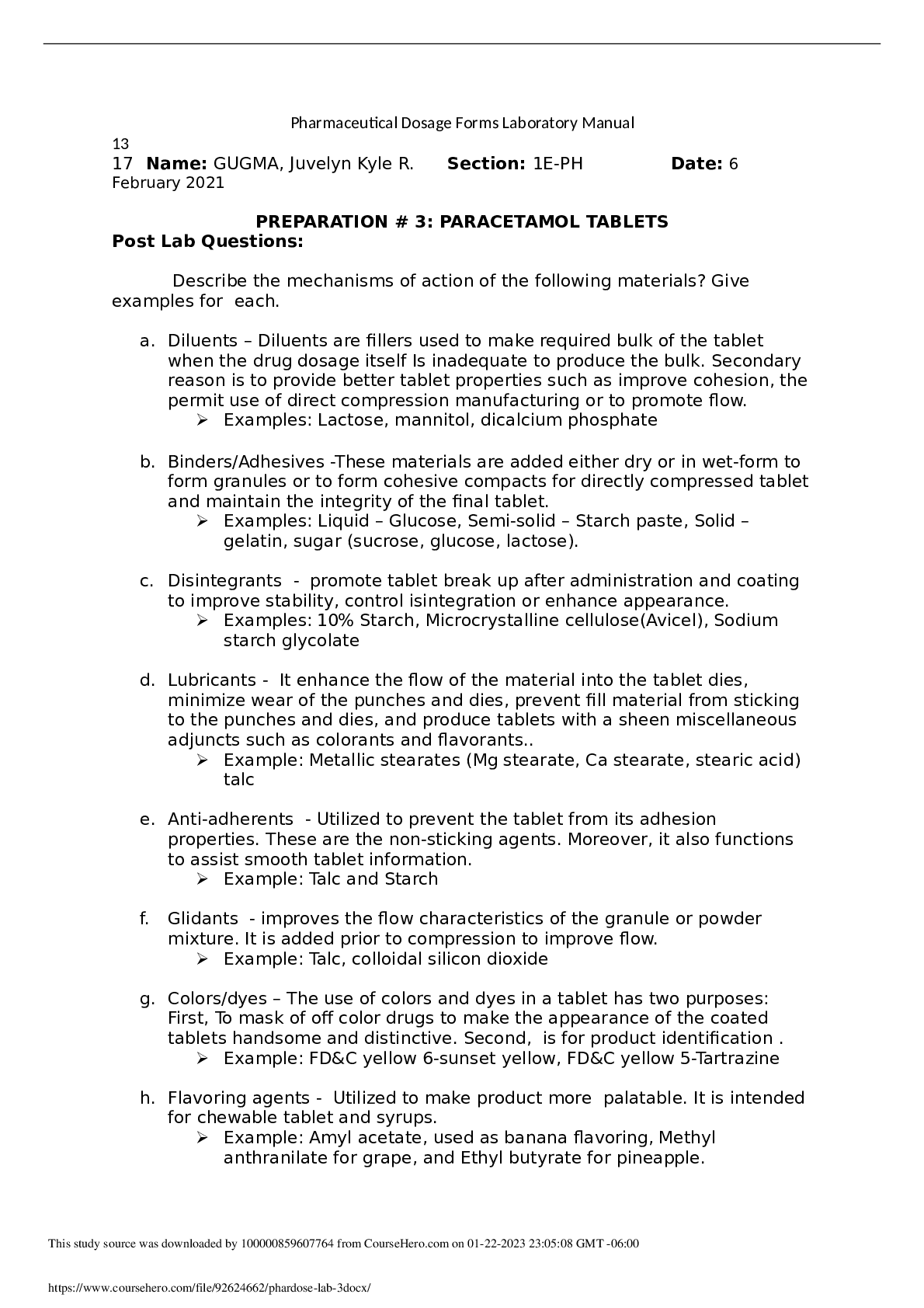
Pharmaceutical Dosage Forms Laboratory Manual
13
Section: 1E-PH Date: 6
February 2021
PREPARATION # 3: PARACETAMOL TABLETS
Post Lab Questions:
Describe the mechanisms of action of the following materials? Give
examples for each.
a. Diluents – Diluents are fillers used to make required bulk of the tablet
when the drug dosage itself Is inadequate to produce the bulk. Secondary
reason is to provide better tablet properties such as improve cohesion, the
permit use of direct compression manufacturing or to promote flow.
Examples: Lactose, mannitol, dicalcium phosphate
b. Binders/Adhesives -These materials are added either dry or in wet-form to
form granules or to form cohesive compacts for directly compressed tablet
and maintain the integrity of the final tablet.
Examples: Liquid – Glucose, Semi-solid – Starch paste, Solid –
gelatin, sugar (sucrose, glucose, lactose).
c. Disintegrants - promote tablet break up after administration and coating
to improve stability, control isintegration or enhance appearance.
Examples: 10% Starch, Microcrystalline cellulose(Avicel), Sodium
starch glycolate
d. Lubricants - It enhance the flow of the material into the tablet dies,
minimize wear of the punches and dies, prevent fill material from sticking
to the punches and dies, and produce tablets with a sheen miscellaneous
adjuncts such as colorants and flavorants..
Example: Metallic stearates (Mg stearate, Ca stearate, stearic acid)
talc
e. Anti-adherents - Utilized to prevent the tablet from its adhesion
properties. These are the non-sticking agents. Moreover, it also functions
to assist smooth tablet information.
Example: Talc and Starch
f. Glidants - improves the flow characteristics of the granule or powder
mixture. It is added prior to compression to improve flow.
Example: Talc, colloidal silicon dioxide
g. Colors/dyes – The use of colors and dyes in a tablet has two purposes:
First, To mask of off color drugs to make the appearance of the coated
tablets handsome and distinctive. Second, is for product identification .
Example: FD&C yellow 6-sunset yellow, FD&C yellow 5-Tartrazine
h. Flavoring agents - Utilized to make product more palatable. It is intended
for chewable tablet and syrups.
Example: Amyl acetate, used as banana flavoring, Methyl
anthranilate for grape, and Ethyl butyrate for pineapple.
Artificial sweeteners: Utilized to make product more palatable. It is used in
foods and pharmaceuticals.
Aspartame, Acesulfame potassium (Nonnutritive sweetener),
Sucrose
2. Discuss briefly the classification of tablets based on methods/forms of
manufacture.
There are two classifications of tablets based on methods or forms of
manufacture. These are the Wet Granulation, Dry Granulation, and Direct
Compression. In Wet Granulation, it involves the massing of a mix of dry primary
powder particles using a granulating fluid. Meanwhile, Dry Granulation is
commonly used if the ingredients are sensitive to moisture and heat because this
process does not require the aid of any liquid solution. On the other hand, in
Direct Granulation the tablets are compressed directly from powdered ctive drug
substances and suitable into a firm compact without utilizing the process of
granulation.
3. Briefly discuss the common processing problems in the manufacturing of
tablets.
[Show More]