FNSC2200 - Crime Scene Theory
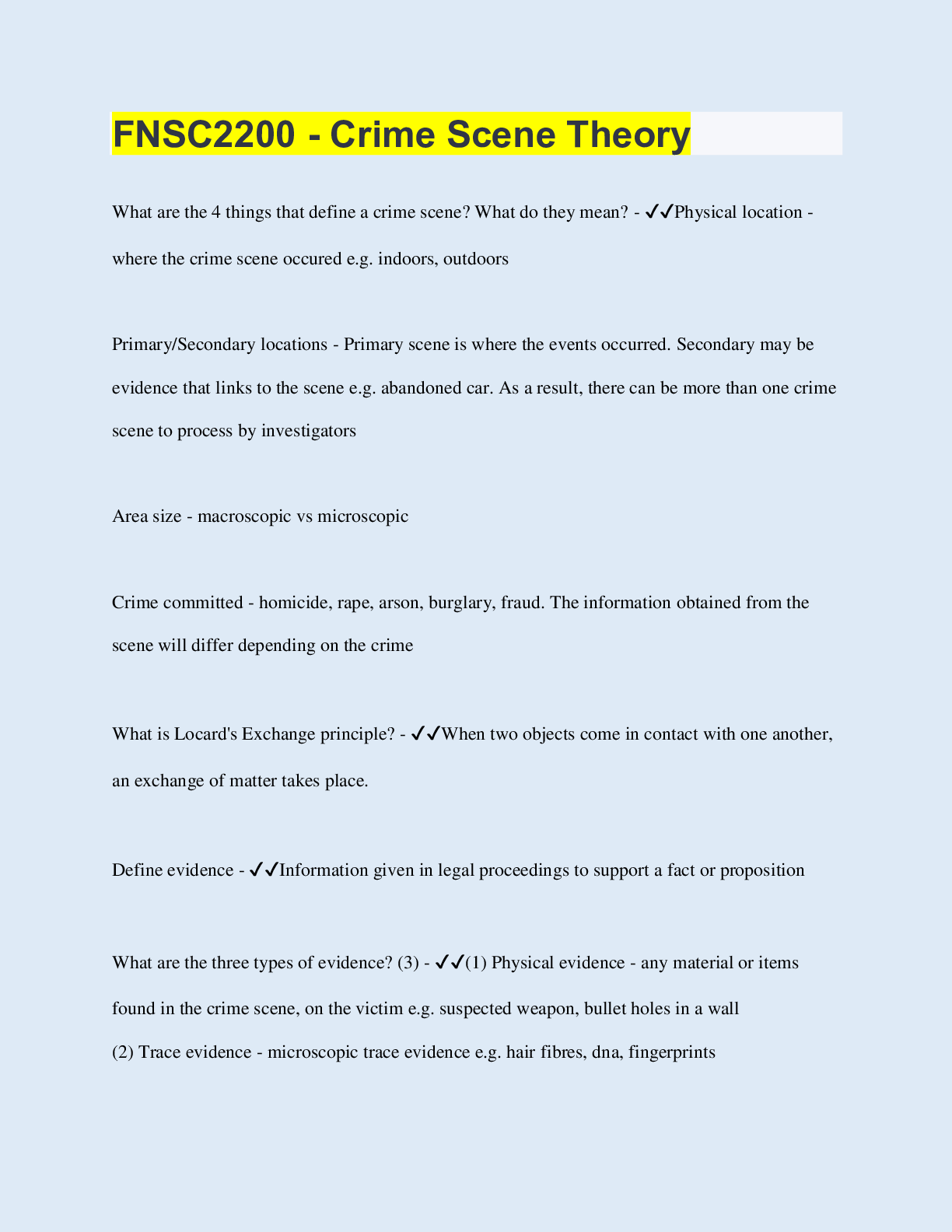
What are the 4 things that define a crime scene? What do they mean? - ✔✔Physical location -
where the crime scene occured e.g. indoors, outdoors
Primary/Secondary locations - Primary scen
...
FNSC2200 - Crime Scene Theory
What are the 4 things that define a crime scene? What do they mean? - ✔✔Physical location -
where the crime scene occured e.g. indoors, outdoors
Primary/Secondary locations - Primary scene is where the events occurred. Secondary may be
evidence that links to the scene e.g. abandoned car. As a result, there can be more than one crime
scene to process by investigators
Area size - macroscopic vs microscopic
Crime committed - homicide, rape, arson, burglary, fraud. The information obtained from the
scene will differ depending on the crime
What is Locard's Exchange principle? - ✔✔When two objects come in contact with one another,
an exchange of matter takes place.
Define evidence - ✔✔Information given in legal proceedings to support a fact or proposition
What are the three types of evidence? (3) - ✔✔(1) Physical evidence - any material or items
found in the crime scene, on the victim e.g. suspected weapon, bullet holes in a wall
(2) Trace evidence - microscopic trace evidence e.g. hair fibres, dna, fingerprints
(3) Testimonial evidence - written or verbal statements given to police , common evidence in
rape or assault cases
Whats the difference between direct and circumstantial evidence? - ✔✔Direct evidence are
firsthand observations. They include eyewitness accounts, cameras and confessions.
Circumstantial evidence is indirect evidence. They may be used to imply or support. May link a
suspect to a crime scene.
There are 2 branches of circumstantial evidence. What are they? (2) - ✔✔(1) Physical -
impressions, fibers, weapons, bullets, shell casings
(2) Biological - body fluids, hair, plant parts
State the 4 main Investigation roles in the Australian system. (4) - ✔✔Uniformed Officer
Detective
Scene of Crime Officer
Forensic Scientist
What is the role of the Scene of Crime Officer (4) - ✔✔Primary role is crime scene processing
and evidence collection. Also involved in documentation and secure transportation of evidence
to the laboratory.
What is the role of the forensic scientist - ✔✔Receives evidence, undertakes scientific analysis,
provides expert testimony in court
What are the main investigator roles in the U.S system? (5) - ✔✔Police officer
Detective
Crime Scene Investigator (CSI)
Medical Examiner
Specialist
What are the 5 steps of processing the crime scene? (5) - ✔✔1.Securing the Crime Scene
2. Crime Scene Survey
3. Crime Scene Documentation
4. Searching the Crime Scene
5. Collection of Physical Evidence
What does the first officer at the crime scene do? - ✔✔Since disturbance to the scene cannot be
reversed, they secure against further disturbance
Look at:
- safety
- detain individuals involved
- identify area to secure
- cordon off area / restrict access
What are the scene cordons? (3) - ✔✔(1) Hot zone - encompasses the primary location of the
crime. Scene processing occurs here
(2) Warm - approx 100 m around the hot zone
(3) Cool zone- pedestrians, media,
What are some examples of crime scene documentation? (4) - ✔✔Detailed notes, videotaping,
photographing, sketching
What are the search patterns used when searching the crime scene? (4) - ✔✔(1) Spiral - inwards
or outwards position but must be in one direction
(2) Strip - parallel lines, size of the lane should be arms length of the searcher
(3) Grid - more thorough strip method
(4) Zone - like a "window", quandrants
[Show More]