Med Surg Ch 29 Cardiac Dysrhythmia
A patient's heart rate is 48 beats per minute. Which structure is most likely generating this heart
rate?
1) Purkinje fibers
2) Sinoatrial node
3) Atrioventricular node
4) Ventric
...
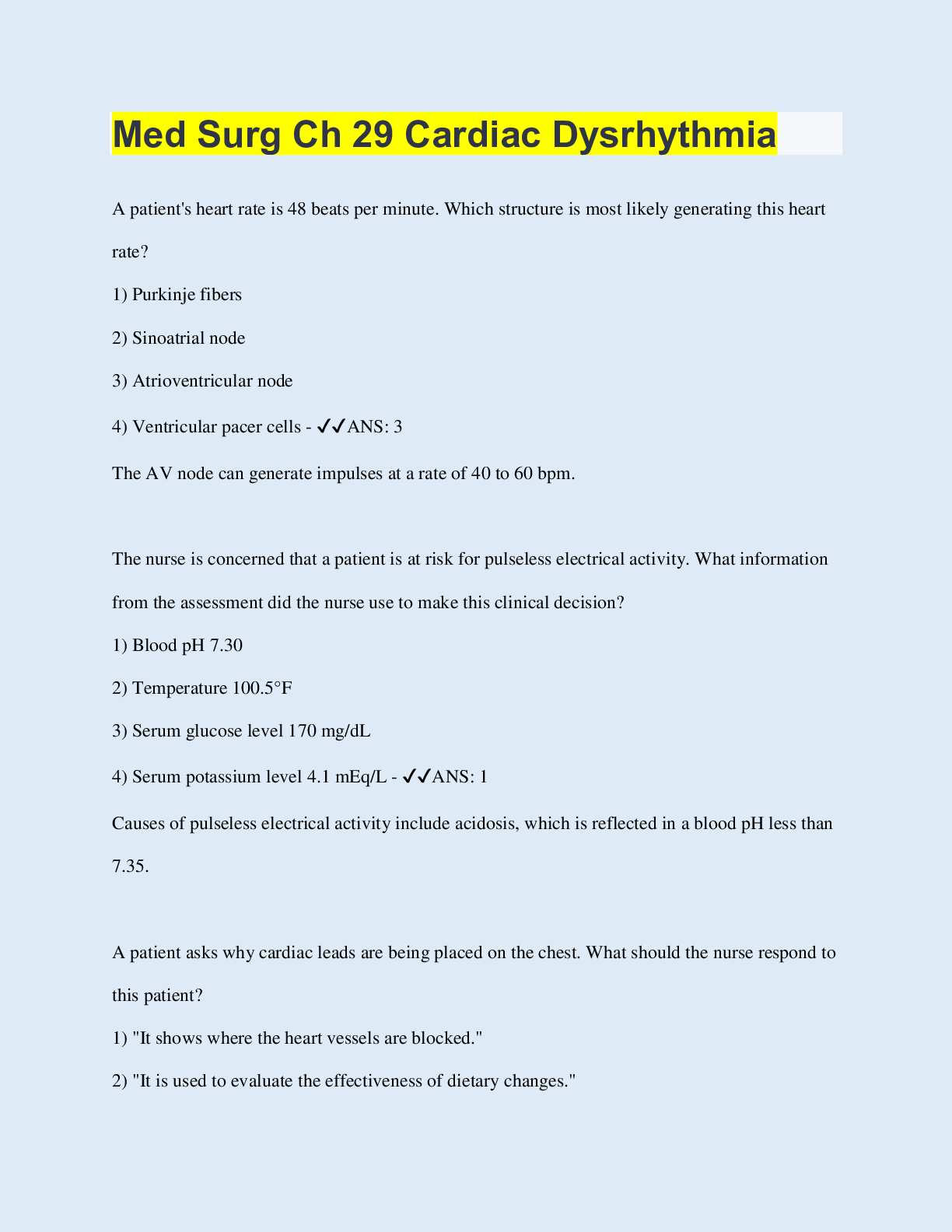
Med Surg Ch 29 Cardiac Dysrhythmia
A patient's heart rate is 48 beats per minute. Which structure is most likely generating this heart
rate?
1) Purkinje fibers
2) Sinoatrial node
3) Atrioventricular node
4) Ventricular pacer cells - ✔✔ANS: 3
The AV node can generate impulses at a rate of 40 to 60 bpm.
The nurse is concerned that a patient is at risk for pulseless electrical activity. What information
from the assessment did the nurse use to make this clinical decision?
1) Blood pH 7.30
2) Temperature 100.5°F
3) Serum glucose level 170 mg/dL
4) Serum potassium level 4.1 mEq/L - ✔✔ANS: 1
Causes of pulseless electrical activity include acidosis, which is reflected in a blood pH less than
7.35.
A patient asks why cardiac leads are being placed on the chest. What should the nurse respond to
this patient?
1) "It shows where the heart vessels are blocked."
2) "It is used to evaluate the effectiveness of dietary changes."
3) "It provides a graphic picture of the heart's electrical activity."
4) "It determines which medications are needed to improve heart function." - ✔✔ANS: 3
An electrocardiogram provides a graphic representation of the heart's electrical activity.
When analyzing a patient's electrocardiogram, the nurse notes that the P wave is normal. What
criteria did the nurse use to make this decision?
1) Pointed and skinny in width
2) Small and rounded in lead II
3) Upright and rounded in lead II
4) Length 0.10 seconds and height 2.5 mm - ✔✔ANS: 4
The P wave itself should not be longer than 0.10 sec in length and no higher than 2.5 mm.
A patient is being evaluated for a blockage in the cardiac ventricles. On which part of the
electrocardiogram should the nurse focus as evidence of this blockage?
1) T wave
2) U wave
3) PR interval
4) QRS interval - ✔✔ANS: 4
The QRS interval is the measure of time to depolarize the ventricles. The normal interval is 0.04
to 0.10 sec in length. If the QRS is prolonged it may be a sign of a disturbance within the
ventricle itself such as a block in the ventricles delaying impulse travel time through the
ventricles.
The nurse is observed marching out the rhythm on a patient's cardiac monitor tracing. What is
this nurse assessing?
1) Rate
2) Polarity
3) Regularity
4) Amplitude - ✔✔ANS: 3
Regularity can be determined by counting the boxes between the waveforms being measured A
regular rhythm will have the same number of boxes or equal space between waveforms or
complexes. This is called marching out the rhythm.
A patient with shortness of breath has a heart rhythm of 46 beats per minute. Which medication
should the nurse anticipate being prescribed for this patient?
1) Atropine sulfate
2) Atenolol (Tenormin)
3) Diltiazem (Cardizem)
4) Adenosine (Adenocard) - ✔✔ANS: 1
Treatment of symptomatic sinus bradycardia is atropine 0.5 mg IV push.
A patient with atrial fibrillation has a heart rate of 90 beats per minute. Which manifestation
should the nurse expect to assess in this patient?
1) Headache
2) Chest pain
3) Palpitations
4) Hypotension - ✔✔ANS: 3
Palpitations are associated with atrial fibrillation.
A patient with atrial fibrillation is being considered for cardioversion. Which diagnostic test
should the nurse anticipate being prescribed prior to this procedure being completed?
1) Chest x-ray
2) CT scan of the chest
3) 12-lead electrocardiogram
4) Transesophageal echocardiogram (TEE) - ✔✔ANS: 4
Cardioversion should be considered for at
[Show More]