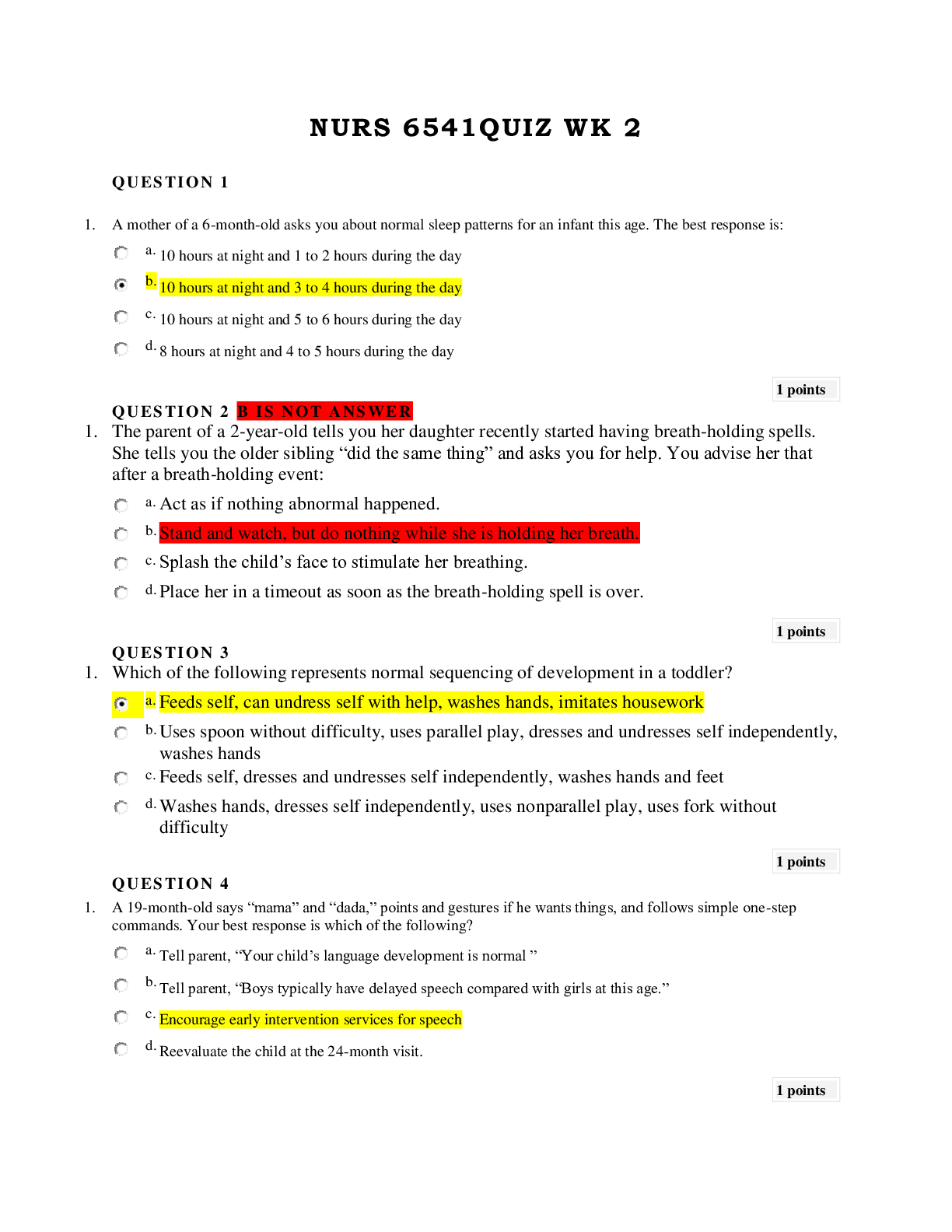
NURS 6541QUIZ WK 2
QUE ST ION 1
1. A mother of a 6-month-old asks you about normal sleep patterns for an infant this age. The best response is:
a. 10 hours at night and 1 to 2 hours during the day
b.
10 hours at nig
...
NURS 6541QUIZ WK 2
QUE ST ION 1
1. A mother of a 6-month-old asks you about normal sleep patterns for an infant this age. The best response is:
a. 10 hours at night and 1 to 2 hours during the day
b.
10 hours at night and 3 to 4 hours during the day
c. 10 hours at night and 5 to 6 hours during the day
d.
8 hours at night and 4 to 5 hours during the day
1 points
QUE ST ION 2 B IS NOT ANSWER
1. The parent of a 2-year-old tells you her daughter recently started having breath-holding spells.
She tells you the older sibling “did the same thing” and asks you for help. You advise her that
after a breath-holding event:
a. Act as if nothing abnormal happened.
b.Stand and watch, but do nothing while she is holding her breath.
c. Splash the child’s face to stimulate her breathing.
d.Place her in a timeout as soon as the breath-holding spell is over.
1 points
QUE ST ION 3
1. Which of the following represents normal sequencing of development in a toddler?
a. Feeds self, can undress self with help, washes hands, imitates housework
b.Uses spoon without difficulty, uses parallel play, dresses and undresses self independently,
washes hands
c. Feeds self, dresses and undresses self independently, washes hands and feet
d.Washes hands, dresses self independently, uses nonparallel play, uses fork without
difficulty
1 points
QUE ST ION 4
1. A 19-month-old says “mama” and “dada,” points and gestures if he wants things, and follows simple one-step
commands. Your best response is which of the following?
a. Tell parent, “Your child’s language development is normal ”
b.
Tell parent, “Boys typically have delayed speech compared with girls at this age.”
c. Encourage early intervention services for speech
d.
Reevaluate the child at the 24-month visit.
1 pointsQUE ST ION 5
1. You receive a phone call from the mother of a 2-year-old. She states her child has sleep refusal.
You suggest the child should be able to:
a. Set his own bedtime based on his internal clock
b.Protest when he goes to bed, but the parents should not pick him up or give him any
attention
c. Put himself to sleep somewhere other than his own bed and the parents should move him
to the bed once he is asleep
d.Make multiple requests, but the parents should only respond to every third request
1 points
QUE ST ION 6
1. You see a 4-year-old for a well-child visit. He has received four diphtheria, tetanus, and acellular
pertussis vaccines (DTaP); three injected polio vaccines (IPV); one measles, mumps, and rubella
vaccine (MMR); one varicella vaccine; and two hepatitis B (Hep B) vaccines. What do you order
today?
a. Pneumococcal conjugate vaccine (PCV13), IPV, varicella, and DTaP
b.Tetanus and diphtheria toxoid with acellular pertussis (TdaP), MMR, hepatitis B, and IPV
c. DTaP, IPV, MMR, and Varivax
d.PCV13, DTaP, IPV, MMR, and Varivax
1 points
QUE ST ION 7 ANSWER IS N OT C
1. A common feature of 2-year-old behavior is:
a. Negativism
b.
Stranger anxiety
c. Nonparallel play
d.
a and b
1 points
QUE ST ION 8AN SWER IS N OT D
1. You see a healthy 18-month-old for a well-child visit. At the 12-month visit he received the
diphtheria, tetanus, and acellular pertussis (DTaP) third dose; hepatitis B second dose; measles,
mumps, and rubella (MMR) first dose; injected poliovirus (IPV) second dose; pneumococcal
conjugate (PCV13) fourth dose; and Haemophilus influenzae type B (Hib) fourth dose. Which of
the following do you order today?
a. Varicella and DTaP
b.DTaP, varicella, hepatitis A, and hepatitis B
c. DTaP, IPV, varicella, PCV13, and hepatitis B
d.Hib, PCV 13, IPV, and hepatitis A1 points
QUE ST ION 9
1. You see a 6-month-old who is fussy, has interrupted sleep, and is drooling. You note large lower lateral incisor
bulges. You recommend:
a. Acetaminophen 10-15 mg/kg/dose every 4 to 6 hours as needed
b.
Ibuprofen 20 mg/kg/dose every 6 to 8 hours as needed
c. Over-the-counter topical anesthetic gels
d.
Gum massage with a cold washcloth
e. A and D
1 points
QUE ST ION 10
1. You see a young child who has tripled her birth weight and looks for hidden objects. When given blocks, she places
one in each hand. She has a fine pincer grasp. On the floor, she walks around holding objects and is trying to take
independent steps. This child is most likely how old?
a. 9 months
b.
12 months
c. 15 months
d.
18 months
[Show More]







.png)
.png)
![Preview of NR667 Complete Question Bank with Correct Answers: Final Exam Study Guide [2026 Updated]](https://browseimages.nyc3.digitaloceanspaces.com/paper-images/2026/02/25/AULA53fD2026-02-25-02-58699ee3d811bc7.png)