NURS 6541 Quiz 10
The initial evaluation of an asymptomatic child with 1+ proteinuria and 1.020 specific gravity on
a random dipstick urinalysis would include:
a. Urine protein/creatinine ratio
b. CBC, renal disease
...
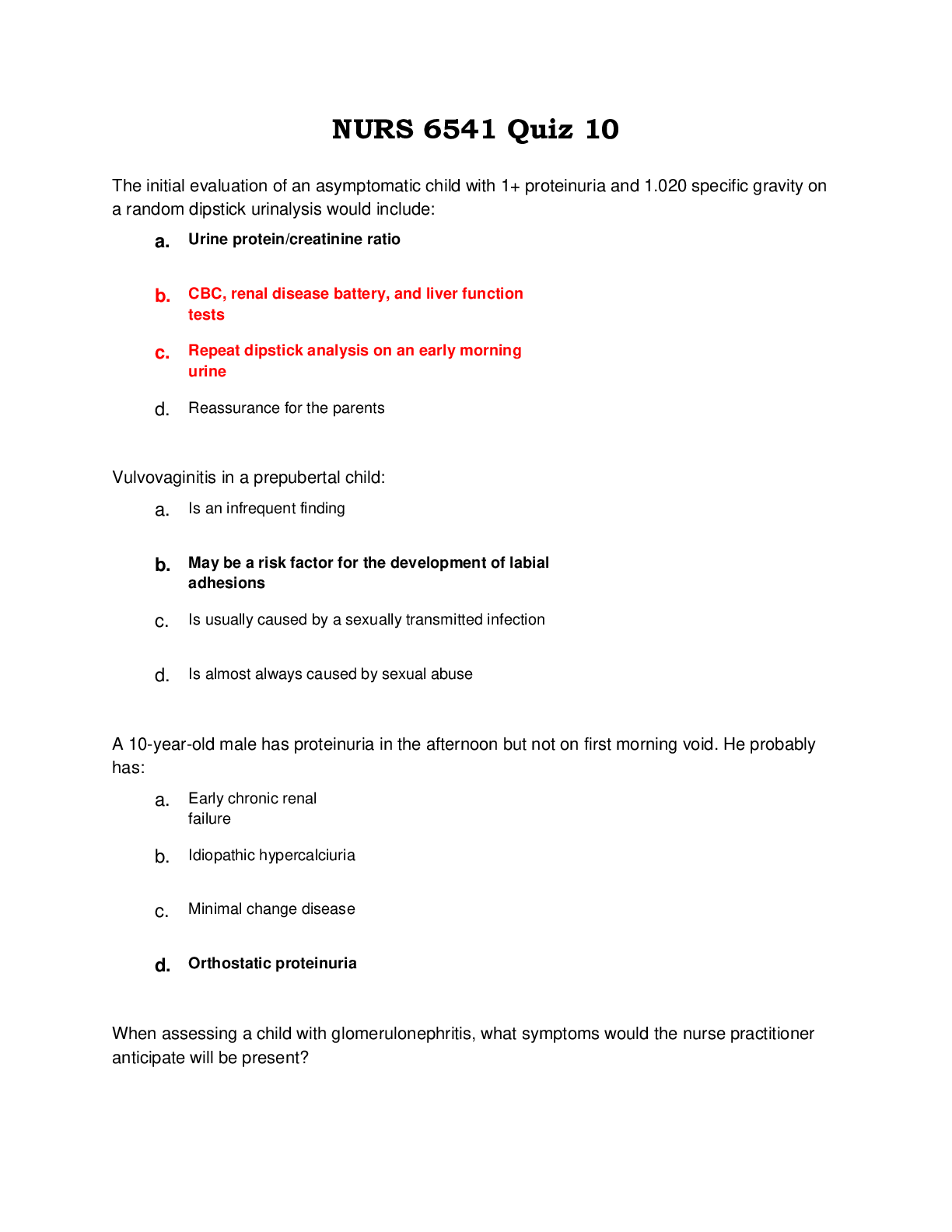
NURS 6541 Quiz 10
The initial evaluation of an asymptomatic child with 1+ proteinuria and 1.020 specific gravity on
a random dipstick urinalysis would include:
a. Urine protein/creatinine ratio
b. CBC, renal disease battery, and liver function
tests
c. Repeat dipstick analysis on an early morning
urine
d. Reassurance for the parents
Vulvovaginitis in a prepubertal child:
a. Is an infrequent finding
b. May be a risk factor for the development of labial
adhesions
c. Is usually caused by a sexually transmitted infection
d. Is almost always caused by sexual abuse
A 10-year-old male has proteinuria in the afternoon but not on first morning void. He probably
has:
a. Early chronic renal
failure
b. Idiopathic hypercalciuria
c. Minimal change disease
d. Orthostatic proteinuria
When assessing a child with glomerulonephritis, what symptoms would the nurse practitioner
anticipate will be present?a. Anorexia and dysuria
b. Periorbital edema and hypertension
c. Polyuria with strong-smelling, concentrated
urine
d. Fever to 102°F and unilateral flank pain
After diagnosing a urinary tract infection in a 14-month-old, you note partial fusion of the labia
minora that extends for 1 centimeter and obscures the posterior fourchette. There is no
evidence of inflammation, although she does have some dysuria. The preferred management of
this condition is:
a. Administration of low-dose oral estrogen
therapy
b. Application of estrogen cream
c. Genital examination under anesthesia
d. Watchful waiting
A 7-month-old male presents with a bulge in the scrotal sac. It is only found in the scrotum and
does not seem to bother the child. No difference in size is noted when the child strains or cries.
His scrotum’s size is normal in the morning but increases as the day progresses. The scrotal
mass is transilluminable and both testes are located in the scrotal sac. You anticipate:
a. Emergent referral to a pediatric surgeon/urologist for repair
b. Surgical repair of the above condition before age 1 to maintain testicular viability
c. Reassurance for the parents and observation of the condition with no need for further
intervention as long as the mass resolves by age 1
d. Increased risk of testicular cancer with decreased fertility in later life
A male infant born at 36 weeks gestation has a left testicle palpated in the inguinal canal. At 12
months of age the left testicle has failed to descend. Which of the following is most appropriate?a. Observation until 12 years of age
b. Refer for orchiopexy
c. Radionucleotide scan of the left
testicle
d. Treatment with testosterone
You see a 3-year-old female with dysuria. She is potty trained, febrile, and nontoxic. She has no
prior history of UTI. Urine dipstick reveals 1+ leukocyte esterase, 2+ nitrites, 1+ non-hemolyzed
blood, pH of 6.0, and specific gravity 1.025. Her vulvovaginal area is slightly red with no
discharge. Which of the following treatments is recommended?
a. Start sulfamethoxazole/trimethoprim (Bactrim) for 10 days and refer for renal ultrasound by
day 2 of illness.
b. Start azithromycin (Zithromax) for 5 days, increase fluids, and send urine for culture and
sensitivity.
c. Start cephalexin (Keflex) for 10 days, increase fluids, and send urine for culture and
sensitivity.
d. Increase fluids, use sitz baths, and apply liberal A&D ointment to the vulvovaginal area.
A 4-year-old presents with a chief complaint of pallor. He was well until 1 week ago when he
developed bloody diarrhea that improved with oral antibiotics. His blood pressure is 150/100, he
is afebrile, and his heart rate is 130 beats per minute. The best test to establish diagnosis is:
a. Complete blood count and smear, serum
electrolytes
b. Renal ultrasound
c. Routine stool culture
d. Urine analysis and cultureA 12-year-old boy awakes with onset of severe, unilateral scrotal pain, nausea, and vomiting.
He is afebrile. Inspection reveals a tender scrotum and marked scrotal edema. The most likely
cause is:
a. Scrotal trauma
b. Epididymitis
c. Testicular torsion
d. Testicular
malignancy
[Show More]