Legal terms for Court Interpreter Written
Exam Already Passed
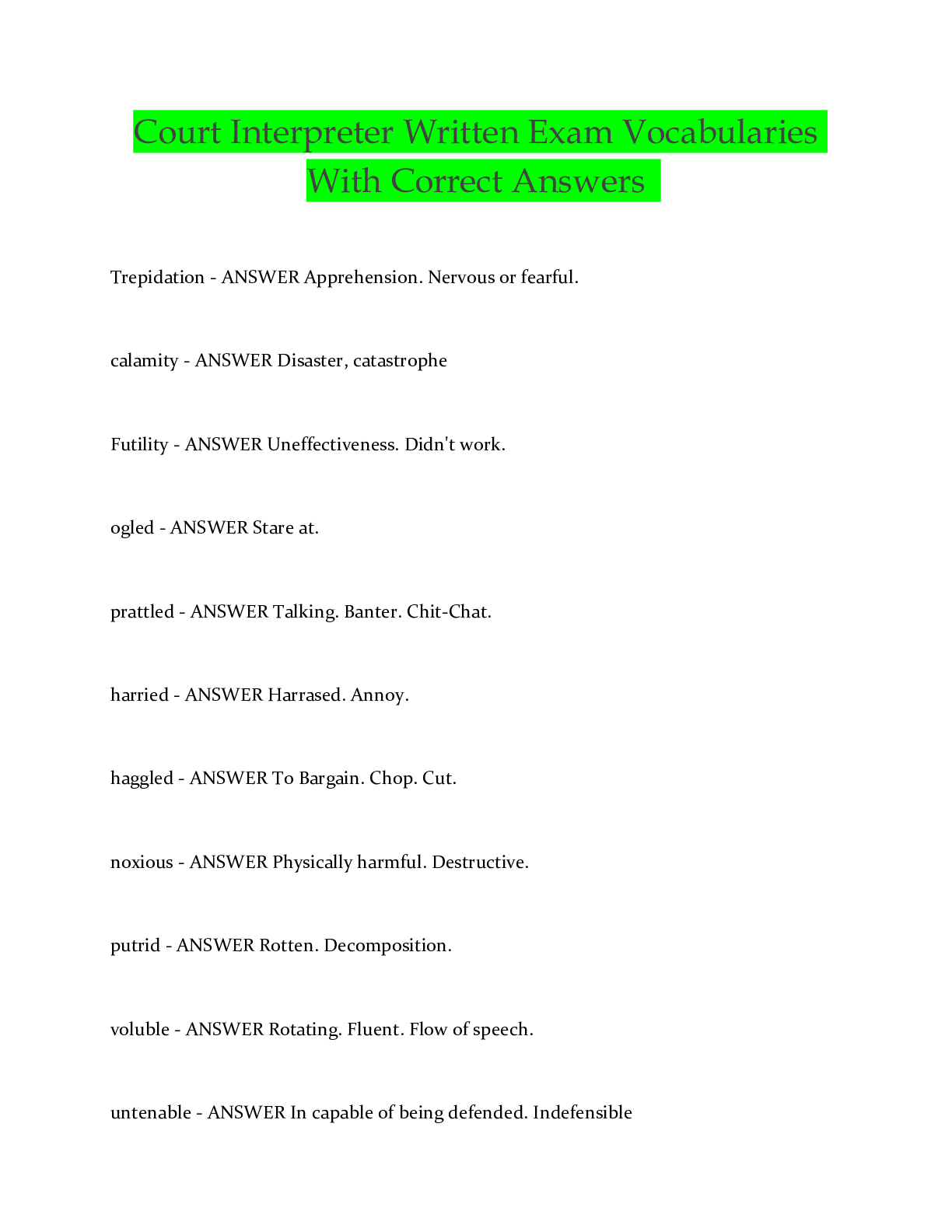
demur ✔✔to object
Default ✔✔fail to do something required to do
Deponent ✔✔Person giving testimony
Discovery ✔✔The pretrial procedures used by the partie
...
Legal terms for Court Interpreter Written
Exam Already Passed
demur ✔✔to object
Default ✔✔fail to do something required to do
Deponent ✔✔Person giving testimony
Discovery ✔✔The pretrial procedures used by the parties to obtain information about
the case from the other parties in order to prepare for trial. (Exchange of evidence)
Dismiss trial without prejudice ✔✔Without right to a new trial
Dismiss case with prejudice ✔✔Without a right to a new trial
Diversion ✔✔The suspension of criminal prosecution of an offender. The offender may
be asked to participate in a treatment or supervisory program in exchange for his
agreement to stop or to suspend prosecution. (alternate program)
Hearsay evidence, testimony ✔✔A written or oral out-of-court statement offered to prove the
truth of the
matter asserted. Hearsay is inadmissible into evidence, unless one or more of the hearsay
exceptions apply.
Heretofore ✔✔up to this time
Hold harmless ✔✔of, relating to, or being an agreement between parties in which one assumes
the potential liability for injury that may arise from a situation and thus relieves the other of
liability
hung jury ✔✔no unanimous decision
Indictment ✔✔A formal written accusation submitted to a grand jury by a prosecutor,
charging one or more persons with one or more crimes. The grand jury must determine
whether the person or persons named should be prosecuted for the crime charged, in
which case the indictment is endorsed by the foreman of the grand jury as a true bill. An
indictment authorizes trial of the persons named for the crimes charged.
Indict ✔✔to accuse formally
Interdiction ✔✔Prohibition
Intestate ✔✔having made no valid will
Double Jeopardy ✔✔Trial of a person by the same jurisdiction more than once for
the same crime. The U.S. Constitution prohibits subjecting persons to double jeopardy.
Jurisdiction ✔✔The power to hear and to decide cases. Jurisdiction exists over
particular types of cases (i.e., over subject matter), and over parties (i.e., personal
jurisdiction). Also used to refer to a particular unit of government (e.g., a state),
particularly with respect to its judicial powers (e.g., different jurisdictions have different
legal tests for insanity).
Larceny ✔✔theft
Lechery ✔✔lewdness
Levy ✔✔tax or fee
Libel ✔✔written defamation
Parole ✔✔A conditional release from imprisonment which entitles the person receiving
the parole to serve the remainder of his term outside of prison if he satisfactorily
complies with all the terms and conditions connected therewith.
Plea bargain ✔✔Plea negotiations can center around the defendant's pleading guilty to a lesser
offense, or
to only one or several of the counts in a multi-count indictment or information. In return,
the defendant seeks to obtain concessions as to the type or length of his sentence or the
reduction or elimination of charges against him.
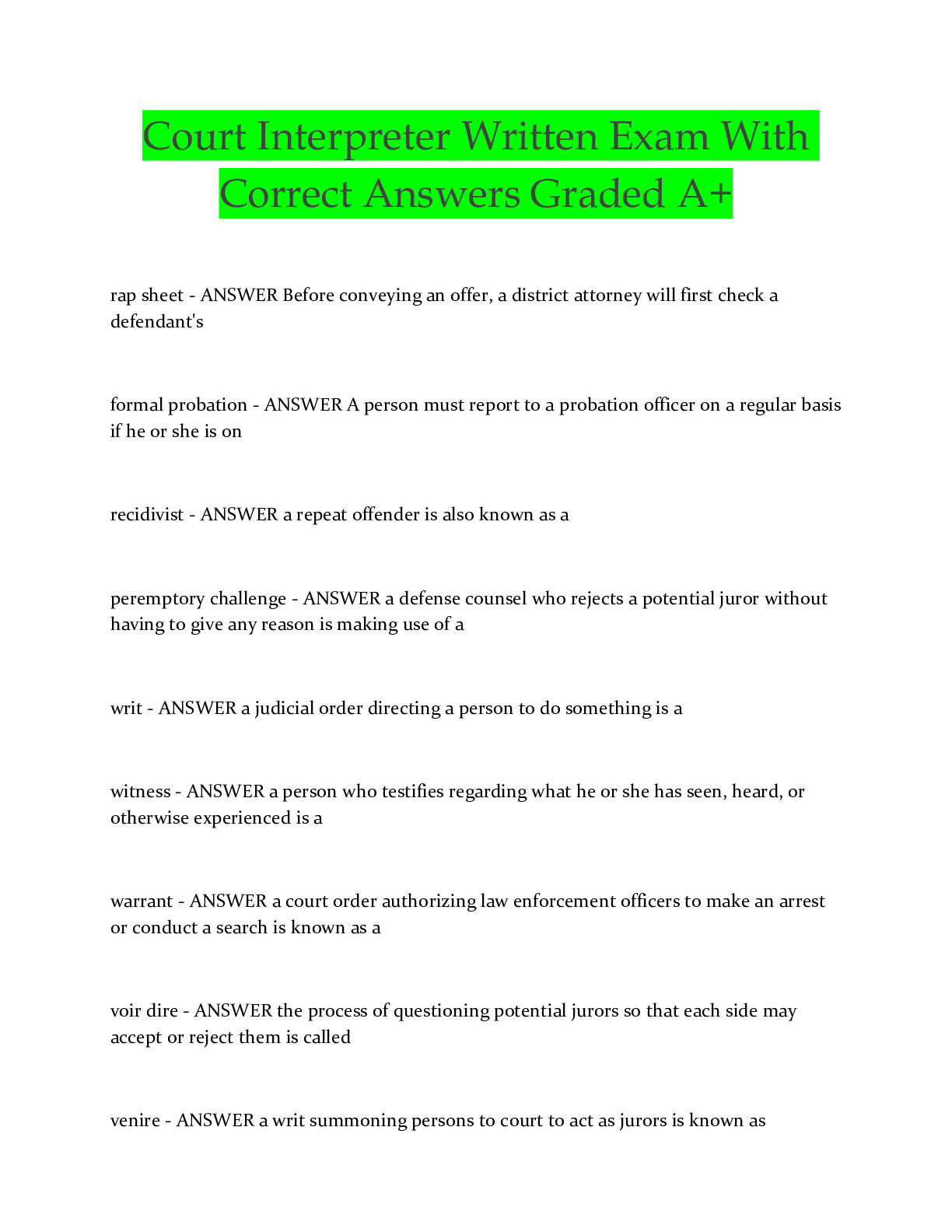
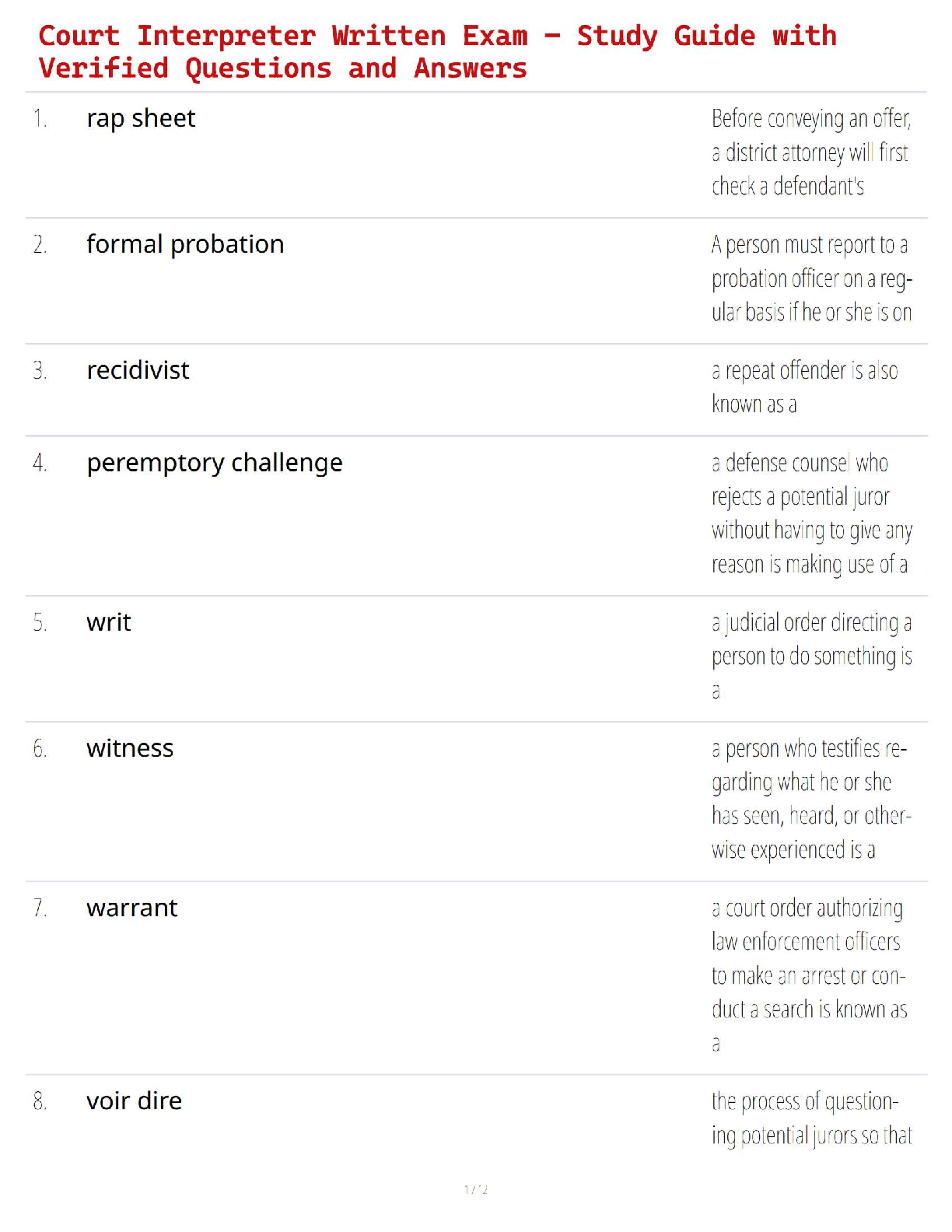
Peremptory challenge ✔✔The right of a party to exclude a prospective juror from
serving on the jury for any reason and without explanation, subject to the civil rights
laws.
Probable cause ✔✔Reasonable ground for belief that certain facts exist.
Allegation ✔✔n. a statement of claimed fact contained in a complaint (a written pleading filed to
begin a lawsuit), a criminal charge, or an affirmative defense (part of the written answer to a
complaint). Until each statement is proved it is only an allegation. Some allegations are made
"on information and belief" if the person making the statement is not sure of a fact.
Allow the Claim ✔✔To decide a claim in favor of the party asserting it. Also to deny
a pre-trial motion to dismiss a claim and thereby to allow the proponent to continue
litigating it.
Arrears ✔✔That which is unpaid although due to be paid. A person "in arrears" is
behind in payment.
Asked and Answered ✔✔An objection that a question to a witness is cumulative,
that is, it has already been asked by counsel and answered by the witness.
Attorney General ✔✔The chief law enforcement officer of the federal government
and generally of a state government. His office represents the government and its
agencies in court, including assisting or serving as prosecutors in the prosecution of
criminal cases.
Bail Forfeiture ✔✔Loss of bail status by order of a judge, usually upon a defendant's
failure to appear.
Bench Trial ✔✔Trial held before a judge sitting without a jury. It usually requires
waiver by the defendant of a jury trial.
Beyond a reasonable Doubt ✔✔- Burden of proof which prosecution must meet
to convict a criminal defendant. See "reasonable doubt," below.
Bill of particulars ✔✔A written statement of the particulars of the charges or
claims against the defendant or another party.
Bonding over ✔✔Act by which a judge or magistrate requires a person to furnish bail
or to enter into a recognizance as a condition to his release from custody to ensure that he
will appear for trial, attend as a witness, or perform some other act.
Magistrate ✔✔A civil or lay judge or other official who is responsible for administering and
enforcing the laws, usually by holding hearings on minor offenses. A judge that hears traffic
ticket cases and fines people is an example of a magistrate.
Breach of Conditions ✔✔Violation by a parolee of the conditions of his parole,
which may result in revocation of parole and incarceration. Also failure of an event to
occur which is a condition to a party's performance under a contract.
Brief ✔✔A document prepared by counsel setting out argument on a particular matter in
dispute.
Case Law ✔✔the law as established by the outcome of former cases.
Caveat ✔✔A warning to someone to be careful. Also a limitation or qualification on
something stated or agreed to. Also a proceeding to challenge the validity of a will.
Chain of Custody ✔✔The sequence of persons who have possession of a thing to be
offered as evidence. The party who offers certain things into evidence, such as the
narcotics in a drug case, must often prove who had custody of the evidence from the time
it came under the party's control until the time it is offered into evidence to ensure that
the evidence is what the party contends it is.
to challenge ✔✔To object or except to. In jury selection, to object to the inclusion
in the jury of a particular prospective juror.
Challenge for Cause ✔✔Motion that a prospective juror be excused from service in
a particular case because of bias, incompetence, or another reason recognized under law
as disqualifying a juror.
Admission ✔✔A voluntary oral or written statement made by a person or his lawyer that
certain facts exist or legal conclusions apply. When used in this sense, an admission may
only tend to prove guilt or liability and is not necessarily a confession of guilt or liability.
Also, in the law of evidence, any statement by an opposing party.
Affiant ✔✔The person who makes and subscribes an affidavit.
Aggravating Circumstances ✔✔Factors which tend to increase the guilt or
liability of a person for a crime or other wrongful conduct, or the punishment or other
consequences therefor.
Bench Trial ✔✔Trial held before a judge sitting without a jury. It usually requires
waiver by the defendant of a jury trial.
Bench Warrant ✔✔An arrest warrant issued by a judge.
Beyond a reasonable doubt ✔✔Burden of proof which prosecution must meet
to convict a criminal defendant. See "reasonable doubt," below.
Bill of Particulars ✔✔A written statement of the particulars of the charges or
claims against the defendant or another party.
Chain of Venue ✔✔The removal of a case begun in a court in one location to a court
in another location.
Charge to the Jury ✔✔The final address from the judge to the jury before jury
deliberations, in which he sums up the case and instructs the jury as to the rules of law
which the jury must apply to the various issues in the case.
Citation ✔✔A written order requiring the appearance of a person at the time and place
indicated therein. It may be issued in lieu of arresting the person. If the person fails to
appear, then an arrest warrant may be issued. Also a reference to the law (e.g., court
decisions, constitution, statutes, regulations) supporting a particular legal point.
Claim ✔✔A right to or demand for money or other thing of value. More loosely, any
allegation.
Clear and Convincing Evidence ✔✔A burden of proof applicable in certain
proceedings (e.g., indefinite commitment of the mentally ill) which requires a more
convincing level of proof than the greater weight of the evidence standard used in most
civil cases, but a less convincing level of proof than the beyond a reasonable doubt
standard used in criminal cases.
Clerk of Court ✔✔Court official who supervises the administrative operations of the
court, including maintenance of case files.
Closing Argument ✔✔The final statements by the attorneys seeking to persuade the
judge or jury, as the case may be, to agree with their respective positions on the issues on
the case, drawing on the evidence admitted and applicable law.
Common Law ✔✔Body of law developed and derived through court decisions. A
common law crime is one which was or is still defined in court decisions, rather than a
statute. Also the type of legal system used in the United States, Great Britain, and
elsewhere based on common law, as opposed to the civil law system, which is based on a
central code of laws.
Commutation ✔✔Reduction of a criminal sentence.
Compensation ✔✔Damages designed to restore an injured party to his former position.
Also money or other thing of value earned for work performed.
[Show More]
.png)

.png)
.png)
.png)