NUR2356 MDC EXAM 2 REVIEW
1. The effects of Immobility
a) Interventions that improve flexibility
P.R.E.P.(Perform passive ROM, Reposition Q2HR, Encourage independent activity
as much as possible even in bedrest, Pr
...
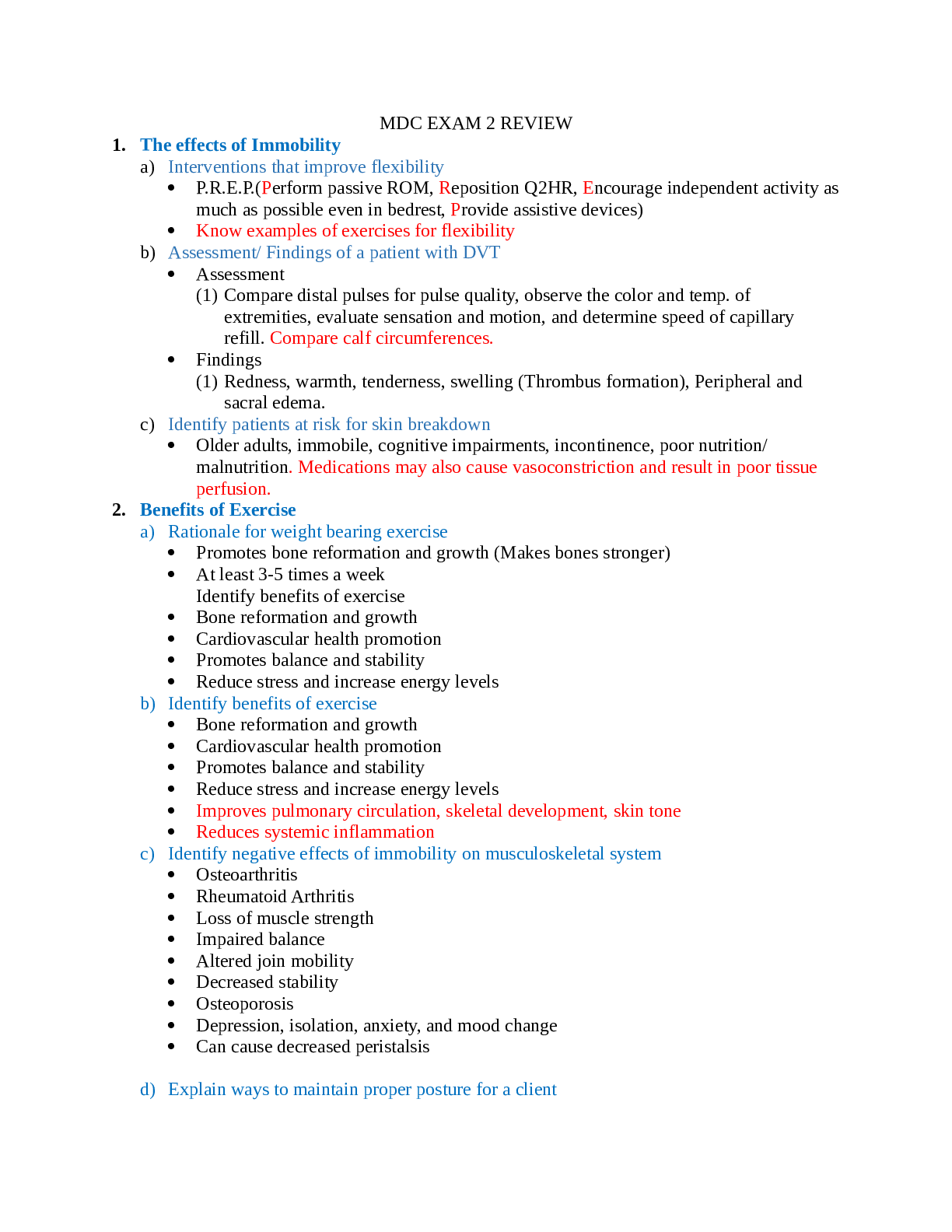
NUR2356 MDC EXAM 2 REVIEW
1. The effects of Immobility
a) Interventions that improve flexibility
P.R.E.P.(Perform passive ROM, Reposition Q2HR, Encourage independent activity
as much as possible even in bedrest, Provide assistive devices)
Know examples of exercises for flexibility
b) Assessment/ Findings of a patient with DVT
Assessment
(1) Compare distal pulses for pulse quality, observe the color and temp. of
extremities, evaluate sensation and motion, and determine speed of capillary
refill. Compare calf circumferences.
Findings
(1) Redness, warmth, tenderness, swelling (Thrombus formation), Peripheral and
sacral edema.
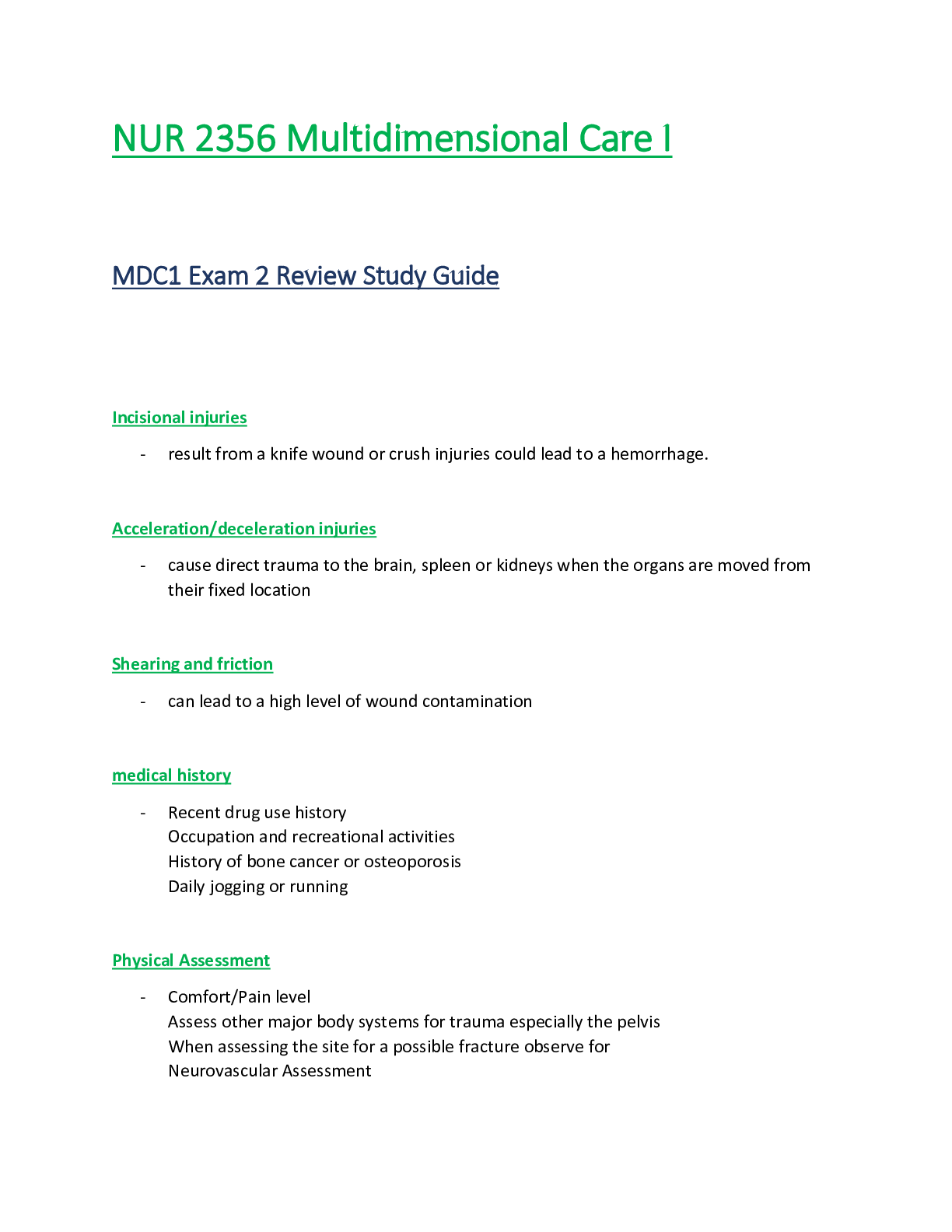
c) Identify patients at risk for skin breakdown
Older adults, immobile, cognitive impairments, incontinence, poor nutrition/
malnutrition. Medications may also cause vasoconstriction and result in poor tissue
perfusion.
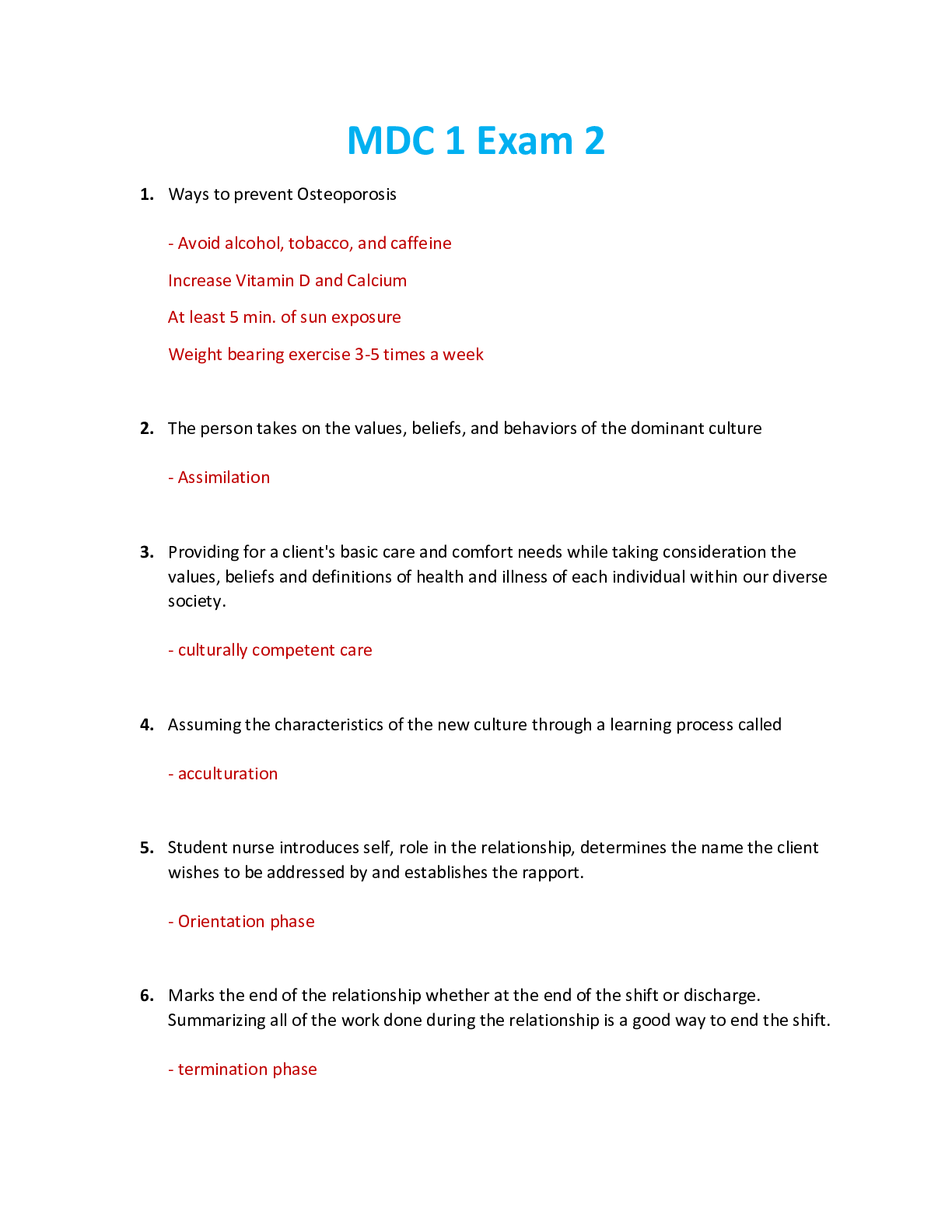
2. Benefits of Exercise
a) Rationale for weight bearing exercise
Promotes bone reformation and growth (Makes bones stronger)
At least 3-5 times a week
Identify benefits of exercise
Bone reformation and growth
Cardiovascular health promotion
Promotes balance and stability
Reduce stress and increase energy levels
b) Identify benefits of exercise
Bone reformation and growth
Cardiovascular health promotion
Promotes balance and stability
Reduce stress and increase energy levels
Improves pulmonary circulation, skeletal development, skin tone
Reduces systemic inflammation
c) Identify negative effects of immobility on musculoskeletal system
Osteoarthritis
Rheumatoid Arthritis
Loss of muscle strength
Impaired balance
Altered join mobility
Decreased stability
Osteoporosis
Depression, isolation, anxiety, and mood change Can cause decreased peristalsis
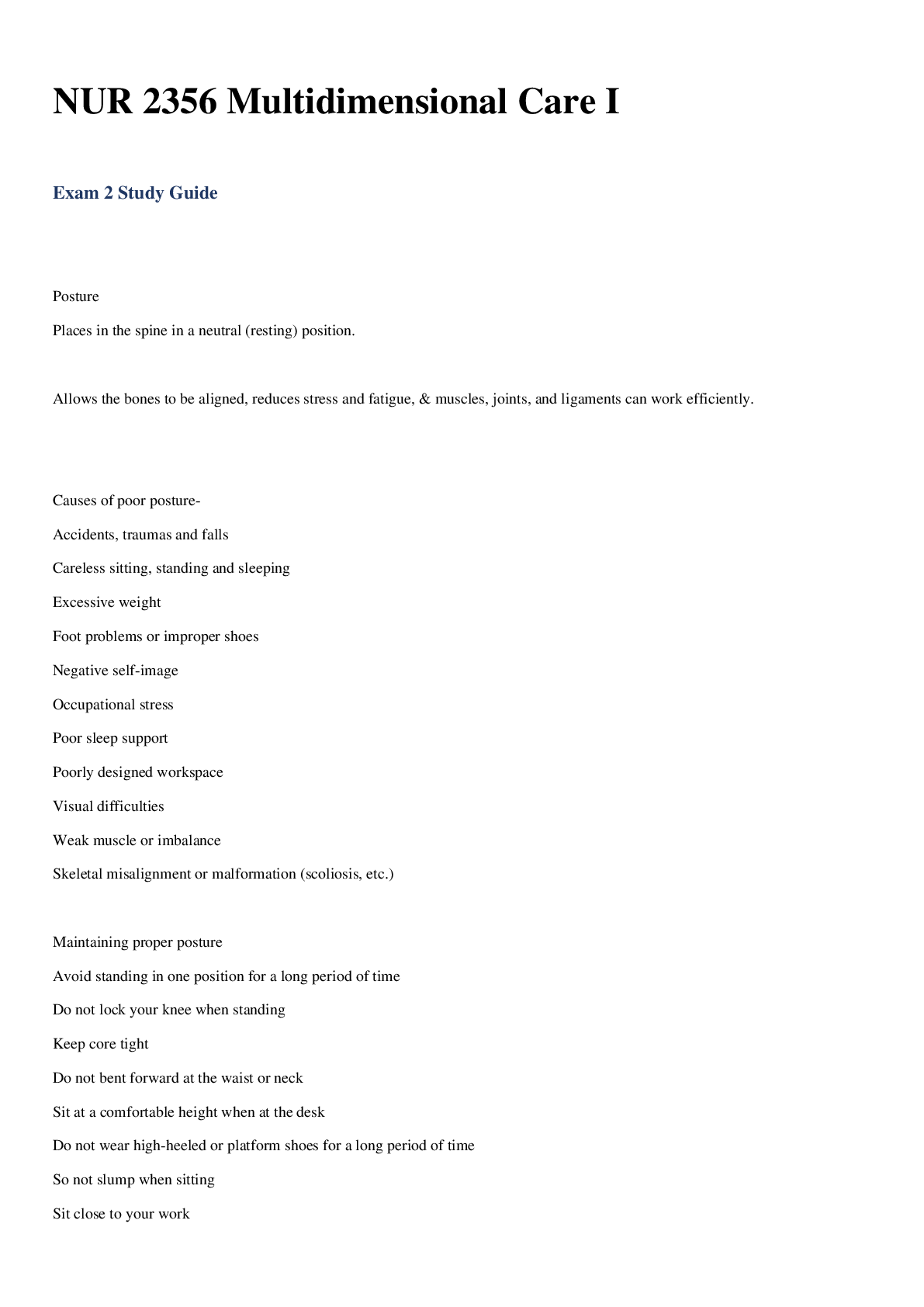
d) Explain ways to maintain proper posture for a client
Place the spine in a neutral position(Resting)
This allows the bones to be aligned, reduce stress and fatigue & muscle joints, and
ligament can work efficiently
Avoid standing in 1 position for a long period of time
Do not lock your knees when standing
Keep core tight and don’t bend at the waist or neck
No slumping when sitting
Sit close to your work and use back support
Sit with feet flat on floor
Sleep on firm mattress
Do not wear high heels for a prolonged time, do not slump, and use a chair that
supports your back.
e) Identify interventions in minimizing contractures (which is a negative effect of
immobility)
Gently straighten out contracted extremity, fingers. Etc
Mobility-encouraging interventions such as passive ROM, and rotation. Flexion and
extension exercises
These interventions should be performed about every 2hrs and as needed if the
contractures are present
3. Identify bed positions
Semi-fowlers: Patient is on their back with the head raised between 15 and 45 degrees.
High-fowlers: Patient is on their back with the head of the bed raised between 60 and 90
degrees.
Prone: Lying on the abdomen with the head turned to one side
Supine: Lying on the back
Sims: Patient lies on their side with the left thigh slightly flexed and the right thigh
acutely flexed on the abdomen.
Trendelenburg's Position: Patient is on their back whose lower section is inclined 15-30
degrees so that the head is lower than the body.
Reverse Trendelenburg's Position: Patient is in the supine position with the feet facing
downward and head is inclined 15-30 degrees.
Lateral Position: Side lying position, and a pillow is often placed between the legs for
patient comfort
4. Identify proper body mechanics for moving the patients in bed
Transfer board
Mechanical lift
Transfer belt
What are the proper ways to move patients in bed?
5. Explain how to use walkers to the elderly
Push or lift your walker 6-12 inches forward
Make sure all 4 tips or wheels of your walker are touching the ground before taking a
step Step forward with your weak leg first
Then step forward with your other leg placing it in front of the weaker leg
6. Be able to assess client with diabetic neuropathy
Monofilament test: touch foot at the same time and have patient which time they were
touched
Vibration perception: use a 128 hz tuning fork and ask the patient if they are able to feel
vibrations
Look for ulceration or inspection of the feet
7. Assessment of pain and questions to ask
P: What causes the pain or when did it start? What makes it better and what makes it
worse?
Q: How does the pain feel?
R: Where is the pain? Does it spread from one area to another?
S: How does the pain rate on a scale of 1-10, with ten being the worst pain?
T: When did the pain start? Is it sudden or gradual? Intermittent or constant
8. Teaching plan for patients with bunionectomy and healing
Allow them to walk with foot shoe or boot
Healing time is 6 to 12 weeks (healing time is slow due to less blood flow)
Use assistive devices for ambulatory until full weight bearing and allowed after surgery
which is several weeks postop.
When educating patients and they do not follow recommendations, ask them to tell about
their experiences.
9. Osteomy
elitis
a) Interventions in prevention and risk of osteomyelitis
Proper dental care
Maintaining clean & intact skin
Proper hand hygiene
Not leaving catheters in long tern
Understanding who is at risk
Using proper standard and contact precautions
Reduce caffeine and stop smoking
b) Explain why clients would have chronic osteomyelitis
A chronic infection or disease
If it is difficult to treat the underlying cause or inadequate treatment of acute
osteomyelitis
Misdiagnosis
c) Care for patients with kyphosis
ROM & mobility issues
Turn patient every 2 hours
Passive and active ROM exercises
Prevention of skin breakdown
Consider breathing issues & a plan of care that includes this ( auscultate lungs)
d) Teaching plan for care of osteomyelitis
Use of contact precautions to prevent spread of the infection Hand Hygiene
Complete antibiotic regimen
e) Identify various ROM exercises and when they would be utilized
Passive ROM – is movement of the joints through their ROM by another person,
moving the leg inward, toward the body’s midline.
Active ROM – are often performed as a rehabilitation procedure; also improves
respiratory and cardiac function
Both types improve joint mobility, increase circulation to the area exercised, and
help maintain function
Types of Passive ROM for each body part; understand what flexion, extension,
etc are (Funds book vol 2 pg 643-647)
What are proper body mechanics for moving a patient in bed
10. Bone Diseases/ Immobility
a) Identify goals for a patient with osteoarthritis
Osteoarthritis – progressive deterioration & loss of cartilage & bone in one or more
joints (crepitus).
Goals
i) Maintain proper nutrition to prevent obesity
ii) Take care to avoid injuries, especially those that can occur from professional or
amateur sports
iii) Take adequate work breaks to rest joints in jobs where repetitive motion is
common
iv) Stay active & maintain a healthy lifestyle (low impact sports, maintain nutrition)
v) Manage chronic pain
vi) Increase activity tolerance
vii)Participation in ADLs and increase range of motion
b) Explain why patients with osteoporosis are prone to fractures
Bone resorption (osteoclastic) is greater than bone building (osteoblastic). This results
in decreased bone mineral density (BMD). BMD is what determines bone strength.
Due to the loss of strength spongy bone & compact bone can be lost or pourous. This
results in fragile bine tissue at more risk for fractures
c) Identify assessment of a client with rheumatoid arthritis
Physical assessment
i) Early signs and symptoms – Inflammation; low-grade fever, fatigue, weakness,
anorexia, paresthesia
ii) Late signs – deformities, moderate to severe pain & morning stiffness;
osteoporosis, severe fatigue, anemia, weight loss, subcutaneous nodules,
peripheral neuropathy, vasculitis, pericarditis, fibrotic lung disease, Sjogren’s
syndrome, kidney disease, Felty’s syndrome, chronic pain, redness and swelling
of affected joints. Symptoms are bilateral and symmetric
Psychosocial Assessment
Diagnostic
i) X-Ray, CT
ii) Arthrocentisis
Laboratory Assessment
i) Rheumatoid Factorii) ANA
iii) Serum Complement
iv) Erythrocyte Sedimentation Rate
v) SPEP
(1) Albumin
(2) Globulin
(3) Alpha1 Globulin
(4) Alpha2 Globulin
(5) Beta Globulin
(6) Gamma Globulin
(7) HLA Testing
What non-pharmalogical interventions would help for a patient with rheumatoid
arthritis?
d) Explain complications of patients on prolonged bedrest
Pressure ulcers
Loss of muscle mass
Increased risk of kidney stones
Constipation
Altered ventilation/ perfusion
Weakness & tightness of the diaphragm
Decreased carbohydrate tolerance
Postural hypotension
DVT/ pulmonary embolus
Neurological changes
11. Falls
a) Identify priority assessment after a patient has fallen
The nurse should assist the patient in ensuring that they are safe
Do not leave the patient alone
Ensure the patient has not suffered major injuries
Ensure the patient is breathing
Assess neurological status
b) Identify interventions to prevent falls
Hand rails in bathrooms
Ramps instead of stairs
Wear rubber sole shoes
Avoid scatter rugs
Prevent clutter
Avoid slippery floors
Offer frequent toileting (Maslow’s hierarchy of needs)
12. CAST care
a) Care of a patient with a cast and interventions for poor circulation
Handle with the palms of your hands
Have the patient report painful “hot spots” under the cast which might indicate
area of pressure necrosis. Encourage the patient/family to smell the area for mustiness or unpleasant odor.
(if ignored the patient may develop a fever)
Instruct the patient to never put anything down into the cast (like a pencil or
hanger)
If the cast or patient is immobilized for a long period of time, the patient may
suffer from complications of immobility.
b) Care of a patient in traction, purpose, and proper use.
Skin traction (Buck’s): a boot attached to 5-10 pound weight used to relieve
muscle spasm pain from a hip or proximal femur fracture
Skeletal traction: screws directly into the bone which allows for heavier weights
15-30 pounds. Client is immobile so will need to be monitored for all the
complications associated with immobility
Equipment ropes, pulleys and weights need to be checked every shift
If the patient reports severe pain and realignment and repositioning of the patient
does not relieve the discomfort, the weight may be too heavy and the PCP will
need to be notified.
Monitor neurovascular checks of affected limb
Monitor pin sites for infection
c) Post-op hip fracture surgery care, identity possible complications
Pneumonia
UTI
Loss of muscle mass (fall risk)
Take pedal pulses (prevent necrosis)
Take capillary refill (prevent necrosis)
Bed sore/pressure ulcer
d) Explain compartment syndrome- know signs and symptoms- numbness and tingling are
not always compartment syndrome
A condition in which increased tissue pressure in a confined anatomic space
causes decreased perfusion (peripheral blood flow to the area). The decreased
circulation to the area leads to hypoxia and pain in the area.
Alert the primary health care provider promptly if the patient exhibits any signs of
decreased circulation to the limb such as coolness, swelling, mottling, or
discoloration.
Without improvement in perfusion to the limb, the patient could ultimately
require amputation of the limb.
e) Identify stages of bone healing
In stage one, within 24 to 72 hours after the injury, a hematoma forms at the
site of the fracture because bone is extremely vascular.
Stage two occurs in 3 days to 2 weeks when granulation tissue begins to
invade the hematoma. This then prompts the formation of fibrocartilage,
providing the foundation for bone healing.
Stage three of bone healing occurs as a result of vascular and cellular
proliferation. The fracture site is surrounded by new vascular tissue known as
a callus (within 3 to 6 weeks). Callus formation is the beginning of a nonbony union. As healing continues in stage four, the callus is gradually resorbed and
transformed into bone. This stage usually takes 3 to 8 weeks.
During the fifth and final stage of healing, consolidation and remodeling of
bone continue to meet mechanical demands. This process may start as early as
4 to 6 weeks after fracture and can continue for up to 1 year, depending on the
severity of the injury and the age and health of the patient.
13. Fractures, Traction and Bone Healing
a) Identify care for pincare (p.1042)
Pay particular attention to the pin sites for signs of inflammation or infection.
In the first 48 to 72 hours, clear fluid drainage or weeping is expected.
Although no standardized method or evidence-based protocol for pin-site care
has been established, recommendations have been made based on the
evidence available regarding pin-site care.
Because the pins go through the skin and into bone, the risk for infection is
high. Monitor the pin sites at least every 8 to 12 hours for drainage, color,
odor, and severe redness, which indicate inflammation and possible infection.
Follow agency policy for how to clean the pin-site areas.
b) Complications of surgery for fractures (p.1042)
Patients with open-reduction with external fixation are at greater risk for
infection related to the pin sites. Proper hand hygiene and strict infection
control practices are used to prevent infections or osteomyelitis. Educate
patients on antibiotic medication adherence.
When infected, what actions are taken?
Pulmonary embolism
c) Identify the difference between compartment syndrome and poor circulation (p.1033)
Acute compartment syndrome (ACS) is a serious, limb-threatening condition
in which increased pressure within one or more compartments reduces
circulation to the area. The most common sites for this problem in patients
with musculoskeletal trauma are the compartments in the lower leg (tibial
fractures) and forearm
Related to the muscle, blood vessels and nerves are caught within the fascia
leading to the increase in the venous pressure and the resulting edema.
The edema leads to increasing pain which is unrelieved by pain medication.
The edema continues to increase and leads to tissue necrosis and possible
tissue infection.
If unrelieved could lead to amputation distal to the compartment syndrome.
May appear 6 – 8 hours following an injury or can take up to 2 days to appear.
Monitor for the 6 P’s (pain, pressure, paralysis, paresthesia, pallor,
pulselessness)
d) Stages of bone healing (p.1032)
1st stage: Hematoma Formation
i. First 24-72 hours a hematoma forms at the site of the fracture
2nd stage: Hematoma to Granulation Tissue
i. 3 days- 2 weeks when granulation tissue begins to invade the
hematomaii. This prompts the formation of fibrocartilage providing the foundation
for bone healing
3rd stage: Callus Formation
i. Occurs as a result of vascular and cellular proliferation
ii. Within 3-6 weeks the fracture site is surrounded by new vascular
tissue (callus is the beginning of a nonbony union)
4th stage: Osteoblastic Proliferation
i. In 3-8 weeks, the callus is gradually resorbed and transformed into
bone (osteoblastic proliferation)
5th stage: Bone Remodeling à Bone Healing Completed
i. Consolidation and remodeling of bone continue to meet mechanical
demands
ii. This process may start as early as 4-6 weeks after fracture and can
continue for up to 1 year
iii. Depends on the severity of the injury and the age and health of the
patient
e) Discharge instructions for cast care (p.1039)
Handle with the palms of your hands
Have patient report painful “hot spots” under the cast which might indicate
area of pressure necrosis.
Instruct the patient to never put anything down into the cast i.e. pencil.
Encourage the patient/family to smell the area for mustiness or unpleasant
odor. If ignored the patient may develop a fever.
If the cast or patient is immobilized for a log period of time, may suffer from
complications of immobility
f) Reasons for traction (p.1040)
Traction is the application of a pulling force to a part of the body to provide
reduction, alignment, and rest. It is also used as a last resort to decrease
muscle spasm (thus relieving pain) and prevent or correct deformity and tissue
damage
Skin Traction (Buck’s)- Boot attached to 5 – 10-pound weight used to relieve
muscle spasm pain from a hip or proximal femur fracture.
Skeletal Traction
i. Screws directly into the bone which allows for heavier weights 15 – 30
pounds.
ii. Client is immobile so will need to be monitored for all the
complications associated with immobility.
iii. The equipment ropes, pulleys and weights need to be checked every
shift- where should the weights be placed?
iv. If patient reports severe pain and realignment and repositioning of the
patient does not relieve the discomfort the weight may be to heavy and
the PCP will need to be notified
v. Monitor Neurovascular checks of affected limb
vi. Monitor pin sites for infection
14. Sensory-Visiona) Care for patients who are blind (p.982)
Teach the patient techniques to perform ADLs and self-care independently
Refer the patient to local services, resources, and support groups for the blind
and those with low vision.
Speaking with patient in normal voice and natural tone
Promote safety:
Teach family members who have good vision to make appropriate adaptations
in the patient’s home to increase his or her safety and independence
Ask the patient whether describing the space layout would help
Use clock or compass direction for room orientation
b) Test to diagnose glaucoma (p. 972)
Ophthalmoscopic exam shows cupping and atrophy of optic disc. Optic disc
turns white or gray
Loss of peripheral visual fields with a gradual increase in the loss of the fields
test by perimetry
Tonometry: measures intraocular pressure. Intraocular pressure varies
throughout the day. Increase IOP (22 and 32 mmHg). Normal IOP is 10 to
21 mmHg.
Gonioscopy: is used when elevation intraocular pressure is diagnosed to
determine if the glaucoma is open-angle or closed-angle. It allows the
visualization of the angle where the iris meets the cornea. Determine whether
the angle is open or closed.
Ultrasonic imagining of the retina and optic nerve: creates a three-dimensional
view of the back of the eye. Used for clients with ocular hypertension or at
risk for glaucoma from other problems. Used to evaluated the thickness,
contour of the optic nerve fiber layers and retina for changes indicating
damage from high intraocular pressure.
c) Symptoms of cataracts (p.968)
Blurred vision
Decreased color perception
May think that glasses are smudged, prescription changes for eyeglasses
Double vision
Problems with ADL’s
Without surgical intervention blindness follows
Affects reading and driving
Halos, difficulty with night vision
d) Special care patients taking Timolol eye drops
Timolol is a beta-blocker eye drop used to treat glaucoma. Timolol lower the
pressure in the eye by decreasing the amount of fluid within the eye. This drug
induces hypoglycemia and also mask the hypoglycemic symptoms. Therefore,
special care may include monitoring patient’s glucose level. Take vital signs.
Other side effects of Timolol are slow heart rate, hives, difficult breathing,
swelling of face, lips, tongue, or throat. Therefore, when caring for patient
taking Timolol eye drops, assess breathing, swelling of face, lips, tongue, and
throat. In addition, asses skin for hives.e) Clients with decreased vision may require additional care at home-what are these
considerations?
Assistance with ADLs and self-care
Safety concerns/fall risk: Teach family members who have good vision to
make appropriate adaptations in the patient’s home to increase his or her
safety and independence
f) Difference between Glaucoma and Cataracts.
Glaucoma is increase intraocular pressure in the hollow organ. When the
intraocular pressure increase it leads to compression of the retinal blood
vessels and photoreceptors and their nerve fibers resulting in hypoxemia and
death of the tissue and loss of vision
Cataracts is opacity of the lens of the eye that lies just behind the iris. Most
are related to age. Causes for cataract may be due to blunt injury to eye or
head, lens water loss, radiation exposure, diabetes, glaucoma & retinal
detachment.
15. Sensory-Hearing
a) Teaching for clients with Meniere’s Disease
teach patients to move head slowly to prevent worsening of the vertigo,
reduce sodium intake, and reduce or stop smoking, continue medications. P.
995
b) Definition of Ringing in the ears(Tinnitus)
Tinnitus, a continuous ringing or noise perception in the ears. P. 995
c) What is considered emergent at the Urgent Care- Which patients should be seen first?
ABC’s (airway, breathing, circulation)
This is related to vision.
d) What assessment uses a tuning fork?
“Weber and Rinne” distinguishes between conductive and sensorineural
hearing. P. 989
[Show More]






![Preview of NR667 Complete Question Bank with Correct Answers: Final Exam Study Guide [2026 Updated]](https://browseimages.nyc3.digitaloceanspaces.com/paper-images/2026/02/25/AULA53fD2026-02-25-02-58699ee3d811bc7.png)