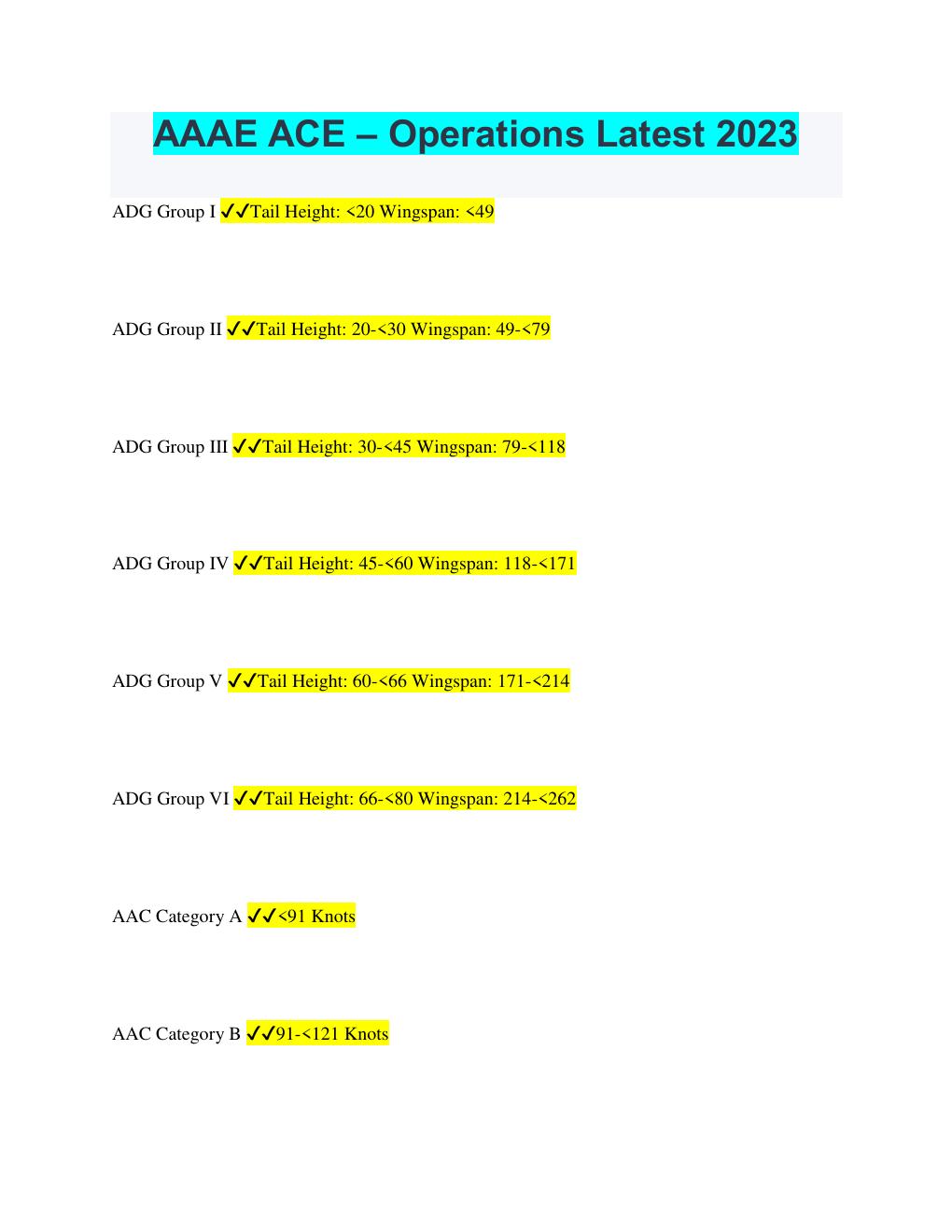
AAAE ACE – Operations Latest 2023
ADG Group I ✔✔Tail Height:
AAAE ACE – Operations Latest 2023
ADG Group I ✔✔Tail Height: <20 Wingspan: <49
ADG Group II ✔✔Tail Height: 20-<30 Wingspan: 49-<79
ADG Group III ✔✔Tail Height: 30-<45 Wingspan: 79-<118
ADG Group IV ✔✔Tail Height: 45-<60 Wingspan: 118-<171
ADG Group V ✔✔Tail Height: 60-<66 Wingspan: 171-<214
ADG Group VI ✔✔Tail Height: 66-<80 Wingspan: 214-<262
AAC Category A ✔✔<91 Knots
AAC Category B ✔✔91-<121 Knots
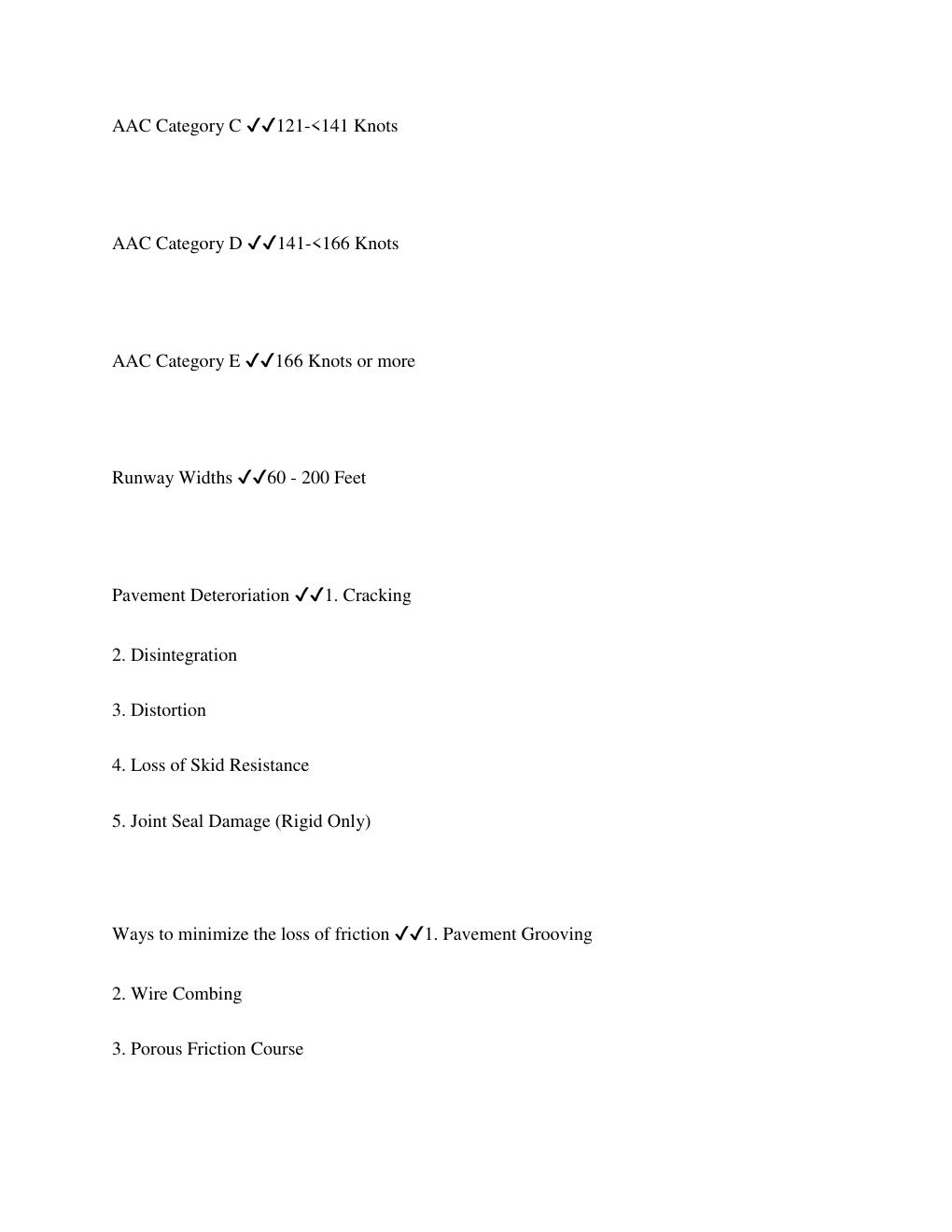
AAC Category C ✔✔121-<141 Knots
AAC Category D ✔✔141-<166 Knots
AAC Category E ✔✔166 Knots or more
Runway Widths ✔✔60 - 200 Feet
Pavement Deteroriation ✔✔1. Cracking
2. Disintegration
3. Distortion
4. Loss of Skid Resistance
5. Joint Seal Damage (Rigid Only)
Ways to minimize the loss of friction ✔✔1. Pavement Grooving
2. Wire Combing
3. Porous Friction Course
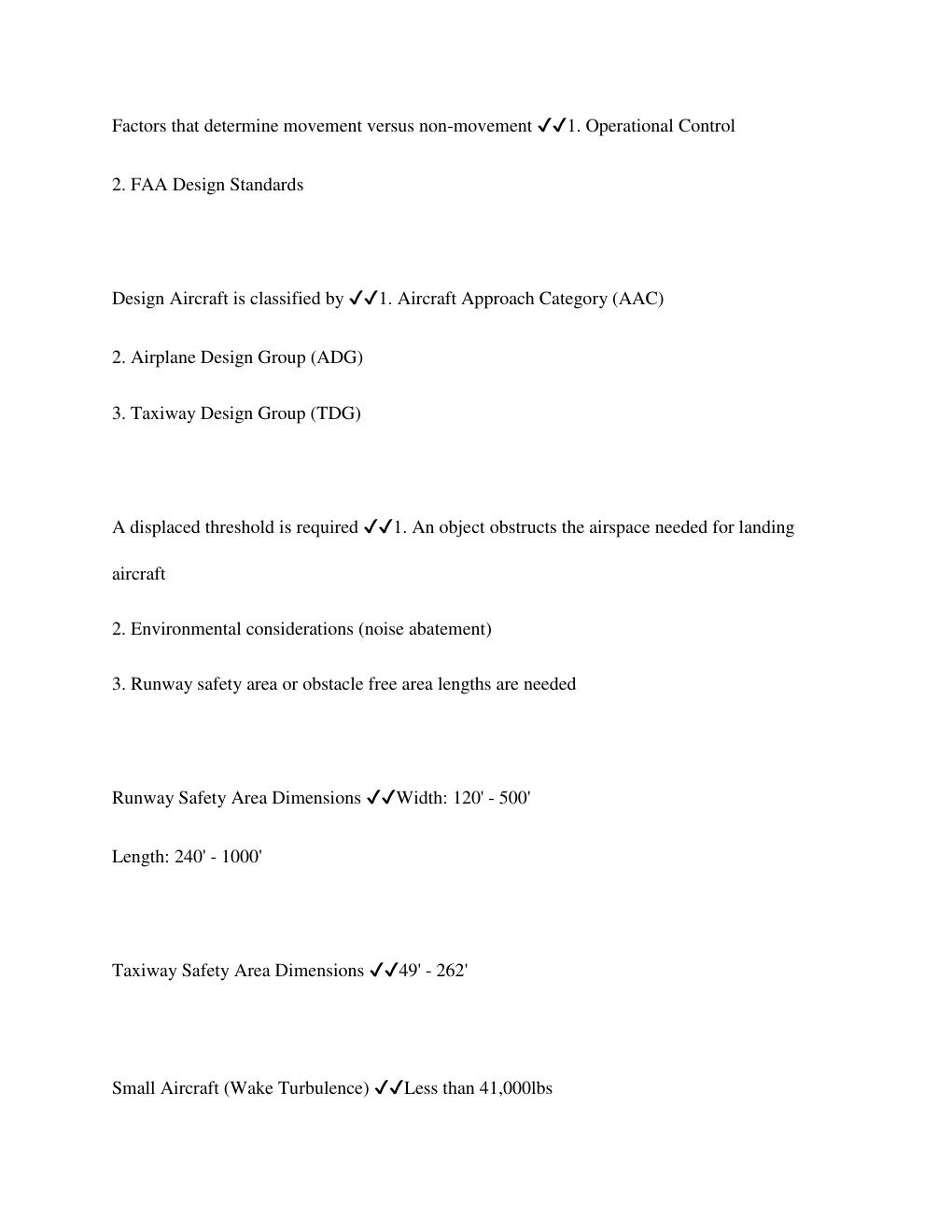
Factors that determine movement versus non-movement ✔✔1. Operational Control
2. FAA Design Standards
Design Aircraft is classified by ✔✔1. Aircraft Approach Category (AAC)
2. Airplane Design Group (ADG)
3. Taxiway Design Group (TDG)
A displaced threshold is required ✔✔1. An object obstructs the airspace needed for landing
aircraft
2. Environmental considerations (noise abatement)
3. Runway safety area or obstacle free area lengths are needed
Runway Safety Area Dimensions ✔✔Width: 120' - 500'
Length: 240' - 1000'
Taxiway Safety Area Dimensions ✔✔49' - 262'
Small Aircraft (Wake Turbulence) ✔✔Less than 41,000lbs
Large Aircraft (Wake Turbulence) ✔✔41,000lbs - 300,000lbs
Heavy Aircraft (Wake Turbulence) ✔✔300,000lbs or more
Class A Airspace ✔✔18,000 MSL up to FL600 including 12NM of coast over the continuous 48
states
Class B Airspace ✔✔Surface up to 10,000 ft MSL surrounding nation's busiest airports; upsidedown wedding cake. ATC clearance required; VFR operations is "clear of clouds"
Class C Airspace ✔✔Surface to 4,000 ft above airport elevation within 5 NM radius. From 5-10
NM out, 1,200 ft to 4,000 ft above airport elevation.
Class D Airspace ✔✔Surface up to 2,500 ft MSL surrounding airports with operational control
tower.
Class E Airspace ✔✔Unless designated at lower altitudes; 14,500' MSL up to 17,999' MSL.
1. Federal Airways
2. Offshore Airspace Areas
3. Transition Airspace
4. En-route Domestic Areas
5. Surface Area designated for an Airport
6. Extension to a Surface Area
Restricted Areas ✔✔Area where flight is not prohibited but subject to certain limitations
Prohibited Areas ✔✔Area where flight is not allowed
Warning Areas ✔✔Extending 3NM outward from the US coast, contains activity that may be
hazardous to nonparticipating aircraft
Special Use Airspace ✔✔Activities must be confined because of there nature or limitations
imposed on aircraft operations
Non-Regulatory Airspace ✔✔1. Military Operations Areas
2. Warning Areas
3. Alert Areas
4. Controlled Firing Areas
Regulatory Airspace ✔✔1. Class A,B,C,D,E
2. Restricted Areas
3. Prohibited Areas
Two Types of Airspace ✔✔Regulatory and Non-regulatory
Sub Types of Airspace ✔✔1. Controlled
2. Uncontrolled (Class G)
3. Special Use
Alert I ✔✔Signifies a precautionary approach to a situation where a real or suspected emergency
exists on an aircraft, but the nature of the emergency would not normally cause serious difficulty
or make the anticipated landing unsafe.
Alert II ✔✔Signifies an actual aircraft emergency exists in flight, and an accident may well
occur resulting in injuries and aircraft damage.
Alert III ✔✔Signifies an actual aircraft accident has occurred.
Parts of Airport Emergency Plan ✔✔1. Mitigation
2. Preparedness
3. Response
4. Recovery
Category A Incursion ✔✔A serious incident in which a collision was narrowly avoided.
Category B Incursion ✔✔An incident in which separation decreases and a significant potential
for collision exists, which may result in a time-critical corrective and evasive response to avoid a
collision.
Category C Incursion ✔✔An incident characterized by ample time or distance to avoid a
collision.
Category D Incursion ✔✔An incident that meets the definition of runway incursion such as
incorrect presence of a single vehicle, person or aircraft on the protected area of a surface
designated for the landing and take-off of aircraft but with no immediate safety consequences
Navigational Systems must operate with: ✔✔1. Integrity
2. Accuracy
3. Availability
Personnel training records must be maintained for: ✔✔24 CCM
ARFF and EMS Personnel training records must be maintained for: ✔✔24 CCM
Airport Fueling Agent Inspection records must be maintained for: ✔✔12 CCM
Fueling Personnel training records must be maintained for: ✔✔12 CCM
Self inspections records must be maintained for: ✔✔12 CCM
Movement and safety areas training records must be maintained for: ✔✔24 CCM
Accident and incident records must be maintained for: ✔✔12 CCM
Airport Conditions (NOTAMS) records must be maintained for: ✔✔12 CCM
Class I Airports ✔✔Scheduled Small and Large + Unscheduled Large
Class II Airports ✔✔Scheduled Small + Unscheduled Large
Class III Airports ✔✔Scheduled Small Only
Class IV Airports ✔✔Unscheduled Large Only
Joint-Use Airport ✔✔Airport owned by the US that leases a portion of the airport to a person
operating an airport specified under Part 139
Shared-Use Airport ✔✔US Government owned airport that is co-located with an airport
specified under Part 139 and which portions of the movement and safety areas are shared by both
parties
Part 139 Does Not Apply To ✔✔1. Airports serving scheduled air carrier operations only by
reason of being designated as an alternative airport
2. Airports operated by the United States
3. Airports located in Alaska that only serve scheduled operations of small air carrier aircraft
4. Airports located in Alaska during periods of time
when not serving large air carrier operations
5. Heliports
Part 139 Does Apply To ✔✔1. Scheduled Passenger-carrying operations of air carrier operating
aircraft for more than 9 seats
2. Unscheduled Passenger-carrying operations of air carrier operating aircraft configured for at
least 31 seats
3. Portions of a joint-use or shared-use airport that are within the authority of a person serving
passenger-carrying operations
Index A ✔✔Aircraft less than 90'
Index B ✔✔Aircraft 90' - less than 126'
Index C ✔✔Aircraft 126' - less than 159'
Index D ✔✔Aircraft 159' - less than 200'
Index E ✔✔Aircraft 200' or more
.png)

.png)