Assess Your Knowledge
Mental Health Exam 1
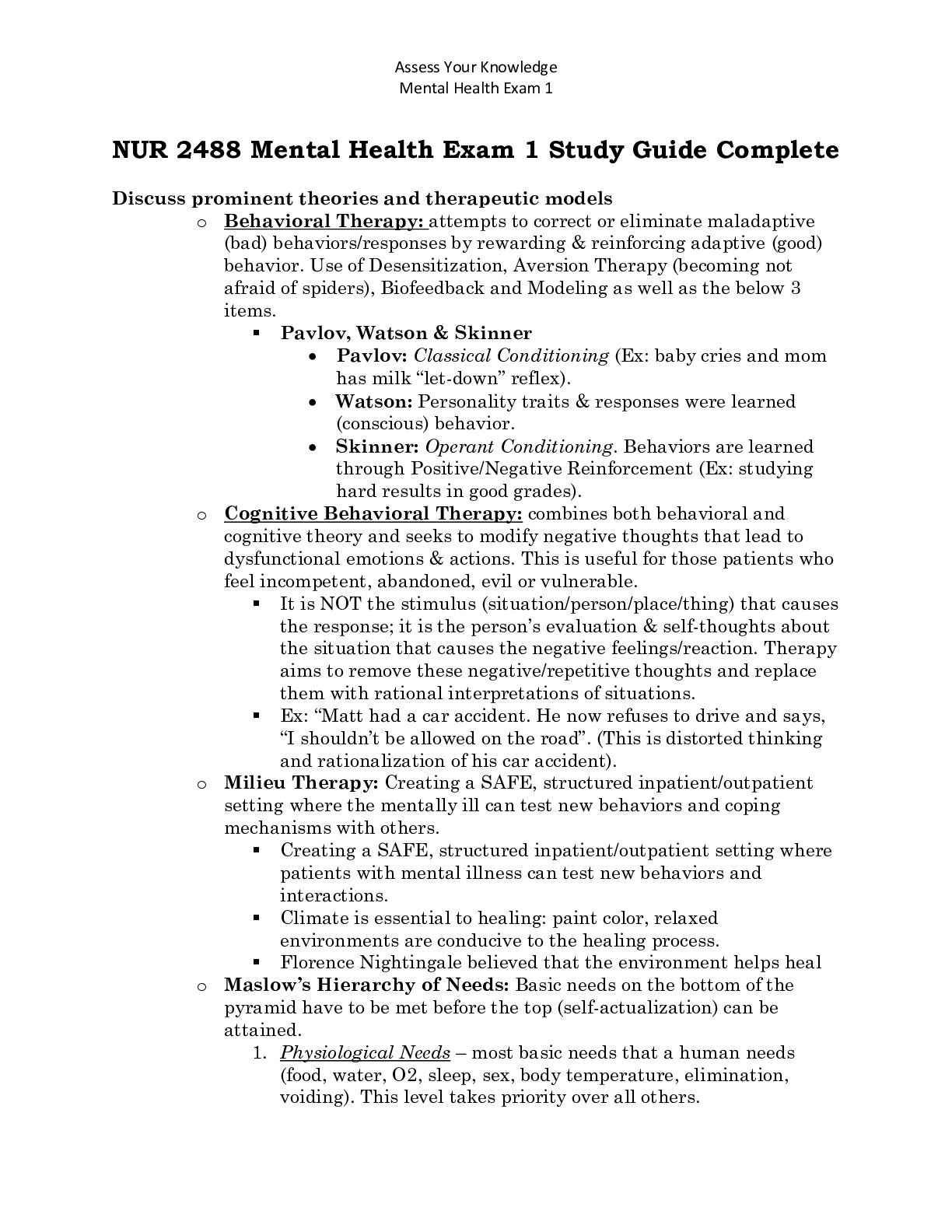
NUR 2488 Mental Health Exam 1 Study Guide Complete
Discuss prominent theories and therapeutic models
o Behavioral Therapy: attempts to correct or eliminate maladaptive
(bad
...
Assess Your Knowledge
Mental Health Exam 1
NUR 2488 Mental Health Exam 1 Study Guide Complete
Discuss prominent theories and therapeutic models
o Behavioral Therapy: attempts to correct or eliminate maladaptive
(bad) behaviors/responses by rewarding & reinforcing adaptive (good)
behavior. Use of Desensitization, Aversion Therapy (becoming not
afraid of spiders), Biofeedback and Modeling as well as the below 3
items.
Pavlov, Watson & Skinner
Pavlov: Classical Conditioning (Ex: baby cries and mom
has milk “let-down” reflex).
Watson: Personality traits & responses were learned
(conscious) behavior.
Skinner: Operant Conditioning. Behaviors are learned
through Positive/Negative Reinforcement (Ex: studying
hard results in good grades).
o Cognitive Behavioral Therapy: combines both behavioral and
cognitive theory and seeks to modify negative thoughts that lead to
dysfunctional emotions & actions. This is useful for those patients who
feel incompetent, abandoned, evil or vulnerable.
It is NOT the stimulus (situation/person/place/thing) that causes
the response; it is the person’s evaluation & self-thoughts about
the situation that causes the negative feelings/reaction. Therapy
aims to remove these negative/repetitive thoughts and replace
them with rational interpretations of situations.
Ex: “Matt had a car accident. He now refuses to drive and says,
“I shouldn’t be allowed on the road”. (This is distorted thinking
and rationalization of his car accident).
o Milieu Therapy: Creating a SAFE, structured inpatient/outpatient
setting where the mentally ill can test new behaviors and coping
mechanisms with others.
Creating a SAFE, structured inpatient/outpatient setting where
patients with mental illness can test new behaviors and
interactions.
Climate is essential to healing: paint color, relaxed
environments are conducive to the healing process.
Florence Nightingale believed that the environment helps heal
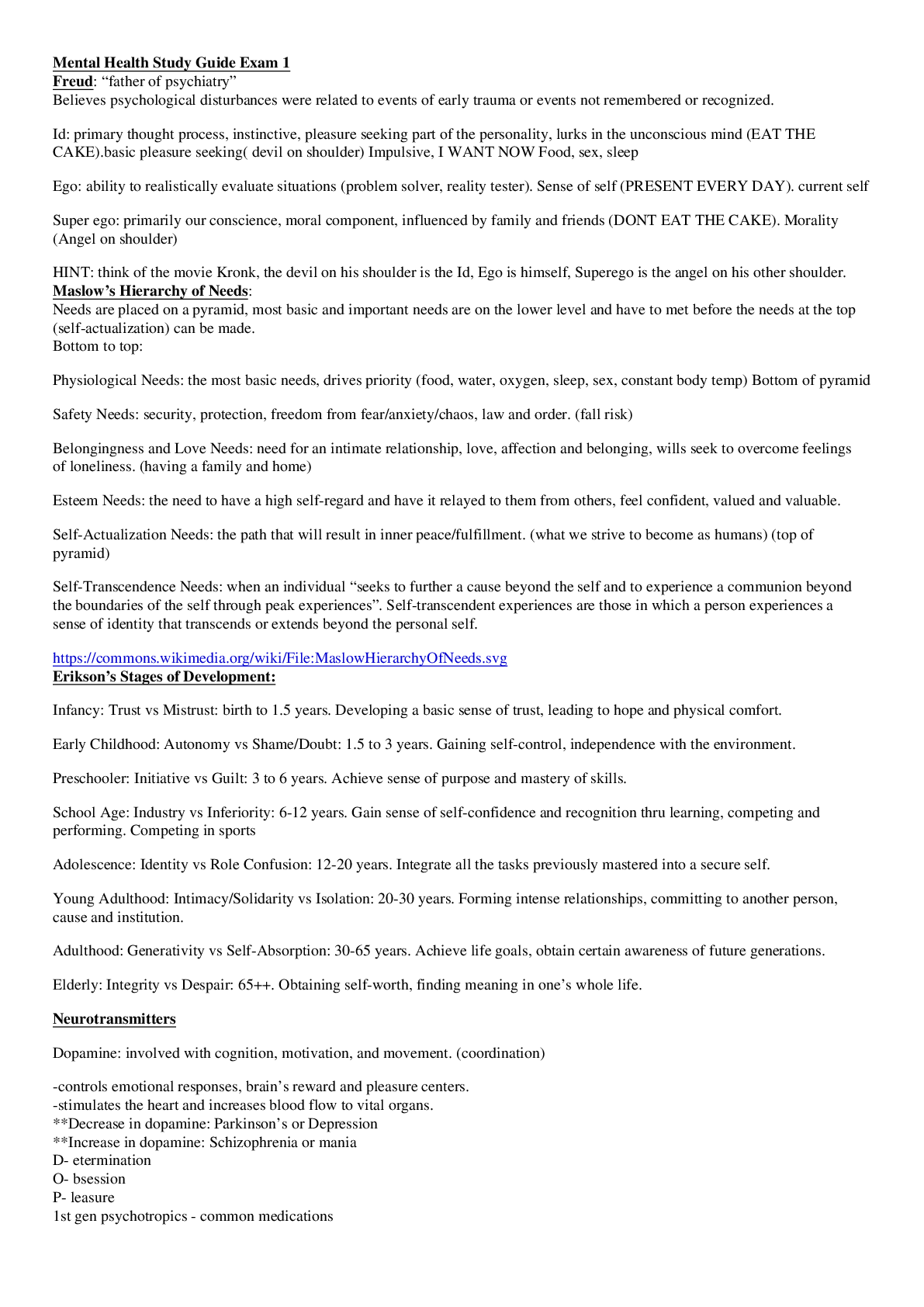
o Maslow’s Hierarchy of Needs: Basic needs on the bottom of the
pyramid have to be met before the top (self-actualization) can be
attained.
1. Physiological Needs – most basic needs that a human needs
(food, water, O2, sleep, sex, body temperature, elimination,
voiding). This level takes priority over all others.Assess Your Knowledge
Mental Health Exam 1
2. Safety Needs – security, protection, and freedom from
fear/anxiousness/chaos, law, order and limitations.
3. Belonging & Love Needs – The need for love, affection, intimate
relationships and belonging will see to overcome feelings of
loneliness and alienation. (Having a Family and a Home is very
important).
4. Esteem Needs – If this need is met, we feel confident, valued and
valuable. If this need is NOT met, we feel inferior, worthless and
helpless.
5. Self-Actualization – What we strive to become as humans.
Fulfillment of this need brings inner piece and contentment with
ones self.
Describe the role of neurotransmitters: dopamine, serotonin, and
norepinephrine, GABA
Dopamine: controls emotional responses, the brain’s reward and
pleasure centers, stimulates heart and increases blood flow to organs.
(Haloperidol = dopamine blocker). Cocaine allows more of dopamine to
stay active for longer = increased HR, etc.
o EPS is the result of Dopamine blockers (Dopamine needs
to get through for proper brain functioning!)
o Disorders with HIGH levels: Schizophrenia, Mania
o Disorders with LOW levels: Depression, Parkinson’s Disease
Serotonin: Regulates mood, arousal, attention, behavior, and body
temperature. Most anti-depressants increase Serotonin production.
Muscle Relaxants block serotonin production. Serotonin release by
platelets play important role in homeostasis.
o High levels of Serotonin S/Sx: causes restlessness, shivering,
diarrhea, muscle rigidity, fever and seizures.
o Disorders with HIGH levels: Anxiety
o Disorders with LOW levels: Depression
Norepinephrine: Regulate mood. A deficiency can cause Depression
and excess can cause Mania.
o Disorders with HIGH levels: Mania, Anxiety, Schizophrenia
o Disorders with LOW levels: Depression
GABA: inhibitory neurotransmitter that regulates excitability and
helps treat anxiety by helping you “chill out”. Anti-Anxiety Meds help
increase the effectiveness of GABA by making the receptors more
responsive.
o Disorders with HIGH levels: Reduction of Anxiety
o Disorders with LOW levels: Mania, Anxiety, Schizophrenia
Describe the phases of the nurse-client relationship, and what occurs
during each phase (Hildegard Peplau)
1. Orientation Phase: first time the nurse & patient meet, interact
according to their own backgrounds/standards/values/beliefs, roles ofAssess Your Knowledge
Mental Health Exam 1
the patient and nurse are clarified, confidentiality is discussed and
assumed, nurse becomes aware of transferences & countertransference
issues, goals are established, termination terms are introduced.
2. Working Phase: exploration of feelings or situations that are causing
the problems, re-experiencing of old conflicts can awaken high levels of
anxiety, intense emotional states may surface, defense mechanisms,
denying, manipulation, evaluation of problems and goals, promote
alternative reactions/behaviors to situations, etc. The nurse’s
awareness of his or her own personal feelings and reactions to the
patient are VITAL for effective interaction with the patient.
3. Termination Phase: summarization of goals, review of what was
achieved during communication, discussing new ways to implement
new coping strategies, evokes strong feelings in both client & nurse.
Describe the client interview- what should be considered and included
What should be Considered:
o The interview (content & direction) is lead by the patient.
o The nurse uses open communication, positive attending
behaviors, and active listening to better understand the
patient’s situation. This allows the patient to feel understood,
listened to, explore problems, healthy ways to meet emotional
needs and have a satisfying interpersonal relationship
experience.
What should be Included:
o Setting: has a large impact on healing (remember to use Milieu
techniques)
o Seating: stay between patient and door, avoid sitting behind a
desk, sit at an angle with the chairs (not face-to face)
o Introductions: who you are, purpose of meeting, length of
meeting, confidentiality of meeting, asking patient how they like
to be addressed (Blake vs. Mr. Anderson), etc.
o Initiating Interview: use open ended questions like “Where
should we start”, “Tell me what has been going on when you
recently”
o Offering Leads: “Go on…”
o Making statements of Acceptance: “I follow you…”
Helpful Guidelines
o Speak briefly
o When you don’t know what to say, don’t say anything
o Focus on feelings
o Don’t give advice
o Avoid relying on questions
o Note patient’s non-verbal ques
o Keep the focus on the patientAssess Your Knowledge
Mental Health Exam 1
Describe the sections of a psychiatric assessment- what should be
included?
1. MSE: organizes OBJECTIVE data (physical behavior, mood, perceptions,
speech patterns, appearance, nonverbal communication, etc.)
2. Psychosocial Assessment: provides additional information to plan care for
the patient. SUBJECTIVE data.
Spirituality/Religious beliefs
Cultural/Social factors
Stressors & Coping methods
Personal background
Quality of ADL’s
Family Psychiatric history
History of violent/suicidal behaviors
Current Meds & Alternative Therapies
Current Drug abuse problems (if any)
Discuss the nursing process as it applies to mental health clients
Assess, Diagnosis, Outcome Identification, Planning, Intervention, &
Evaluation
Care plan should be: Evidence based, individualized, appropriate,
compatible with other therapies, realistic, and safe.
NIC: standardized nursing interventions
NOC: standardized nursing outcomes
Describe the role of the psychiatric nurse vs. advanced practice
Nurses (RN) CANNOT: prescribe medications, psychotherapy, or
perform consultations.
Describe and give examples of therapeutic communication techniques
Therapeutic Communication: goal directed, professional, scientifically
based. Goal is to get information so that you can plan care for the patient.
Active Listening
o Clarifying: promotes understanding of the patient’s statement
o Restating: repeating the same key words the patient has just spoken
to echo their feelings. (Ex: If a patient remarks, “My life is empty…it
has no meaning,” additional information may be gained by restating,
“Your life has no meaning?”)
o Reflecting: helps people understand their own thoughts better;
summarizes (Ex: For example, to reflect a patient's feelings about his
or her life, a good beginning might be, “You sound as if you have had
many disappointments.”)
o Exploring: use of open-ended questions or statements to allow the
patient to express thoughts/feelings. (Ex: “Tell me more…”, “Give me
an example of…”)
Communication Technique Examples in Different Scenarios
o For Suicidal Patients: “These thoughts are very serious Mr. Adams.
I do not want any harm to come to you. Can you tell me what you wereAssess Your Knowledge
Mental Health Exam 1
feeling and if there were any circumstances that led you to this
decision?”
o For Patients who start Crying: Stay with your patient and reinforce
that it is all right to cry & offer tissues. “You seem upset, what are you
thinking right now?”
o For Patients who say they “don’t want to talk”: “Its alright. I
would like to spend time with you. We don’t have to talk.” Or
reapproach at a later time, “Our 5 minutes is up. I will be back at
10am and spend another 5 minutes with you.”
o For Patients who ask the nurse to keep a secret: Nurses cannot
make such promises, as it may be important to share that information
with other staff for safety reasons. “I cannot make that promise Mr.
Adams as it might be important for me to share it with the other staff”.
Describe and give examples of nontherapeutic communication techniques
Non-Therapeutic Communication: not goal-directed, false reassurances,
double messages, giving personal opinions, making assumptions of feelings,
asking “Why” questions, showing disapproval, excessive questioning, nonattending behaviors, poor non-verbal communication (eye rolling, staring off
into distance, ignoring patient).
o Double Bind Messages: intent of the message is to cause confusion
o Double Messages: conflicting/mixed messages
Describe the types of nonverbal communication- give examples
Tone of voice (tone, pitch, intensity, stuttering, silence, pausing)
Facial expressions (frown, smile, grimaces, raises eyebrows, licks lips)
Posture (slumps over, puts face in hands, taps feet, fidgets with fingers)
Amount of eye contact (angry, suspicious or accusatory looks, wandering)
Sighs
Hand gestures (fidgeting, snapping fingers)
Yawning
Cultural Considerations- discusses how these impact the nursing
assessment, communication, give examples of cultural differences
Always have a medically trained interpreter for non-English speaking
patients.
Communication Styles: some Hispanics/Italians use hand gestures
& dramatic body language when describing emotional problems.
French/Americans use animated facial expressions and hands during
communication. African Americans can be guarded and highly
selective in their communication outside of their cultural group.
Eye Contact: Some consider eye contact disrespectful. Hispanics
avoid eye contact with authority figures as a sign of respect. Asian
cultures believe eye contact is disrespectful (they prefer to shift eye
glances towards neck instead of meeting eyes). Haiti – it is customary
to hold eye contact with everyone but the poor.Assess Your Knowledge
Mental Health Exam 1
Touch: Hispanics, Italian, & French are accustomed to frequent
handholding and touch. Check facility policy on touch (especially with
teens and children who could have experienced inappropriate touch in
the past)
Cultural Filters: cultural bias; determines what we notice and what
we ignore. Bias builds distorted understanding and treat people
unfairly.
Define Negligence, Autonomy, Justice, Beneficence, Fidelity, and VeracityBe able to give examples of each:
o Negligence –or malpractice is an act or an omission to act that breaches
the duty of due care and results in or is responsible for a person’s injuries.
The five elements required to prove negligence are: (1) duty, (2) breach of
duty, (3) cause in fact, (4) proximate cause, and (5) damages.
o Example – A nurse know that a patient’s IV is malfunctioning and the
wires are frayed, but decides not to act in a timely manner and leaves
the IV on the patient and doesn’t tag it for repair, this results in the
patient dying.
o Beneficence - This relates to the quality of doing good and can be described
as charity.
o Example - A nurse helps a newly admitted client who has psychosis
feel safe in the environment of the mental health facility.
o Autonomy - This refers to the client’s right to make her own decisions. But
the client must accept the consequences of those decisions. The client must
also respect the decisions of others.
o Example - Rather than giving advice to a client who has difficulty
making decisions, a nurse helps the client explore all alternatives and
arrive at a choice.
o Justice - This is defined as fair and equal treatment for all.
o Example - During a treatment team meeting, a nurse leads a
discussion regarding whether or not two clients who broke the same
facility rule were treated equally.
o Fidelity - This relates to loyalty and faithfulness to the client and to one’s
duty.
o Example - A client asks a nurse to be present when he talks to his
mother for the first time in a year. The nurse remains with the client
during this interaction.Assess Your Knowledge
Mental Health Exam 1
o Veracity - This refers to being honest when dealing with a client.
o Example - A client states, “You and that other staff member were
talking about me, weren’t you?” The nurse truthfully replies, “We were
discussing ways to help you relate to the other clients in a more
positive way.”
Describe the use of seclusion- what it for, when is it appropriate:
Use of seclusion rooms and/or restraints may be warranted and authorized
for clients in some cases. In general, seclusion and/or restraint should be
ordered for the shortest duration necessary, and only if less restrictive
measures are not sufficient. They are for the physical protection of the
client and/or the protection of other clients and staff.
*A client may voluntarily request temporary seclusion in cases in which the
environment is disturbing or seems too stimulating. *
*Restraints can be either physical or chemical, such as neuroleptic medication to
calm the client. *
Seclusion and/or restraint must never be used for:
Convenience of the staff
Punishment of the client
Clients who are extremely physically or mentally unstable
Clients who cannot tolerate the decreased stimulation of a seclusion room
When all other less restrictive means have been tried to prevent a client from
harming self or others, the following must occur in order for seclusion or restraint to
be used:
The primary care provider in writing must order the treatment.
The order must specify the duration of treatment.
The provider must rewrite the order, specifying the type of restraint, every 24
hr. or the frequency of time specified by facility policy.
Nursing responsibilities must be identified in the protocol, including how often the
client should be:
Assessed (including for safety and physical needs), and the client’s behavior
documented
Offered food and fluid
Toileted
Monitored for vital signs
Complete documentation includes a description of the following:
Precipitating events and behavior of the client prior to seclusion or restraint
Alternative actions taken to avoid seclusion or restraint
The time treatment beganAssess Your Knowledge
Mental Health Exam 1
The client’s current behavior, what foods or fluids were offered and taken,
needs provided for, and vital signs
Medication administration
An emergency situation must be present for the charge nurse to use seclusion
or restraints without first obtaining a provider’s written order. If this
treatment is initiated, the nurse must obtain the written order within a
specified period of time (usually 15 to 30 min).
Discuss patient rights during an involuntary vs. voluntary admission:
Voluntary Commitment – The client or client’s guardian chooses commitment to
a mental health facility in order to obtain treatment. A voluntarily committed client
has the right to apply for release at any time. This client is considered competent,
and so has the right to refuse medication and treatment.
Involuntary (civil) Commitment – The client enters the mental health facility
against her will for an indefinite period of time. The commitment is based on the
client’s need for psychiatric treatment, the risk of harm to self or others, or the
inability to provide self-care. The need for commitment could be determined by a
judge of the court or by another agency. The number of physicians, which is usually
two, required to certify that the client’s condition requires commitment varies from
state to state.
Emergency Involuntary Commitment – A type of involuntary
commitment in which the client is hospitalized to prevent harm to self
or others. Emergency commitment is usually temporary (may be up to
10 days). Primary care providers, mental health providers, or police
officers usually impose this type of commitment.
Observational/Temporary Involuntary Commitment – A type of
involuntary commitment in which the client is in need of observation, a
diagnosis, and a treatment plan. The time for this type of commitment
is controlled by state statute and varies greatly between states. A
family member, legal guardian, primary care provider, or a mental
health provider may impose this.
Long-Term/formal Involuntary Commitment – A type of
commitment that is similar to temporary commitment but must be
imposed by the courts. Time of commitment varies, but is usually 60 to
180 days. Sometimes, there is no set release date.
Clients admitted under involuntary commitment are still considered
competent and have the right to refuse treatment, unless they have
gone through a legal competency hearing and have been judged
incompetent. The client who has been judged incompetent has a
temporary or permanent guardian, usually a family member if
possible, appointed by the court. The guardian can sign informed
consent for the client. The guardian is expected to consider what the
client would want if he were still competent.Assess Your Knowledge
Mental Health Exam 1
Describe the impact of Duty to Warn and Tort Law to nursing:
Duty to Warn – The California Supreme Court, 1974, Tarasoff v. Regents of
University of California, ruled that a psychotherapist has a duty to warn a
patient’s potential victim of potential harm. Duty to warn usually includes
the following:
o Assessing and predicting the patient’s danger of violence toward
another.
o Identifying the specific individual(s) being threatened.
o Taking appropriate action to protect the identified victim
Tort - Some legal issues regarding health care may be decided in court using
a specialized civil category called a tort. A tort is a wrongful act or injury
committed by an entity or person against another person or another person’s
property. Torts can be used to decide liability issues, as well as intentional
issues that may involve criminal penalties, such as abuse of a client.
Understand what different classes of medications are used for:
Antidepressants - is a substance that prevents/relieves depression.
o SSRI (Selective Serotonin Reuptake Inhibitor) – (Associated
NT: Serotonin). Anti-Depressant drugs that blocks reuptake of
Serotonin. SSRI’s have fewer side effects than TCA’s. (Ex: fluoxetine,
citalopram, sertraline). Black Box Warning: increased suicidal
thoughts are possible. Takes 2-4 weeks to work. Helps treat
Depression, ETOH withdrawal, OCD,
Side Effects: Anxiety, tremors, sexual dysfunction, H/A,
agitation, sleeplessness.
S/Sx of Overdose: Serotonin Syndrome (fever, Hyper-Reflexia,
sweating, high BP, delirium, hostility). Wait 2 weeks before
starting an MAOI or vice-versa.
Contraindications: Those who have attempted suicide don’t
use! Pregnancy, Renal/Liver issues
o Tricyclic Antidepressant (TCA) – (Associated NT: Norepinephrine
& Serotonin). Anti-Depressant drugs that block reuptake of
Norepinephrine & Serotonin (so there’s more available). Helps elevate
mood. Used for Depression, anorexia, insomnia, ODC, Panic disorder,
and neurogenic pain (Mosby’s Pocket Dictionary, 2015). Takes 10-14
days to become effective. Provider will chose this drug if (1) it worked
on family member in past and (2) severity of adverse effects. Start with
LOW dose and gradually increase if necessary.
Side Effects: Anticholinergic effects (urinary retention, dry
mouth, blurred vision, tachycardia, constipation, reflux),
Postural Hypotension (increasing falls risk w/this med)
S/Sx of Overdose: tachycardia, MI, heart block, dysrhythmiasAssess Your Knowledge
Mental Health Exam 1
Contraindications: Elderly and those with Cardiac Disease
Labs to Watch:
o MAOI– (Associated NT: Norepinephrine) Prevents MAO enzyme
from breaking down Norepinephrine. Helps treat Depression when
other medications fail to work. Irreversible inhabitation of MAO. (ex:
Phenelzine)
Side Effects: insomnia, palpitations, H/A, loss of libido,
Orthostatic Hypotension
Contraindications: Foods with Tyramine (causes
Hypertensive Crisis), Pregnancy
Vitals to Watch: BP and Liver Function
Anxiolytics – (Associated NT: GABA). Drug used to depress the CNS; Treats
Anxiety, ETOH Withdrawal.
o Benzodiazepines – Drug that acts in the Limbic & RAS System to
make GABA more effective; depresses CNS to block the S/Sx of
Anxiety.
Side Effects: CNS Depression, urinary retention, dry mouth,
constipation.
S/Sx of Overdose:
Contraindications: pregnancy, Glaucoma, Renal/Liver issues
Considerations: Patient can build tolerance; monitor
Antipsychotics – (Associated NT: Dopamine). Dopamine-receptor blocker that
helps people to organize their thoughts, alters perception and behavior.
Side Effects: EPS, CNS Depression, Anticholinergic Effects
(dry mouth very common, nasal congestion, constipation),
Neuroleptic Malignant Syndrome
Vitals to Monitor: Pulse, BP, Respirations
Contraindications: Beta-Blockers & Alcohol.
Labs to Watch: CBC, LFT’s, Glucose
o Typical – Blocks Dopamine receptors. Used for Schizophrenia. (Ex:
Chlorpromazine).
o Atypical – are newer antipsychotic drugs that block both dopamine
and serotonin receptors. Doesn’t have as severe adverse effects as
Typical Antipsychotics. If patient has EPS with Typicals, then an
Atypical is used.
PET Scan/SPECT Scan
Show us evidence of metabolic changes in unmedicated individuals
with Depression, Schizophrenia or OCD.Assess Your Knowledge
Mental Health Exam 1
Functional MRI
Shows us the effectiveness of psychotropic drugs. Helps us properly
dose patients because these tests show us their cognitive function after
meds are given.
Parts of the Brain & their Function
[Show More]

.png)
.png)

.png)


![Preview of NR667 Complete Question Bank with Correct Answers: Final Exam Study Guide [2026 Updated]](https://browseimages.nyc3.digitaloceanspaces.com/paper-images/2026/02/25/AULA53fD2026-02-25-02-58699ee3d811bc7.png)