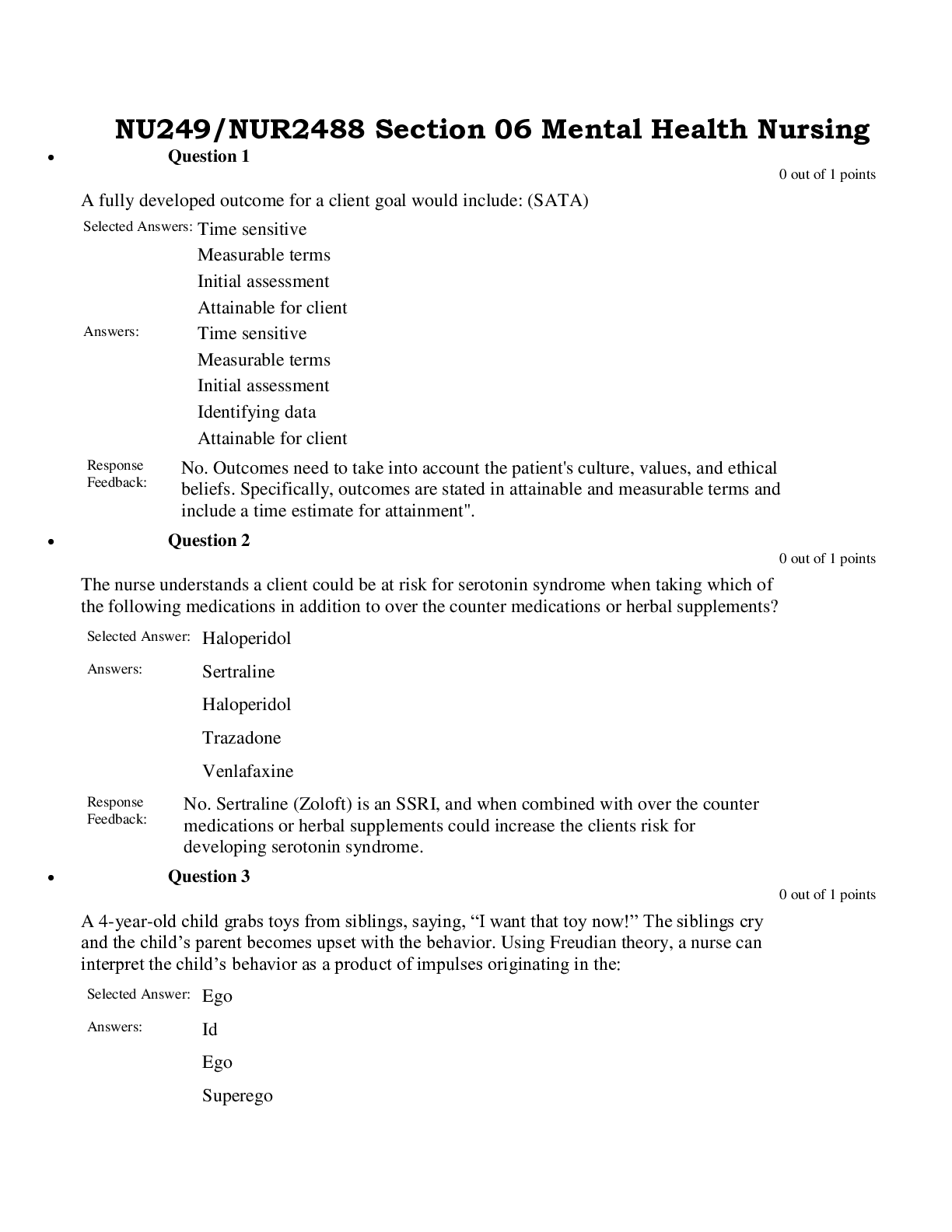
NU249/NUR2488 Section 06 Mental Health Nursing
Question 1
0 out of 1 points
A fully developed outcome for a client goal would include: (SATA)
Selected Answers: Time sensitive
Measurable terms
Initial assessment
...
NU249/NUR2488 Section 06 Mental Health Nursing
Question 1
0 out of 1 points
A fully developed outcome for a client goal would include: (SATA)
Selected Answers: Time sensitive
Measurable terms
Initial assessment
Attainable for client
Answers: Time sensitive
Measurable terms
Initial assessment
Identifying data
Attainable for client
Response
Feedback:
No. Outcomes need to take into account the patient's culture, values, and ethical
beliefs. Specifically, outcomes are stated in attainable and measurable terms and
include a time estimate for attainment".
Question 2
0 out of 1 points
The nurse understands a client could be at risk for serotonin syndrome when taking which of
the following medications in addition to over the counter medications or herbal supplements?
Selected Answer: Haloperidol
Answers: Sertraline
Haloperidol
Trazadone
Venlafaxine
Response
Feedback:
No. Sertraline (Zoloft) is an SSRI, and when combined with over the counter
medications or herbal supplements could increase the clients risk for
developing serotonin syndrome.
Question 3
0 out of 1 points
A 4-year-old child grabs toys from siblings, saying, “I want that toy now!” The siblings cry
and the child‟s parent becomes upset with the behavior. Using Freudian theory, a nurse can
interpret the child‟s behavior as a product of impulses originating in the:
Selected Answer: Ego
Answers: Id
Ego
SuperegoPreconscious
Response
Feedback:
No. The id operates on the pleasure principle, seeking immediate gratification of
impulses. The ego acts as a mediator of behavior and would weigh the
consequences of the action, perhaps determining that taking the toy is not worth
the parent‟s wrath. The superego would oppose the impulsive behavior as “not
nice.” The preconscious is a level of awareness.
Question 4
1 out of 1 points
Which expected client outcome should a nurse identify as being correctly formulated?
Selected Answer: Client will initiate interaction with one peer during free time within 2 days.
Answers: Client will feel happier by discharge.
Client will demonstrate two relaxation techniques.
Client will verbalize triggers to anger by end of session.
Client will initiate interaction with one peer during free time within 2 days.
Response
Feedback:
Yes. The statement “Client will initiate interaction with one peer during free time
within 2 days” is an example of a correctly formulated expected outcome.
Outcomes should be measurable, realistic, client-focused goals that include a
time frame. Appropriate nursing interventions are guided by client outcomes.
Question 5
1 out of 1 points
A voluntarily hospitalized patient tells the nurse, “Get me the forms for discharge against
medical advice so I can leave now.” Which is the nurse‟s best response?
Selected
Answer:
“I will get them for you, but let‟s talk about your decision to leave
treatment.”
Answers: “I can‟t give you those forms without your health care provider‟s
knowledge.”
“I‟ll get the forms for you right now and bring them to your room.”
“Since you signed your consent for treatment, you may leave if you desire.”
“I will get them for you, but let‟s talk about your decision to leave
treatment.”
Response
Feedback:
Yes. A patient who has been voluntarily admitted as a psychiatric inpatient has
the right to demand and obtain release in most states. However, as a patient
advocate, the nurse is responsible for weighing factors related to the patient‟s
wishes and best interests. By asking for information, the nurse may be able to
help the patient reconsider the decision. The statement that discharge forms can‟t
be given without the health care provider‟s knowledge is not true. Facilitating
discharge without consent is not in the patient‟s best interests before exploring
the reason for the request. Question 6
0 out of 1 points
The client is being admitted to the inpatient psychiatric unit. The nurse conducts a mental
status examination. Which of the following items are included in this examination? (Select all
that apply)
Selected Answers: Appearance
Mood and Affect
Physical Exam
Cognition
Answers: Appearance
Mood and Affect
Thought
Physical Exam
Cognition
Response
Feedback:
Personal information, appearance, behavior, speech, mood and affect, thought,
perceptual disturbances and cognition are all parts of a mental status exam. Physical
assessment would not be included with the MSE. (Chapter 7, p 103-104)
Question 7
1 out of 1 points
A client with schizophrenia has recently begun a new medication, clozapine (Clozaril). Which
signs and symptoms of a potentially fatal side effect will the nurse teach the client about?
Selected Answer: Blurring vision and muscular weakness
Answers: Blurring vision and muscular weakness
Sore throat, fever, and malaise
Tremor, shuffling gait, and neck stiffness
Fine tremor, tinnitus, and nausea
Response
Feedback:
Yes. These are symptoms of agranulocytosis, which is a potentially fatal
disorder in which the client's white blood cell count drops to extremely low
levels. This places the client at great risk for infections.
Question 8
0 out of 1 points
Which information suggests that caution is necessary in prescribing a benzodiazepine to an
anxious client?
Selected Answer: The client has a history of diabetes mellitus.
Answers: The client has a history of alcohol dependence.
The client has a history of diabetes mellitus.
The client has a history of schizophrenia.
The client has a history of hypertension.Response
Feedback:
No. Tolerance and psychological dependence are common problems with the
long-term use of benzodiazepines. They should be used cautiously with clients
who have a history of substance abuse.
Question 9
1 out of 1 points
A brother calls to speak to his sister who has been admitted to the psychiatric unit. The nurse
connects him to the community phone and the sister is summoned. Later the nurse realizes
that the brother was not on the client‟s approved call list. What law has the nurse broken?
Selected Answer: The Health Insurance Portability and Accountability Act
Answers: The National Alliance for the Mentally Ill Act
The Tarasoff Ruling
The Health Insurance Portability and Accountability Act
The Good Samaritan Law
Response
Feedback:
The nurse has violated the Health Insurance Portability and Accountability Act
(HIPAA) by revealing that the client had been admitted to the psychiatric unit.
The nurse should not have provided any information without proper consent
from the client.
Question 10
1 out of 1 points
The client attempted suicide by overdosing on pain medication. Once the client ingested the
medication, she decided that she did not want to die and she sought immediate treatment.
Once the client recovered from the physical effects of overdose, the client voluntarily sought
inpatient mental health treatment. Which of the following statements is true of voluntary
admission?
Selected Answer: The client retains the right to request release
Answers: The client is required to stay a minimum of 72 hours
The client must have certification by two or more physicians
Only a judge can determine if the client is able to be discharged
The client retains the right to request release
Response
Feedback:
Yes. Release from the hospital depends on the patient‟s admission status. All
clients have the right to request release; thereby negating a 72 hour length of
stay. It may not be granted if there is a civil commitment process. Certification
is required by physicians or judges in a commitment process. (Chapter 6 pp 82-
83)
Question 11
1 out of 1 points
A nurse says to a client, “Things will look better tomorrow after a good night‟s sleep.” This is
an example of which communication technique?Selected Answer: The nontherapeutic technique of giving reassurance
Answers: The therapeutic technique of giving advice
The therapeutic technique of defending
The nontherapeutic technique of presenting reality
The nontherapeutic technique of giving reassurance
Response
Feedback:
Yes. The nurse‟s statement, “Things will look better tomorrow after a good
night‟s sleep,” is an example of the nontherapeutic communication technique of
giving reassurance. Giving reassurance indicates to the client that there is no
cause for anxiety, thereby devaluing the client‟s feelings.
Question 12
1 out of 1 points
A patient is involuntarily admitted to a psychiatric unit after calling a friend and saying, “I‟ve
got a gun and I‟m going to shoot myself.” Which of the following rights has the patient lost
temporarily?
Selected Answer: The right to leave the hospital without medical approval
Answers: The right to communicate with family members
Freedom of speech
The right to refuse medications
The right to leave the hospital without medical approval
Response
Feedback:
Yes. If a patient is admitted involuntary, she cannot leave without medical or
court approval. The patient still retains the rights to communicate with family,
refuse medication and speak her mind.
Question 13
1 out of 1 points
A depressed client states, “I have a chemical imbalance in my brain. I have no control over
my behavior. Medications are my only hope to feel normal again.” Which nursing response is
appropriate?
Selected
Answer:
“Medications are one way to address chemical imbalances. Environmental and
interpersonal factors can also have an impact on biological factors.”
Answers: “Medications are one way to address chemical imbalances. Environmental and
interpersonal factors can also have an impact on biological factors.”
“Because biological factors are the sole cause of depression, medications will
improve your mood.”
“Environmental factors have been shown to exert the most influence in the
development of depression.”
“Researchers have been unable to demonstrate a link between nature (biologyand genetics) and nurture (environment).”
Response
Feedback:
Yes. The nurse should advise the client that medications are one treatment
approach to address biological factors, but there are other factors that affect
mood. The nurse should educate the client on environmental and interpersonal
factors that can lead to depression and the potential for psychological treatments
to have a positive impact on biological factors
Question 14
1 out of 1 points
During an intake interview, which question would assist the nurse in gathering data about the
client‟s judgment?
Selected
Answer:
“If you found a stamped, addressed envelope in the street, what would you
do?”
Answers: “Do you know what day and season it is now?”
“On a scale of 1 to 10, how would you rate your stress level?”
“What does the phrase „a rolling stone gathers no moss‟ mean to you?”
“If you found a stamped, addressed envelope in the street, what would you
do?”
Response
Feedback:
Yes. In the assessment phase of the nursing process, the nurse collects
comprehensive health data that are pertinent to the client‟s health or situation.
The nurse presents a situation that requires the client to make a judgment call and
can assess appropriate judgment on the basis of the client‟s action choice.
Question 15
1 out of 1 points
A nursing instructor asks a student to describe the nursing process when initiating care of a
client. The student nurse understands the nursing process order to be correctly identified as:
Selected
Answer:
Assessment, Nursing Diagnosis, Outcomes, Planning, Implementation,
Evaluation
Answers: Assessment, Nursing Diagnosis, Outcomes, Planning, Implementation,
Evaluation
Assessment, Medical Diagnosis, Implementation, Planning, Outcomes and
Evaluation
Assessment, Nursing Diagnosis, Implementation, Planning, Outcomes, and
Evaluation
Assessment, Medical Diagnosis, Planning, Outcomes, Implementation and
Evaluation
Response
Feedback:
Yes. The nursing process as is follows: assessment, nursing diagnosis, outcomes,
planning, implementation, and evaluation. It should not include medical
diagnoses. Identifying the outcomes allows for planning followed byimplementation. Evaluations needs to occur after nursing interventions have been
implemented.
Question 16
0 out of 1 points
During an intake assessment, a nurse asks both physiological and psychosocial questions. The
client angrily responds, “I‟m here for my heart, not my head problems.” Which is the nurse‟s
best response?
Selected
Answer:
“Why are you concerned about these types of questions?”
Answers: “It‟s just a routine part of our assessment. All clients are asked these questions,
you need to answer them.”
“Why are you concerned about these types of questions?”
“Psychological factors, like excessive stress, have been found to affect medical
conditions.”
“We can skip these questions, if you like. It isn‟t imperative that we complete
this section.”
Response
Feedback:
No. The nurse should attempt to educate the client on the negative effects of
excessive stress on medical conditions. It is not appropriate to skip either
physiological or psychosocial questions, as this would lead to an inaccurate
assessment.
Question 17
0 out of 1 points
A mother rescues two of her four children from a house fire. In an emergency department, she
cries, “I should have gone back in to get them. I should have died, not them.” Which of the
following responses by the nurse is an example of reflection?
Selected Answer: “The smoke was too thick. You couldn‟t have gone back in.”
Answers: “The smoke was too thick. You couldn‟t have gone back in.”
“You‟re feeling guilty because you weren‟t able to save your children.”
“Focus on the fact that you could have lost all four of your children.”
“It‟s best if you try not to think about what happened. Try to move on.”
Response
Feedback:
No. The best response by the nurse is, “You‟re experiencing feelings of guilt
because you weren‟t able to save your children.” This response utilizes the
therapeutic communication technique of reflection, which identifies a client‟s
emotional response and reflects these feelings back to the client so that they may
be recognized and accepted.
Question 18
1 out of 1 points
An entry level registered nurse works with patients in a community setting. Which groups
should this nurse expect to lead? (Select all that apply.)Selected Answers: Symptom management
Family therapy
Psychotherapy
Self-care
Answers: Symptom management
Family therapy
Medication education
Psychotherapy
Self-care
Response
Feedback:
Yes. Symptom management, medication education, and self-care groups
represent psychoeducation, which is provided by the basic level registered nurse.
Family therapy and psychotherapy would be provided by advanced practice
registered nurses
Question 19
1 out of 1 points
A client has been involuntarily admitted to an inpatient behavioral health unit. During this
admission, which of the following rights does the client still retain? (Select all that apply.)
Selected Answers: The right to refuse medications
The right to informed consent
Answers: The right to refuse medications
The right to keep all personal items
The right to informed consent
The right to choose the nurse assigned to them
Response
Feedback:
Yes. The patient has a right to refuse medication and the right to informed
consent even during an involuntary admission. The patient may not be able to
keep all personal items if those items would present a safety risk to himself or
others. Choosing which staff are assigned to you is not a patient right
Question 20
1 out of 1 points
A mother who is notified that her child was killed in a tragic car accident states, “I can‟t bear
to go on with my life.” Which nursing statement conveys empathy?
Selected
Answer:
“It must be horrible to lose a child, and I‟ll stay with you until your husband
arrives.”
Answers: “This situation is very sad, but time is a great healer.”
“You are sad, but you must be strong for your other children.”
“Once you cry it all out, things will seem so much better.”
“It must be horrible to lose a child, and I‟ll stay with you until your husband
arrives.”Response
Feedback:
The nurse‟s response, “It must be horrible to lose a child, and I‟ll stay with you
until your husband arrives,” conveys empathy to the client. Empathy is the ability
to see the situation from the client‟s point of view. Empathy is considered to be
one of the most important characteristics of the therapeutic relationship
Question 21
1 out of 1 points
During the implementation phase of the nursing process, a nurse is teaching an adult
depressed patient with a cochlear implant about medications. Which modification in the
teaching plan would be the most appropriate for this client?
Selected Answer: Speaking directly face-to-face
Answers: Using repetition
Speaking directly face-to-face
Employing the use of sign language
Providing large-print materials
Response
Feedback:
Yes. Speaking face-to-face is an appropriate way to teach individuals with
alterations in hearing.
Question 22
1 out of 1 points
A 22 year old college student is admitted to a hospital following a suicide attempt and states,
“No one will ever love a loser like me.” According to Erikson‟s theory of personality
development, a nurse should recognize a deficit in which developmental stage?
Selected Answer: Intimacy versus isolation
Answers: Trust versus mistrust
Ego integrity versus despair
Intimacy versus isolation
Initiative versus guilt
Response
Feedback:
Yes. The nurse should recognize that the client who states, “No one will ever
love a loser like me” has not adequately completed the intimacy versus isolation
stage of development. The intimacy versus isolation stage is presumed to occur
in young adulthood between the ages of 20 and 30 years. The major
developmental task in this stage is to establish intense, lasting relationships or
commitment to another person, cause, institution, or creative effort.
Question 23
0 out of 1 points
A nursing instructor is teaching about the monoamine category of neurotransmitters. Which
student statement indicates that learning about the function of norepinephrine has occurred?
Selected
Answer:
Norepinephrine functions to regulate arousal, libido, and appetite.Answers: Norepinephrine functions to regulate movement, coordination, and emotions.
Norepinephrine functions to regulate mood, cognition, and perception.
Norepinephrine functions to regulate arousal, libido, and appetite.
Norepinephrine functions to regulate pain, inflammatory response, and
wakefulness.
Response
Feedback:
No. The functions of norepinephrine include the regulation of mood, cognition,
perception, locomotion, and cardiovascular function. Norepinephrine has also
been implicated in certain mood disorders such as depression and mania, anxiety
states, and schizophrenia.
Question 24
1 out of 1 points
A nurse is educating a patient about the difference between mental health and mental illness.
Which statement by the patient reflects an accurate understanding of mental health?
Selected
Answer:
Mental health is successful adaptation to stressors in the internal and external
environment.
Answers: Mental health is the absence of any stressors.
Mental health is successful adaptation to stressors in the internal and external
environment.
Mental health is incongruence between thoughts, feelings, and behavior
Mental health is a diagnostic category in the DSM-5.
Response
Feedback:
Yes. Several definitions of mental health exist, but this definition highlights
concepts of successful adaptation to stressors, including thoughts, feelings, and
behaviors that are age-appropriate and congruent with cultural and societal
norms.
Question 25
0 out of 1 points
The nurse understands a client taking which medication could place a client at high risk for a
life-threatening hypertensive crisis if tyramine is ingested? (Select All That Apply)
Selected Answers: A client taking tranylcypromine (Parnate)
A client taking phenelzine (Nardil)
A client taking sertraline (Zoloft)
Answers: A client taking tranylcypromine (Parnate)
A client taking isocarboxazid (Marplan)
A client taking venlafaxine (Effexor)
A client taking phenelzine (Nardil)
A client taking sertraline (Zoloft)
Response
Feedback:
No. Isocarboxazid, tranylcypromine, and phenelzine are all MAOIs, andingesting foods containing tyramine could place the client at risk for a life
threatening hypertensive crisis.
Question 26
1 out of 1 points
A client was recently admitted to the inpatient unit after a suicide attempt and has not
responded to SSRIs or tricyclic antidepressants. The client asks the nurse, “I heard about
MAOIs (monoamine oxidase inhibitors). Why can't they be added to what I am on now?
Wouldn't adding one help?” Which is the appropriate nursing response?
Selected
Answer:
“Combined use can lead to a life-threatening condition called a hypertensive
crisis.”
Answers: “Electroconvulsive therapy (ECT) is your best option at this point.”
“Combined use can lead to a life-threatening condition called a hypertensive
crisis.”
“There is no reason why an MAOI couldn‟t be added to your therapy.”
“They can't be used together because their mechanisms of action are very
different.”
Response
Feedback:
Yes. If MAOIs are taken with other antidepressants, a hypertensive crisis
could result.
Question 27
0 out of 1 points
A 29-year-old client living with parents has few interpersonal relationships. The client states,
“I have trouble trusting people.” Based on Erikson‟s developmental theory, which should the
nurse recognize as true statements about the client? (Select All That Apply)
Selected
Answers:
The client not has progressed beyond the trust versus mistrust developmental
stage.
Developmental deficits in earlier life stages have impaired the client‟s adult
functioning.
The client cannot move to the next developmental stage until mastering all
earlier stages
Answers: The client not has progressed beyond the trust versus mistrust developmental
stage.
Developmental deficits in earlier life stages have impaired the client‟s adult
functioning.
The client cannot move to the next developmental stage until mastering all
earlier stages
The client‟s developmental problems began in the intimacy versus isolation
stage.
Response
Feedback:
No. Many individuals with mental health problems are still struggling to achieve
tasks from a number of developmental stages. Nurses can plan care to assist
these individuals to complete these tasks and move on to a higher developmentallevel
Question 28
1 out of 1 points
A patient discloses several concerns and associated feelings. If the nurse wishes to seek
clarification, which comment would be most appropriate?
Selected Answer: “Am I correct in understanding that . . .”
Answers: “What are the common elements here?”
“Tell me again about your experiences.”
“Am I correct in understanding that . . .”
“Tell me everything from the beginning.”
Response
Feedback:
Yes. Asking, “Am I correct in understanding that…” permits clarification to
ensure that both the nurse and patient share mutual understanding of the
communication. Asking about common elements encourages comparison rather
than clarification. The remaining responses are implied questions that suggest the
nurse was not listening.
@No. Asking, “Am I correct in understanding that…” permits clarification to
ensure that both the nurse and patient share mutual understanding of the
communication. Asking about common elements encourages comparison rather
than clarification. The remaining responses are implied questions that suggest the
nurse was not listening.
Question 29
1 out of 1 points
The health care provider prescribes an antidepressant for an elderly client, but nurse notices
that the dosage is greater than the usual adult dosage. Which of the following best describes
what action the nurse should take?
Selected Answer: Hold the medication until clarified with the health care provider
Answers: Consult a drug reference guide
Implement the order as written
Administer the usual geriatric dosage
Hold the medication until clarified with the health care provider
Response
Feedback:
Yes. The dosage of antidepressants for older adult patients is often less than the
usual adult dosage. The nurse should withhold the medication and consult the
health care provider who wrote the order. The nurse‟s duty is to intervene and
protect the patient. Consulting a drug reference is unnecessary because the nurse
already knows the dosage is excessive. Implementing the order is negligent.
Giving the usual geriatric dosage would be wrong; a nurse without prescriptive
privileges cannot change the dosage. Question 30
1 out of 1 points
Which intervention by a psychiatric nurse best utilizes the ethical principle of autonomy? The
nurse:
Selected Answer: Explores alternative solutions with a patient, who then makes a choice
Answers: Stays with a patient who is demonstrating a high level of anxiety
Suggests that two patients who were fighting be restricted to the unit
Explores alternative solutions with a patient, who then makes a choice
Intervenes when a self-mutilating patient attempts to harm self
Response
Feedback:
Autonomy is the right to self-determination, that is, to make one‟s own decisions.
By exploring alternatives with the patient, the patient is better equipped to make
an informed, autonomous decision. Staying with a highly anxious patient or
intervening with a self-mutilating patient demonstrates beneficence and fidelity.
Suggesting that two fighting patients be restricted to the unit demonstrates the
principles of fidelity and justice.
Question 31
1 out of 1 points
Which of the following should the nurse plan to include in the assessment of an older adult
client?
Selected
Answer:
Identify physical needs and necessary accommodations for this client.
Answers: Ask all questions in the order they are presented on the formal assessment tool.
Interpret all data objectively without consideration of context of the client‟s
spiritual or cultural beliefs.
Share all pertinent information with the family after leaving the patient.
Identify physical needs and necessary accommodations for this client.
Response
Feedback:
Yes. Any physical needs and necessary accommodations, such as for hearing loss
or pain, must be addressed so that the assessment is valid. Sharing all information
with the family automatically without the patient present would be a breach of
confidentiality unless the patient has expressly granted this permission in writing.
Following the exact order of a formal assessment tool does not allow for
individual variation and the client may present important information out of
context that may need to be addressed immediately. Spiritual and cultural beliefs
are an important part of an assessment.
Question 32
0 out of 1 points
A patient is about to be released and tells the staff nurse “I‟m glad I‟m getting out of here; I
swear the first thing I‟ll do is kill my ex-wife and that stupid boyfriend of hers.” Which of the
following is the staff nurse‟s legal duty?Selected Answer: Warn the patient‟s ex-wife and boyfriend.
Answers: Obtain an order for an increase in the patient‟s medication before discharge.
Warn the patient‟s ex-wife and boyfriend.
Keep this information confidential to avoid legal action.
Report the threat to the treatment team and document the statement
Response
Feedback:
No. The team has a duty to warn any third party who has threats made against
them by a patient (Tarasoff warning). Increasing his medication is not guaranteed
to prevent violence. There is no requirement to keep this information
confidential. Transferring the patient to another state may not be legal and does
not guarantee safety for the ex-wife and her boyfriend.
Question 33
1 out of 1 points
A client tells a nurse that he hates his doctor and plans to hurt the doctor, but she did not
report this prior to leaving. When the nurse returns to work the next day, she finds that the
physician has been brutally beaten by the client and the physician is hospitalized. Which of
the following best represents the nurse‟s failure to act by not reporting the client‟s intent?
Selected Answer: Negligence
Answers: Carelessness
Assault and battery
Negligence
Slander
Response
Feedback:
Yes. Negligence is an omission to act and can be charged if the nurse does not
report a foreseeable harm and it results in injury; in this case the client told the
nurse what he intended to do. Breach of duty is conduct that exposes the patient
to harm. The client committed assault and battery, not the nurse. Slander
involves damaging someone‟s reputation or divulging confidential information
by the spoken word.
Question 34
1 out of 1 points
A newly admitted patient is hyperactive, restless, and disorganized. The patient goes to the
dining room and begins to throw food. Verbal intervention is ineffective. Seclusion is
instituted for the primary purpose of:
Selected Answer: Reducing environmental stimuli that negatively affect the patient.
Answers: Isolating the patient until his prn medication can take effect.
Reducing environmental stimuli that negatively affect the patient.
Limit setting and encouraging the patient to follow unit rules.Preventing other patients from observing the behavior.
Response
Feedback:
Yes. Seclusion can help reduce overwhelming stimuli when less restrictive
measures have failed to helped the patient maintain control. Setting limits
regarding unit rules would not be effective or appropriate during a manic
episode. Seclusion is not an appropriate or legal method to use to prevent other
patient‟s from viewing the behavior. Seclusion may not be used to isolate the
patient until his medication takes effect, unless he presents a danger to himself or
others.
Question 35
1 out of 1 points
A Mexican American patient puts a picture of the Virgin Mary on the bedside table. Under
which section of the assessment should the nurse document this behavior?
Selected Answer: Culture
Answers: Ethnicity
Culture
Verbal communication
Non-verbal communication
Response
Feedback:
Yes. Cultural heritage is expressed through language, works of art, music, dance,
ethnic clothing, customs, traditions, diet, and expressions of spirituality. This
patient‟s prominent placement of the picture is an example of expression of
cultural heritage.
Question 36
1 out of 1 points
Which one of the following best represents a potential liability issue for the professional
nurse?
Selected
Answer:
Placing a patient who talks constantly and loudly into a secluded room alone.
Answers: Restraining a combative patient who is stabbing himself with a pencil.
Reporting threats of violence made by a patient against his employer.
Calling the psychiatric nurse practitioner to clarify an order for an
antipsychotic.
Placing a patient who talks constantly and loudly into a secluded room alone.
Response
Feedback:
Yes. Restraining a patient is allowed if he presents an immediate threat to
himself or others. Talking constantly and loudly is not a threat to the patient or
anyone around him, and would be considered false imprisonment. It‟s
appropriate to contact the prescriber to clarify an order before giving it. The
nurse has a duty to warn a third party if a patient makes threats against them
(Tarasoff warning) Question 37
1 out of 1 points
A researcher tells the nurse that she would like a patient to participate in a study on the effects
of a new medication. The nurse‟s responsibility in regard to this study is:
Selected
Answer:
To assess whether the patient has the ability and legal right to give informed
consent.
Answers: To tell the patient about the benefits of the study and encourage participation.
To gather data that the researcher requests.
To assess whether the patient has the ability and legal right to give informed
consent.
To coach the patient in how she should answer questions and behave during
the study.
Response
Feedback:
Yes. Consent is not informed consent if the patient is not cognitively able to
understand what she is consenting to do; a patient may also not be able to sign a
consent if someone else is her power of attorney for health care. The researcher,
not the nurse, gathers the data. It is not within the nurse‟s role and is not ethical
to try to convince a patient to participate in a research study. The researcher, not
the nurse, prepares the patient for the research study; no one should; coach the
patient about what to say or do during the study, as that could result in inaccurate
data
Question 38
0 out of 1 points
A nurse is performing a mental health assessment on an adult client. According to Maslow‟s
hierarchy of needs, which client action would demonstrate the highest achievement in terms of
mental health?
Selected Answer: Maintaining a long-term, faithful, intimate relationship
Answers: Maintaining a long-term, faithful, intimate relationship
Achieving a sense of self-confidence
Possessing a feeling of self-fulfillment and realizing full potential
Developing a sense of purpose and the ability to direct activities
Response
Feedback:
No. The nurse should identify that the client who possesses a feeling of selffulfillment and realizes his or her full potential has achieved self-actualization,
the highest level on Maslow‟s hierarchy of needs.
Question 39
0 out of 1 points
A nurse explains to the family of a mentally ill patient how the nurse-patient relationship
differs from other interpersonal relationships. Which is the nurse‟s best explanation?
Selected
Answer:
“The focus shifts from nurse to patient as the relationship develops. Advice isgiven by both and solutions are implemented.”
Answers: “The focus is on the patient. Problems are discussed by the nurse and patient;
but solutions are implemented by the patient.”
“The focus is creation of a partnership in which each member is concerned with
being a “friend”.
“The focus of the relationship is socialization. Mutual needs are met and
feelings are shared openly.”
“The focus shifts from nurse to patient as the relationship develops. Advice is
given by both and solutions are implemented.”
Response
Feedback:
No. Only the first response describes elements of a therapeutic relationship.
The remaining responses describe events that occur in social or intimate
relationships
Question 40
1 out of 1 points
A client who is very dirty and has an offensive odor refused to take a shower when he was
admitted to the psychiatric inpatient unit of the hospital. He yelled, “No, no, no bath!” when
two staff members carried him into the shower and made him wash himself thoroughly before
allowing him to leave the shower area. Which of these statements is correct regarding this
patient‟s rights?
Selected
Answer:
This was a violation of patient rights because the patient was restrained by
force.
Answers: There was no violation because an intake shower is required for all new
patients, not just this patient
There was no violation of patient rights because this is considered a potential
threat to self, due to inappropriate hygiene.
This was a violation of patient rights because the patient was restrained by
force.
There was a rights violation due to excessive verbal interventions.
Response
Feedback:
Yes. Being dirty is not a situation that calls for restraining a patient; forcing him
to get into the shower violated his rights. Inappropriate hygiene is not considered
an immediate threat to self. Even if an intake shower is required, it does not
allow the use of force. There is no indication that excessive, or any, verbal
interventions were attempted; verbal interventions would the preferred method
for getting the patient to take a shower
Question 41
0 out of 1 points
The nurse is assessing a client who has a diagnosis of schizophrenia and takes a typical
antipsychotic agent daily. Which assessment finding should alert the nurse to a potential
adverse effect of a typical antipsychotic medications?Selected Answer: Excess salivation
Answers: Respirations of 22 breathes/minute
Weight gain of 8 pounds in 2 months
Temperature of 101oF
Excess salivation
Response
Feedback:
No. A fever could be one of the first signs of an infection caused by reduced
immunity from agranulocytosis secondary to antipsychotic medication.
Question 42
0 out of 1 points
Using Erickson‟s theory of personality development, which of the following task occur with
teenagers during puberty?
Selected Answer: Forming sexual relationships
Answers: Develop abstract thinking
Forming sexual relationships
Identifying oneself from one‟s parents
Sensing the flow of time, past, present and future
Type MA:
Response
Feedback:
No. The differentiation from parents leads to fidelity or sense of self. This task
typically occurs in 12 to 20 year olds. Abstract thinking refers to Piaget.
Sullivan discusses the formation of sexual relationships. Sensing the flow of
time is in Erickson‟s stage of generativity versus stagnation.
Question 43
0 out of 1 points
According to Freud, which statement should a nurse associate with predominance of the
superego?
Selected Answer: “No one is looking, so I will take three cigarettes from Mom‟s pack.”
Answers: “No one is looking, so I will take three cigarettes from Mom‟s pack.”
“I don‟t ever cheat on tests; it is wrong.”
“I think I may skip school today, I need a break.”
“Dad won‟t miss this little bit of vodka.”
Response
Feedback:
No. The nurse should associate the statement “I don‟t ever cheat on tests; it is
wrong” as indicative of the predominance of the superego. Freud described the
superego as the part of the personality that internalizes the values and morals set
forth by primary caregivers. The superego can be referred to as the “perfection
principle.” Question 44
1 out of 1 points
An inpatient psychiatric physician treating clients omits treatment options for those without
insurance. Which violation of an ethical principle should a nurse recognize in this situation?
Selected Answer: Justice
Answers: Autonomy
Beneficence
Non-maleficence
Justice
Response
Feedback:
Yes. The nurse should determine that the ethical principle of justice has been
violated by the physician‟s actions. The principle of justice requires that
individuals should be treated equally regardless of race, sex, marital status,
medical diagnosis, social standing, economic level, or religious belief.
Question 45
1 out of 1 points
During a nurse–client interaction, which nursing statement may belittle the client‟s feelings
and concerns?
Selected Answer: “Don‟t worry. Everything will be alright.”
Answers: “Don‟t worry. Everything will be alright.”
“You appear uptight.”
“I notice you have bitten your nails to the quick.”
“Tell me more about your feelings.”
Response
Feedback:
Yes. This nursing statement is an example of the nontherapeutic communication
block of belittling feelings. Belittling feelings occurs when the nurse misjudges
the degree of the client‟s discomfort, suggesting a lack of empathy and
understanding.
Question 46
1 out of 1 points
A nurse assessed a patient who participated reluctantly, answered questions with minimal
responses, and rarely made eye contact. What data should be included when documenting the
assessment?
Selected Answer: A description of the patient‟s behavior during the interview
Answers: Only data obtained from the patient‟s verbal responses
The observation that the patient was uncooperative
Analysis of why the patient did not respond openly during the interview
A description of the patient‟s behavior during the interviewResponse
Feedback:
Yes. Both content and process of the interview should be documented. Providing
only the patient‟s verbal responses would create a skewed picture of the patient.
Writing that the patient was uncooperative is subjectively worded. An objective
description of patient behavior would be preferable. Analysis of the reasons for
the patient‟s behavior would be speculation, which is inappropriate.
Question 47
1 out of 1 points
Which client action should a nurse expect during the working phase of the nurse-client
relationship?
Selected Answer: The client gains insight and incorporates alternative behaviors.
Answers: The client gains insight and incorporates alternative behaviors.
The client establishes rapport with the nurse builds trust.
The client explores feelings related to reentering the community.
The client outlines problems to be discussed.
Response
Feedback:
The nurse should expect that that the client will gain insight and incorporate
alternative behaviors during the working phase of the nurse-client relationship.
The client may also overcome resistance, problem-solve, and continually
evaluate progress toward goals
Question 48
0 out of 1 points
The nurse is conversing with a client in a locked in-patient psychiatric unit. The client states,”
Please don‟t tell anyone about my sexual abuse.” Which nursing response clearly outlines the
professional nurse‟s responsibility related to confidentiality?
Selected
Answer:
“Yes, I will keep this information confidential.”
Answers: “Yes, I will keep this information confidential.”
“All of the health-care team is focusing on helping you. I will bring information
to the team that can assist them in planning your treatment.”
“Why don‟t you want the team to know about your sexual abuse? It is essential
information.”
“Let‟s talk about your feelings about your history of sexual abuse?”
Response
Feedback:
No. The nurse is being honest and open with the client and giving information
about the client focus of the treatment team. This builds trusts and sets limits on
potentially manipulative behaviors by the client. Although talking about feelings
is a positive intervention, in this situation, the nurse needs to deal with the
concerns of the client and give information about the treatment team. The nurse
cannot promise to keep this important information secret, and by requesting an
explanation may put the client on the defensive.
Question 490 out of 1 points
Within professional scope of practice, which function is exclusive to the advanced nurse
practice specialty?
Selected Answer: Providing case management to coordinate continuity of health services
Answers: Teaching about the side effects of MAOI medications.
Using psychotherapy to improve mental health status
Using milieu therapy to structure a therapeutic environment
Providing case management to coordinate continuity of health services
Response
Feedback:
No. The advanced practice psychiatric nurse is authorized to use psychotherapy
to improve mental health. This includes individual, couples, group, and family
psychotherapy. It is within the scope of practice of a registered psychiatric
mental health nurse generalist to provide education, case management, and
milieu therapy.
Question 50
1 out of 1 points
A physically healthy, 35-year-old single client lives with parents who provide total financial
support. According to Erikson‟s theory, which developmental task should a nurse assist the
client to accomplish?
Selected Answer: Establishing a career, personal relationships, and societal connections
Answers: Establishing the ability to control emotional reactions
Establishing a strong sense of ethics and character structure
Establishing and maintaining self-esteem
Establishing a career, personal relationships, and societal connections
Response
Feedback:
Yes. The nurse should assist the client in establishing a career, personal
relationships, and societal connections. According to Erikson, non-achievement
in the generativity versus stagnation stage results in self-absorption, including
withdrawal from others and having no capacity for giving of the self to others.
Monday, March 6, 2017 5:15:42 PM CST
[Show More]


.png)
.png)





![Preview of NR667 Complete Question Bank with Correct Answers: Final Exam Study Guide [2026 Updated]](https://browseimages.nyc3.digitaloceanspaces.com/paper-images/2026/02/25/AULA53fD2026-02-25-02-58699ee3d811bc7.png)